
AI in HR software helps businesses handle growing complexity by automating processes, reducing manual work, and improving the employee experience. HR teams face changing workforce expectations, remote work models, and pressure to make data-driven decisions.
Traditional HR management often involves time-consuming administrative tasks, manual data entry, and inefficiencies that create compliance risks and weak workforce planning. These problems slow recruitment, hurt employee engagement, and create bottlenecks in decision-making.
AI-powered HR software changes how organizations handle hiring, payroll, employee engagement, and workforce analytics. Adding AI HR software as a strategic layer helps align those functions, embed predictive insights into people processes, and move HR from operations toward strategy. With automation, businesses can cut administrative effort, support compliance, and raise productivity, so HR teams can focus on strategic goals.
What You’ll Learn About AI in HR Software for 2026
To help businesses choose the right AI-driven HR software, this guide covers:
- Key AI trends shaping HR in 2026 – From recruitment automation to predictive workforce planning
- Essential AI-powered features – Chatbots, resume screening, performance analytics, and more
- Top HR software solutions using AI – Platforms for SMBs, enterprises, and remote teams
- Compliance, automation, and analytics tools – How AI reduces risks and improves decision-making
- How to choose the best AI HR software – Factors to weigh based on budget, scalability, and industry needs
If you are an HR professional, a business leader, or a recruiter, this guide gives you practical points to help you invest in the right AI-powered HR platform for both efficiency and stronger workforce management.
2026 AI Trends in HR Software: What’s Changing and Why It Matters
AI is changing HR software by automating repetitive tasks, improving decision-making, and supporting the employee experience. As businesses adopt AI-powered tools, HR teams can simplify hiring, improve workforce management, and keep up with changing regulations.
| AI-Driven HR Trend | Key Applications |
|---|---|
| AI-Driven Recruitment & Talent Acquisition | Automated resume screening, AI-powered candidate matching, chatbots for candidate engagement. |
| AI for Employee Engagement & Retention | Sentiment analysis for workplace insights, predictive analytics for retention, personalized learning recommendations. |
| AI in Workforce Planning & Management | Intelligent workforce forecasting, AI-powered shift scheduling, optimized resource allocation. |
| AI for Compliance & Risk Management | Automated regulatory compliance tracking, AI-driven bias detection, fair hiring practices. |
| Conversational AI & HR Chatbots | AI-powered virtual assistants for self-service HR queries, chatbots for automating onboarding and performance management. |
| AI-Powered HR Analytics & Decision-Making | Real-time workforce insights, predictive analytics for HR strategies, automated performance tracking. |
AI-Powered Recruitment & Talent Acquisition Tools Explained
Recruitment has traditionally been time-intensive, requiring manual resume screening and multiple interview rounds. AI now speeds up the process by automating key tasks and improving candidate selection.
- Automated Resume Screening – AI scans resumes and identifies the most relevant candidates based on skills, experience, and job requirements, cutting the time spent on manual narrowing down.
- AI-Powered Candidate Matching – Machine learning models analyze candidate profiles and match them to job openings based on qualifications, past experience, and cultural alignment.
- Chatbots for Candidate Engagement – AI-driven chatbots interact with applicants, answer frequently asked questions, schedule interviews, and provide real-time updates, improving the candidate experience.
How AI Improves Employee Engagement and Boosts Retention
Keeping employees engaged and satisfied is essential for retention. AI tools help HR teams understand employee needs and build personalized experiences.
- Sentiment Analysis & Predictive Analytics – AI evaluates employee feedback, emails, and surveys to measure workplace sentiment and detect early signs of disengagement or burnout.
- Personalized Learning & Development – AI-driven platforms analyze employee performance and recommend tailored training programs, helping individuals grow within the organization.
Smarter Workforce Planning with AI: Forecasting, Scheduling, and Resource Allocation
Managing a dynamic workforce requires real-time insights and predictive analytics. AI makes workforce planning more efficient by improving employee allocation and shift scheduling.
- Intelligent Workforce Forecasting & Demand Planning – AI analyzes historical workforce data and business trends to predict future hiring needs, so businesses have the right talent at the right time.
- AI-Powered Shift Scheduling & Resource Allocation – AI-based scheduling tools assign shifts based on employee availability, workload, and business priorities, reducing scheduling conflicts.
Using AI for Compliance, Risk Management, and Fair Hiring Practices
HR teams must keep policies aligned with labor laws and company regulations. AI helps businesses stay compliant by automating policy tracking and reducing risks.
- Automated Regulatory Compliance Tracking – AI monitors legal updates, flags potential compliance issues, and checks that HR policies meet industry standards.
- Bias Detection & Elimination in Hiring – AI tools analyze hiring patterns to detect unconscious biases in job descriptions, interview processes, and promotions, supporting fair hiring practices.
Conversational AI in HR: How Chatbots Automate Workflows and Support Employees
AI-powered chatbots improve HR operations by offering instant support and automating administrative workflows.
- AI-Powered Virtual Assistants for Employee Self-Service – Employees can access HR information, such as leave balances and benefits, through AI-driven virtual assistants without waiting for manual help.
- Chatbots for Automating HR Workflows – AI-driven chatbots assist with onboarding, performance reviews, and benefits enrollment, improving efficiency and reducing administrative workload.
Who Should Use AI HR Software? SMBs, Enterprises, Recruiters, and More
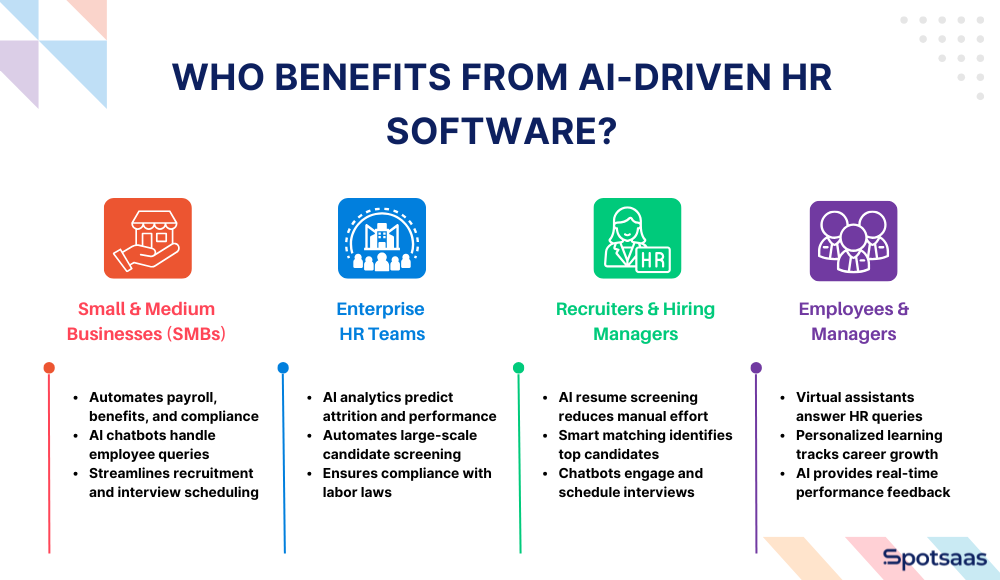
AI-powered HR software is not just for large enterprises. It offers real advantages for businesses of all sizes. Whether it automates routine HR tasks, improves recruitment, or supports employee engagement and retention, AI-driven tools improve efficiency and decision-making across many roles.
Why AI HR Tools Work for Small & Medium Businesses (SMBs)
For smaller businesses, managing HR tasks by hand can be time-consuming and resource-intensive. AI-driven HR software helps SMBs work more efficiently without large HR teams.
- Automates administrative tasks such as payroll processing, benefits management, and compliance tracking.
- AI-powered chatbots handle employee queries, reducing dependence on HR staff.
- Simplifies recruitment by screening candidates, scheduling interviews, and matching skills to job roles.
AI Use Cases for Enterprise HR Teams: Compliance, Scale, and Analytics
Larger organizations handle complex HR operations, including talent acquisition, employee engagement, and compliance across many locations. AI helps enterprise HR teams scale their operations efficiently.
- AI-driven analytics help HR leaders track employee performance, predict attrition, and put proactive retention strategies in place.
- Automates large-scale candidate screening, so the right talent is selected quickly.
- AI-powered compliance management tools help teams keep up with changing labor laws and regulations.
How Recruiters and Hiring Managers Benefit from AI in HR
Hiring can be time-intensive, with recruiters spending hours reviewing resumes and coordinating interviews. AI simplifies these tasks, so recruiters can focus on building strong candidate relationships.
- AI-powered resume screening cuts the time spent manually reviewing applications.
- Smart candidate matching tools analyze experience, skills, and cultural fit to identify the best applicants.
- AI chatbots engage candidates, provide real-time application updates, and schedule interviews.
How AI HR Software Improves the Employee and Manager Experience
AI-driven HR software helps HR professionals and improves the overall employee experience. AI tools provide personalized support and useful insights from onboarding to career development.
- AI-powered virtual assistants answer HR-related queries, such as leave balances and payroll details, reducing wait times.
- Personalized learning and development programs recommend courses and training based on career goals.
- AI-driven performance tracking gives employees real-time feedback and growth recommendations.
Key Challenges of Adopting AI HR Software in 2026 (And How to Solve Them)
AI-driven HR software brings automation and efficiency to workforce management, but adoption comes with challenges that businesses must address. From data security to integration complexity, understanding these points helps organizations make informed decisions when they implement AI-powered HR solutions.
AI in HR: Data Privacy and Security Risks You Need to Know
HR software manages sensitive employee data, including personal details, payroll information, and performance records. Implementing HR software requires strong data protection to prevent breaches and meet regulations.
- AI tools process large volumes of employee data, which makes data encryption and access controls essential.
- Compliance with GDPR, CCPA, and other labor laws is necessary to avoid legal risks.
- Organizations must review how AI vendors store and manage employee information to keep it confidential and secure.
Understanding AI Bias in HR: Ethics, Risks, and Solutions
AI algorithms are only as unbiased as the data they are trained on. If AI models are built using historical hiring or performance data with biases, they may reinforce discrimination in hiring and promotions.
- Companies must audit AI models to detect and remove potential biases in candidate selection and performance evaluations.
- HR teams should pair AI-driven hiring tools with diversity and inclusion strategies.
- HR professionals should always review AI-driven decisions to keep them fair and in line with company policies.
Integrating AI HR Tools with Your Current HR Systems
Many organizations already use HR platforms for payroll, benefits, and employee performance tracking. Adding AI-powered solutions to existing systems can be difficult if they lack compatibility.
- Businesses must check whether AI-driven HR tools can connect with payroll, attendance tracking, and compliance management platforms.
- Keeping data consistent across different HR systems is key to avoiding errors in reporting and analytics.
- Companies should choose AI solutions that offer API connectivity and custom integration options to prevent workflow disruptions.
AI HR Software Pricing and ROI: What Businesses Need to Consider
AI-powered HR software often comes with higher upfront costs, so businesses should assess the return on investment (ROI) before they commit to a platform.
- Organizations should compare pricing models, including subscription-based SaaS solutions and custom-built AI integrations.
- Calculating the time and cost savings from automation, such as reduced hiring times, better retention rates, and lower compliance risks, helps in evaluating ROI.
- Businesses must assess scalability, checking that the AI-driven solution can grow with the organization without frequent system overhauls.
2026 Cost Trends for AI HR Software: What Impacts Pricing?
The cost of AI-powered HR software varies based on features, business size, and deployment type. AI-driven automation brings efficiency, and it also affects pricing models because of the advanced capabilities built into modern HR platforms.
Reviewing a detailed pricing guide helps businesses understand what they are paying for and compare options that fit both their needs and budget.
| Challenge | Key Considerations |
|---|---|
| Data Privacy & Security | AI tools handle sensitive employee data, requiring encryption, access controls, and compliance with GDPR & CCPA. |
| AI Bias & Ethical Concerns | AI can reinforce hiring biases if trained on biased data. Regular audits and human oversight keep it fair. |
| Integration with HR Systems | AI must integrate with payroll, attendance, and compliance tools to keep data consistent and workflows smooth. |
| Cost & ROI | Businesses must compare pricing models, assess automation benefits, and check scalability to maximize ROI. |
Why AI Features Influence HR Software Costs in 2026
AI-powered HR tools add automation, predictive analytics, and machine learning, which generally push pricing higher than traditional HR software. Costs vary depending on:
- The level of AI automation — basic automation tools cost less than platforms with advanced machine learning models.
- Data processing capabilities — AI solutions handling large-scale workforce data or predictive analytics may require higher-tier plans.
- The need for custom AI models — enterprise-grade HR platforms often require AI customization, which raises implementation costs.
Common SaaS Pricing Models for AI-Powered HR Platforms
Most AI-powered HR software solutions follow a Software-as-a-Service (SaaS) pricing model, giving businesses of all sizes some flexibility.
- Per-user/month pricing – Many platforms charge based on the number of employees using the software, which scales for growing teams.
- Tiered pricing plans – Vendors offer different pricing tiers with AI-driven features like automated resume screening, chatbots, and workforce analytics included in higher plans.
- Pay-as-you-go models – Some AI HR tools use usage-based pricing, where businesses pay for the number of AI-driven HR tasks performed.
Enterprise Pricing Models for AI HR Software: What to Expect
Larger organizations with complex HR requirements often need custom AI solutions built for their workflows.
- Custom-built AI integrations – Enterprises may choose AI models trained on company-specific data for recruitment, employee engagement, or workforce planning.
- Advanced compliance and security features – Businesses in regulated industries may need specialized AI-driven compliance tracking, which affects costs.
- Scalability considerations – Custom pricing is often based on workforce size, required AI automation levels, and integration needs.
Free vs. Paid AI HR Software Features: What’s the Difference?
Some vendors offer free AI-powered HR tools with basic automation, but advanced AI capabilities usually require paid plans.
- Free AI HR tools – Basic resume screening, chatbot-assisted employee support, or limited analytics may be included in free plans.
- Premium AI features – Advanced machine learning for talent matching, AI-driven workforce analytics, and intelligent shift scheduling are generally in paid plans.
- Trial periods & freemium models – Many platforms offer free trials of AI-powered features, so businesses can test automation benefits before they commit.
How to Choose the Best AI HR Software for Your Business
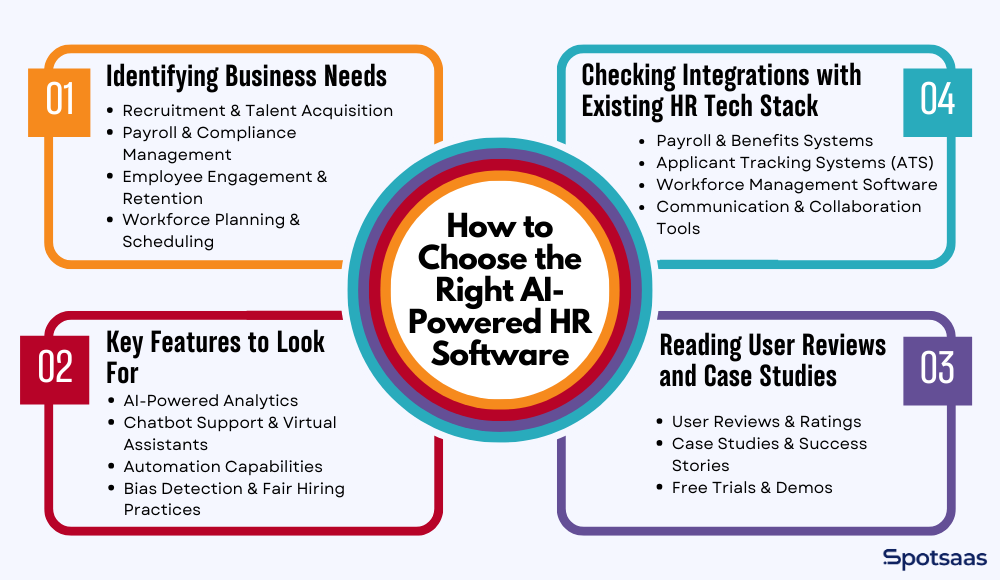
As adoption of AI-driven HR solutions grows, choosing the right platform takes a clear approach. Businesses need to assess their workforce management needs, evaluate software features, and check integration with existing HR tools. Here is a step-by-step guide to making the right choice.
Step 1: Identifying Business Needs for AI HR Tools
Before investing in AI-powered HR software, businesses must define their main HR challenges and objectives. Different platforms serve different workforce management needs, such as:
- Recruitment & Talent Acquisition – AI-driven tools for resume screening, candidate matching, and interview scheduling.
- Payroll & Compliance Management – Automated payroll processing, benefits tracking, and regulatory compliance monitoring.
- Employee Engagement & Retention – Sentiment analysis, personalized learning recommendations, and AI-driven feedback collection.
- Workforce Planning & Scheduling – AI-based shift scheduling, demand forecasting, and workforce analytics.
Understanding these needs helps narrow down the best HR software that fits business goals.
Step 2: Must-Have AI Features in HR Software
AI-powered HR platforms come with many features, but the right capabilities depend on business size and complexity. Essential AI-driven features include:
- AI-Powered Analytics – Real-time workforce insights, predictive hiring trends, and retention analysis.
- Chatbot Support & Virtual Assistants – AI-driven HR chatbots for employee self-service, answering HR-related queries, and automating workflows.
- Automation Capabilities – Automated resume screening, AI-based performance tracking, and smart scheduling.
- Bias Detection & Fair Hiring Practices – AI tools that keep hiring fair and remove unconscious bias from recruitment processes.
Step 3: Ensure AI HR Software Integrates with Your HR Stack
For a smooth transition, AI-powered HR software should connect with existing HR tools such as:
- Payroll & Benefits Systems – So AI-driven HR tools work with payroll platforms for automated processing.
- Applicant Tracking Systems (ATS) – AI-powered hiring tools should sync with ATS platforms for an efficient recruitment process.
- Workforce Management Software – Compatibility with employee scheduling and time-tracking solutions.
- Communication & Collaboration Tools – Integration with platforms like Slack, Microsoft Teams, or email for better HR workflow automation.
Choosing an AI HR solution with API support and third-party integrations prevents workflow disruptions and improves efficiency.
Step 4: Read Reviews and Case Studies Before You Buy AI HR Software
Before making a final decision, businesses should research how AI-powered HR software has performed for other organizations.
- User Reviews & Ratings – Platforms like Spotsaas, G2, Capterra, and Trustpilot show user satisfaction, ease of use, and customer support.
- Case Studies & Success Stories – Reviewing how businesses of similar size and industry have used AI-driven HR tools helps assess real-world impact.
- Free Trials & Demos – Many vendors offer trial periods or demo sessions to explore AI capabilities before a purchase.
Final Thoughts: Why AI HR Software Matters in 2026
AI-driven HR software is changing workforce management by automating recruitment, improving employee engagement, and supporting better decisions. Businesses that adopt AI-powered solutions get faster hiring, better workforce planning, and stronger compliance tracking. As AI develops, its role in HR will grow to include predictive analytics, personalized career development, and closer integration with hybrid work models.
To stay competitive over time, companies should look closely at AI-driven HR platforms that fit their own business needs. Investing in AI HR software improves efficiency and also improves employee experiences, which makes it a practical tool for modern businesses that want to scale and improve HR operations.
AI HR Software FAQs: Top Questions Answered
How does AI improve HR software compared to traditional systems?
AI automates HR tasks, improves recruitment accuracy, predicts workforce trends, and provides data-driven insights for better decisions.
Is AI-powered HR software suitable for small businesses?
Yes, many platforms offer scalable AI HR solutions that help small businesses manage payroll, hiring, and compliance efficiently.
Can AI in HR software help reduce hiring bias?
AI reduces bias by using data-driven assessments, but regular audits are necessary to keep decisions fair.
What are the key AI features to look for in HR software?
Key features include resume screening, AI chatbots, workforce analytics, automated compliance tracking, and performance insights.
How much does AI-powered HR software cost?
Costs vary, with SaaS-based per-user/month pricing and custom enterprise plans, while some platforms offer free basic AI features.
Is HR being replaced by AI?
No, and the pattern so far is narrower than the headline suggests. AI is absorbing the parts of HR that are high-volume and rule-based — resume screening, interview scheduling, answering the same policy question two hundred times a month, first-pass payroll anomaly checks. What it has not absorbed is anything requiring judgement under conflicting interests: a grievance, a restructure, a pay decision that has to be defended to the person affected.
The practical effect on headcount has been compositional rather than absolute. HR operations roles shrink; roles that interpret what the software surfaces grow. The teams struggling are the ones whose value was mostly administrative throughput, which is exactly the work that automates first.
What are the key HR trends for 2026?
Four are visible in how buyers are actually behaving this year. Consolidation onto fewer platforms, after a decade of point solutions produced data that does not reconcile. Pay transparency compliance becoming a system requirement rather than a policy document, driven by disclosure rules across the EU and a growing number of US states. AI features moving from differentiator to baseline, so the question shifts from whether a vendor has them to whether they can be audited. And skills data replacing job titles as the unit of workforce planning.
The unifying thread is defensibility. Buyers are asking how a system reaches a conclusion, not just what it concludes — which is a change from three years ago.

- Independent picks for exactly what you just read about
- Matched to your team size & needs
- Vendors don't pay for placement
Step 1 of 4
How big is your team?
We tailor recommendations to companies your size.















Related Articles
AI Software
How AI-Powered ATS Tools Boost Diversity in Hiring — Real DEI Use Cases (2026)
Continue reading →
AI Software
5 Powerful AI Features Revolutionizing Hiring Workflows in 2026
Continue reading →
AI Software
How To Choose The Best Image Recognition Software For 2026
Continue reading →
AI Software
Best AI Resume Screening Tools in 2026 to Hire Faster
Continue reading →