
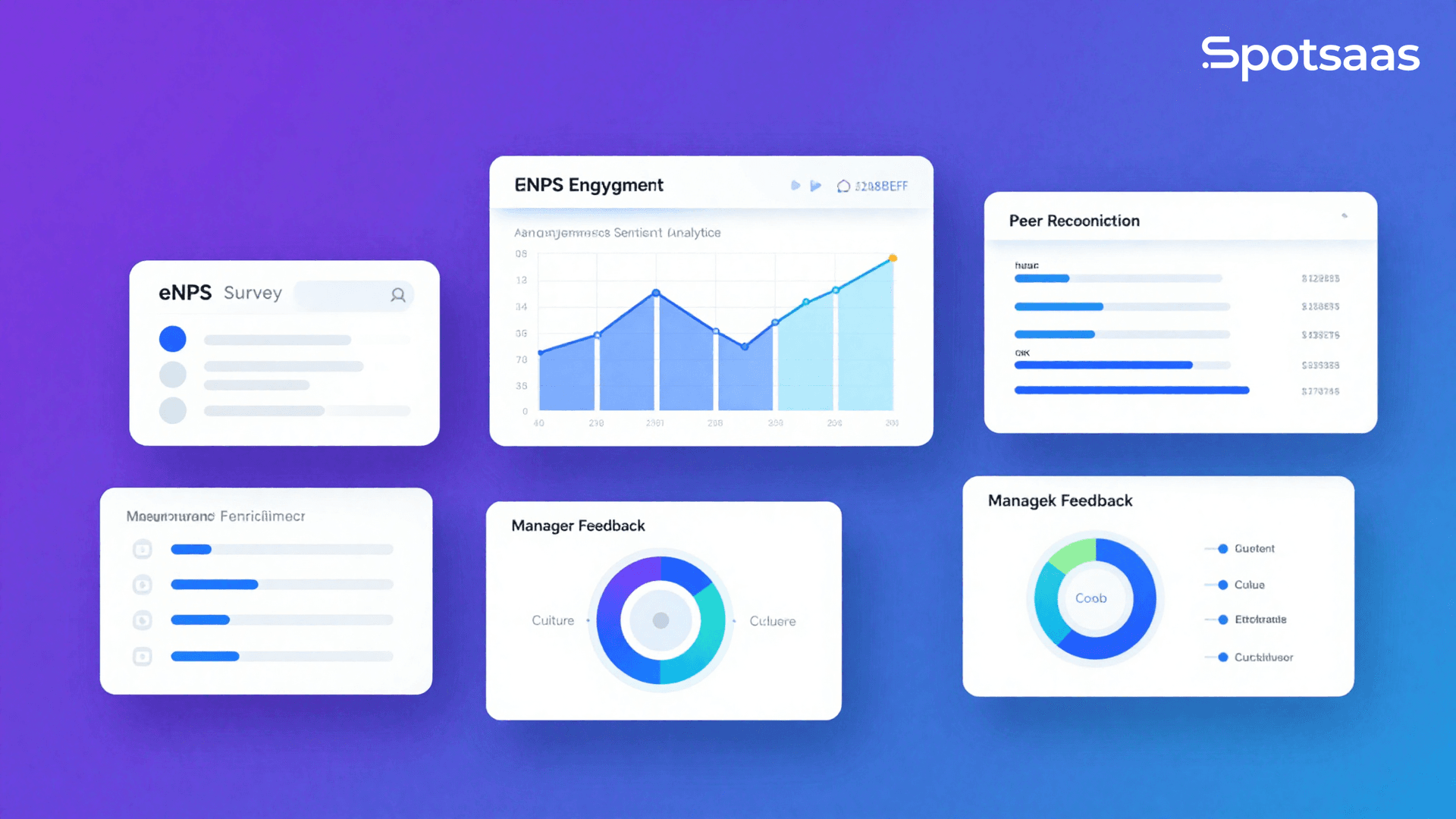
Employee engagement survey software lets you ask everyone the same questions, report the results by team and manager without exposing individuals, and track whether scores move after you act. It is the measurement layer of an engagement program. Broader engagement platforms add recognition, internal communication or performance reviews on top.
This guide covers what survey tools do, the features that separate them from a generic form builder, published pricing for the main options, and how to run a survey program people keep answering. For the wider category, including recognition and communication platforms, see our guide to the best employee engagement software.
What Is Employee Engagement Survey Software?
It is software built specifically for surveying employees. Unlike general tools such as a form builder, it comes with validated question sets on topics such as manager quality, role clarity, growth and workload, protects anonymity with minimum reporting group sizes, and connects to your HR system so results can be cut by team, location, tenure or manager automatically.
Most tools support three survey types:
- Engagement surveys: a full survey once or twice a year, typically 15 to 50 questions, used for benchmarking and planning.
- Pulse surveys: short, frequent check-ins of a few questions that track movement between full surveys.
- Lifecycle surveys: onboarding and exit surveys triggered automatically at key moments in the employee journey.
Features That Matter in Employee Survey Software
Anonymity controls
A configurable minimum group size (often five respondents) below which results are hidden. Without it, people can work out who said what and stop answering honestly.
HRIS integration and segmentation
Automatic sync of employee attributes from your HR system, so results can be filtered by department, manager or location without manual spreadsheets.
Question library and benchmarks
Research-backed question templates and, on some platforms, external benchmarks that compare your results with similar organizations.
eNPS
Employee Net Promoter Score asks how likely people are to recommend the company as a place to work. Most tools calculate it automatically and track it over time.
Action planning
Tools that help managers turn results into a small number of committed actions and report back. This is what keeps participation up in the second and third rounds.
Comment analysis
AI or keyword analysis of free-text answers, which helps at scale, although reading the comments in full is still worth doing for smaller teams.
Channels
Delivery by email, Slack, Microsoft Teams, SMS or mobile app. If you have frontline or deskless staff, check that they can respond without a company email address.
Employee Engagement Survey Tools and Pricing
Prices below are vendor-published, checked September 2026.
| Tool | Survey capabilities | Published pricing |
|---|---|---|
| 15Five (Engage plan) | Engagement surveys, targeted assessments, action planning, heat maps and data breakdowns, benchmarking | $4 per user per month, billed annually |
| Lattice (Engagement) | Pulse, onboarding and exit surveys, action planning, eNPS, AI analysis and trends | $4 per seat per month; $4,000 minimum annual agreement |
| Workleap Officevibe | Surveys and feedback, team health and engagement reports, recognition | Workleap Standard from $4,999 a year, Pro from $11,999 a year (billed annually); custom above 250 employees |
| Culture Amp | Engagement, pulse and lifecycle surveys with benchmarking and action planning | Quote-based |
| Qualtrics EmployeeXM | Enterprise employee experience surveys and analytics | Quote-based |
For a 100-person company, the per-seat tools above list at about $400 a month before any minimums, which on Lattice means the $4,000 annual floor applies until you pass roughly 84 seats. Workleap’s published plans are annual flat fees rather than per-seat rates.
How to Choose Employee Survey Software
- Decide what you will act on. If you are not prepared to change something based on the results, a survey tool will not help, and a survey that goes nowhere lowers trust.
- Pick survey-only or suite. If you already run performance reviews in another system, a survey-first tool is simpler. If you are choosing performance software too, a suite such as 15Five or Lattice keeps engagement and performance data together.
- Check the anonymity model. Ask how the minimum group size works, who can see comments, and whether admins can ever see individual responses.
- Test segmentation with your HRIS. Results by manager are where most of the value is, and that depends on a clean integration.
- Confirm reach. Make sure hourly and frontline staff can respond, or your results will reflect head office only.
- Model the real cost. Check annual minimums and whether the survey module is sold on its own or only in a bundle.
Running an Engagement Survey Program That Works
Keep the first full survey to 15 to 20 questions so people finish it. Share results within about two weeks, including the uncomfortable parts, and name two or three specific changes with owners. Then use short pulses to check whether those changes are landing before the next full survey. Organizations that skip the report-back step usually see participation fall on the second round, whatever tool they use.
If what you actually need is for good work to be noticed more often, that is a recognition problem rather than a measurement one: see our staff recognition software comparison. For general-purpose surveys outside HR, our SurveyMonkey alternatives guide covers form and survey builders.
Frequently Asked Questions
What is employee engagement survey software?
Software built for surveying employees, with validated questions, anonymity protection, HRIS-based segmentation, eNPS tracking and action planning, so HR and managers can measure engagement and act on the results.
How much does employee survey software cost?
Published prices checked in September 2026: 15Five Engage and Lattice Engagement are $4 per user per month (Lattice has a $4,000 annual minimum), and Workleap starts at $4,999 a year. Culture Amp and Qualtrics EmployeeXM are quote-based.
What is the difference between a pulse survey and an engagement survey?
An engagement survey is a longer survey run once or twice a year for depth and benchmarking. A pulse survey is a short, frequent check-in that tracks change between full surveys. Most organizations use both.
How often should you run employee engagement surveys?
A common pattern is one full survey a year, or two, with monthly or quarterly pulses in between. Run them only as often as you can act on the results and report back.
Are employee engagement surveys anonymous?
Good tools report results only for groups above a minimum size, often five respondents, so individuals cannot be identified. Check how each vendor handles comments and admin access before you buy.
Can I use a general survey tool for employee surveys?
You can, but you lose anonymity thresholds, HRIS segmentation, benchmarks and action planning. General tools suit one-off surveys; dedicated employee survey software suits a recurring engagement program.
Compare alternatives to the tools in this post

- Independent picks for exactly what you just read about
- Matched to your team size & needs
- Vendors don't pay for placement
Step 1 of 4
How big is your team?
We tailor recommendations to companies your size.















Related Articles
Employee Engagement
How HR Software Improves Employee Engagement and Retention in 2026
Continue reading →
Best Tools
Best Employee Engagement Software in 2026: Top Platforms to Improve Culture and Retention
Continue reading →
Employee Engagement
How to Improve Company Culture: Actionable Tips for a Stronger Workplace
Continue reading →
Employee Engagement
PerkSpot Review 2026: Free for Employers, Merchant-Funded
Continue reading →