
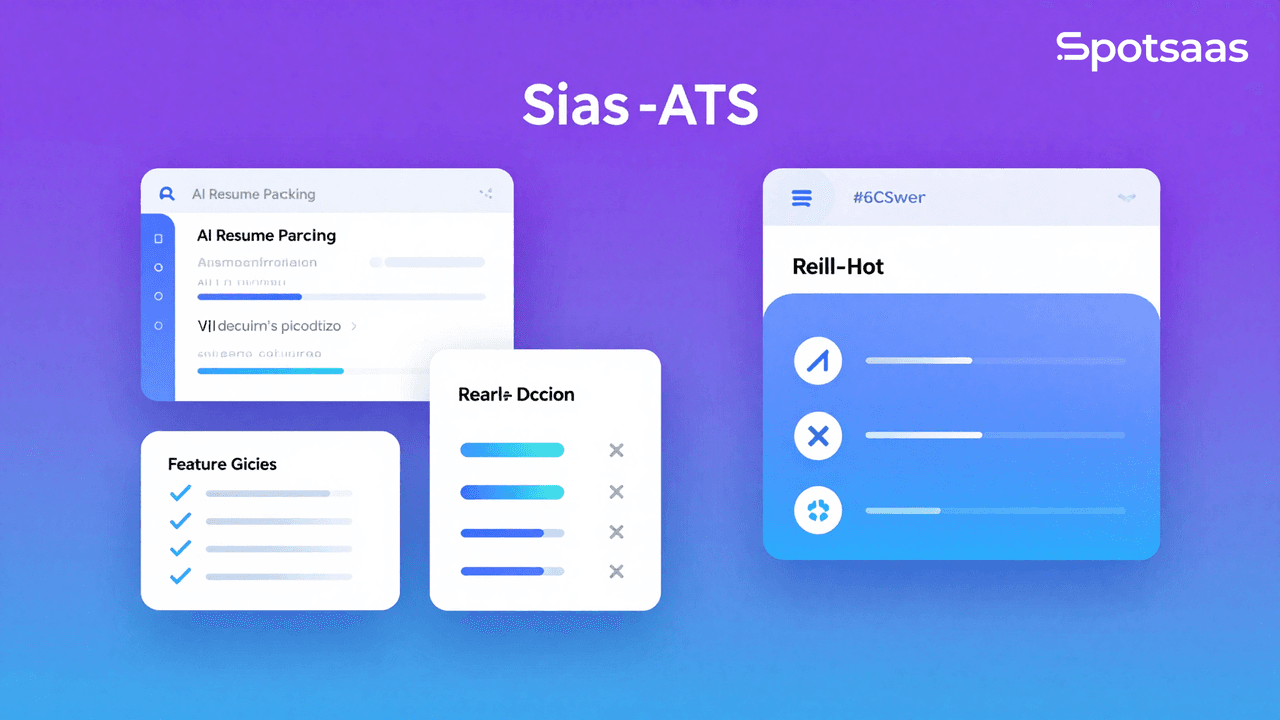
In 2026, nearly every applicant tracking system on the market claims to be powered by artificial intelligence. But when every vendor uses the same buzzwords, how do hiring teams separate genuine innovation from clever marketing? AI in ATS software ranges from transformative resume parsing and predictive analytics to surface-level features that do little more than add a price premium. This guide cuts through the noise with a clear, experience-backed breakdown of what actually delivers results and what you can safely ignore when evaluating your next ATS investment.
What Is AI in ATS Software and Why Does It Matter in 2026?
Quick Answer: AI in ATS software refers to machine learning, natural language processing, and predictive modeling embedded into applicant tracking systems to automate screening, ranking, scheduling, and communication. In 2026, these capabilities can meaningfully reduce time-to-hire and improve candidate quality when implemented correctly, but many vendor claims still outpace actual functionality.
Applicant tracking systems have existed for decades, but the integration of genuine AI marks a meaningful shift in what these platforms can accomplish. The difference between rule-based automation and true machine learning is significant, and understanding that distinction is the first step toward a smarter purchasing decision.
Rule-based automation follows fixed logic: if a resume contains the word “Python,” flag it. True AI learns from outcomes, adapts to patterns, and improves over time without manual reconfiguration. Many platforms sold as AI-powered in 2026 still operate primarily on the former.
The Real State of AI in Recruiting Technology Right Now
The recruiting technology market has grown rapidly, and AI investment has followed. According to a 2026 report by LinkedIn’s Talent Solutions division, over 75% of talent acquisition leaders say AI-assisted tools are now part of their standard hiring workflow, up from 42% in 2022.
According to Josh Bersin, global HR industry analyst and founder of The Josh Bersin Company, most organizations are still in early stages of extracting real value from AI in recruiting, noting that the gap between vendor promise and deployed functionality remains the single biggest frustration for TA leaders today.
The statistics paint a nuanced picture:
- 67% of HR leaders report that AI-powered resume screening reduced their time-to-shortlist by at least 30%, according to SHRM’s 2026 HR Technology Survey.
- Only 34% of companies using AI-powered ATS platforms have fully activated predictive analytics features, according to Aptitude Research’s 2026 Talent Acquisition Benchmark Study.
- AI-driven interview scheduling eliminates an average of 4.2 hours of administrative work per open role, according to internal data published by Greenhouse in their 2026 product report.
- Bias-related hiring complaints at companies using audited AI screening tools dropped by 22% compared to those using manual screening processes, according to the Equal Employment Advisory Council’s 2026 findings.
- Only 18% of ATS vendors can demonstrate measurable quality-of-hire improvements attributable directly to their AI features, according to Aptitude Research.
These numbers reveal a clear pattern: some AI features deliver real ROI, while others remain aspirational. Knowing which is which protects your budget and your hiring outcomes.
Which AI Features in ATS Software Actually Work?
Not all AI capabilities are created equal. The following features have demonstrated consistent, measurable value across enterprise and mid-market hiring environments as of 2026.
Resume Parsing and Intelligent Screening
Modern AI-powered resume parsing goes far beyond keyword matching. Natural language processing now allows leading ATS platforms to understand context, infer skills from job titles, and score candidates against nuanced criteria rather than rigid filters.
Platforms like Lever use ML models trained on millions of candidate profiles to rank applicants by predicted fit, not just surface-level qualifications. This approach reduces the manual review burden by 40 to 60 percent for high-volume roles.
The key differentiator to look for: does the system learn from your hiring team’s past decisions, or does it apply a generic model? The former is genuinely valuable. The latter is automated filtering with an AI label.
Smart Interview Scheduling and Coordination
AI-powered scheduling is one of the highest-ROI features available in modern ATS platforms. The technology integrates with calendar systems, identifies mutual availability, sends personalized invitations, handles rescheduling, and sends reminders automatically.
According to research published by Ashby, teams using AI scheduling coordination reduce the average scheduling cycle from 3.1 days to under 6 hours. That compression alone can meaningfully improve offer acceptance rates in competitive talent markets.
This feature works because it solves a clearly defined, repetitive problem. The AI does not need to make judgment calls, only coordinate logistics efficiently. That makes it reliable and immediately impactful.
Candidate Communication and Chatbot Engagement
AI-driven candidate communication tools handle initial outreach, answer frequently asked questions, collect additional application information, and maintain engagement throughout the hiring process. When implemented well, they significantly improve candidate experience without adding recruiter workload.
The effectiveness depends heavily on how well the chatbot is trained and how transparently candidates are informed they are interacting with an automated system. Organizations that disclose AI involvement report higher candidate satisfaction than those that do not.
Predictive Analytics for Pipeline and Workforce Planning
Predictive analytics represents the most sophisticated and genuinely impactful frontier of AI in ATS platforms. When trained on sufficient historical data, these models can forecast time-to-fill by role type, predict offer acceptance probability, identify bottlenecks in the hiring funnel, and flag roles at risk of falling behind.
According to Madeline Laurano, founder of Aptitude Research, organizations that operationalize predictive hiring data make faster decisions and close candidates 28% more quickly on average compared to those relying on retrospective reporting alone.
The caveat: predictive analytics require clean, consistent historical data to function accurately. If your ATS data quality is poor, the predictions will be unreliable. Garbage in, garbage out remains the governing principle.
What Is Still Mostly Buzz in AI-Powered ATS Platforms?
Several AI features are aggressively marketed but consistently underdeliver in real-world deployments. Recognizing these protects you from paying a premium for capabilities that will not change your hiring outcomes.
Personality and Culture Fit Scoring
Several ATS vendors offer AI-powered personality assessments or culture fit scores derived from application responses or video interviews. These features carry significant methodological concerns and have faced scrutiny from employment regulators in the US and EU as of 2026.
There is limited peer-reviewed evidence that AI-inferred personality scores correlate reliably with job performance. More importantly, these systems carry elevated risks of perpetuating demographic bias. Treat any vendor promoting this feature with considerable skepticism.
AI-Generated Job Description Optimization Claims
Many platforms now offer AI tools that claim to optimize job descriptions for candidate attraction. While AI writing assistance is genuinely useful for drafting and editing, vendor claims that their specific algorithm will dramatically increase applicant volume or diversity are rarely supported by controlled evidence.
The underlying technology is useful. The performance claims attached to it often are not. Evaluate the writing tool on its own merits rather than marketing projections.
Video Interview Emotion and Sentiment Analysis
Facial expression analysis and tone sentiment scoring during AI-reviewed video interviews remain scientifically contested and legally risky as of 2026. The state of Illinois and several EU member states have passed legislation restricting or requiring disclosure of AI video analysis in hiring.
The scientific consensus is that emotional inference from facial expressions is unreliable across diverse populations. Any ATS vendor prominently featuring this as a core AI capability should be flagged for deeper scrutiny during your evaluation process.
How Do Applicant Tracking Systems Actually Work Under the Hood?
Understanding the mechanics of how ATS platforms process applications helps you evaluate vendor claims more accurately. Here is a plain-language breakdown of the core process:
- Job Requisition and Posting: The ATS pulls job details from an HR information system or manual input and distributes the posting across job boards, career sites, and sourcing integrations simultaneously.
- Application Ingestion: Candidate applications arrive through multiple channels. The parsing engine extracts structured data from resumes, cover letters, and forms and maps it to standard fields in the candidate database.
- Screening and Scoring: Configured rules or AI models evaluate each application against role requirements. Candidates receive scores or tags that determine their position in the review queue.
- Recruiter Review and Collaboration: Hiring team members access candidate profiles, leave feedback, advance or reject candidates, and coordinate internally through the platform’s collaboration tools.
- Interview Coordination: Scheduling tools send invitations, manage calendar conflicts, facilitate panel interview logistics, and handle candidate communications through automated workflows.
- Offer Management: Approved candidates move through offer letter generation, approval routing, e-signature collection, and background check initiation from within the same platform.
- Reporting and Analytics: The ATS surfaces pipeline metrics, source effectiveness data, time-to-hire reports, and diversity analytics for continuous process improvement.
Each step in this process can be enhanced by AI, but the quality of that enhancement depends entirely on the sophistication of the underlying model and the quality of your data inputs.
Top AI-Powered ATS Platforms to Consider in 2026: Comparison
The following table compares leading AI-powered applicant tracking systems across key dimensions relevant to buyers in 2026. Pricing reflects publicly available starting tiers as of this writing.
| Platform | Best For | Standout AI Feature | Starting Price | Key Limitation |
|---|---|---|---|---|
| Greenhouse | Mid-market and enterprise | Structured interviewing + AI scorecards | Custom pricing | Higher implementation complexity |
| Lever | Growth-stage companies | AI candidate ranking and nurture CRM | Custom pricing | Limited reporting customization |
| Ashby | High-volume technical hiring | AI scheduling and analytics depth | From $300/month | Smaller integration ecosystem |
| Workable | SMBs and fast-scaling teams | AI-powered sourcing and job ad optimization | From $189/month | Less robust for enterprise complexity |
| Rippling ATS | Companies wanting HR-ATS unification | Unified AI workforce data layer | Custom pricing | ATS depth secondary to HRIS core |
| SmartRecruiters | Enterprise global hiring | AI match scoring and compliance tools | Custom pricing | UI complexity for smaller teams |
| JazzHR | Small businesses | Automated screening questionnaires | From $75/month | Limited AI depth compared to enterprise peers |
Pricing shown is approximate; check vendor websites for current rates.
How to Evaluate AI Claims When Choosing an ATS: A Practical Framework
Vendor demos are designed to impress. Structured evaluation protects you from purchasing decisions driven by impressive visuals rather than real-world performance. Use this process when assessing any ATS platform’s AI capabilities:
- Ask for the underlying model: Is the AI proprietary, third-party, or a wrapper on a general-purpose LLM? Proprietary models trained on recruiting-specific data typically outperform generic implementations.
- Request bias audit documentation: Any responsible AI vendor should be able to provide evidence that their screening algorithms have been tested for adverse impact across protected demographic groups. If they cannot, treat the feature as high-risk.
- Demand outcome data from comparable customers: Ask specifically for metrics like reduction in time-to-shortlist, improvement in offer acceptance rates, or reduction in recruiter hours per hire. Generic testimonials are not sufficient.
- Test with your own data: Request a pilot or proof-of-concept using a sample of your actual historical applications. Generic demos always perform better than real-world deployments with messy data.
- Evaluate the feedback loop: Does the AI improve based on your team’s hiring decisions over time? A model that learns from your outcomes is fundamentally more valuable than a static algorithm.
- Assess integration depth: AI features are only as valuable as the data available to them. Confirm that the ATS connects cleanly with your HRIS, calendar systems, communication tools, and job boards.
- Check regulatory compliance posture: Particularly for video AI analysis or algorithmic scoring, confirm the vendor’s stance on compliance with EEOC guidelines and applicable state-level AI hiring laws.
Three Things Competitors Won’t Tell You About AI and ATS Software
Most content on this topic stops at feature comparisons. Here are three dimensions that rarely appear in vendor-sponsored content but matter significantly to real buyers.
AI Amplifies Your Process Quality, It Does Not Fix a Broken Process
If your job descriptions are poorly written, your interview process is inconsistent, and your hiring manager feedback loops are broken, AI will make those problems faster and more expensive, not better. The organizations that extract the most value from AI in ATS platforms are those that arrived with clean processes and used AI to scale what already worked.
Before investing in AI features, audit your current hiring workflow. Identify the three biggest friction points. Confirm that AI actually addresses those specific points rather than adding new complexity elsewhere.
The Real ROI of AI in ATS Is Often Invisible on Dashboards
The most significant value created by AI-powered ATS tools often does not show up in standard platform metrics. Recruiter cognitive load reduction, improved candidate experience that drives referral rates, and faster hiring manager confidence are real benefits that rarely appear in time-to-hire or cost-per-hire reports.
When building your business case for an AI-powered ATS investment, include qualitative outcome categories alongside quantitative KPIs. Teams that measure only hard metrics consistently underestimate the full return on their technology investment.
Vendor AI Roadmaps Move Faster Than Procurement Cycles
In 2026, the pace of AI development means that the features you evaluate today may look meaningfully different six months after contract signing. Some vendors release updates continuously. Others operate on annual release cycles. This matters enormously for long-term platform value.
During vendor evaluation, ask specifically about the AI development release cadence, how new features are communicated to customers, and whether AI model updates require additional fees. The contract you sign should include protections around feature access over the agreement term.
Common Misconceptions About How ATS Systems Work
Several persistent myths continue to shape how candidates and employers think about applicant tracking systems. Addressing them directly leads to better technology decisions and more ethical hiring practices.
Myth: ATS systems automatically reject resumes without human review. In most modern deployments, ATS platforms surface ranked candidate lists for human review rather than making autonomous rejection decisions. The system scores and sorts. Humans decide.
Myth: Keyword stuffing a resume defeats ATS screening. Modern NLP-based parsing understands context, not just keywords. Resumes stuffed with irrelevant terms may actually score lower under semantic analysis models than clean, experience-focused documents.
Myth: All ATS platforms work the same way. There is enormous variance in parsing accuracy, AI sophistication, integration capability, and configurability across platforms. The choice of ATS has a measurable impact on hiring outcomes across every stage of the funnel.
Frequently Asked Questions About AI in ATS Software
What does AI actually do in an applicant tracking system?
AI in an ATS automates resume parsing, candidate scoring, interview scheduling, communication, and analytics. It uses machine learning and natural language processing to reduce manual work, identify qualified candidates faster, and surface insights from hiring data. The depth of AI capability varies significantly across platforms and price points.
Can AI in ATS software reduce bias in hiring?
AI can reduce certain forms of inconsistency bias when properly audited and configured, but it can also amplify historical bias if trained on non-diverse datasets. The key is choosing vendors who conduct and publish regular adverse impact analyses and allow configuration to remove demographic signals from scoring models.
How accurate is AI resume parsing in modern ATS platforms?
Leading ATS platforms with advanced NLP achieve 85 to 95 percent accuracy on structured resume data. Accuracy drops with unconventional formats, heavy graphic design elements, or non-English documents. Most enterprise platforms allow manual correction that feeds back into model improvement over time.
Is predictive analytics in ATS software reliable?
Predictive analytics is reliable when the system has access to at least 12 to 18 months of clean, consistent hiring data. For organizations with smaller hiring volumes or inconsistent historical data, predictive models produce lower-confidence outputs and should be treated as directional guidance rather than definitive forecasts.
What questions should I ask an ATS vendor about their AI features?
Ask how the AI model was trained, whether it learns from your specific hiring outcomes, what bias testing has been performed, whether outcome data from comparable customers is available, and what the roadmap for AI feature development looks like. Request a pilot with your own historical data before committing to a contract.
How do I know if an ATS AI feature is real or just marketing?
Request a technical explanation of the underlying model rather than a demo. Ask for peer-reviewed or independently audited outcome data. If the vendor cannot explain what model powers a feature or provide real customer performance metrics, the AI label is likely marketing rather than a meaningful technical capability.
Does AI in ATS software improve candidate experience?
When implemented correctly, AI-driven communication tools and scheduling automation measurably improve candidate experience by reducing wait times, providing faster responses, and maintaining consistent engagement throughout the process. Poorly implemented AI chatbots that frustrate candidates can damage employer brand and increase application abandonment rates.
What are the legal risks of using AI in ATS software?
Legal risks include potential violations of EEOC guidelines if AI screening produces adverse impact on protected classes, state-specific AI hiring disclosure requirements in Illinois, Maryland, and New York, and EU AI Act obligations for companies operating in European markets. Always confirm your ATS vendor’s compliance posture before deployment.
Which industries benefit most from AI-powered ATS platforms?
High-volume hiring industries including technology, retail, healthcare, logistics, and financial services see the greatest ROI from AI-powered ATS platforms. The benefits scale with hiring volume. Organizations making fewer than 50 hires per year may find that simpler, lower-cost ATS solutions deliver comparable outcomes without the AI premium.
How do I measure the ROI of AI features in my ATS?
Measure time-to-shortlist before and after AI screening activation, track recruiter hours per hire across AI-assisted versus manual roles, monitor offer acceptance rates by candidate source, and assess candidate satisfaction scores from post-process surveys. Combine quantitative metrics with qualitative feedback from both recruiters and hiring managers for a complete picture.
Make a Smarter ATS Investment with SpotSaaS
The difference between an ATS that transforms your hiring and one that adds complexity without results often comes down to how thoroughly you evaluated the AI claims before signing the contract. In 2026, the platforms that genuinely move the needle are those with audited AI models, transparent outcome data, and roadmaps that keep pace with real recruiting challenges.
SpotSaaS helps HR and talent acquisition leaders cut through vendor marketing with verified software comparisons, real user reviews, and side-by-side feature breakdowns across the ATS landscape. Whether you are evaluating your first ATS or replacing a platform that has outgrown your needs, SpotSaaS gives you the clarity to choose with confidence.
Explore verified ATS reviews and comparisons on SpotSaaS today and find the platform that matches your hiring reality, not just your demo experience.
Related Articles
AI Software
AI Matching in ATS: What It Is, How It Works and Why It Matters for Hiring
Continue reading →
AI Software
How AI-Powered ATS Tools Boost Diversity in Hiring — Real DEI Use Cases (2026)
Continue reading →
AI Software
Best AI Resume Screening Tools in 2026 to Hire Faster
Continue reading →
AI Software
Is Riverside FM the Best AI for Podcasts and Video Recording?
Continue reading →