
Spotsaas Editorial
HR Software Pricing in 2026: Complete Guide to Costs, Models & Hidden Fees
Effective HR management is essential for business growth in 2026. As companies scale, handling payroll, recruitment, benefits, and compliance manually becomes inefficient. HR software simplifies these processes. This improves accuracy and saves time while ensuring businesses stay compliant with labor laws.
However, the cost of HR software varies significantly depending on factors like company size, required features, and deployment type. While some platforms cater to startups with budget-friendly plans, others provide enterprise-grade solutions with advanced automation and AI-driven insights. Understanding these cost differences helps businesses invest wisely without overspending or compromising on essential features.
What You’ll Learn About HR Software Pricing in 2026
To help businesses choose the right HR software within their budget, this guide covers:
- Different HR software pricing models and how they impact costs
- Key factors that influence pricing, such as company size, features, and support
- Cost comparisons of popular HR software solutions in 2026
- Hidden fees and additional charges businesses should watch for
- Steps to evaluate HR software based on value, not just price
Whether managing a small team or an enterprise workforce, this guide provides practical insights to help businesses select an HR solution that aligns with their needs and financial goals.
HR Software Pricing Models Explained: SaaS, Tiered, and More
HR software vendors offer various pricing models to cater to different business needs. Choosing the right software depends on factors like company size, budget, scalability, and the level of HR automation required. Below is a detailed breakdown of the most common pricing structures used in 2026.
| Pricing Model | Best For | Cost Structure | Examples |
|---|---|---|---|
| Subscription-Based (SaaS) | Small & mid-sized businesses | Monthly/annual fee per user | BambooHR, Namely, Workday |
| Per Employee, Per Month | Companies planning workforce growth | Charges per employee | Gusto, Zenefits, Justworks |
| Tiered Pricing | Businesses needing flexibility | Feature-based tiers | Zoho People, Rippling, Paycor |
| One-Time License Fee | Large enterprises with IT teams | Large upfront payment | SAP ERP HCM, PeopleSoft |
| Custom Pricing | Enterprises with complex needs | Custom quote | SAP SuccessFactors, Oracle HCM |
Pricing shown is approximate; check vendor websites for current rates.
What is Subscription-Based HR Pricing (SaaS) and How Does It Work?
Cloud-based HR solutions commonly operate on a subscription model, where companies pay a recurring fee, either monthly or annually, per user or employee. This approach is especially beneficial for small to mid-sized businesses as it requires a lower upfront investment while providing automatic updates and managed IT maintenance.
The pay-as-you-go model minimizes financial risk. This allows organizations to adjust their subscriptions as needed. In addition, SaaS vendors typically offer ongoing customer support and enhanced security protocols. This ensures that the software remains compliant with evolving industry standards.
How Per Employee HR Software Pricing Works in 2026
This pricing model ties the overall cost directly to the number of employees using the system. This makes it an attractive option for companies anticipating workforce expansion. It works on a simple principle: as your team grows, so do your costs. This ensures that you only pay for active users.
This transparent model enables businesses to scale their HR operations in line with their growth. Furthermore, it provides predictability in budgeting, as the costs increase proportionally with employee numbers. Companies such as Gusto, Zenefits, and Justworks exemplify this approach. This offers tailored solutions that cater to evolving HR demands.
Understanding Tiered Pricing Models in HR Software
Tiered pricing models divide services into multiple plans, each offering different levels of functionality, from basic HR management to complete systems that include advanced analytics, automation, and AI-driven insights. This model allows organizations to start with a plan that covers essential functions and then upgrade as their needs evolve.
It’s particularly useful for businesses that want the flexibility to add features over time without overcommitting financially from the outset. Vendors like Zoho People, Rippling, and Paycor provide a range of tiers. This ensures that businesses can find a balance between cost and the level of sophistication required in their HR processes.
One-Time License Fee for On-Premise HR Software: Pros and Cons
Some organizations, particularly large enterprises, prefer to invest in an on-premise HR solution through a one-time license fee. This model requires a significant upfront investment but grants lifetime access to the software without recurring subscription fees.
It offers complete control over the system, allowing for extensive customization and strong data security, as the software is managed internally. However, companies opting for this model should be prepared for ongoing maintenance costs and periodic upgrades to keep the system up-to-date.
How Custom Pricing Works for Enterprise HR Software
This ensures that businesses only pay for what they truly need, often including dedicated support and personalized training. While this approach typically involves detailed negotiations and a more intricate pricing structure, it can offer significant long-term value by addressing unique operational challenges.
For enterprises with unique and complex HR needs, custom pricing provides a tailored solution that aligns precisely with their specific requirements. In this model, vendors work closely with clients to create a bespoke package based on factors like company size, must-have features, and necessary integrations.
How to Choose the Best HR Software Pricing Model for Your Business
Businesses should assess their budget, growth plans, and feature needs before selecting an HR solution. Subscription models offer affordability, per-employee pricing scales with growth, tiered plans allow gradual upgrades, and custom pricing ensures flexibility. Comparing total costs and vendor offerings helps organizations make an informed decision.
What Factors Influence HR Software Costs?
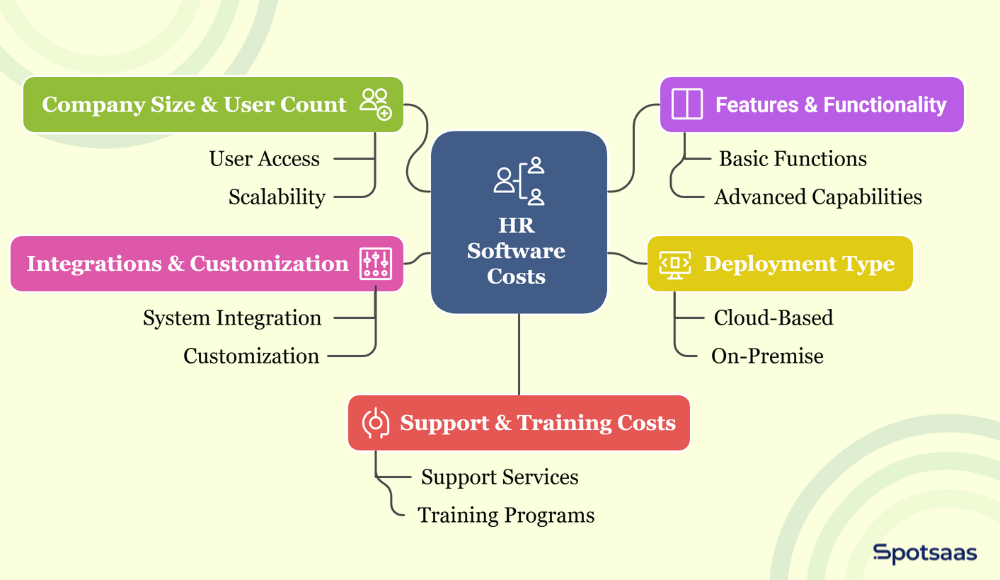
Several key factors influence the overall pricing of HR software. Understanding these factors helps businesses evaluate the total cost of ownership and choose a solution that fits both their needs and budget.
How Company Size Affects HR Software Pricing
Larger organizations incur higher costs because more employees require access to the system. As the number of users increases, licensing and support expenses naturally grow. This makes scalability a essential consideration when budgeting for HR software.
In addition, implementing HR Software across multiple departments often requires more complete deployment strategies. This added complexity can lead to increased setup, maintenance, and ongoing support costs.
Why Features & Functionality Drive HR Software Costs
The range of features the software offers plays a significant role in its cost. Basic HR functions, such as payroll and benefits management, typically come at a lower price, while advanced capabilities like AI-powered recruiting, complete analytics, and automation tools command higher prices.
Additional functionalities, such as performance management and mobile access, may further drive up the cost. Investing in advanced features can enhance operational efficiency, so it is important to balance these benefits against the increased expense.
Cloud vs. On-Premise: How Deployment Affects HR Software Pricing
The method of deployment, cloud-based vs. on-premise, greatly affects initial and ongoing costs. Cloud-based solutions generally require a lower upfront investment and operate on a subscription model, whereas on-premise systems demand a higher initial investment due to hardware and infrastructure requirements, along with potential maintenance expenses.
Cloud solutions offer the advantage of flexibility and regular updates without significant IT overhead. Conversely, on-premise systems may provide greater control over data security and customization, albeit at a higher initial and maintenance cost.
The Cost Impact of Integrations and Custom HR Features
Additional costs can arise when integrating HR software with existing systems such as payroll, accounting, or CRM tools. Customization to meet specific business processes or to add API access further influences the overall price, as these enhancements often require extra development and support.
Smooth integrations can unify various systems. This reduces operational silos but increasing implementation complexity. Tailored solutions that align with unique workflows offer significant benefits yet typically come with a higher price tag due to specialized development work.
How Support and Training Add to HR Software Expenses
Beyond the software itself, premium support services, onboarding, and training contribute significantly to the total expense. Investing in these services ensures that the system is implemented effectively and that employees are well-equipped to use the platform, which improves overall efficiency and adoption.
Strong support minimizes downtime and enhances the user experience by resolving issues promptly. Moreover, effective training programs help maximize the software’s potential and secure long-term success in managing HR processes.
Hidden HR Software Costs to Know Before You Buy
While the initial price of HR software is often clearly defined, businesses should remain aware of additional fees that can impact the overall investment. These hidden costs can significantly influence the total cost of ownership and should be considered during the decision-making process.
| Hidden Cost | Description |
|---|---|
| Implementation & Setup Fees | Fees for configuration, installation, and training; increased by customization. |
| Add-ons for Payroll, Recruiting, or Time Tracking | Separate fees for advanced modules; evaluate based on need and growth. |
| Premium Customer Support | Extra cost for faster responses, dedicated support, and extended hours. |
| Data Migration Costs | Fees for transferring and cleaning data from legacy systems; complexity increases cost. |
Setup & Implementation Costs in HR Software: What to Expect
During the initial adoption phase, organizations may encounter extra charges for system configuration, on-site installation, and initial user training. These fees ensure the software is properly integrated into existing workflows and may increase if custom integrations or specialized configurations are needed.
The complexity of the existing IT infrastructure and the required customization level can further drive up these costs. Businesses should request a detailed breakdown of implementation fees to avoid any surprises during deployment.
How to Add-ons Features Like Payroll & Time Tracking Affect Pricing
Many HR platforms offer core functionalities as part of their base package, but advanced modules like payroll processing, applicant tracking system, or time management may incur separate fees. These additional modules can be structured as either recurring charges or one-time fees and are sometimes bundled only within higher-tier plans.
Companies should assess the necessity of these add-ons relative to their current HR processes and future growth plans. This ensures that they are only investing in features that will add significant value.
What is Premium Support and Is It Worth the Extra Cost?
Standard support is often included with HR software, yet premium customer support services, such as faster response times, dedicated account management, or extended service hours, typically come at an additional cost. Enhanced support can provide peace of mind during critical business operations and minimize downtime when issues arise.
Vendors may offer different tiers of support packages, so it is essential to evaluate your organization’s operational needs and decide whether the investment in premium support will yield long-term benefits.
Understanding Data Migration Costs in HR Software
Transitioning to a new HR system frequently involves transferring data from legacy platforms, a process that can be both complex and resource-intensive. Data migration fees may apply, particularly if extensive data cleaning, reformatting, or integration with existing systems is required.
The complexity of legacy systems and the volume of data being migrated are key factors that determine the overall cost. Securing expert assistance to ensure data accuracy and integrity is essential, and planning for these expenses upfront can help avoid delays and additional costs during implementation.
Budgeting for HR Software: A Step-by-Step Buying Guide
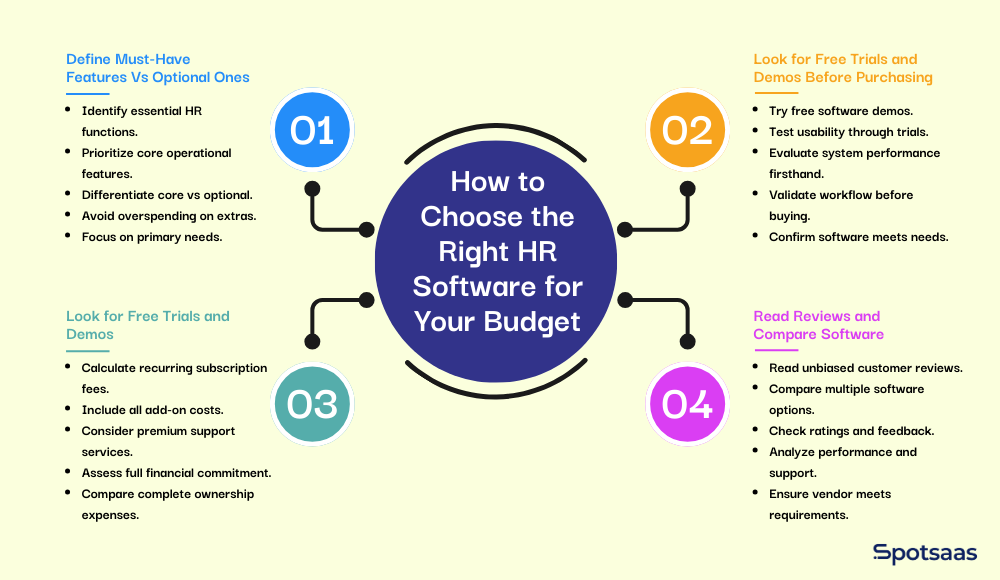
Step 1: Identify Must-Have HR Features vs. Nice-to-Haves
Begin by identifying the core HR features that are essential for your organization. Determine which functionalities, such as payroll management, benefits administration, and performance tracking, are indispensable for your daily operations.
At the same time, additional features like advanced analytics or AI-driven recruitment should be considered as optional enhancements that can be adopted later if needed. This clear distinction helps focus your search and prevents overspending on unnecessary capabilities.
Step 2: Calculate Total Cost of Ownership (TCO) Before You Buy
When evaluating HR software, looking beyond the base subscription fee is important. Calculate the total cost of ownership by factoring in recurring subscription fees, add-on costs, and any required premium support services.
This complete assessment ensures you understand the full financial commitment over the long term. A well-calculated TCO helps compare different solutions accurately. This makes choosing one that fits your budget while meeting your operational needs easier.
Step 3: Use Free Trials & Demos to Test HR Software Fit
Taking advantage of free trials and demos is a practical step in the decision-making process. These trial periods allow you to interact with the software firsthand. This ensures that it meets your usability and functionality requirements.
Demos provide insights into the software’s workflow and can reveal potential challenges before a financial commitment is made. Testing the system in a real-world scenario is invaluable, as it helps confirm that the solution aligns with your organization’s needs and expectations.
Step 4: Read User Reviews & Compare HR Software Side-by-Side
Before making a final decision, it is wise to research customer reviews and compare different HR software options on trusted marketplaces such as Spotsaas. Reviews offer unbiased insights into the performance, support, and overall satisfaction of current users.
By comparing multiple solutions, you gain a clearer understanding of which software fits your budget and delivers the features and support your organization requires. This research helps ensure that the chosen solution is well-suited to support both your current operations and future growth.
2026 HR Software Trends and Industry Pricing Insights
| Trend | Key Points |
|---|---|
| Integration of Emerging Technologies | Uses AI/ML for screening, analytics, and performance; often in premium pricing tiers. |
| Adjustments in Pricing Models | Advanced features drive higher-tier or custom pricing options. |
| Impact of Regulatory Changes | Compliance and reporting updates increase overall costs. |
| Convergence of Innovation & Compliance | Merges modern tech with security for complete, secure platforms. |
| Long-Term Investment Considerations | Evaluate ROI by balancing advanced features with their cost for sustained efficiency. |
- AI & ML in HR Software: How Emerging Tech Affects Pricing
- In 2026, HR software will increasingly incorporate AI and machine learning to enhance candidate screening, predictive analytics, and performance management.
- These advanced capabilities simplify processes and add significant operational value, often reflected in premium pricing tiers.
- Why HR Software Pricing Models Are Evolving in 2026
- As vendors add sophisticated functionalities, pricing models evolve to include higher-tier or custom options to account for the increased development and support costs.
- Businesses can expect more feature-rich solutions as the market shifts towards innovation-driven offerings.
- Regulatory Compliance and Its Influence on HR Software Costs
- Evolving data protection laws, labor regulations, and compliance standards compel vendors to integrate strong compliance management and advanced reporting features.
- These regulatory requirements enhance security and accountability and influence overall software pricing.
- How Innovation and Compliance Are Shaping HR Software
- The combination of emerging tech and stricter regulations is driving HR software toward more complete and secure platforms.
- This trend ensures that solutions are better equipped to handle complex HR needs while balancing cost and functionality.
- Evaluating Long-Term ROI When Buying HR Software
- Organizations should factor in both enhanced features and the corresponding cost implications when selecting an HR solution.
- Evaluating future ROI is essential, as modern capabilities and compliance features contribute to sustained operational efficiency.
Final Takeaways on HR Software Pricing in 2026
This guide has outlined the various pricing models used by HR software vendors, including subscription-based, per-employee, tiered, one-time license fee, and custom pricing. It also examined key factors that impact overall costs, such as company size, functionality, deployment method, integrations, and support services. These elements work together to determine the final investment needed for a solution that aligns with your organization’s requirements.
Evaluating the overall value of an HR solution goes beyond its price tag. It is essential to assess how the software improves efficiency, simplifies processes, and contributes to long-term growth. Focusing on the return on investment ensures that you select a tool that supports both current needs and future expansion while maximizing your resources.
HR Software Pricing: Frequently Asked Questions (2026)
What is the most common pricing model for HR software?
Subscription-based (SaaS) pricing is the most common, offering predictable, recurring costs.
How do company size and user count affect HR software costs?
Larger organizations with more users typically incur higher licensing and support expenses.
What is the difference between cloud-based and on-premise deployment?
Cloud-based solutions require lower upfront costs and offer scalability, while on-premise systems demand a higher initial investment with ongoing maintenance.
How can I estimate the total cost of ownership (TCO) for HR software?
TCO is calculated by combining subscription fees, add-on costs, integrations, support, and implementation expenses.
What should I do before finalizing my HR software purchase?
Evaluate must-have features, test free trials, compare reviews, and request detailed quotes to ensure the best fit.

- Independent picks for exactly what you just read about
- Matched to your team size & needs
- Vendors don't pay for placement
Step 1 of 4
How big is your team?
We tailor recommendations to companies your size.















Related Articles

HR software
BambooHR Pricing 2026: Plans, Costs, and Is It Worth It?
Continue reading →
HR software
What Is Employer of Record (EOR)? A Complete Guide for 2026
Continue reading →
HR software
Employer of Record Pricing Guide 2026: What EOR Services Actually Cost
Continue reading →
HR software
Best Performance Management Software in 2026: Reviewed for HR Teams
Continue reading →