Tebra Review: Is It The Right EHR Software For Your Team?
Best for SMB teams · Mid-market
 SOC 2
SOC 2 HIPAA
HIPAAAdd to compare
Tebra offers custom pricing plan
Integrates with
 Microsoft Excel
Overview
Pricing
Features
Buyer feedback
Alternatives
Integrations
Media
Security & Compliance
Support
FAQ
Blogs
What is Tebra?
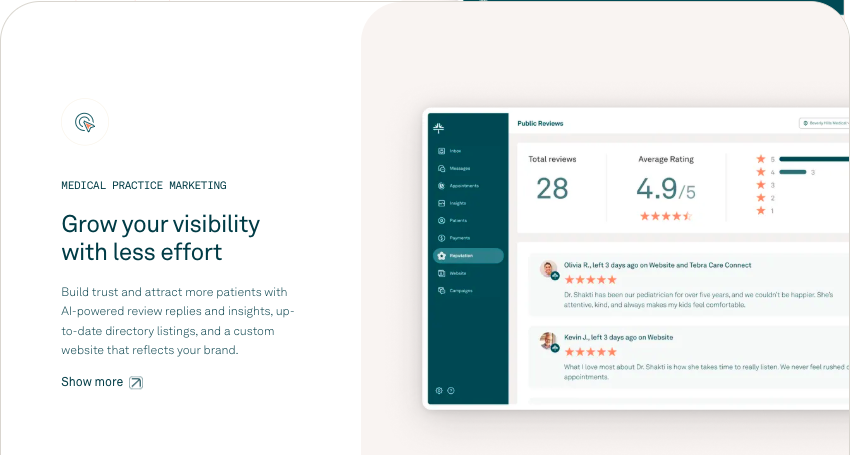
Tebra is an integrated EHR and practice management platform designed to help independent medical practices streamline clinical workflows, automate billing, enhance patient engagement, and improve practice visibility—all from one centralized system. Built for private care providers, including physicians, clinical staff, and front-office teams, Tebra combines tools for charting, online scheduling, eligibility checks, and claims management. It includes AI-powered features to speed up clinical note-taking, automate administrative tasks, and manage online reviews. Practices can also attract and retain patients through website management, directory listings, and secure messaging. With over 130 integrations, Tebra connects with labs, pharmacies, and third-party health systems to support seamless operations.
Pricing
Tebra offers custom pricing plan
Best For
Built for growing teams, from small businesses to mid-market
Security & Compliance
SOC 2HIPAAData residency:🇺🇸
Platform
Web + mobile app (iOS & Android)
Tebra Screenshots
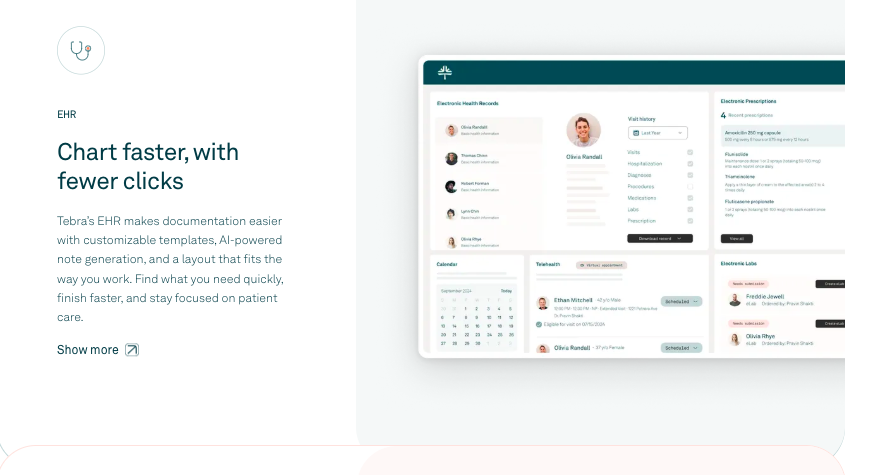
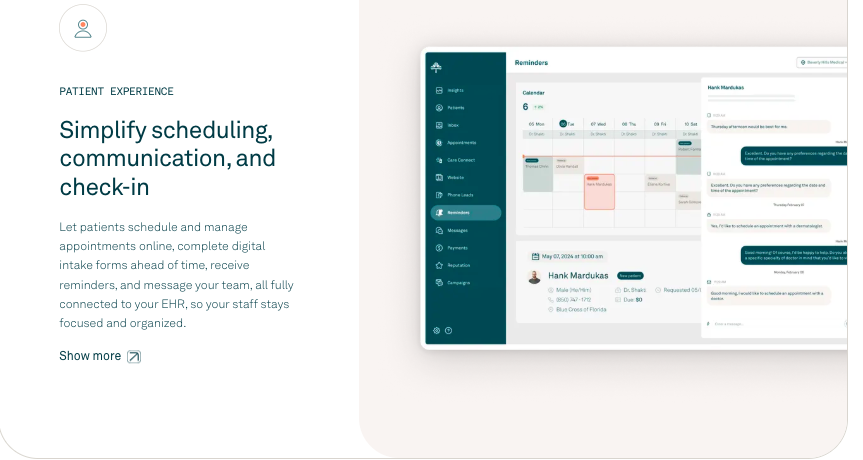
Tebra was reviewed internally using user feedback, in-house testing, and market research to assess its performance, reliability, and user experience. Learn how we review products and our evaluation process.

Who should consider Tebra
- Use cases
- Independent Medical Practices, Family Medicine Clinics, Behavioral Health
- Team types
- Physicians, Medical Office Managers
- Company size
- 5 to 100+ Employees
Why teams choose Tebra
Tebra offers a fully integrated solution that brings together electronic health records, billing, scheduling, and reputation management, reducing the need to juggle multiple systems. This holistic approach simplifies operations and promotes workflow efficiency across clinical and administrative teams.
With built-in artificial intelligence, Tebra accelerates note-taking, automates repetitive tasks, and improves administrative accuracy. This leads to reduced errors, faster documentation, and time savings for both clinicians and office staff.
Tebra enhances patient engagement through features like online scheduling, digital intake forms, secure messaging, and automated reminders. These tools make it easier for patients to interact with their providers and reduce front-desk workload.
Is Tebra right for you?
What buyers should know before shortlisting Tebra
Tebra has been a game-changer for managing my private practice. The platform's seamless combination of EHR, billing, and patient engagement tools in one interface has drastically improved efficiency for both my clinical and administrative teams.
I especially appreciate the AI-driven features that simplify note-taking and automate tasks that used to take hours. Migrating from our old system was surprisingly smooth, and their support team helped us every step of the way.
While Tebra may not offer deep customization for highly specialized fields, for general outpatient care and small practices like mine, it delivers exactly what we need—clarity, speed, and better patient interactions.
Tebra pros and cons
- Tebra pros
Tebra offers a fully integrated solution that brings together electronic health records, billing, scheduling, and reputation management, reducing the need to juggle multiple systems. This holistic approach simplifies operations and promotes workflow efficiency across clinical and administrative teams.
With built-in artificial intelligence, Tebra accelerates note-taking, automates repetitive tasks, and improves administrative accuracy. This leads to reduced errors, faster documentation, and time savings for both clinicians and office staff.
Tebra enhances patient engagement through features like online scheduling, digital intake forms, secure messaging, and automated reminders. These tools make it easier for patients to interact with their providers and reduce front-desk workload.
- Tebra cons
While Tebra supports a broad range of practices, it may not offer deep customization or specialty-specific templates for more niche medical fields, which could limit its appeal for complex specialties like oncology or cardiology.
Tebra is best suited for independent or small-to-midsize practices. Larger healthcare organizations or hospital systems might require more robust enterprise-grade features not included in the core offering.
Ready to try it?
Get started with Tebra
Connect with the team for a personalised demo.
Still comparing?
See how it stacks up
Compare Tebra side-by-side with top EHR Software alternatives.



What is the pricing of Tebra?
Tebra uses custom pricing — plans are tailored to your team size and needs. Contact them for a quote.
Tebra Pricing Plans
Weighing your options?
Not sure if Tebra fits your budget?
Tebra reviews and ratings
What buyers like
- Tebra offers a fully integrated solution that brings together electronic health records, billing, scheduling, and reputation management, reducing the need to juggle multiple systems. This holistic approach simplifies operations and promotes workflow efficiency across clinical and administrative teams.
- With built-in artificial intelligence, Tebra accelerates note-taking, automates repetitive tasks, and improves administrative accuracy. This leads to reduced errors, faster documentation, and time savings for both clinicians and office staff.
- Tebra enhances patient engagement through features like online scheduling, digital intake forms, secure messaging, and automated reminders. These tools make it easier for patients to interact with their providers and reduce front-desk workload.
Common complaints
- While Tebra supports a broad range of practices, it may not offer deep customization or specialty-specific templates for more niche medical fields, which could limit its appeal for complex specialties like oncology or cardiology.
- Tebra is best suited for independent or small-to-midsize practices. Larger healthcare organizations or hospital systems might require more robust enterprise-grade features not included in the core offering.
- The platform is designed primarily for U.S.-based practices, and lacks multilingual or international billing code support, making it less ideal for providers operating outside the United States.
Be the first to review Tebra
You'll help thousands of buyers make a smarter decision.

- See if Tebra fits your business
- Real pricing — no sales pressure
- A demo or quick answers, your call
Step 1 of 4
How big is your team?
We tailor recommendations to companies your size.















What are the features of Tebra?
Tebra offers a complete appointment management system that lets healthcare providers efficiently organize, track, and oversee patient visits…
Tebra's appointment scheduling functionality lets patients book their visits online while giving providers control over availability, provid…
Tebra includes HIPAA-compliant audio and video conferencing to support secure virtual consultations. Providers can conduct telehealth sessio…
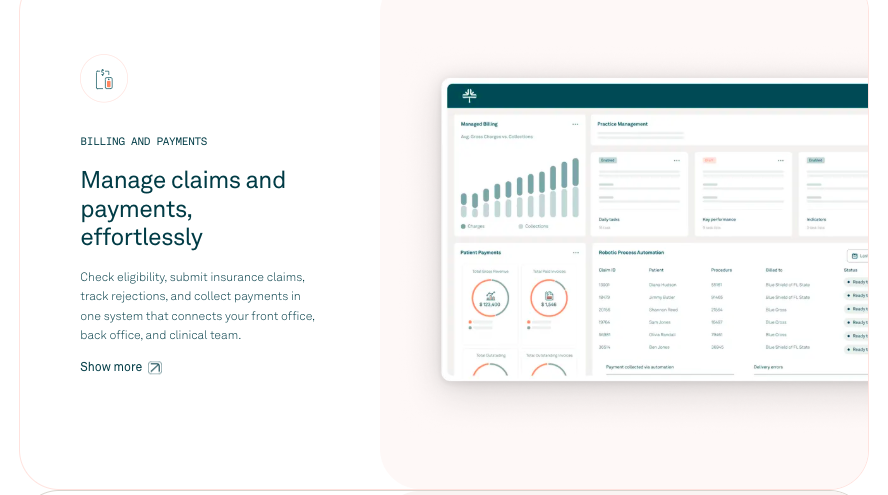
Tebra’s billing and invoicing tools automate the financial workflows of a medical practice, supporting faster payments and fewer administrat…
Tebra's calendar management feature provides a centralized view of all scheduled appointments, staff availability, and telehealth sessions a…
Tebra simplifies claims management by automating the creation, submission, and tracking of insurance claims from within the platform. Claims…
Tebra includes built-in compliance tracking features to support HIPAA and regulatory standards across documentation, billing, and communicat…
Tebra offers flexible data import and export capabilities to support system migration, reporting, and third-party integration. Practices can…
Connected Business's Multi-Location Accounting function helps businesses with many locations or branches to keep track of their financials p…
Tebra's patient portal lets patients manage their healthcare interactions online, including scheduling appointments, completing intake forms…
Tebra offers reliable tools for physician management, letting administrators track provider credentials, productivity, and schedules in one…
Reminders are a valuable feature found in many software programs that serve as helpful tools for users to stay organized and on top of impor…
Tebra's scheduling feature provides controls for managing provider availability, appointment types, and resource allocation. Users can confi…
The self-service portal in Tebra lets patients manage their healthcare tasks without needing constant help from front-office staff. Through…
Tebra security and data handling
Key compliance certifications and security features for IT and security teams evaluating Tebra.
Certifications
Developer & data
Alternatives to Tebra
Best of the Breed
Integrated Cloud-Based EHR for ...
Very Good








Why buyers keep looking beyond Tebra
Users in complex specialties often seek platforms that provide deeper clinical documentation, diagnostic tools, or specialty-specific workflows not readily available in Tebra.
Large health systems may prefer enterprise-grade solutions with advanced analytics, role hierarchies, and custom reporting features that exceed Tebra’s current scope.
Tebra’s platform primarily supports U.S. compliance and billing standards, which may deter global users looking for multilingual interfaces and international code support.
Some practices may opt for software that offers more flexibility through modular pricing or features instead of Tebra’s all-in-one bundled approach.
Though Tebra is accessible online, some providers may prefer platforms with fully-featured standalone mobile apps for both providers and patients.
Clinics seeking highly customizable data analytics, predictive modeling, or AI-driven population health tools may turn to more analytics-focused platforms.
Tebra Integrations
Tebra Support Options
Frequently Asked Questions About Tebra
Common questions buyers ask before choosing Tebra.
Tebra is a EHR Software. Tebra offers Billing and Invoicing, Patient Portal, Appointment Scheduling, Appointment Management, Claims Management and many more functionalities.
Buyers commonly note the following limitations of Tebra: While Tebra supports a broad range of practices, it may not offer deep customization or specialty-specific templates for more niche medical fields, which could limit its appeal for complex specialties like oncology or cardiology.; Tebra is best suited for independent or small-to-midsize practices. Larger healthcare organizations or hospital systems might require more robust enterprise-grade features not included in the core offering.; The platform is designed primarily for U.S.-based practices, and lacks multilingual or international billing code support, making it less ideal for providers operating outside the United States..
Some top alternatives to Tebra includes RXNT Clinical EHR, NextGen Healthcare EHR, Athenahealth EHR, Remedly and Sunwave.
Tebra offers Quotation Based pricing model
Yes, Tebra can integrate with
The starting price is not disclosed by Tebra. You can visit Tebra pricing page to get the latest pricing.
Free buyer scorecard
Evaluate Tebra with the EHR software buyer scorecard
A weighted EHR software scorecard to assess Tebra objectively and compare it against the alternatives.
- Weighted criteria you can edit
- Score vendors side-by-side
- Shareable with your buying committee
No file downloads on screen — we email it to you. One-click unsubscribe anytime.
Ready to try it?
Get started with Tebra
Get connected with the team for a personalised demo.
About the reviewer
Rajat Gupta is the founder of Spotsaas. Over the past two years, he has reviewed 2,000+ tools across CRM, HR, AI, and finance — applying hands-on product research and a background in commerce and the CFA program to evaluate software through a business and ROI lens. His goal: help teams make software decisions they won't regret.
Disclaimer: This research has been collated from a variety of authoritative sources. We welcome your feedback at [email protected].