
Workday Financial Management vs Quickbooks vs Xero vs Zoho Books Comparison

Workday Financial Management
Starting at Contact for pricing
- Large Enterprises
- Medium Business
Workday Financial Management is a powerful business management software product that helps you manage financial activities, such as budgeting, reporting, and forecasting. It includes the following modules: Payroll Manage…

Quickbooks
Starting at $3.80 /month
- Free Trial
- Individuals
- Freelancers / Consultants
QuickBooks is a user-friendly financial management platform designed to help small businesses, freelancers, and growing teams handle accounting, invoicing, payroll, and reporting all in one place. Built for business owne…
Xero
Starting at $3.75 /month
- Free Trial
- Freelancers / Consultants
- Medium Business
Xero software is a cloud-based accounting system that helps businesses manage their finances, run payroll, and save time so they can focus on growing their business. This single platform connects all your finances and in…

Zoho Books
Starting at Contact for pricing
- Free Trial
- Freelancers / Consultants
- Large Enterprises
Zoho Books is cloud accounting software for small to mid-sized businesses, particularly teams already using other Zoho products like CRM or Desk. It covers the full accounting cycle — invoicing, journal entries, bank rec…
Quickbooks leads on user satisfaction with a 4.8-star rating across 8,404 reviews.
Spotsaas Analysis
Workday Financial ManagementQuickbooksXero
The core difference lies in the target market: Workday Financial Management is tailored for medium to large enterprises needing comprehensive financial solutions, while Quickbooks is designed for small businesses seeking straightforward accounting tools. Ideal buyers include finance professionals in larger organizations for Workday and small business owners or freelancers for Quickbooks.
Workday Financial Management vs Quickbooks vs Xero vs Zoho Books — at a glance
| Feature | Workday Financial Management | Quickbooks | Xero | Zoho Books |
|---|---|---|---|---|
| Rating | 3.6 / 5 | 4.8 / 5 | 4.7 / 5 | 4.9 / 5 |
| Reviews | 148 | 8,404 | 4,665 | 319 |
| Starting price | Contact for pricing | $3.80 /month | $3.75 /month | Contact for pricing |
| Free trial | No | Yes | Yes | Yes |
| Free version | No | No | No | No |
| Best for | Large Enterprises, Medium Business, Small Business | Individuals, Freelancers / Consultants, Medium Business | Freelancers / Consultants, Medium Business, Small Business | Freelancers / Consultants, Large Enterprises, Medium Business |
| Category | Accounting Software | Accounting Software | Accounting Software | Accounting Software |
| Integrations | — | — | 14+ apps | — |
| Platforms | SaaS/Web/Cloud | SaaS/Web/Cloud, Mobile - Android, Mobile - iOS, Installed - Windows, Installed - Mac | SaaS/Web/Cloud, Mobile - Android, Mobile - iOS | SaaS/Web/Cloud, Mobile - Android, Mobile - iOS |
| API | — | Available | Available | Available |
| Support modes | 24/7 (Live rep), Online | 24/7 (Live rep), Online | 24/7 (Live rep), Online | Business Hours, Online |
| Certifications | SOC 2, GDPR, ISO 27001 | SOC 2, GDPR | SOC 2, GDPR, ISO 27001 | GDPR |
| Data residency | Global | US | Global | Global |
Key differences between Workday Financial Management and Quickbooks
- Pricing: Quickbooks starts at $3.80 /month. Workday Financial Management pricing is not publicly listed.
- Free trial: Quickbooks offers a free trial; Workday Financial Management does not.
- Target audience: Workday Financial Management is built for Large Enterprises and Medium Business, while Quickbooks targets Individuals and Freelancers / Consultants.
- User satisfaction: Quickbooks scores higher with a 4.8-star average.
- Deployment: Workday Financial Management supports SaaS/Web/Cloud; Quickbooks supports SaaS/Web/Cloud, Mobile - Android, Mobile - iOS, Installed - Windows, Installed - Mac.
Compare Workday Financial Management vs Quickbooks vs Xero vs Zoho Books — and walk away knowing which one fits.
Which tool fits your team best
Which is actually cheaper for your team size
Where each product wins, per real buyers
Most Accounting Software tools look identical on paper. This comparison cuts to the differences that matter — pricing structure, team fit, and what real buyers found after signing up.
Biggest differences
Features
Pricing
Buying details
Security
Buyer feedback
Integrations
Product tour
Other options
Talk to an expert Talk to an expert | Talk to an expert Talk to an expert |
Free PDF comparison
Download this Workday Financial Management vs Quickbooks vs Xero vs Zoho Books comparison
Get the full side-by-side as a PDF — these picks plus the top Accounting Software tools, with verified ratings, pricing and features.
- Side-by-side on pricing, features & ratings
- Plus the category top 10, scored & ranked
- Emailed to you — no on-screen download
No file downloads on screen — we email it to you. One-click unsubscribe anytime.
Biggest differences
Start here before you go deeper into features.
Best for medium to large enterprises needing integrated, customizable financial management.
- You require seamless integration with HR and other Workday applications for unified operations.
- Your organization needs real-time reporting and automation to enhance financial efficiency.
- You have the resources to manage a high-complexity setup and want a highly configurable platform.
- You are a small business with limited budget due to high licensing and implementation costs.
- You need a simple, lightweight financial tool without complex customization or performance issues.
Best for small businesses needing simple, automated accounting and invoicing.
- You are a small business or freelancer seeking easy bookkeeping and invoicing.
- You want strong, responsive customer support to help resolve issues quickly.
- You value automation features like AI-powered invoicing and bank feed integration.
- You are a large enterprise with complex accounting and payroll requirements.
- You need specialized payroll or tax features such as maternity pay or VAT handling.
Best for small businesses needing user-friendly, cloud-based accounting with strong support.
- You are a small business or professional services firm with up to 50 employees.
- You want an intuitive interface with real-time collaboration for multiple users.
- You value highly responsive and knowledgeable customer support for troubleshooting.
- You are a large enterprise requiring complex, multi-entity accounting features.
- You need extensive self-service options for advanced accounting processes without relying on support.
Best for small to mid-sized businesses needing simple, automated cloud accounting.
- You run a small or medium business with up to 100 employees.
- You want an intuitive, user-friendly interface for easy accounting management.
- You need automated workflows to save time on invoicing and bank reconciliation.
- You are a large enterprise with complex, multi-entity accounting requirements.
- You require highly customizable or industry-specific accounting workflows.
Workday Financial Management: Best for medium to large enterprises needing integrated, customizable financial management. Quickbooks: Best for small businesses needing simple, automated accounting and invoicing.
Description | Workday Financial Management is a powerful business management software product that helps you manage financial activities, such as budgeting, reporting, and forecasting. It includes the ... Read More about Workday Financial Management | QuickBooks is a user-friendly financial management platform designed to help small businesses, freelancers, and growing teams handle accounting, invoicing, payroll, and reporting all in one ... Read More about Quickbooks | Xero software is a cloud-based accounting system that helps businesses manage their finances, run payroll, and save time so they can focus on growing their business. This single platform ... Read More about Xero | Zoho Books is cloud accounting software for small to mid-sized businesses, particularly teams already using other Zoho products like CRM or Desk. It covers the full accounting cycle — ... Read More about Zoho Books |
|---|---|---|---|---|
Entry Level Pricing |
|
|
|
|
Free Trial Availability |
| |||
SpotScoreWhat's this? ↗ | 8.8/10 | 9.8/10 | 9.6/10 | 9.2/10 |
User RatingsBased on verified Spotsaas reviews | ||||
Best Company Size | 1,000 to 25,000 employeesMedium to Large Enterprises | 1-50 employees51-100 employees | 1-50 employeesSmall Business | 1-50 employees51-100 employees |
Get pricing help | Get pricing help |
Where each option fits best
See where each product is strongest, which teams it fits, and what causes buyers to keep looking — before you commit.
Based on buyer reviews and verified product data collected by Spotsaas.
Key strengths
- Smooth Integration: Workday Financial Management integrates easily with other Workday applications, letting you simplify operations and improve collaboration across departments. Accessing real-time data becomes straightforward, allowing your team to make informed decisions.
- Real-time Insights: With powerful analytics and reporting capabilities, you’ll gain immediate visibility into financial performance. This means you can quickly identify trends, manage risks, and seize opportunities, all while keeping your stakeholders in the loop.
- Scalability and Flexibility: As your organization grows, Workday adapts to your evolving needs. Whether you're expanding into new markets or adjusting your business model, its cloud-based architecture lets you stay agile without the headache of complex upgrades.
- Streamlined Financial Management: With QuickBooks, we can easily track income and expenses, keeping our financial records up to date and accurate. This helps us make informed decisions.
- Time-Saving Automation: Many repetitive tasks, such as invoicing and payroll processing, can be automated. This means we spend less time on administrative work and more time focusing on growing our business.
- User-Friendly Interface: QuickBooks is designed with the user in mind. Its intuitive layout lets us—regardless of our tech-savviness—work through features easily, reducing the learning curve for our teams.
- Simplified Financial Management: With Xero, you can easily manage your business finances in one place. Users appreciate the intuitive dashboard that provides a clear overview of cash flow, invoices, and expenses at a glance.
- Real-Time Collaboration: Xero allows multiple users to access and work on financial data simultaneously. This feature builds collaboration among teams, keeping everyone aligned and current without emailing spreadsheets back and forth.
- Automated Processes: Say goodbye to tedious manual entries! Xero automates recurring invoicing and bank reconciliation, saving you precious time that you can redirect towards strategic planning and growth initiatives.
- Simplified Financial Management: With Zoho Books, managers can easily track income and expenses, maintaining clear financial oversight. This lets you focus on strategic decision-making instead of handling paperwork.
- Automated Workflows: Executives will appreciate the efficiency of automated workflows that save time and reduce errors. By automating recurring tasks like invoicing and payment reminders, your team can dedicate more time to high-value activities.
- Real-Time Collaboration: Administrators can collaborate with team members and accountants in real-time, building a culture of transparency and teamwork. This feature keeps everyone on the same page, regardless of location.
Best fit
- 1,000 to 25,000 employees
- Fintech, Consulting, SaaS, and various segments within the broader technology market
- Finance Managers, CFOs, Financial Analysts, Accounting Managers who require robust financial planning, analysis, and reporting capabilities
- 1-100 employees
- Accounting, Retail, Construction, Nonprofits, E-commerce
- Accountants, Small Business Owners, Bookkeepers, Financial Managers, Office Administrators
- 1-50 employees
- Accounting, Retail, Hospitality, Non-Profit, Professional Services
- Accountants, Bookkeepers, Business Owners, Finance Managers, Operations Managers
- 1-100 employees
- Accounting, E-commerce, Consulting, Retail, Nonprofit, Professional Services
- Accountants, Finance Managers, Small Business Owners, Bookkeepers, Operations Managers
Reasons buyers look elsewhere
- Some organizations may find Workday Financial Management's pricing structure to be prohibitive, leading them to explore more budget-friendly alternatives that offer similar functionalities without the high cost.
- Users might seek alternatives due to specific industry needs or unique compliance requirements that Workday Financial Management does not fully address, prompting the search for tailored solutions.
- Companies experiencing rapid growth may require more scalable options that can adapt quickly to changing business environments, making other financial management systems more appealing.
- Pricing starts at $15/month and scales to $180+/month for advanced plans — freelancers and teams under 10 employees often switch to Wave (free) or Zoho Books ($99/year) to reduce accounting costs
- QuickBooks' desktop interface requires navigation through multiple menus to complete basic tasks — users switching to Xero or FreshBooks cite faster workflows for invoice creation and expense categorization
- Construction, nonprofits, and legal firms need compliance features (lien waivers, grant tracking, trust accounting) that QuickBooks doesn't include — these buyers move to specialized platforms like Procore or Aplos
- Users may seek alternatives to Xero due to its pricing structure, especially for small businesses or startups that require budget-friendly accounting solutions without compromising essential features.
- Some businesses might find Xero’s interface challenging, prompting them to explore options that offer a more intuitive and user-friendly experience for their team members.
- Companies with specific industry needs might find that Xero lacks certain tailored functionalities, leading them to consider alternatives that provide specialized features for their sector.
- Lacks customization for complex workflows — teams needing custom fields, approval chains, or industry-specific processes often switch to NetSuite or Sage Intacct
- Missing industry-specific features — niche sectors (nonprofits, manufacturing, professional services) need specialized tax handling or compliance tools that Zoho Books doesn't provide
- Pricing becomes expensive at scale — companies with 50+ employees find per-user costs higher than QuickBooks Online Plus or Xero, especially with add-on modules
Software Demo
Demo |
|---|
Need a second opinion?
Get shortlist help from a software advisor
Share your priorities, budget, and team needs, and we’ll help you narrow the options and understand the tradeoffs before you talk to vendors.

- Independent advice — matched to your business
- Understand the tradeoffs before you talk to vendors
- Free 15-min call with a software advisor.
Step 1 of 4
How big is your team?
We tailor recommendations to companies your size.















How do Workday Financial Management, Quickbooks, Xero and Zoho Books Compare on Features?
Total Features | 17 Features | 17 Features | 17 Features | 16 Features |
|---|---|---|---|---|
Unique Features | No unique features | No unique features | No unique features | No unique features |
Get Quote | Get Quote |
Compare Workday Financial Management, Quickbooks, Xero and Zoho Books on pricing
Review starting price, plan structure, and free-trial access side by side so you can see which option fits your budget and buying process.
Pricing Option | ||||
|---|---|---|---|---|
Starting From |
|
|
|
|
Pricing Plans |
|
|
|
|
Pricing Page | Pricing information not available | 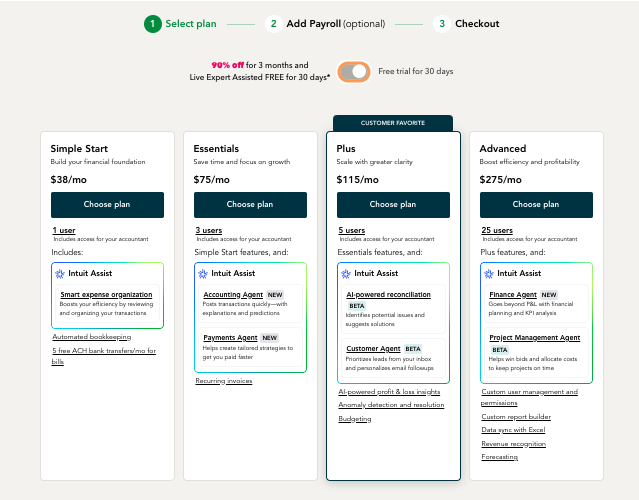 |  |  |
Other Details
Organization Types supported |
|
|
|
|
|---|---|---|---|---|
Platforms Supported |
|
|
|
|
Modes of support |
|
|
|
|
API Support |
|
|
|
|
Get help choosing | Get help choosing |
Security & Compliance
Certifications, data handling, and security controls for IT and compliance evaluators.
SOC 2 | ✓ Yes | ✓ Yes |
|---|---|---|
HIPAA | — | ✗ No |
GDPR | ✓ Yes | ✓ Yes |
ISO 27001 | ✓ Yes | — |
Single Sign-On (SSO) | ✓ Yes | ✓ Yes |
Multi-Factor Auth (MFA) | ✓ Yes | ✓ Yes |
Data Encryption | ✓ Yes | ✓ Yes |
Audit Logs | ✓ Yes | ✓ Yes |
Data Residency | 🌐 Global | 🇺🇸 US |
Workday Financial Management vs Quickbooks vs Xero User Reviews & Rating Comparison
User Ratings | ||||
|---|---|---|---|---|
Rating Distribution | ||||
Spotsaas Editor’s POV generated by AI | Buyer sentiment Buyers appreciate Workday Financial Management's comprehensive features and integration but express frustration with its complexity and performance issues. What buyers like
Common complaints
| Buyer sentiment Overall, buyers appreciate QuickBooks for its excellent customer support and ease of use, though some express frustration with technical issues and complex feature areas. What buyers like
Common complaints
| Buyer sentiment Overall positive sentiment highlights Xero's ease of use and excellent customer support, though some users note challenges with initial support access and advanced features. What buyers like
Common complaints
| Buyer sentiment Users generally express high satisfaction with Zoho Books for its ease of use, automation, and collaborative features, though some note limitations for larger or more complex organizations. What buyers like
Common complaints
|
Pros and Cons |
|
|
|
|
Positive Reviews | No reviews available for the product | No reviews available for the product | No reviews available for the product | No reviews available for the product |
Integrations
Integration with other apps | No Integration information available. | No Integration information available. | No Integration information available. |
|---|


List of Customers
Customers | No Customers information available. | No Customers information available. |  Coco cubano |  Brandography  Legal consultant  Samteq |
|---|
Media and Screenshots
Screenshots | No screenshots available. |  4 Screenshots |
|---|---|---|
Videos |  2 Videos |  2 Videos |
Alternatives
Alternatives |
|---|
Add another option to compare side by side
Search by product name to compare pricing, fit, and buyer feedback in one view.Compare similar software options

/logo_1622728934.296577.png)

Related Blogs and Articles for Accounting Software


Disclaimer: This research has been collated from a variety of authoritative sources. We welcome your feedback at [email protected].
Frequently asked questions
- Which is better, Workday Financial Management or Quickbooks?
- Quickbooks edges out the other on user ratings (4.8 vs 3.6). That said, the best pick depends on your use case — use the comparison tables above to evaluate each dimension.
- Do Workday Financial Management and Quickbooks offer a free trial?
- Quickbooks offers a free trial. Workday Financial Management does not.
- What is the starting price of Workday Financial Management vs Quickbooks?
- Workday Financial Management starts at Contact for pricing. Quickbooks starts at $3.80 /month.
- What are the top alternatives to Workday Financial Management?
- Top alternatives to Workday Financial Management include Xero, Zoho Books, Quickbooks, Freshbooks, Sage Accounting (Sage One).
- What are the top alternatives to Quickbooks?
- Top alternatives to Quickbooks include Xero, Zoho Books, Freshbooks, Sage Accounting (Sage One), easybook.io.