
Bill.com vs Oracle Financials Cloud Comparison

Bill.com
Starting at $0 /user/month
- Free Trial
- Free Version
- Freelancers / Consultants
- Large Enterprises
Bill.com is a financial operations platform for small businesses that handles invoicing, bill payments, and expense tracking. It supports electronic document exchange, ACH, credit card, and international payments, and in…

Oracle Financials Cloud
Starting at $10 /Month
- Individuals
- Large Enterprises
Oracle Financials Cloud is a versatile platform that meets your financial requirements. It is a reliable enterprise resource planning system that provides insights into a company's financial standing and success in the g…
Oracle Financials Cloud leads on user satisfaction with a 4.1-star rating across 140 reviews.
Bill.com vs Oracle Financials Cloud — at a glance
| Feature | Bill.com | Oracle Financials Cloud |
|---|---|---|
| Rating | 4.0 / 5 | 4.1 / 5 |
| Reviews | 601 | 140 |
| Starting price | $0 /user/month | $10 /Month |
| Free trial | Yes | No |
| Free version | Yes | No |
| Best for | Freelancers / Consultants, Large Enterprises, Medium Business | Individuals, Large Enterprises, Medium Business |
| Category | Accounting Software | ERP Software |
| Platforms | SaaS/Web/Cloud, Mobile - Android, Mobile - iOS | SaaS/Web/Cloud |
| API | Available | — |
| Support modes | Business Hours, Online | Business Hours, Online |
Key differences between Bill.com and Oracle Financials Cloud
- Pricing: Bill.com starts at $0 /user/month, while Oracle Financials Cloud starts at $10 /Month.
- Free trial: Bill.com offers a free trial; Oracle Financials Cloud does not.
- Target audience: Bill.com is built for Freelancers / Consultants and Large Enterprises, while Oracle Financials Cloud targets Individuals and Large Enterprises.
- User satisfaction: Oracle Financials Cloud scores higher with a 4.1-star average.
- Deployment: Bill.com supports SaaS/Web/Cloud, Mobile - Android, Mobile - iOS; Oracle Financials Cloud supports SaaS/Web/Cloud.
Bill.com vs Oracle Financials Cloud — find the better fit before you commit.
Which tool fits your team best
Which is actually cheaper for your team size
Where each product wins, per real buyers
Most Accounting Software tools look identical on paper. This comparison cuts to the differences that matter — pricing structure, team fit, and what real buyers found after signing up.
Biggest differences
Features
Pricing
Buying details
Security
Buyer feedback
Integrations
Product tour
Other options
Talk to an expert Talk to an expert |
Free PDF comparison
Download this Bill.com vs Oracle Financials Cloud comparison
Get the full side-by-side as a PDF — these picks plus the top Accounting Software tools, with verified ratings, pricing and features.
- Side-by-side on pricing, features & ratings
- Plus the category top 10, scored & ranked
- Emailed to you — no on-screen download
No file downloads on screen — we email it to you. One-click unsubscribe anytime.
Bill.com vs Oracle Financials Cloud: Biggest differences
Start here before you go deeper into features.
Best for small to mid-sized businesses streamlining invoicing and payment workflows.
- You need a simple, user-friendly platform to automate invoicing and bill payments.
- Your business uses QuickBooks, Xero, or similar accounting software requiring integration.
- You want real-time visibility and automated notifications for invoice and payment status.
- Your company requires extensive cross-border payments with multi-currency support.
- You rely heavily on responsive, personalized customer support for financial software.
Individuals, Large Enterprises, Medium Business
Bill.com typically suits Freelancers / Consultants and Large Enterprises. Oracle Financials Cloud tends to fit Individuals and Large Enterprises better. The right choice depends on your team size, workflow, and whether a free trial matters.
Description | Bill.com is a financial operations platform for small businesses that handles invoicing, bill payments, and expense tracking. It supports electronic document exchange, ACH, credit card, and ... Read More about Bill.com | Oracle Financials Cloud is a versatile platform that meets your financial requirements. It is a reliable enterprise resource planning system that provides insights into a company's ... Read More about Oracle Financials Cloud |
|---|---|---|
Entry Level Pricing |
|
|
Free Trial Availability |
| |
SpotScoreWhat's this? ↗ | 9.2/10 | 8.3/10 |
User RatingsBased on verified Spotsaas reviews | ||
Best Company Size | 1-50 employees51-500 employees | — |
Get pricing help | Get pricing help |
Where each option fits best
See where each product is strongest, which teams it fits, and what causes buyers to keep looking — before you commit.
Based on buyer reviews and verified product data collected by Spotsaas.
Key strengths
- Payment Processes: With Bill.com, I’ve seen firsthand how easy it is to automate your accounts payable and receivable. This means less time spent on manual data entry and more focus on strategic initiatives.
- Cash Flow Management: Managers value the real-time visibility into cash flow that Bill.com provides. You can track payments, send reminders, and predict cash needs more accurately, which supports better financial planning.
- Smooth Integration: Bill.com integrates easily with popular accounting software like QuickBooks and Xero. This simplifies your workflow and reduces the risk of errors from data duplication.
Best fit
- 1 to 500 employees
- Fintech, SaaS, Consulting, Accounting, and Professional Services
- Finance Managers, Accounts Payable Specialists, CFOs, Bookkeepers, and Small Business Owners
Reasons buyers look elsewhere
- Users may seek alternatives to Bill.com due to high subscription costs, especially if their business is small or just starting, making budget-friendly options more appealing for managing invoicing and payments.
- Some businesses may require more customizable features than what Bill.com offers, prompting them to explore alternatives that allow for tailored workflows and specific integrations with their existing systems.
- Companies experiencing rapid growth might find that Bill.com lacks scalability, leading them to consider solutions that can better accommodate their evolving financial management needs without sacrificing efficiency.
Software Demo
Demo |
|---|
Need a second opinion?
Get decision help from a software advisor
Share your priorities, budget, and team needs, and we’ll help you narrow the options and understand the tradeoffs before you talk to vendors.

- Independent advice — matched to your business
- Understand the tradeoffs before you talk to vendors
- Free 15-min call with a software advisor.
Step 1 of 4
How big is your team?
We tailor recommendations to companies your size.















How do Bill.com and Oracle Financials Cloud Compare on Features?
Total Features | 15 Features | 8 Features |
|---|---|---|
Unique Features | No unique features | No unique features |
Get Quote | Get Quote |
Compare Bill.com and Oracle Financials Cloud on pricing
Review starting price, plan structure, and free-trial access side by side so you can see which option fits your budget and buying process.
Pricing Option | ||
|---|---|---|
Starting From |
|
|
Pricing Plans |
|
|
Pricing Page | 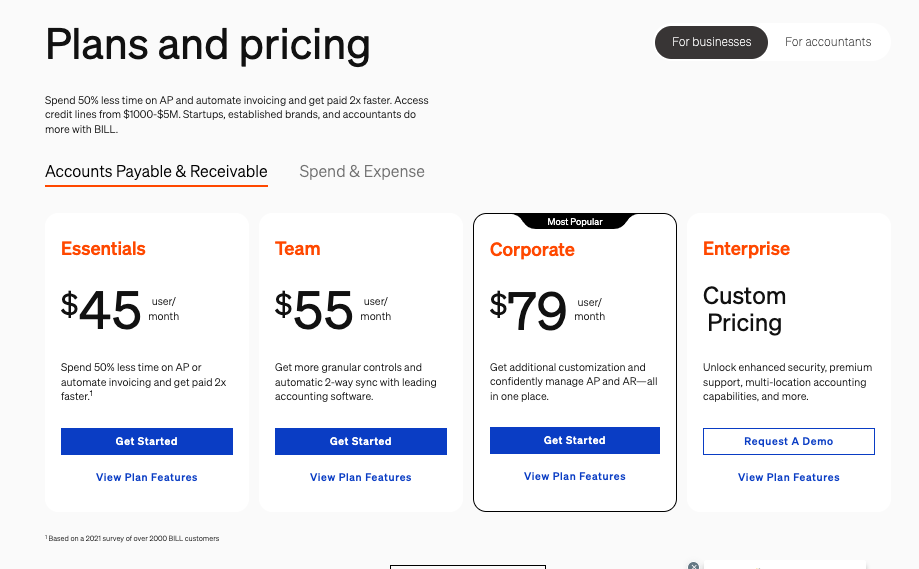 |  |
Bill.com vs Oracle Financials Cloud: Other Details
Organization Types supported |
|
|
|---|---|---|
Platforms Supported |
|
|
Modes of support |
|
|
API Support |
|
|
Get help choosing | Get help choosing |
Bill.com User Reviews & Rating Comparison
User Ratings | ||
|---|---|---|
Rating Distribution | ||
Spotsaas Editor’s POV generated by AI | Buyer sentiment Users generally appreciate Bill.com for its ease of use and efficiency in automating payments, though customer support and international payment features receive notable criticism. What buyers like
Common complaints
| Buyer sentiment Buyer sentiment is positive across 180 reviews, with strong overall satisfaction. What buyers like
Common complaints
|
Pros and Cons |
|
|
Positive Reviews | No reviews available for the product | No reviews available for the product |
| Negative Reviews | No reviews available for the product | No reviews available for the product |
Bill.com and Oracle Financials Cloud Customers
Customers |  Wag  Marine Layer  Quicken |  Scottish Water  Emblem Health  TrueBlue |
|---|
Media and Screenshots
Screenshots | 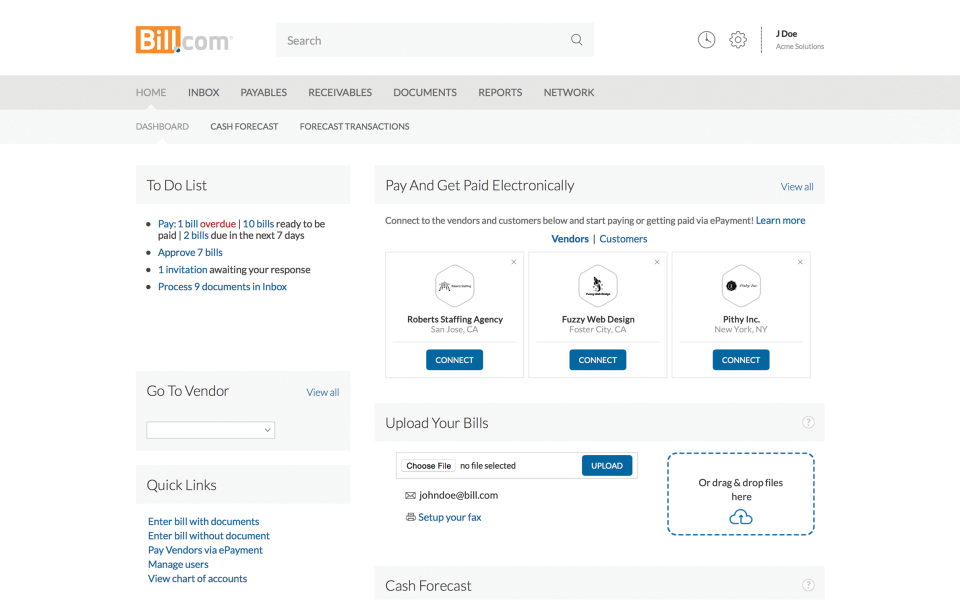 10 Screenshots | No screenshots available. |
|---|---|---|
Videos |  1 Videos |  1 Videos |
Top Alternatives to Bill.com and Oracle Financials Cloud in 2026
Alternatives |
|---|


Add another option to compare side by side
Search by product name to compare pricing, fit, and buyer feedback in one view.Compare similar software options



Related Blogs and Articles for Erp Software
Disclaimer: This research has been collated from a variety of authoritative sources. We welcome your feedback at [email protected].
Frequently asked questions
- Which is better, Bill.com or Oracle Financials Cloud?
- Oracle Financials Cloud edges out the other on user ratings (4.1 vs 4.0). That said, the best pick depends on your use case, so use the comparison tables above to evaluate each dimension.
- Do Bill.com and Oracle Financials Cloud offer a free trial?
- Bill.com offers a free trial. Oracle Financials Cloud does not.
- What is the starting price of Bill.com vs Oracle Financials Cloud?
- Bill.com starts at $0 /user/month. Oracle Financials Cloud starts at $10 /Month.
- What are the top alternatives to Bill.com?
- Top alternatives to Bill.com include Xero, Zoho Books, Freshbooks, Reckon One, QuickBooks Online Advanced.
- What are the top alternatives to Oracle Financials Cloud?
- Top alternatives to Oracle Financials Cloud include ERP-ONE+, BizAutomation Cloud ERP, LOGIC Enterprise, Odoo ERP, Sage Intacct.
- What would make me regret choosing Bill.com?
- Bill.com is credited with the following: handles invoicing, payments, and accounts payable processes saving significant time; user-friendly and intuitive interface. The recurring reservations: customer service is often unhelpful and difficult to reach; payments can be held for extended periods or require extra fees for faster transfers. It does not include Payroll and Spend Management.
- Is Oracle Financials Cloud a safe bet?
- It depends what you need. In its favour: offers extensive financial analytics; highly scalable for growing businesses. Against it: implementation can be resource-intensive; higher costs compared to competitors. Note that it does not include Accounts Payable and Accounts Receivable.
More ERP Software comparisons
Side by side breakdowns of the same products against other options in this category.