
Picking a 401k provider ranks among the more consequential decisions a business makes when it decides to offer retirement benefits. A well-built 401k plan does real work: it helps attract and keep talent, gives employees tax advantages, and supports their long-term financial security.
The number of providers on the market can make the choice feel overwhelming. Administrative fees, the range of investment options, compliance support, and how easy the plan is to run day-to-day are the factors that actually narrow the field down to the provider that fits your company.
This guide walks through the considerations that matter most in that selection process, so businesses can land on a 401k provider that delivers real value for both employees and employers. It also covers employer matching and safe harbor options, and how recent regulatory changes affect the decision.
What Is a 401(k) Plan? How It Works and Why It Matters
A 401k plan is a retirement savings program where employees set aside a portion of their salary in an investment account, often topped up by employer-matching contributions.
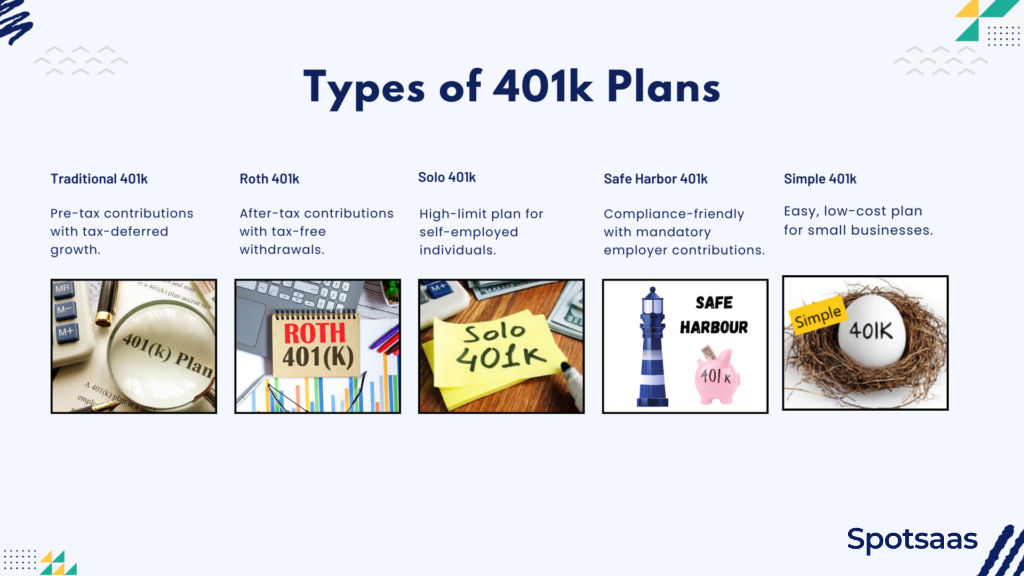
Traditional 401(k): Pre-Tax Contributions and Employer Match Explained
With a Traditional 401k, employees contribute part of their earnings before taxes are taken out, which lowers their taxable income for the year. Those contributions aren’t taxed until the money is withdrawn in retirement, typically after age 59½. Many employers add matching contributions on top, often tied to a vesting schedule that decides when an employee fully owns that employer money.
For employees, that means a lower tax bill now while savings build for later. For the business offering the plan, it’s a benefit that supports retention and gives staff a path toward financial stability.
Examples:
- Fidelity 401k Services: offers employer-sponsored plans with flexible contribution matching.
- Vanguard Retirement Plans: provides tax-advantaged retirement solutions with low-cost investment options.
- Charles Schwab 401k Plans: helps businesses set up traditional retirement plans with compliance support.
- Empower Retirement: offers personalized investment advice and tax-deferred savings for employees.
Roth 401(k): Tax-Free Withdrawals and Long-Term Retirement Benefits
A Roth 401k works the other way around: contributions come from after-tax dollars, so withdrawals in retirement are tax-free. Unlike a Traditional 401k, the contributions don’t lower taxable income today, but the earnings grow tax-free over time.
It suits employees who expect to land in a higher tax bracket later on. Offering a Roth option gives employees the flexibility to pay taxes now instead of at withdrawal.
Examples:
- Betterment for Business: offers automated, personalized investment options.
- Fidelity Roth 401k: provides tax-free growth and flexible withdrawal options in retirement.
- T. Rowe Price 401k Plans: includes Roth and traditional options with professional fund management.
- Human Interest: a startup-friendly provider with low-cost investment choices.
Solo 401k Plans: Best for Self-Employed and Freelancers
A Solo 401k is built for self-employed people and business owners who have no employees other than a spouse. Because the account holder can contribute in both the employer and employee role, it allows for larger tax-deferred savings, along with generous contribution limits and flexible investment choices.
That combination makes it a strong option for entrepreneurs who want to grow retirement savings while reducing taxable income, whether they’re a solo consultant or run a small business.
Examples:
- E*TRADE Solo 401k: offers flexible investment options and no setup fees for self-employed professionals.
- Vanguard Individual 401k: a low-cost retirement plan with diverse fund choices.
- Fidelity Solo 401k: provides easy online setup and investment management for small business owners.
- Schwab Individual 401k: features a broad range of investments with no maintenance fees.
Safe Harbor 401k Plans: IRS Compliance Made Simple
A Safe Harbor 401k simplifies compliance with IRS regulations by requiring the employer to make mandatory contributions. That guarantees every employee benefits, regardless of salary or tenure, and in exchange, the business skips the complex nondiscrimination testing that other plans require.
It’s a good fit for small and mid-sized businesses that want to offer retirement benefits without risking a failed IRS compliance test, giving them a structured way to raise employee participation while staying compliant.
Examples:
- ADP 401k Plans: provides Safe Harbor plans with integrated payroll services.
- Paychex Safe Harbor 401k: helps small businesses stay compliant while offering tax benefits.
- Guideline 401k: automates compliance and simplifies plan administration for businesses.
- Ascensus Safe Harbor 401k: supports flexible contribution structures for employers.
Simple 401k: Low-Cost Retirement Plans for Small Businesses
A Simple 401k is designed for businesses with fewer than 100 employees and is easier to set up than a traditional 401k. Employers are still required to contribute, but the plan carries a lighter administrative load.
Employees still get tax-deferred savings, and businesses sidestep the heavier compliance requirements of other plans, which makes it a solid option for small businesses wanting lower costs and fewer regulatory headaches. The trade-off is lower contribution limits compared to other 401k plans.
Examples:
- Gusto: offers SIMPLE 401k plans with built-in payroll integration.
- Zenefits: provides an easy-to-use retirement plan solution for small businesses.
- Ubiquity Retirement + Savings: affordable SIMPLE 401k plans designed for startups and SMBs.
- Paychex SIMPLE: helps small employers set up and manage cost-effective retirement benefits.
What to Look for in a 401(k) Provider: Features That Matter Most
Choosing the right 401k provider is about more than comparing costs. It means picking a plan that fits your business size, your employees’ needs, and your long-term financial goals.
Best Investment Options Offered by Top 401(k) Providers
Employees need a range of investment choices to build a diversified retirement portfolio. A strong 401k provider should offer:
- Mutual Funds & ETFs: a mix of actively and passively managed funds tailored to different risk levels.
- Target Date Funds: Target Date Funds are investments that automatically adjust as an employee nears retirement.
- Managed Portfolios: professionally managed plans that adjust for market conditions to optimize returns.
- Self-Directed Investment Options: some providers let participants invest directly in individual stocks, bonds, or alternative assets.
Example providers: Fidelity, with its extensive mutual fund selection; Vanguard, known for low-cost index funds; and Betterment for Business, which handles investment management automatically.
Understanding Employer and Employee Contributions in 401(k) Plans
A well-structured 401k plan gives both employers and employees flexibility in how they contribute, so both sides can maximize retirement savings.
- Employer Matching: many businesses match a portion of employee contributions as a savings incentive, and providers should support a range of match structures (for example, 100% of the first 3%, then 50% of the next 2%).
- Vesting Schedules: determine when employees gain full ownership of employer contributions, which also supports retention.
- Catch-Up Contributions: employees over 50 should be able to contribute beyond the standard IRS limits.
- Safe Harbor Contributions: some providers add automatic employer contributions that simplify compliance.
Example providers: ADP 401k offers customizable matching, Paychex supports flexible vesting options, and Guideline automates employer contributions.
401(k) Administrative Support: What Providers Should Offer
Running a 401k plan takes ongoing administrative work, which can be a lot for businesses without a dedicated HR team. A reliable provider should take care of:
- Plan Setup & Maintenance: guided onboarding and ongoing support.
- Regulatory Compliance: keeping the plan aligned with IRS and Department of Labor rules, including nondiscrimination testing.
- Form 5500 Filing: annual reporting to the IRS and Department of Labor.
- Employee Education: webinars, FAQs, and retirement planning resources that help employees understand their benefits.
Example providers: Guideline automates plan administration, Ascensus provides comprehensive compliance support, and Human Interest pairs dedicated customer service with HR integrations.
401(k) Costs and Fees: What to Expect from Providers
Cost is one of the biggest factors in choosing a 401k provider, since high fees eat into retirement savings over time. Businesses should look closely at:
- Setup Fees: one-time charges for launching a new plan.
- Ongoing Management Fees: annual or monthly costs to maintain the plan, usually charged as a percentage of assets under management (AUM) or as a flat fee.
- Expense Ratios: the percentage of fund assets that go toward management expenses; lower ratios leave employees with higher returns.
- Hidden Fees: extra charges for things like fund transfers, recordkeeping, plan terminations, or IRS filings.
Example providers: Ubiquity Retirement + Savings uses a flat-rate pricing model, Empower Retirement keeps administrative costs low, and Human Interest prices its fees for small businesses.
Fiduciary Responsibilities in 401(k) Plans: Why They Matter
Employers managing a 401k plan are expected to act in their employees’ best interests. Some providers offer fiduciary services that reduce liability for business owners by taking on compliance and investment-selection responsibilities themselves.
Key fiduciary services include:
- 3(16) Fiduciary: manages plan administration, compliance, and filings.
- 3(21) Fiduciary: provides investment recommendations but leaves the final decision to the employer.
- 3(38) Investment Fiduciary: takes full responsibility for selecting and monitoring investments.
Example providers: Empower Retirement offers full fiduciary services, T. Rowe Price provides investment management fiduciary support, and Charles Schwab offers ERISA-compliant fiduciary services.
401(k) Integration with Payroll and HR Tools: What to Look For
A 401k plan should connect cleanly with a company’s existing payroll and HR software to automate deductions and keep the plan compliant. Look for providers that offer:
- Automatic Payroll Deductions: ensures employee contributions are processed accurately.
- Tax Reporting & Compliance: handles IRS reporting, including W-2 preparation and tax filings.
- Employee Onboarding & Eligibility Tracking: integrates with HR platforms to manage enrollments and eligibility.
- Third-Party Software Compatibility: works with leading payroll providers like Gusto, ADP, QuickBooks, Paychex, and Zenefits.
Example providers: Gusto 401k has native payroll integration, Zenefits combines its HR and benefits platform with 401k support, and Paychex covers both payroll and retirement benefits.
2026’s Best 401(k) Providers for Businesses: Comparison and Highlights
Landing on the right 401k provider takes a careful look at several factors that affect both employers and employees, from how easy onboarding is to compliance and reputation.
How Easy Is It to Set Up a 401(k) Plan with Each Provider?
A smooth onboarding process lets businesses set up a plan without unnecessary complications. Providers like Fidelity and ADP Retirement Services offer guided support, straightforward online registration, and payroll integration that works out of the box.
A quicker rollout means businesses can keep their attention on running the company while employees start saving for retirement without waiting around.
Comparing 401(k) User Experience and Customer Support
A user-friendly 401k platform lets both employers and employees manage their accounts efficiently. The best providers back that up with round-the-clock customer service, mobile access, and financial education resources.
Charles Schwab and Vanguard, for instance, focus on ease of use with clear dashboards and resources for participants. A system that’s responsive and well-supported tends to see higher employee participation.
Customizing and Scaling 401(k) Plans to Fit Your Business
Businesses of different sizes need flexible retirement plan options. A good 401k provider should offer a mix of plan types, flexibility in employer matching, and investment choices that fit different risk levels.
Empower Retirement and Guideline stand out here for solutions that scale, working for startups as well as larger enterprises that need their plans to grow along with their workforce.
Compliance and Security Features of Leading 401(k) Providers
Staying compliant with IRS and Department of Labor regulations is essential for avoiding penalties. The strongest 401k providers handle ERISA compliance, nondiscrimination testing, cybersecurity measures, and automated tax reporting.
Fidelity and ADP, for example, offer strong compliance support that keeps businesses in good standing with regulators, and their security protocols protect sensitive financial data and maintain participant trust.
Top 401(k) Providers by Reputation and User Feedback
A provider’s reputation says a lot about its reliability and service quality. It’s worth weighing third-party ratings, customer testimonials, and reviews that speak to investment performance, pricing transparency, and customer service.
Vanguard and Charles Schwab regularly earn positive feedback for cost-effective investment options and strong customer satisfaction. Looking at real user experiences helps businesses make an informed choice and pick a provider with a track record that holds up.
Best 401(k) Providers for Small to Large Businesses in 2026
Here’s a quick side-by-side look at these providers, their strengths, and the business types they suit best:
| Provider | Best For | Key Strengths | Support & Integration |
|---|---|---|---|
| Fidelity Investments | Large businesses | Wide investment options, 24/7 support | Integrates with ADP, Workday, QuickBooks |
| Vanguard | Small businesses | Low fees, strong mutual fund options | Compatible with payroll & HR software |
| Charles Schwab | Businesses needing investment flexibility | Diverse fund choices, easy administration | Phone, email, live chat support |
| Empower Retirement | Companies focusing on engagement | Interactive planning tools, scalable plans | Integrates with HR & benefits platforms |
| ADP Retirement Services | Businesses needing payroll integration | Seamless payroll & 401k management | Phone and email support |
| Guideline | Startups and small businesses | Affordable, automated 401k solution | Email and phone support |
| Betterment for Business | Companies preferring automation | Robo-advisor investment management | Integrates with payroll platforms |
How to Set Up a 401(k) Plan for Your Business: A Step-by-Step Guide
Setting up a 401k plan takes careful planning so it lines up with business goals and employee needs. A structured approach makes implementation simpler while keeping the plan compliant and built to last.
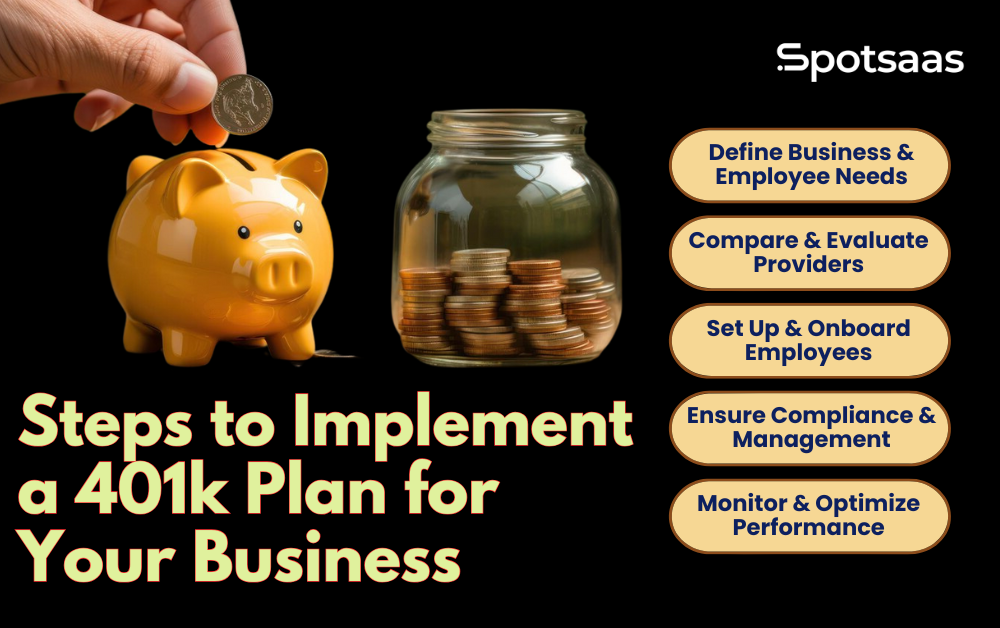
Step 1: Define Retirement Goals and Employee Benefit Needs
Start by assessing company goals, budget, and what employees actually want from retirement benefits, then decide on the contribution structure, vesting schedule, and eligibility criteria.
Step 2: Compare 401(k) Providers and Narrow Your Options
Compare providers on cost, investment options, and administrative support, and look for payroll integration that works cleanly along with solid compliance assistance.
Step 3: Finalize 401(k) Plan Setup and Employee Onboarding
Finalize the plan details, including employer contributions and enrollment rules, then walk employees through the plan’s benefits with clear communication and training.
Step 4: Manage 401(k) Plan Compliance and Annual Reporting
Stay on top of IRS and labor regulations by filing what’s required, and lean on providers with automated compliance tools to make audits and reporting easier.
Step 5: Track and Improve 401(k) Plan Performance Over Time
Check in regularly on participation rates, investment performance, and fees, and adjust matching contributions or plan features as needed to keep employees engaged.
5 Common 401(k) Mistakes to Avoid When Choosing a Provider
Choosing the right 401k provider affects both the business and its employees, so it’s worth avoiding a few common mistakes that get in the way of a cost-effective, compliant plan.
Mistake #1: Overlooking Hidden Fees in 401(k) Plans
Many plans carry administrative, investment, and transaction fees that quietly cut into savings. Reviewing all the costs upfront helps businesses avoid surprises later.
Mistake #2: Ignoring Your Fiduciary Responsibilities
Employers are on the hook for staying compliant and acting in employees’ best interests. Picking a provider that offers fiduciary services cuts down on legal and financial risk.
Mistake #3: Choosing a Provider with Limited Investment Options
A narrow fund lineup limits how much employees can diversify. Providers that offer mutual funds, ETFs, and managed portfolios give employees more room to work with.
Mistake #4: Skipping Employee Education and Engagement Tools
Employees engage more once they understand what the plan actually offers them. Providers that supply financial education tools and retirement planning resources tend to see better participation.
Final Thoughts: How to Choose the Right 401(k) Provider for Your Business
The right 401k provider makes it possible to run a retirement plan that’s cost-effective, compliant, and genuinely engaging for employees. Employers should weigh providers on fees, fiduciary services, investment options, employer matching, safe harbor structures, and employee engagement tools, all of which help control plan costs while keeping options like 401k loans available to employees.
A well-designed 401k plan supports hiring and retention while giving employees long-term financial security. Recently enacted 401k rule changes bring tax incentives and simpler administration for small businesses offering competitive benefits. Comparing multiple providers helps a business land on a solution that fits its workforce and its financial goals.
Comparing providers this way makes it possible to build a retirement plan that works for the business and gives employees, freelancers, and gig workers the means to save for their future.
401(k) Provider FAQs: What Business Owners Need to Know
How do I choose the right 401k provider for my business?
Weigh fees, investment options, compliance support, and payroll integration against what your business actually needs.
What is a fiduciary, and why is it important?
A fiduciary manages the plan in employees’ best interests, which keeps it compliant and reduces the employer’s liability.
Can small businesses afford to offer a 401k plan?
Yes. Providers like Guideline, Betterment, and Ubiquity offer affordable, automated 401k solutions built for small businesses.
How can I encourage employees to participate in the 401k plan?
Financial education, employer matching, and simple enrollment all help boost participation and engagement.
Compare alternatives to the tools in this post

- Independent picks for exactly what you just read about
- Matched to your team size & needs
- Vendors don't pay for placement
Step 1 of 4
How big is your team?
We tailor recommendations to companies your size.















Related Articles
401K Providers
Top 5 Best 401k Providers for Small Businesses in 2026
Continue reading →
401K Providers
5 Best 401k Plans for Freelancers and Gig Workers in 2026
Continue reading →
401K Providers
IRS Tax Code Changes for 2026: Key Updates That Could Save or Cost You Thousands
Continue reading →
401K Providers
Betterment vs Guideline 401k: Which Retirement Plan Is Best for Your Small Business?
Continue reading →