
🚨 Why This Blog Matters
Tax year 2026 brings new brackets, a higher standard deduction, new OBBBA deductions, bigger credits and new 1099 reporting thresholds. These rules set the bill on the return you file in early 2027, so the last months of 2026 are the time to plan. This guide covers what changed for individuals and small businesses.
🧠 What You’ll Learn Here
The 2026 Tax Brackets, Standard Deduction Increases, Tips, Overtime & Senior Deductions, Child & Family Credits, Freelancer & Small Business Rules, and New 1099 Reporting Thresholds. Learn how to adjust your W-4, claim the new deductions and plan year-end moves.
🎯 Who Should Read This
Written for employees, freelancers, gig workers, investors, parents, retirees and small business owners who want to lower their 2026 tax bill and file a clean return in 2027.
The federal tax code for tax year 2026 looks noticeably different from a year ago. The IRS applied its annual inflation adjustments, and the One Big Beautiful Bill Act (OBBBA), signed July 4, 2025, added new deductions, raised several credits and rewrote some reporting rules. The IRS now also refers to this law as the “Working Families Tax Cuts”.
Everything below applies to income you earn in 2026 and report on the return you file in early 2027. With a few months left in the year, there is still time to adjust withholding, time deductions and get your records in order.
Key Takeaways
- 2026 tax brackets and the standard deduction rose with inflation: $16,100 for single filers and $32,200 for married couples filing jointly.
- OBBBA deductions for seniors, tips, overtime and car loan interest are available whether or not you itemize, and non-itemizers can deduct up to $1,000 ($2,000 married filing jointly) of cash gifts to charity starting in 2026.
- The Child Tax Credit is $2,200 per child and is now permanent; the Child and Dependent Care Credit rate rises to as much as 50% of qualifying expenses.
- Form 1099-K is back to the $20,000 and more-than-200-transactions threshold, and the 1099-NEC/1099-MISC threshold rises from $600 to $2,000.
- The estate tax exclusion is $15,000,000 per person, and the SALT cap is about $40,400 for 2026.
2026 IRS Tax Bracket Changes: What They Mean for Every Income Level
The seven federal rates (10%, 12%, 22%, 24%, 32%, 35% and 37%) stay the same in 2026. The income ranges for each rate moved up with inflation, so a cost-of-living raise is less likely to push you into a higher bracket. These are the brackets for tax year 2026.
2026 Federal Income Tax Brackets (Full Table for Single & Joint Filers)
Single Filers
| Tax Rate | Taxable Income Range |
|---|---|
| 10% | Up to $12,400 |
| 12% | $12,401 – $50,400 |
| 22% | $50,401 – $105,700 |
| 24% | $105,701 – $201,775 |
| 32% | $201,776 – $256,225 |
| 35% | $256,226 – $640,600 |
| 37% | Over $640,600 |
Married Filing Jointly
| Tax Rate | Taxable Income Range |
|---|---|
| 10% | Up to $24,800 |
| 12% | $24,801 – $100,800 |
| 22% | $100,801 – $211,400 |
| 24% | $211,401 – $403,550 |
| 32% | $403,551 – $512,450 |
| 35% | $512,451 – $768,700 |
| 37% | Over $768,700 |
Head of household filers have their own bracket ranges. Check the IRS tables for that filing status before you estimate your 2026 tax.
Who Gains from the 2026 IRS Tax Bracket Adjustments?
Lower-Income Earners
The 10% bracket now covers the first $12,400 of taxable income for single filers and $24,800 for joint filers, so a little more income is taxed at the lowest rate.
Middle-Income Earners
The 22% bracket now reaches $105,700 for single filers and $211,400 for joint filers. If your income sat near the top of a bracket last year, a raise in 2026 may still be taxed at the same rate.
High-Income Earners
The top rate stays at 37%, but it now starts above $640,600 for single filers and $768,700 for joint filers. More of a high earner’s income is taxed at lower rates before the top bracket applies.
Why the 2026 Tax Bracket Inflation Adjustments Matter for Your Paycheck
Annual bracket adjustments prevent “bracket creep”, where inflation-driven raises push you into a higher bracket without any real gain in purchasing power. Your employer’s payroll system uses the new tables automatically, but your W-4 settings still decide whether your withholding matches your actual bill.
Standard vs Itemized Deductions in 2026: Which One Saves You More?
The standard deduction sets how much income you can shield from tax without itemizing. Most filers take it, so this adjustment affects more people than any other single change.
2026 Standard Deduction by Filing Status
These are the confirmed IRS amounts for tax year 2026:
| Filing Status | 2026 Standard Deduction |
|---|---|
| Single / Married Filing Separately | $16,100 |
| Married Filing Jointly | $32,200 |
| Head of Household | $24,150 |
What These Deduction Changes Mean for Your Taxable Income
- If you take the standard deduction, a larger share of your 2026 income is tax-free.
- Itemizing pays off when your mortgage interest, state and local taxes, medical costs and charitable gifts add up to more than your standard deduction. The higher SALT cap makes itemizing worth a fresh look for many homeowners.
- Several new OBBBA deductions (below) are claimed on top of the standard deduction, so you do not have to itemize to use them.
SALT Deduction in 2026: The Cap Is Now About $40,400
The State and Local Tax (SALT) deduction lets itemizers deduct state and local income or sales taxes plus property taxes.
How OBBBA Changed the SALT Deduction Cap
- The cap rose from $10,000 to $40,000 for 2025 and increases 1% a year from 2026 through 2029, which puts it at about $40,400 for 2026.
- The cap is reduced once modified adjusted gross income (MAGI) passes roughly $500,000, but it never drops below $10,000.
- The cap reverts to $10,000 in 2030.
- Taxpayers in high-tax states can now itemize deductions that were capped out in earlier years.
Who Benefits Most from the Higher SALT Cap?
- Homeowners and residents of high-tax states who pay large property or state income taxes.
- Filers with MAGI below the phase-down range, who get the full cap.
Mortgage, Medical & Charity Deductions: What’s New in 2026?
In light of tax changes affecting investors, it’s crucial for property owners to optimize financial strategies. When pursuing deductions like the mortgage interest deduction, investors might benefit from exploring specific financing solutions tailored to their unique needs.
One such option includes the mortgage for investors, often known as DSCR loans, which focus on a property’s income potential rather than borrower income, offering flexibility in securing investment properties.
Mortgage Interest Deduction
- Itemizers can still deduct interest on qualifying home mortgage debt, subject to the IRS limit on loan size. Check the limit that applies to the date your loan was taken out.
Medical Expense Deduction
- Itemizers can deduct qualified medical expenses above a set share of adjusted gross income. Bunching elective procedures into one year can help you clear that floor.
Charitable Contribution Deduction
- New for tax year 2026: filers who take the standard deduction can deduct up to $1,000 (single) or $2,000 (married filing jointly) of cash gifts to qualifying charities. Gifts to donor-advised funds do not count.
- Itemizers continue to deduct gifts on Schedule A, subject to AGI limits.
- Keep receipts for every gift and written acknowledgments for larger ones. Non-cash gifts such as clothing, furniture and vehicles need documentation.
New OBBBA Deductions for 2026: Seniors, Tips, Overtime & Car Loans
OBBBA created four temporary deductions that apply for tax years 2025 through 2028. You can claim them whether you itemize or take the standard deduction.
- Senior deduction: an extra $6,000 per person age 65 or older ($12,000 for a married couple when both qualify). It phases out above MAGI of $75,000 ($150,000 married filing jointly).
- No tax on tips: deduct up to $25,000 of qualified tips. The deduction phases out above MAGI of $150,000 ($300,000 married filing jointly).
- No tax on overtime: deduct up to $12,500 ($25,000 married filing jointly) of the qualified overtime premium, the extra pay above your regular rate. It phases out above MAGI of $150,000 ($300,000 married filing jointly).
- Car loan interest: deduct up to $10,000 a year of interest on a loan for a new personal-use vehicle bought after 2024 with final assembly in the US. The deduction is limited above MAGI of $100,000 ($200,000 married filing jointly).
OBBBA also created Trump Accounts for children. Contributions can be made from July 4, 2026, eligible children can receive a one-time $1,000 federal seed deposit, and combined contributions are capped at $5,000 a year, of which an employer can add up to $2,500.
IRS Tax Credit Updates for 2026: Maximize CTC, EITC & Family Credits
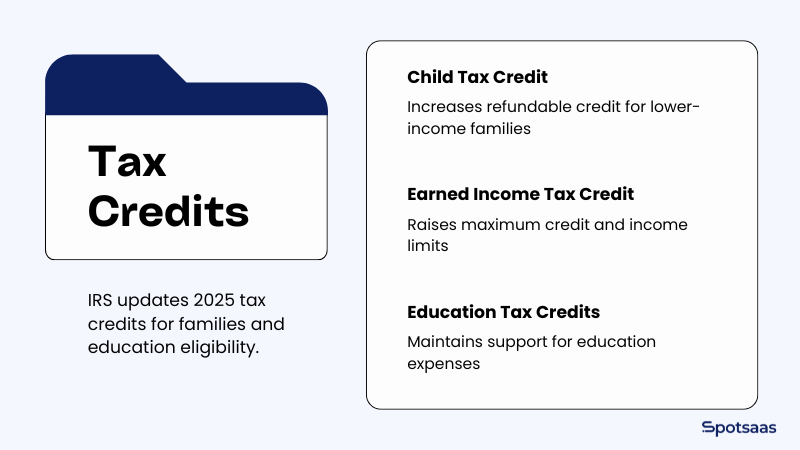
Several family credits are larger in 2026. The biggest changes affect the Child Tax Credit (CTC), the Earned Income Tax Credit (EITC), the Child and Dependent Care Credit and the adoption credit.
Child Tax Credit (CTC) Updates
Credit Amount
The credit is $2,200 per qualifying child for 2026, and up to $1,700 of it is refundable, so families with little tax liability can still receive part of it as a refund.
Income Phase-Out
The credit starts to phase down above $200,000 of income for single filers and $400,000 for joint filers.
Permanent Under OBBBA
OBBBA made the higher credit permanent, so families can plan around it beyond 2026. The child must be under 17 at the end of the tax year.
Earned Income Tax Credit (EITC) Changes
Increased Maximum Credit
The maximum EITC for families with three or more qualifying children is $8,231 for 2026.
Income Limits Raised
Eligibility income limits rise each year with inflation, so workers who just missed out before may now qualify.
Age Requirements
Workers without qualifying children must meet minimum and maximum age rules to claim the credit. If your income is close to the phase-out range, run the IRS EITC Assistant before you file.
Child and Dependent Care Credit Changes
- From 2026 the maximum credit rate rises from 35% to 50% of qualifying care expenses.
- Qualifying expenses are capped at $3,000 for one child or dependent and $6,000 for two or more.
Adoption Credit and Education Credits
- The adoption credit is up to $17,670 per child for 2026, and up to $5,120 of it is refundable.
- The Lifetime Learning Credit and the American Opportunity Credit remain available for tuition, fees and course materials. The American Opportunity Credit is partly refundable, which makes it especially useful for lower-income students.
Health Coverage and Other Inflation Adjustments
- HSA limits are $4,400 for self-only coverage and $8,750 for family coverage, plus a $1,000 catch-up at age 55 or older. From January 1, 2026, bronze and catastrophic marketplace plans are HSA-compatible.
- Health FSA salary reductions are capped at $3,400, with a carryover of up to $680.
- Repayment caps on excess advance Premium Tax Credit payments are removed from tax year 2026, so marketplace enrollees should report income changes promptly.
- The foreign earned income exclusion is $132,900, and the monthly transit and parking benefit limit is $340.
Retirement Plan Limits for 2026: 401k and IRA at a Glance
For 2026 you can defer up to $24,500 into a 401(k), 403(b) or 457 plan (up from $23,500 in 2025), and contribute up to $7,500 to a Traditional or Roth IRA (up from $7,000), with higher catch-up amounts for savers age 50 and older. Our guide to the IRS 401(k) contribution limits for 2026 covers catch-ups, the new Roth catch-up rule and income phase-outs, and our comparison of 401k plans and Individual Retirement Accounts (IRAs) explains which account to fund first.
Business Tax Updates 2026: What Self-Employed & Small Businesses Must Know
Several 2026 changes land directly on small business owners, freelancers and self-employed workers, mostly through new reporting thresholds and payroll limits.
Corporate Tax Rates and Small Business Deductions
- Corporate Tax Rate: C corporations continue to pay a flat federal rate. Review your entity choice with your adviser if your profits or plans have changed.
- Qualified Business Income (QBI) Deduction: owners of pass-through businesses such as sole proprietorships, partnerships and S corporations should confirm their QBI eligibility and limits for 2026. Small business owners can use tax software to model the deduction before year-end.
Section 179 Deduction and Depreciation
- Section 179 and Bonus Depreciation: these let a business deduct equipment and software purchases sooner instead of spreading the cost over several years. The limits change often, so confirm the current figures with your tax adviser before you time a large purchase for late 2026.
Changes Pertaining to Self-Employment and Freelancers
- Social Security Wage Base: the Social Security portion of payroll and self-employment tax applies to the first $184,500 of earnings in 2026, up from $176,100 in 2025. Medicare tax applies to all earnings.
- Self-Employment Tax Deduction: self-employed individuals can still deduct the employer-equivalent half of self-employment tax when figuring taxable income.
- Quarterly Estimates: freelancers and independent contractors pay tax through quarterly estimates. The last 2026 payment is due January 15, 2027, and your 2026 return is due April 15, 2027; see our full calendar of tax deadlines for every other date.
- Business Expense Record Keeping: Tax Deductions can be legally maximized by keeping records of all business-related costs, including travel, home office and software subscriptions. Financial management tools can help simplify things, making sure that tax benefits are fully utilized.
New IRS Rules for 2026: 1099-K, 1099-NEC, Digital Assets & Audit Triggers
The biggest reporting changes for 2026 affect who receives a 1099 and when a business has to issue one. Taxability has not changed: income is taxable whether or not you receive a form.

New Reporting Requirements for Taxpayers and Businesses
- Form 1099-K Threshold: OBBBA retroactively restored the original threshold. Payment apps and online marketplaces issue a 1099-K only when a payee receives more than $20,000 across more than 200 transactions, and the planned step-down to $600 will not happen. Card payments have no threshold, and some states set lower thresholds of their own. This affects anyone paid through platforms such as PayPal, Venmo and other e-commerce services.
- Form 1099-NEC and 1099-MISC Threshold: for payments made after December 31, 2025, businesses report payments to contractors only when they reach $2,000 for the year, up from $600. The threshold is indexed for inflation after 2026. Forms for 2026 payments are due to workers and the IRS by February 1, 2027.
IRS Audit Focus and Enforcement Priorities
- Areas of Audit Focus: the IRS continues to review these areas closely:
- Self-Employment Income: ensuring freelancers and gig workers report all earnings and valid deductions.
- High-Income Earners: taxpayers with significant earnings face closer review.
- Charitable Contributions: large deductions relative to income may attract IRS attention.
- Refundable Tax Credits: claims for credits such as the Earned Income Tax Credit (EITC) are reviewed closely because errors are common.
- New OBBBA Deductions: tips and overtime deductions need records that show what was qualified tip income or overtime premium.
- Fraud Prevention Measures: the IRS uses enhanced review of refundable credits and withholding claims to stop fraudulent refunds.
Cryptocurrency, Gig Economy Earnings, and Digital Payments
- Cryptocurrency Taxation: digital asset brokers report sales and exchanges on Form 1099-DA. Keep your own cost-basis records so your return matches what brokers report.
- Gig Economy Earnings: income from freelancing, ride-sharing and online sales is taxable. All earnings must be reported, regardless of payment method or whether you receive a 1099.
- Fewer 1099-K Forms: with the higher threshold, many casual sellers and part-time gig workers will not receive a 1099-K for 2026. Track your income from platforms like Uber, Airbnb and Etsy yourself.
AMT, Estate and Gift Tax Limits for 2026
- Alternative Minimum Tax (AMT): the exemption is $90,100 for unmarried filers (phase-out starts at $500,000) and $140,200 for married couples filing jointly (phase-out starts at $1,000,000).
- Estate tax: the basic exclusion rises to $15,000,000 per person in 2026, up from $13,990,000 in 2025.
- Gift tax: the annual gift exclusion stays at $19,000 per recipient.
Tax Planning Checklist for 2026: 5 Smart Steps to Lower Your Tax Bill
The last quarter of 2026 is the best window to act on these compliance regulations and new deductions. These five steps set you up for a smooth filing in early 2027.

Adjust W-4 Withholding to Cover New Tax Rates
Review your W-4 form so your withholding reflects the 2026 brackets and any new deductions you expect to claim, such as tips, overtime or the senior deduction. The IRS Withholding Estimator shows whether you are on track for a refund or a balance due.
Any change in circumstance like marriage, the birth of a child, or buying a home may also call for an update in your withholding.
Getting Deductions and Credits to Their Max With the New Rules
Compare your expected itemized deductions with the 2026 standard deduction, keeping the higher SALT cap in mind. Contributions to a 401k, Traditional IRA or HSA also reduce current taxable income.
Then check your eligibility for the Child Tax Credit (CTC), Earned Income Tax Credit (EITC), Child and Dependent Care Credit and education credits. These can mean a substantial tax reduction for families, lower-income earners and students.
Document business and freelance expenses
Self-employed individuals, freelancers, and small business owners should document all their income and expense transactions in relation to their businesses to claim all deductions for which they are eligible. Tracking business expenses like home office fees, travel costs, and the purchase of equipment will help keep taxable income low.
If you plan to expense equipment under Section 179 or bonus depreciation, place it in service before year-end. Review your estimated tax payments too, so you avoid underpayment penalties.
Stay Compliant with IRS Regulations
Update your contractor payment records for the new $2,000 1099-NEC threshold, and keep the paperwork that supports any tips, overtime or car loan interest deduction. Clean records make filing faster and support every deduction you claim.
Consult with a Tax Professional for Strategic Planning
With this many new provisions in one year, professional input helps you claim everything you qualify for and avoid mistakes.
Expert advice is especially valuable if you have a high salary, self-employment income or a business, since you may need help with estimated taxes, investment structures and retirement contributions.
Final Thoughts: How to Turn 2026 IRS Changes Into Tax Savings
Tax year 2026 brings higher brackets and standard deductions, new OBBBA deductions, larger family credits and new 1099 thresholds. Together they can change your taxable income, your credits and the size of your refund. Every taxpayer should review withholding, gather expense records and check which new deductions and credits apply before December 31, 2026.
A tax professional is worth consulting if you have self-employment income, cryptocurrency, or a business with contractors. Taking these steps now means a smooth filing season in 2027 with minimal surprises.
IRS Tax Code FAQs for 2026: Bracket Rules, Credits & Common Confusion
How do the 2026 IRS tax brackets affect my income?
The rates stay at 10% to 37%, but each bracket covers more income. For example, the 10% rate applies to the first $12,400 of taxable income for single filers and $24,800 for joint filers, so more of your income is taxed at lower rates.
What is the 1099-K reporting threshold for gig workers and small businesses in 2026?
Payment apps and marketplaces issue a 1099-K only when you receive more than $20,000 across more than 200 transactions. OBBBA restored this threshold and cancelled the planned drop to $600. Card payments have no threshold, and all income remains taxable whether or not you get a form.
How has the Child Tax Credit (CTC) changed for 2026?
The Child Tax Credit is $2,200 per child for 2026, with up to $1,700 refundable. It starts to phase down above $200,000 of income ($400,000 for joint filers), and OBBBA made it permanent.
What are the rules for cryptocurrency taxation?
Digital asset brokers report sales and exchanges of cryptocurrencies and NFTs on Form 1099-DA. You must report every taxable sale or exchange on your return, so keep your own cost-basis records.
Should I adjust my W-4 withholding for 2026?
Yes. Updating your W-4 for the 2026 brackets, life changes, extra income, or new deductions such as tips, overtime or the senior deduction helps you avoid underpayment penalties or an oversized refund.
Compare alternatives to the tools in this post

- Independent picks for exactly what you just read about
- Matched to your team size & needs
- Vendors don't pay for placement
Step 1 of 4
How big is your team?
We tailor recommendations to companies your size.















Related Articles

401K Providers
Best 401(k) Providers for Small Businesses in 2026: 5 Picks Compared
Continue reading →

401K Providers
5 Best 401k Plans for Freelancers and Gig Workers in 2026
Continue reading →

401K Providers
Betterment vs Guideline 401k: Which Retirement Plan Is Best for Your Small Business?
Continue reading →

401K Providers
SECURE 2.0 Act Tax Changes for 2026: Roth Catch-Up, RMDs & More
Continue reading →