
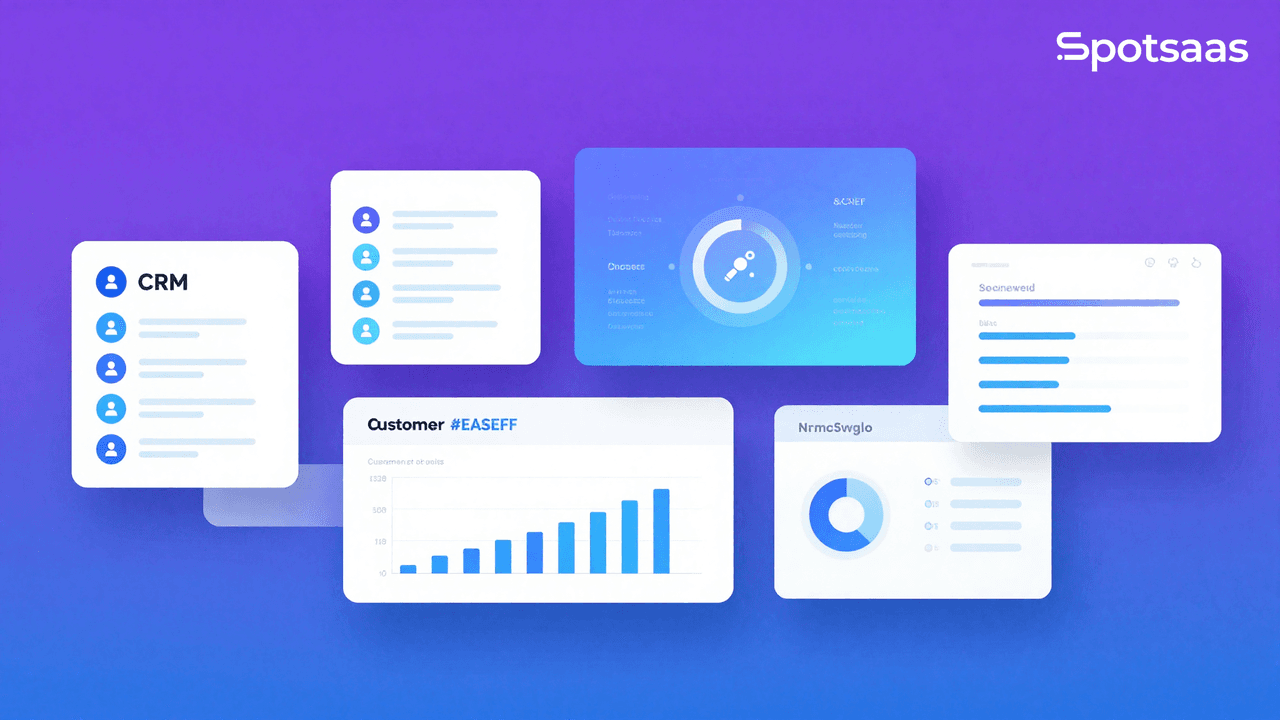
Picking CRM software means comparing systems that all claim to do the same thing — store contacts, track deals, automate follow-ups — while actually working very differently underneath. Whether Salesforce or Zoho fits your business better depends on specifics most vendor pages don’t spell out clearly.
This article walks through the factors that actually matter, and the concrete steps for narrowing a crowded market down to the right CRM for your company.
What is CRM Software?
CRM software, or customer relationship management software, is a tool designed to help businesses manage and improve their interactions with customers. It allows companies to store and organize customer data, track sales activities, automate marketing campaigns, and provide better customer support.
By utilizing CRM software, businesses can turn scattered customer data into insight into what customers actually need, prefer, and do — and use that insight to sharpen the overall customer experience.
Definition and purpose
CRM stands for Customer Relationship Management: software built to help a business understand its customers better by keeping every piece of customer information in one place instead of scattered across inboxes and spreadsheets.
With everything centralized, tracking a given customer’s needs, preferences, and history becomes fast rather than a research project every time someone on the team needs it. The end goal is straightforward: sell more, keep clients happier, and run the business with less friction.
Factors to Consider When Choosing CRM Software
A handful of decisions shape which CRM ends up being the right one. Start by naming your actual business requirements and pain points, then find vendors capable of solving them, and settle on the type of CRM system your business actually needs before you start comparing feature lists.
From there, compile the features that matter to you and compare the software options against each other to build a shortlist. Each step is covered in more detail below.
Identify business requirements and challenges
Start by naming the specific problems you’re trying to fix — lost client data, stalled sales growth, weak customer engagement, whatever it is for your business.
Once those problems are on paper, look for the CRM capabilities that address them directly: better data management, tools for tracking customer behavior, or whatever closes the specific gap you identified. It’s also worth thinking a step ahead — are new markets or products on the roadmap? Matching the software to where the business is headed, not just where it is now, keeps you from outgrowing the tool in a year.
Connect with vendors who can meet your needs
Talk to vendors who actually understand your business and the specific challenges you laid out, not just ones running a generic sales pitch. The right vendor should be able to point to how their system addresses your goals specifically, not in the abstract.
Salesforce, Zoho CRM, and HubSpot are among the more established providers, and each offers enough configurability to adapt to different workflows rather than forcing your process to fit theirs.
Determine the type of CRM system needed
The right system depends on the size and complexity of your organization, your industry’s specific requirements, and what you actually want CRM software to accomplish.
A basic contact management tool is a very different purchase from a comprehensive platform with sales automation and customer service built in — knowing which one you need up front saves a lot of wasted evaluation time later.
Weigh ease of use, scalability, customization options, and integration capabilities against each other as you compare systems — the system with the most features isn’t automatically the right one if your team won’t actually use half of them.
Compile a list of necessary features
Before comparing vendors, write down the features you actually need. These are the ones worth checking for in any CRM shortlist:
| Feature | Description |
|---|---|
| Contact Management | Ability to easily store and manage customer contact information like names, email addresses, and phone numbers. |
| Lead Tracking | Capability to track leads from initial contact to conversion, understanding their position in the sales process. |
| Sales Pipeline Management | Tools for managing the sales pipeline, including tracking deals, forecasting revenue, and monitoring progress. |
| Reporting and Analytics | Robust reporting and analytics to gain insights into sales performance, customer behavior, and business growth. |
| Integration with Other Tools | Ability to integrate with other business tools like email marketing platforms, customer support systems, and accounting software. |
| Mobile Accessibility | Availability of mobile access to manage customer data and sales activities on the go. |
Compare and create a shortlist
With your requirements and feature list in hand, it’s time to line up the CRM options side by side. These are the factors worth weighing during that comparison:
| Factor | Description |
|---|---|
| Features | Compare available features like contact management, lead tracking, task automation, and analytics to align with business requirements. |
| Ease of Use | Assess the software’s user-friendliness, intuitive interface, and ease of navigation for quick team adoption. |
| Customization Options | Check for customization options to tailor the CRM to specific business needs and accommodate growth and evolution. |
| Integration Capabilities | Evaluate the ability to seamlessly integrate with other tools and systems, enhancing efficiency and productivity. |
| Pricing | Compare pricing plans, including upfront costs and subscription fees, to find a solution within your budget. |
| Customer Support | Investigate the provided customer support, including timely assistance, training resources, and ongoing support. |
| User Reviews | Read user reviews to gain insights into performance, reliability, and ease of implementation from other users. |
| Scalability | Consider whether the CRM software can scale with business growth in terms of user capacity, storage, and additional features or modules. |
How to Purchase CRM Software
Once you know what you’re looking for, purchasing follows a fairly predictable sequence: set a budget that matches what the business can actually spend, gather referrals from people who’ve bought CRM software before, and see what those steps turn up before committing to anything.
From there, look at the current market and research the vendors and their offerings directly, reading reviews to understand where each option is strong and where it falls short.
Once you’ve narrowed the field, test the CRM software options that made your shortlist. Hands-on time with the actual product tells you far more than a features page ever will.
Working through these steps in order — budget, referrals, market research, reviews, testing — is what lets you commit to a CRM with confidence instead of guessing. The sections below go deeper into each one.
Set a budget
Figure out what the business can actually afford to spend on a CRM system before you start shopping, including the costs that don’t show up on the pricing page — training time and setup fees add up fast.
A budget set up front keeps the search focused on what’s actually affordable instead of drifting toward whatever has the most features. A higher price tag doesn’t guarantee a better fit — prioritize the functionality your team will actually use over the one with the longest feature list.
Gather referrals
Referrals from trusted colleagues and business contacts carry more weight than marketing copy, since they come from people who’ve actually lived with the software day to day.
Online forums and professional communities are another solid source — people posting there tend to be candid about what worked and what didn’t, which is exactly the kind of detail vendor case studies leave out.
Customer reviews and testimonials round out the picture, giving a sense of how satisfied real users have been over time rather than in the first excited weeks after signing up.
Assess the current market
Look at what’s actually available right now and what similar businesses in your industry are using. Comparing reviews across systems shows which ones consistently earn positive feedback rather than just having a slick landing page.
That gives a read on which software holds up as reliable in practice. Keep in mind your business’s needs may not match the market’s average, so weigh what you find against your own specific requirements rather than following the crowd blindly.
Read reviews
Reviews are worth reading closely before committing to any CRM system on your shortlist — they surface the friction points that only show up after weeks of actual use, not during a demo.
Pay particular attention to reviews that mention ease of use, customer support responsiveness, and overall satisfaction. Those three factors tend to predict whether a system will actually meet expectations once your team is depending on it daily.
Test top choices
Nothing replaces hands-on testing of your top choices. Trial access lets you see firsthand how each system actually performs against your specific requirements rather than how it’s described in a sales deck.
Use the trial period to evaluate ease of use, day-to-day functionality, and interface design, and to check how well customer support responds and how cleanly the system integrates with the other tools your team already relies on.
Make a decision
After research, referrals, market review, reading reviews, and hands-on testing, you’re working with a shortlist grounded in evidence rather than guesswork — whether that’s Salesforce, Zoho CRM, HubSpot, Zendesk, or something else, weigh each against your original requirements and challenges.
Customizability for tailoring the system to your workflows and scalability for handling growth are usually the deciding factors once the basic feature checklist has been satisfied. Compare the pros and cons of what’s left on your list and pick the option that lines up best with your goals.
Pricing still deserves a final check before you sign — a system that looked affordable on the surface can get expensive once add-ons and per-seat costs are factored in.
Get the decision right and the payoff shows up quickly: better customer management, workflows that run without manual babysitting, customer data that stays organized, and performance reporting you can actually trust, all while staying inside the budget set at the start of this process.
Advantages of Using CRM Software
Adopting CRM software pays off in a handful of concrete ways. It centralizes customer management in one database, so every interaction and detail is accessible and current instead of scattered across someone’s inbox.
That visibility into customer needs, preferences, and behavior is what makes more targeted marketing and genuinely personalized customer experiences possible in the first place.
CRM software also automates workflows, taking repetitive tasks off people’s plates and freeing up time for higher-value work, while keeping the process for handling customer interactions consistent regardless of who’s on shift.
Reporting is another piece of the payoff — sales performance, customer satisfaction, and revenue growth all become metrics you can actually track rather than impressions you’re guessing at, which sharpens strategic decisions and surfaces where the business needs to improve.
Customer data management ties it together: with everything organized in one place, communications across channels stay visible and nothing slips through the cracks the way it does when data lives in five different tools.
Most CRM platforms also offer customization, letting a business shape the system around its own processes instead of the other way around. The sections below cover each of these advantages in more depth.
Improved customer management
A CRM system makes it straightforward to track and organize customer information — contact details, interaction history, purchase records — in a way that spreadsheets never quite manage at scale.
That comprehensive view lets a company deliver experiences shaped by what a specific customer actually needs, rather than a one-size-fits-all approach. Automated emails and notifications built into the CRM also keep communication consistent without someone having to remember to send it.
With customer data centralized instead of fragmented, support gets faster and more accurate, which tends to show up directly in customer satisfaction and retention numbers.
Workflow automation
Workflow automation is where a CRM earns back the time it costs to set up. It replaces manual, repetitive steps with triggers and actions that fire automatically once specific conditions are met.
A new lead landing in the system, for instance, can automatically trigger a welcome email or get assigned to a sales rep without anyone manually routing it. Beyond the time saved, that automation keeps the process consistent regardless of who’s handling the account that week.
Reporting
Reporting is worth weighing carefully when comparing CRM software, since it’s what turns raw customer data into something you can act on.
Sales forecast reports, lead conversion reports, and customer activity reports are the standard building blocks — together they show how the business is performing, where trends are heading, and what needs to change in your customer management approach.
With accurate, current reporting on hand, you can track the metrics that matter and measure whether a given marketing campaign or sales push is actually working, rather than relying on gut feel.
Customer data management
Effective customer data management is one of the clearest advantages a good CRM system delivers — contact information, purchase history, preferences, and behavior all collected and organized without extra manual work.
With that data readily available, tailoring marketing efforts to what a customer actually wants becomes far easier than working from guesswork.
Tracking every interaction — emails, calls, whatever channel it happened on — means nothing falls through the cracks. That kind of data management is what turns one-off transactions into stronger, longer relationships with customers.
Customization
Customization determines how well a CRM actually fits your business rather than forcing your business to fit the software. Salesforce Sales Cloud, for example, is known specifically for how far it can be personalized to match a company’s preferred workflows.
That flexibility means the CRM can mirror your actual processes instead of the other way around, which pays off directly in customer management, workflow automation, and reporting quality.
Customization also tends to extend into integrations, making it easier to connect the CRM with the other tools already running your business. A system you can shape to fit your operations end up delivering more value than one you have to work around.
Third-party integrations
A CRM that can’t talk to the rest of your stack becomes another data silo instead of the central hub it’s supposed to be. Integration with the tools your business already runs is what keeps data flowing without manual re-entry.
Email marketing platforms, accounting software, and customer support tools are common integration points — connect them and workflows tighten up, efficiency improves, and both customers and employees get a more consistent experience.
Look for a CRM with a wide native integration library, or at minimum the ability to build custom integrations for whatever your specific stack requires.
Compare alternatives to the tools in this post

- Independent picks for exactly what you just read about
- Matched to your team size & needs
- Vendors don't pay for placement
Step 1 of 4
How big is your team?
We tailor recommendations to companies your size.















Related Articles
Buyers guide
Twilio Alternatives 2026: 6 Compared and What They Cost
Continue reading →
Buyers guide
How To Choose The Best Auto Dialer Software For 2026
Continue reading →
Buyers guide
How To Choose The Best Freelance Platforms For 2026
Continue reading →
Buyers guide
How To Choose The Best Audience Response Software For 2026
Continue reading →