
An effective B2B content marketing strategy is essential for companies that want to attract, engage, and convert high-value customers in 2026. With changing buyer habits, AI-powered personalization, and rising competition, brands need to develop high-quality, data-backed content that speaks to decision-makers. From thought leadership pieces to SEO-friendly resources, companies require a systematic approach to cut through the noise in a competitive market.
This guide examines critical steps, tried-and-tested strategies, and the latest trends to assist you in creating a compelling B2B content marketing strategy that fuels growth and delivers the highest ROI.
Key Takeaways
- Conduct thorough audience research to identify target companies and decision-makers.
- Define specific objectives like brand awareness, lead generation, and thought leadership.
- Utilize a mix of blog posts, research reports, case studies, videos, and infographics to engage different audience segments effectively.
- Optimize content with relevant keywords, high-quality information, and structured content to improve search engine rankings and attract organic traffic.
- Develop a content calendar to ensure regular publishing and promotion across LinkedIn, industry blogs, and email newsletters.
What is B2B Content Marketing?
B2B content marketing refers to the procedure of creating and sharing valuable content to engage a business audience, ultimately driving profitable customer actions. It plays a significant role in building relationships with other businesses by solving their problems through high-quality and relevant information.
This approach helps companies improve brand visibility, generate leads, convert prospects into customers, build brand loyalty and authority in their field. The essence lies not just in recognizing customer personas and using original research or case studies for industry recognition as part of an effective strategy.
Implementing SEO techniques can further enhance this visibility and reach the desired audience on digital platforms.
How B2B Content Marketing Differs from B2C
While both B2B and B2C content marketing focus on engaging audiences and driving conversions, the approaches differ significantly due to audience behavior, decision-making processes, and content consumption patterns.
| Aspect | B2B Content Marketing | B2C Content Marketing |
|---|---|---|
| Sales Cycle | Longer, involves multiple decision-makers, requires nurturing over time. | Shorter, often impulse-driven with quicker conversions. |
| Decision-Making | Data-driven, focused on ROI, efficiency, and long-term impact. | Emotion-driven, based on personal preferences and brand affinity. |
| Content Focus | Informative, data-backed, and problem-solving to address industry pain points. | Engaging, emotionally compelling, and brand-focused. |
| Common Formats | Case studies, whitepapers, thought leadership, webinars. | Short-form videos, social media content, influencer collaborations. |
| Primary Platforms | LinkedIn, industry blogs, email newsletters, webinars. | Instagram, TikTok, YouTube, direct ads. |
Why B2B Content Marketing Matters
B2B content marketing is a powerful strategy that helps businesses attract, educate, and convert high-value clients. Here’s why B2B content marketing is essential for business success in 2026.
Establishes Brand Credibility and Trust
Asserting authority in a B2B marketplace is essential for standing out among competitors and establishing credibility. High-quality content such as whitepapers, case studies, and thought leadership pieces assist in establishing a brand as an expert in its field.
By continually offering useful information, businesses build trust among prospective clients and stakeholders. Trust brings about long-term relationships, repeat business, and greater credibility in the market.
Generates High-Quality Leads
In contrast to conventional marketing, content marketing draws in potential buyers who are actively looking for answers. Gated content like ebooks and webinars assist in capturing lead data while offering value.
Informative blogs and SEO content drive organic traffic, making lead generation effective. A well-structured content strategy ensures prospects are guided through the sales funnel with pertinent information.
Supports the Long B2B Sales Cycle
B2B buying involves multiple stakeholders and is a research-intensive process before the decision is made. B2B content marketing strategy enables companies to lead prospects through every step of the buying process.
Educational content such as product comparisons, case studies, and ROI-based insights resolve concerns at various touchpoints. This process makes buyers feel secure in their choices, which results in increased conversion rates.
Enhances SEO and Organic Visibility
B2B content marketing strategy enhances search engine rankings to facilitate potential customers’ easy discovery of a business. Optimized content with the right keywords, topic clusters, and backlinks increases domain authority. In fact, building high-quality backlinks often involves strategic collaboration between brands, and a well-managed ABC backlink exchange can help businesses strengthen authority while maintaining relevance and credibility across partner sites.
Up-to-date blogs and resource centers generate steady organic traffic. Increased search visibility makes the brand a preferred solution provider for the industry.
Increases Customer Retention and Engagement
Engaging content doesn’t only bring in new customers, it also keeps current customers informed and loyal. Materials like customer testimonials, product news, and best practice guides keep businesses up to date.
Email newsletters, webinars, and industry insights build closer relationships with clients. When companies keep providing valuable content, customers are more likely to renew agreements and recommend the brand.
How to Develop a Successful B2B Content Marketing Strategy
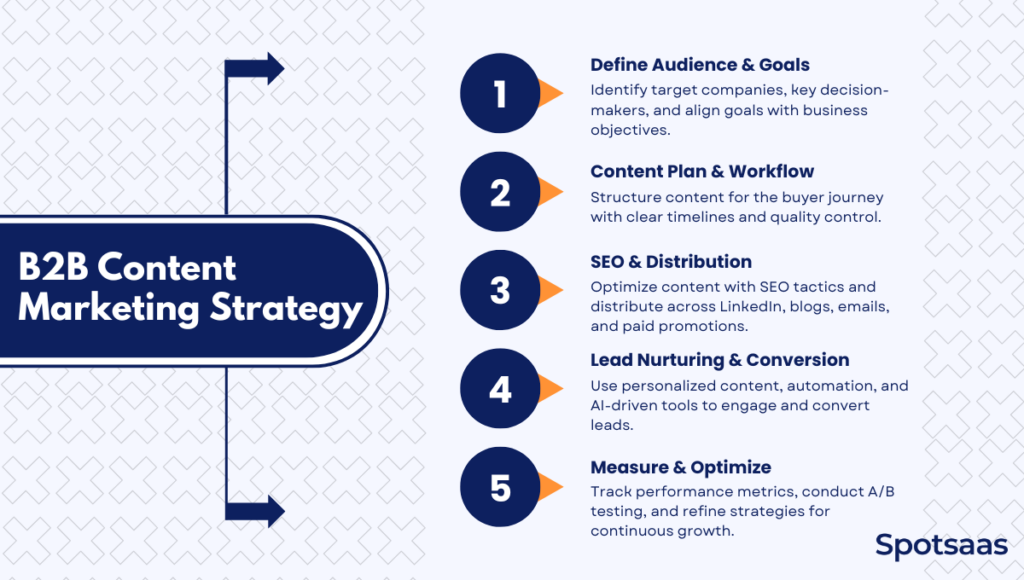
A successful B2B content marketing strategy follows five core steps:
Step 1: Define Your Target Audience and Goals
Start by identifying which companies and decision-makers you want to reach, and what challenges they face. Build buyer personas based on your research, then align your content strategy with concrete business outcomes: lead generation, establishing brand authority, or providing customer education.
Step 2: Develop a Content Plan and Workflow
Map content to the B2B buyer journey with a variety of formats: blogs, case studies, whitepapers, and webinars. Create a production workflow that assigns clear responsibilities, sets deadlines, and maintains quality standards. Tools can help accelerate content creation while keeping your message consistent across pieces.
Step 3: Optimize for SEO and Multi-Channel Distribution
Apply SEO fundamentals, topic clusters, keyword research, and structured data, so your content appears where prospects search. Publish across channels where B2B audiences spend time: LinkedIn, industry publications, email newsletters, and paid social. Leverage employee networks and industry influencers to expand your reach.
Step 4: Engage, Nurture, and Convert Leads
B2B decisions typically require multiple interactions. Use personalized content, email workflows, and account-based marketing (ABM) to move prospects toward conversion. Chatbots and recommendation engines can automate responses and suggest relevant resources at key points in the buyer journey.
Marketing automation platforms streamline lead nurturing by automating routine tasks, reducing manual work, and ensuring consistent outreach across email, social, and other channels.
Step 5: Measure Performance and Optimize Strategy
Monitor metrics that matter: site traffic, engagement, conversion rates, and marketing ROI. Test different content formats and messaging to see what resonates. Use these insights to refine your strategy and stay competitive in the B2B marketing landscape.
Key Factors of a Successful B2B Content Marketing Strategy
A well-executed B2B content marketing strategy requires multiple elements working together to engage the right audience, drive conversions, and establish brand authority. Here are the key factors that contribute to success:
Profound Knowledge of the Target Audience
A B2B content marketing strategy success starts with understanding your audience. Developing in-depth buyer personas allows for content to be tailored to speak directly to their individual pain points and decision-making process.
Companies need to review data, survey, and monitor industry trends to know their customers. Personalization and context create better engagement and increased conversion rates.
High-Quality, Value-Driven Content
Creating useful and informative content makes a brand an industry leader. Content must be problem-solving, providing in-depth analysis, case studies, and actionable recommendations.
Interactive formats like blogs, whitepapers, and webinars appeal to varying audience tastes. The objective is to inform, trust-build, and build leads through all phases of the buyer’s journey.
SEO and Multi-Channel Distribution
A successful B2B content marketing strategy that provides visibility through search optimization and multiple distribution channels. Applying best practices like keyword research, topic clusters, and content structure enhances search rankings.
Using LinkedIn, email newsletters, and industry-specific platforms maximizes reach. A blend of organic and paid promotions guarantees that content reaches the target audience at the right time.
Lead Generation and Nurturing
B2B content marketing strategy is not merely about engaging audiences and about turning them into customers. Gated content such as whitepapers, eBooks, and webinars assists in capturing leads while providing valuable information.
Automated email sequences and personalized outreach assist in nurturing prospects through the sales funnel. A strategic combination of content ensures prospects are kept engaged and move towards making a purchase decision.
Continuous Measurement and Optimization
Monitoring major metrics is vital to perfecting and optimizing content marketing initiatives. Companies must monitor engagement, conversion rates, and lead quality to measure performance.
Testing multiple content types and distribution channels using A/B techniques determines what appeals most to the audience. Continued analysis and refinement guarantee continuous growth and flexibility in response to evolving market conditions.
Setting Goals for Your B2B Content Marketing Strategy
To develop a successful B2B content marketing strategy, it is essential to set clear goals such as increasing brand awareness, generating leads and sales, and establishing thought leadership.
Increasing brand awareness
To develop a successful B2B content marketing strategy, increasing brand awareness is essential. By actively promoting your brand and getting it in front of your target audience, you can build recognition and trust.
Boosting brand visibility increases the chances of attracting new customers and helps establish thought leadership within your industry. So, make sure to prioritize strategies that effectively enhance brand awareness to maximize the impact of your B2B content marketing strategy efforts.
Generating leads and sales
To generate leads and drive sales, it’s essential to develop a strong B2B content marketing strategy. By creating high-quality and relevant content that addresses the pain points of your ideal customers, you can attract and engage them effectively.
Use data-driven insights to optimize your posts for better performance, implementing SEO strategies to enhance visibility and reach. Promote your content on social media platforms to increase engagement and visibility among your target audience.
Establishing thought leadership
Establishing thought leadership is a critical aspect of any successful B2B content marketing strategy. By positioning yourself as an authority in your industry, you can build trust and credibility with your target audience.
This can be achieved through creating high-quality content that offers useful detail, expert opinions, and innovative solutions to the challenges faced by businesses in your niche.
The Ultimate Guide To E-Commerce Software For B2B Requirements
Choose the Right Content Types
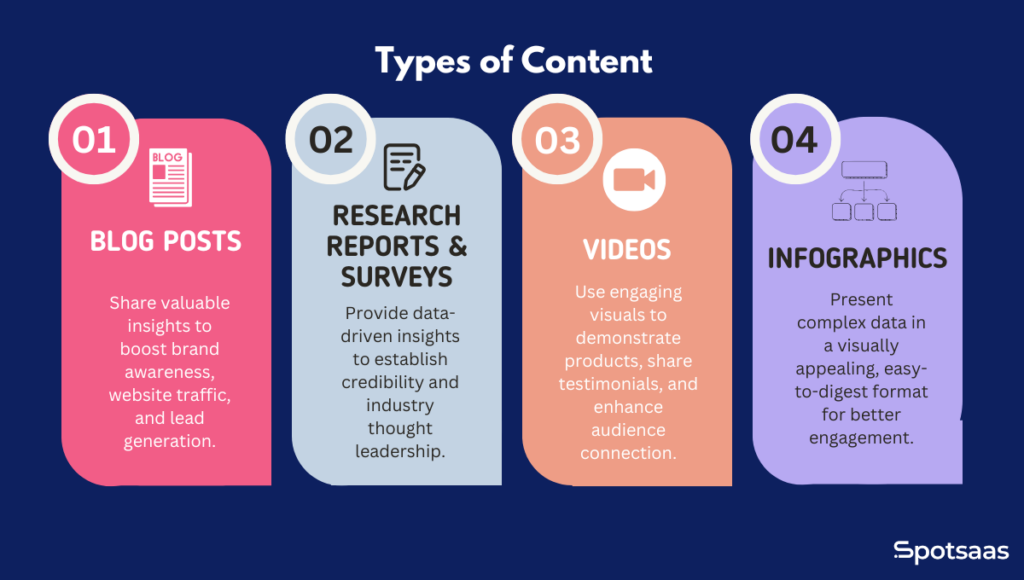
Your B2B content marketing strategy should draw on a mix of formats – blog posts, research reports and surveys, case studies, marketplaces, videos, and infographics – to reach your audience in the ways that suit them best.
Blog posts
Blog posts remain a core part of any B2B content marketing plan. They give businesses a direct way to share expertise, explain how products solve real problems, and answer the questions prospects are already searching for.
Publishing consistently helps grow brand awareness, sends more traffic to your website, and generates leads over time. A steady blog also builds thought leadership, since it shows customers you understand their challenges and have practical answers for them.
Research reports and surveys
Original research and surveys add a layer of credibility that other content types can’t match. When you gather your own data from customers or the market, you’re able to speak to industry trends, buyer preferences, and pain points with real evidence behind you.
This kind of content tends to be more relevant and specific to your audience because it’s built on their actual input. Publishing the findings also signals expertise – it shows your brand is close enough to the market to generate its own insights, not just repeat what others have said.
Videos and Infographics
Video lets you show, not just tell – product demos, customer testimonials, and industry commentary all land differently in video form than in text. Tools like image to video converters make it easier to turn existing visual assets into video content without starting from scratch.
A video to text converter is worth adding to your workflow too – it turns your video content into text that search engines can crawl, which helps with both accessibility and SEO.
Infographics solve a different problem: turning dense data into something people can scan and understand in seconds. They’re especially useful for breaking down complex ideas into visuals that hold attention and communicate quickly.
Implementing Your B2B Content Marketing Strategy
A successful B2B content marketing strategy requires an efficient content creation workflow, strategic distribution, and ongoing performance evaluation to optimize results.
Creating a Content Creation Workflow
A structured workflow ensures consistency and quality. Start by defining clear objectives and conducting thorough research to develop valuable content. Assign tasks based on expertise, set deadlines, and maintain a timeline to simplify production.
After drafting, editing, and proofreading for clarity, incorporate engaging visuals and optimize for SEO before publishing. A final review ensures alignment with brand messaging and audience needs.
Planning Distribution and Promotion
Effective distribution ensures content reaches the right audience. Identify the best platforms such as LinkedIn, email newsletters, and industry blogs. Maintain consistency with a content calendar and optimize for search engines to boost organic visibility.
Engage audiences on social media, collaborate with influencers, and consider paid advertising to expand reach. A mix of organic and paid promotion ensures sustained engagement.
Measuring Success and Making Improvements
Tracking performance is essential for optimization. Define KPIs like website traffic, conversions, and engagement rates. Use analytics tools to assess content effectiveness and conduct A/B testing to refine messaging.
Monitor customer feedback and industry trends to stay relevant. Continuous improvements based on insights ensure long-term success in content marketing.
Conclusion
developing a successful B2B content marketing strategy requires thorough audience research and goal-setting. Choosing the right types of content and implementing a well-defined workflow is essential for achieving brand awareness, lead generation, and thought leadership.
An effective B2B content marketing strategy is essential for establishing brand authority, creating high-quality leads, and fueling long-term business growth. By knowing the target audience, developing valuable content, optimizing for search engines, and using multiple distribution channels, companies can successfully engage decision-makers and build relationships.
Ongoing measurement and optimization ensure that content stays relevant and effective in a changing digital environment. With changing buyer behavior among B2B buyers and the increasing visibility of AI-powered personalization, evolving your approach to industry trends will be vital to being a step ahead of the competition.
Frequently Asked Questions
What is the main goal of a B2B content marketing strategy?
The primary goal of B2B content marketing is to attract, educate, and convert potential business customers. It focuses on generating high-quality leads, establishing brand authority, and nurturing long-term relationships. Unlike B2C marketing, B2B content is more data-driven, educational, and tailored to industry-specific needs. The strategy ultimately aims to support sales and drive revenue growth.
How does B2B content marketing differ from B2C content marketing?
B2B content marketing targets business decision-makers, while B2C focuses on individual consumers. B2B content is typically more informative, long-form, and data-driven, emphasizing ROI and problem-solving. B2C content, on the other hand, is often more emotional, visually engaging, and focused on immediate purchase decisions. Additionally, B2B sales cycles are longer, requiring more in-depth content to nurture leads over time.
What types of content work best for B2B marketing?
Effective B2B content includes blog posts, case studies, whitepapers, eBooks, webinars, and industry reports. Thought leadership articles and expert insights help build credibility, while video content and interactive tools enhance engagement. Email newsletters and LinkedIn content also play a vital role in nurturing relationships with prospects. The best content format depends on the target audience and their stage in the buyer’s journey.
How can businesses measure the success of their B2B content marketing efforts?
Success can be measured using key performance indicators (KPIs) such as website traffic, lead generation, conversion rates, and engagement metrics. Analytics tools like Google Analytics, HubSpot, and LinkedIn Insights help track audience behavior and content performance. A/B testing different content formats and CTAs provides insights into what resonates best with the audience. Regular assessment and optimization ensure continuous improvement and better ROI.
How often should businesses publish B2B content?
Consistency is key in B2B content marketing, but quality matters more than quantity. A good approach is to publish 2-4 high-quality blog posts per month and supplement them with case studies, whitepapers, or webinars quarterly. Social media and email content should be shared more frequently to maintain engagement. The publishing schedule should align with business goals, audience needs, and available resources.

- Independent picks for exactly what you just read about
- Matched to your team size & needs
- Vendors don't pay for placement
Step 1 of 4
How big is your team?
We tailor recommendations to companies your size.















Related Articles
AI Software
AI Marketing Tools in 2026: 8 Use Cases and How to Choose
Continue reading →

Best Tools
Best Web Analytics Tools & Software: A Complete 2026 Guide
Continue reading →

Best Tools
Best Marketing Automation Software in 2026: 10 Platforms Compared
Continue reading →

Buyers guide
What Is Marketing Automation? How It Works, Examples and Costs (2026)
Continue reading →