
Why this post matters
This is the complete 2026 IRS deadline calendar for individuals, businesses, and self-employed taxpayers. As of November 2026, every 2026 date has passed, so each one is marked, and the 2027 filing season dates for tax year 2026 are listed so you can plan ahead.
What you’ll learn here
Get clarity on Individual Filing Deadlines, Quarterly Estimated Payments, IRA & HSA Contribution Dates, Tax Extension Rules, and Business Tax Filing Requirements. Plus, what to do if you missed a deadline and the common filing mistakes to avoid.
Who should read this
Built for freelancers, small business owners, corporate accountants, self-employed professionals, and tax preparers who need one reliable calendar for the 2026 dates and the 2027 filing season.
Most federal tax deadlines in calendar year 2026 cover tax year 2025, and by November 2026 all of them have passed. The last of them was October 15, 2026, the due date for extended individual and C-corporation returns.
This calendar lists every 2026 date for individuals, businesses, and self-employed taxpayers, marks which have passed, and gives the 2027 dates for filing tax year 2026 returns. Taxpayers in federally declared disaster areas often get IRS postponements, so check IRS.gov for any relief that applies to you.
Key takeaways
- 2025 individual returns were due April 15, 2026. Extended returns are due October 15, 2026.
- Quarterly estimated payments fell on January 15, April 15, June 15, and September 15, 2026. The next one, for the fourth quarter of 2026, is due January 15, 2027.
- State tax deadlines may vary, so filers should check specific state requirements.
- S-corporation and partnership returns were due March 16, 2026, because March 15 was a Sunday. C-corporations follow the April 15 deadline.
- The 2027 filing season deadline for 2026 individual and C-corporation returns is April 15, 2027.
| Date | What is due | Status (as of November 2026) |
|---|---|---|
| January 15, 2026 | Fourth-quarter 2025 estimated tax payment | Passed |
| February 2, 2026 | W-2 and 1099-NEC forms to workers and the IRS | Passed |
| March 16, 2026 | S-corporation (Form 1120-S) and partnership (Form 1065) returns | Passed |
| April 15, 2026 | Individual (Form 1040) and C-corporation (Form 1120) returns, first-quarter 2026 estimate, 2025 IRA and HSA contributions, extension requests | Passed |
| June 15, 2026 | Second-quarter 2026 estimated tax payment | Passed |
| September 15, 2026 | Third-quarter 2026 estimate and extended S-corporation and partnership returns | Passed |
| October 15, 2026 | Extended individual and C-corporation returns | Passed |
2026 Tax Filing Deadlines for Individuals: Avoid Penalties and File On Time
Individuals who meet IRS deadlines for returns, estimated taxes, and extensions avoid penalties and processing delays. Here is how the 2026 calendar played out for individual filers.
Key Tax Dates Every Individual Should Know in 2026
- January 15, 2026 (passed): The fourth-quarter 2025 estimated tax payment. This applies to self-employed individuals, freelancers, and taxpayers without enough withholding from an employer.
- April 15, 2026 (passed): The deadline to file 2025 individual returns and pay any tax owed for 2025 without penalty. Returns had to be e-filed or postmarked by this date.
- June 15, 2026 (passed): The second-quarter 2026 estimated tax payment for income not subject to withholding.
- September 15, 2026 (passed): The third-quarter 2026 estimated tax payment. Taxpayers making quarterly payments should compare actual earnings with their estimates and adjust.
- October 15, 2026 (passed): The extended filing deadline for taxpayers who requested an extension by April 15, 2026. Tax owed was still due by April 15, 2026.
Filing as early as possible avoids processing delays. Tax software or a tax professional helps keep the return accurate and compliant.
2026 Business Tax Deadlines: S-Corps, C-Corps & LLCs Explained
Corporations, partnerships, and LLCs each follow deadlines tied to their business structure. These are the 2026 dates for 2025 business returns.
Key Dates for Corporations, Partnerships, and LLCs
- February 2, 2026 (passed): Employers had to send W-2 and 1099-NEC forms to workers and file them with the IRS. The usual date moved because January 31 was a Saturday.
- March 16, 2026 (passed): The deadline for partnership (Form 1065) and S-corporation (Form 1120-S) returns, moved from March 15, which was a Sunday. Businesses needing more time could file Form 7004 by this date.
- April 15, 2026 (passed): The deadline for C-corporation returns (Form 1120) and for sole proprietors and single-member LLCs, who report business income on Schedule C with their Form 1040.
- September 15, 2026 (passed): The extended deadline for partnerships and S-corporations that requested an extension.
- October 15, 2026 (passed): The extended deadline for C-corporations and sole proprietors who requested an extension in April.
Business owners should gather financial statements, expense records, and payroll reports early so returns are ready before each due date.
2026 Tax Calendar for Self-Employed, Freelancers & Contractors
Self-employed individuals, independent contractors, and freelancers have no tax withheld from their earnings, so they pay quarterly estimated taxes to the IRS throughout the year.
2026 Estimated Quarterly Tax Due Dates
- January 15, 2026 (passed): Fourth-quarter 2025 estimated tax payment.
- April 15, 2026 (passed): First-quarter 2026 estimated tax payment.
- June 15, 2026 (passed): Second-quarter 2026 estimated tax payment.
- September 15, 2026 (passed): Third-quarter 2026 estimated tax payment.
- January 15, 2027 (upcoming): Fourth-quarter 2026 estimated tax payment.
Freelancers and business owners who expect to owe tax should calculate their payments using IRS Form 1040-ES and pay by each due date. Tracking income and expenses through the year keeps estimates accurate and avoids underpayment penalties.
Tax Extension Deadlines & Special Filing Rules for 2026
An extension gives more time to file, but the deadline to pay stays the same. Estimate and pay what you owe by the original due date to avoid interest and late-payment penalties.
Need More Time to File?
- April 15, 2026 (passed): The deadline for individuals to request an extension with Form 4868, which gives six more months to file. Businesses use Form 7004, filed by their original return due date.
- October 15, 2026 (passed): The final deadline for extended individual and C-corporation returns. Filing by this date avoids the failure-to-file penalty.
An extension is useful when you need more time to gather documents, calculate deductions, or resolve complex items on your return.
2026 IRA & HSA Contribution Deadlines: Maximize Your Tax Savings
Contributions to Individual Retirement Accounts (IRAs) and Health Savings Accounts (HSAs) can lower taxable income. Each tax year has its own contribution deadline.
Key Contribution Deadlines for 2025 and 2026 Taxes
- April 15, 2026 (passed): The final date to make traditional IRA, Roth IRA, and HSA contributions for the 2025 tax year, subject to annual contribution limits.
- April 15, 2027 (upcoming): The final date to make IRA and HSA contributions for the 2026 tax year. For 2026, the IRA limit is $7,500 (plus a $1,100 catch-up at age 50+), and the HSA limit is $4,400 for self-only coverage or $8,750 for family coverage (plus a $1,000 catch-up at age 55+).
- Business retirement plans: Employer contributions to SEP IRAs and Solo 401(k) plans can generally be made up to the business’s return due date, including extensions.
Contributing before the deadline lets individuals and businesses lower taxable income while building retirement savings.
Upcoming: 2027 Filing Season for Tax Year 2026
These are the federal deadlines for tax year 2026 returns and the first 2027 estimated payments. Add them to your calendar now.
| Date | What is due |
|---|---|
| January 15, 2027 | Fourth-quarter 2026 estimated tax payment |
| February 1, 2027 | W-2 and 1099-NEC forms to workers and the IRS (January 31 is a Sunday) |
| March 15, 2027 | S-corporation and partnership returns |
| April 15, 2027 | 2026 individual and C-corporation returns, first-quarter 2027 estimate, 2026 IRA and HSA contributions, extension requests |
| June 15, 2027 | Second-quarter 2027 estimated tax payment |
| September 15, 2027 | Third-quarter 2027 estimate and extended S-corporation and partnership returns |
| October 15, 2027 | Extended individual and C-corporation returns |
Several rules change for tax year 2026, including new deductions under the One Big Beautiful Bill Act. See IRS tax code changes and what to expect for details.
Missed a Tax Deadline in 2026? Here’s What Happens & How to Fix It
Missing tax filing deadlines can lead to penalties, interest, and lost refunds. Filing on time, or requesting an extension, keeps these costs off your bill.
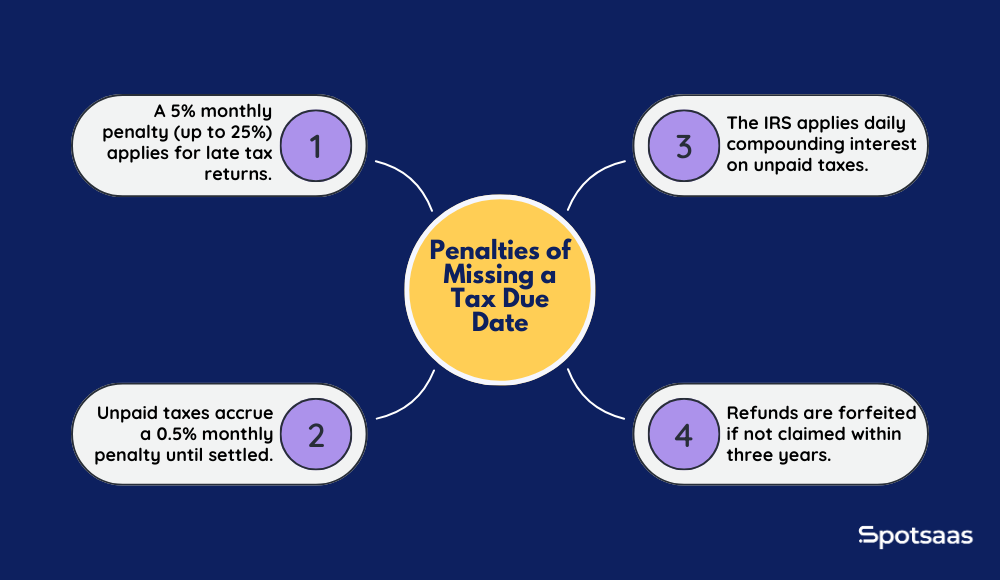
Penalties of Missing a Tax Due Date
- Failure-to-File Penalty: Charged monthly on unpaid tax when a return is filed late, up to a cap. Filing as soon as possible limits it.
- Failure-to-Pay Penalty: Charged monthly on tax not paid by the deadline until the balance is paid in full. It is smaller than the failure-to-file penalty, so filing on time still helps even if you cannot pay.
- Interest Charges: Accrue daily on any unpaid balance from the original due date until it is paid.
- Loss of Refund: Refunds must be claimed within a limited window after the original deadline. After that, the refund is forfeited.
If you missed a deadline, file and pay as soon as possible to reduce penalties and interest. Taxpayers facing financial hardship may qualify for an IRS payment plan or an offer in compromise.
How to File Taxes in 2026: Step-by-Step Guide for Individuals & Businesses
Confirm your filing status, gather your W-2s, 1099s, and receipts, then file with tax software, a CPA, or IRS Free File if you qualify. Apply the correct tax deductions, review every detail, and e-file before your deadline for the fastest processing.
Common Tax Filing Mistakes in 2026 & How to Avoid Them
Errors on a return can delay refunds or trigger IRS notices. Check these four areas before you file, and see our guide to common tax filing mistakes for more.
- Filing status: Choose the status that matches your household, since it sets your tax rates and available deductions.
- All income reported: Include freelance and gig work, investment gains, rental income, and side business earnings.
- Eligible deductions claimed: Review options such as the home office deduction for self-employed individuals, student loan interest, and business expenses to maximize tax savings.
- Personal and bank details: Match names and Social Security numbers to IRS records and confirm direct deposit details.
Final Thoughts: Stay Ahead of the 2026 and 2027 Due Dates
With the 2026 deadlines behind us, the next date to act on is January 15, 2027 for the fourth-quarter estimate. The 2027 filing season for tax year 2026 closes on April 15, 2027.
Mark these dates, set reminders, and file early to avoid last-minute issues. Tax software or a CPA can keep filing accurate and surface deductions you might miss.
Frequently Asked Questions About Filing in 2026
What happens if I choose the wrong tax filing status?
Selecting the wrong filing status can impact your tax bracket, deductions, and credits. The IRS may reject your return or adjust your tax liability, leading to penalties or a lower refund.
Do I have to report freelance or gig income if I didn’t receive a 1099?
Yes, all income, including freelance work, side gigs, and cash payments, must be reported, even if you didn’t receive a 1099 form. Failing to report this income can trigger IRS penalties.
What are the most commonly missed tax deductions?
Many taxpayers overlook deductions such as home office expenses, student loan interest, medical expenses, and business-related costs. Reviewing IRS guidelines can help maximize deductions.
How can I avoid tax return errors?
Double-check personal details, ensure all income is reported, use tax software or a CPA, and review deductions and credits before submitting your return to avoid mistakes.
What should I do if I realize I made a mistake on my tax return?
If you notice an error after filing, submit an amended return using Form 1040-X as soon as possible to correct the mistake and prevent penalties or refund delays.

- Independent picks for exactly what you just read about
- Matched to your team size & needs
- Vendors don't pay for placement
Step 1 of 4
How big is your team?
We tailor recommendations to companies your size.















Related Articles

401K Providers
Best 401(k) Providers for Small Businesses in 2026: 5 Picks Compared
Continue reading →

401K Providers
5 Best 401k Plans for Freelancers and Gig Workers in 2026
Continue reading →

401K Providers
IRS Tax Code Changes for 2026: Brackets, Deductions and Credits
Continue reading →

401K Providers
Betterment vs Guideline 401k: Which Retirement Plan Is Best for Your Small Business?
Continue reading →