
Business technology is no longer a nice to have. It’s a key part of how companies operate and grow. From software tools to cloud platforms and automation systems, the right tech can make everyday work faster, easier, and more effective.
For anyone leading a business or managing operations, understanding how technology fits into the bigger picture isn’t just helpful. It’s a smart move. It can improve productivity, support smarter decisions, and help you stay ahead of the competition.
If you’re thinking about investing in new tools or upgrading your current setup, this blog will give you a clear, practical view of how technology shapes modern business and how it can work for yours.
Key Takeaways
- Business technology is essential for modern operations and sustainable growth.
- The right tools can boost efficiency and simplify daily business tasks.
- Tech supports better decision-making across all teams and functions.
- Staying competitive today requires a smart, flexible tech strategy.
- Investing in technology can directly impact business success and scalability.
What is Business Technology?
Business technology refers to the tools and systems that help companies work smarter. It includes everything from project management software and CRM platforms to accounting tools, communication apps, and automation systems. These technologies support daily tasks, improve teamwork, and provide insights that guide better decisions.
Today, even small businesses can access affordable, cloud-based tools that were once limited to large enterprises. This shift levels the playing field and makes it easier to compete. The key is choosing solutions that align with your business goals and can grow with you.
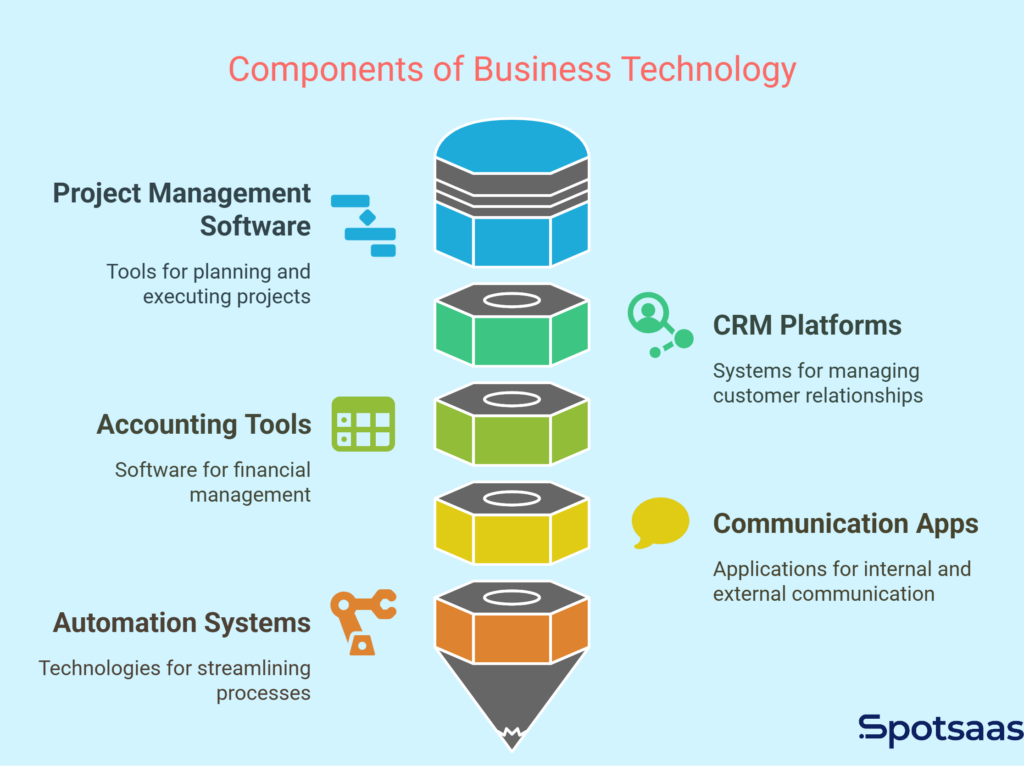
Common Examples of Business Technology
The right business tools can simplify operations, improve collaboration, and support growth at every level. Here are some of the most valuable technologies companies use today.
- Project Management Tools like Asana and Trello help businesses organize work, manage deadlines, and improve team coordination. They’re ideal for keeping everyone on the same page, especially in fast-moving environments.
- Customer Relationship Management (CRM) Systems Tools like Salesforce and HubSpot help track leads, manage customer interactions, and personalize communication. They make it easier to build stronger relationships and close more deals.
- Accounting Software and Finance Software Applications like QuickBooks and Xero simplify tasks such as invoicing, expense tracking, and financial reporting. They help businesses stay organized and make smarter financial decisions.
- Communication Platforms Apps like Slack and Microsoft Teams make it easy to chat, share files, and hold virtual meetings. They keep teams connected and productive, no matter where they’re working from.
Benefits of Business Technology
The right technology changes how a business runs, from internal workflows to how customers experience the brand.
Here are the main benefits that make investing in business technology a strategic move rather than just a passing trend.
Increased Efficiency
Business technology automates repetitive tasks, speeds up processes, and cuts unnecessary steps out of daily operations. Whether it’s auto-generating reports or scheduling tasks, these tools let teams spend more time on high-impact work.
This saves time, reduces manual effort, and lets the business run with more precision. Over time, these gains add up to faster delivery, lower costs, and smoother operations throughout the company.
Better Collaboration
Modern collaboration tools like Slack, Microsoft Teams, and shared cloud platforms make it easy for teams to stay connected. Whether people work in the same office or across different time zones, communication stays clear.
These platforms cut down on email clutter, speed up feedback, and support real-time document sharing. Better collaboration means fewer delays, stronger alignment, and better project outcomes.
Smarter Decision-Making
Analytics and reporting tools give businesses real-time insight for informed decisions. Instead of relying on guesswork or outdated reports, leaders can track performance, monitor trends, and spot opportunities early.
This data-driven approach lowers risk and helps teams focus on what actually works. It also allows faster reactions to shifts in the market or in customer behavior.
Scalability
As a business grows, so do its needs. Scalable technology means systems don’t have to be rebuilt every time the company expands.
Cloud-based platforms, modular software, and flexible tools make it easier to add users, features, or functions without starting over. This lets businesses grow with confidence, knowing their technology can keep pace without slowing them down.
Improved Customer Experience
Technology lets businesses meet customers where they are, whether through live chat, personalized emails, or smooth online purchases. CRM systems store customer preferences and history, which makes every interaction feel more tailored.
Faster response times and smoother support processes build trust and loyalty. A consistent, convenient customer experience leads to higher satisfaction and repeat business.
How Technology Impacts Business
Technology now sits at the center of how businesses run day to day. It shapes team collaboration, customer interactions, and decision-making at every level. Used well, it doesn’t just support a business — it actively improves how that business performs.
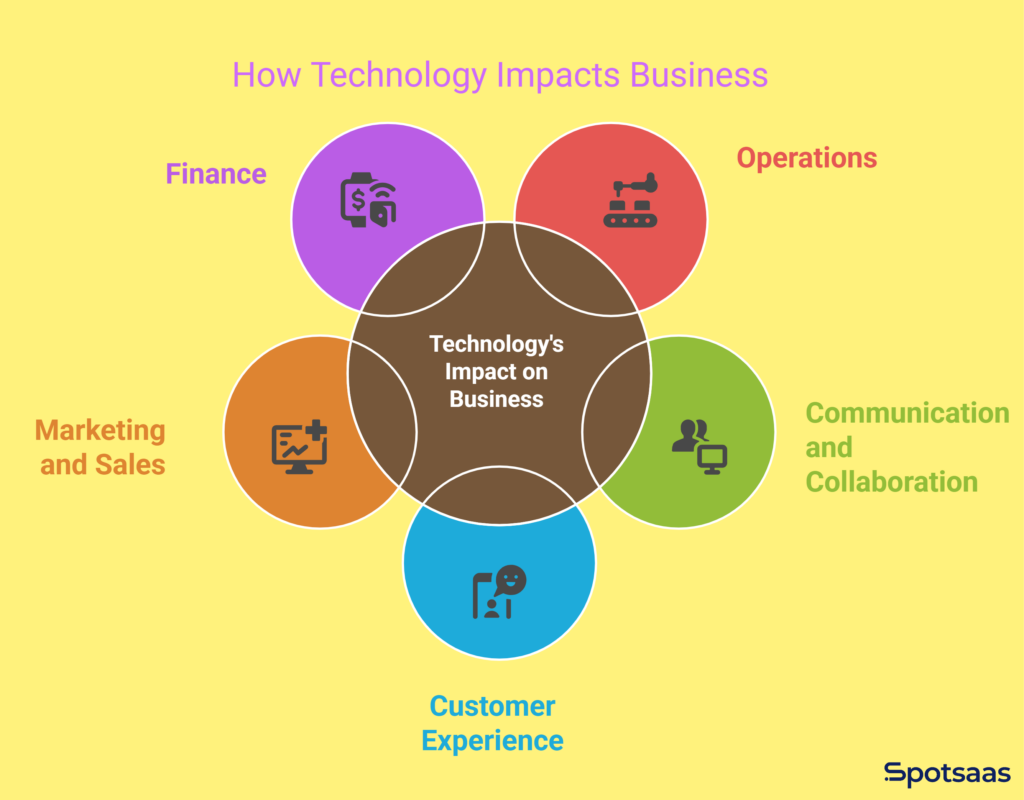
Operations
Automation tools cut down on repetitive tasks, reduce delays, and smooth out process flow across departments. That translates into faster turnaround times and better use of resources.
From inventory tracking to workflow automation, day-to-day operations run more efficiently, letting businesses scale without piling on extra overhead.
Communication and Collaboration
Tools like Slack, Microsoft Teams, and Zoom keep teams connected whether they’re in the office or working remotely. These platforms handle real-time messaging, file sharing, and meetings, tying the work environment together. The payoff is stronger teamwork, quicker feedback, and fewer bottlenecks in daily tasks.
Customer Experience
CRM systems and AI-driven tools let businesses offer personalized, timely support across channels. Automated responses and smart insights help teams read customer needs and respond fast, which leads to more meaningful interactions, higher satisfaction, and stronger loyalty.
Marketing and Sales
Technology makes it easier to reach the right audience through targeted email campaigns, social media tools, and data analytics. Businesses can track engagement, refine messaging, and improve conversion rates using real-time insights, which helps stretch marketing budgets further and bring in more qualified leads.
Finance
Financial software supports budgeting, forecasting, and expense tracking with more precision than manual methods. It simplifies accounting and gives real-time visibility into cash flow. By cutting down on errors and improving reporting accuracy, it helps finance teams make decisions backed by solid data.
Human Resources
From recruitment platforms to performance tracking systems, technology has changed how HR works. It simplifies hiring, automates onboarding, and helps track employee development, improving the overall employee experience and freeing HR teams to focus on strategy rather than paperwork.
Challenges of Business Technology
Technology brings real advantages, but adopting and managing it also comes with a few common challenges.
None of these are dead ends — they’re areas that need the right strategy, planning, and support to work through.
Integration with Existing Systems
Many businesses still depend on legacy systems for daily operations. Adding new technology can be difficult when it doesn’t integrate cleanly with what’s already in place. Poor integration leads to fragmented data, duplicated work, and disrupted processes.
To avoid this, look for tools with open APIs or strong third-party integration options. Taking time to align new technology with existing workflows results in a more connected, efficient system overall.
Employee Adoption and Training
Even the most capable tools only help if employees know how to use them. Introducing a new platform usually comes with a learning curve that can slow productivity in the short term.
Without proper training and support, teams may resist the change or use only a fraction of the features. Building in onboarding time, offering hands-on guidance, and gathering feedback early leads to faster adoption and better results down the line.
Managing Costs and Subscriptions
With so many tools on the market, it’s easy to end up subscribed to more than you need. Monthly fees add up quickly, especially when tools overlap in functionality.
Businesses should regularly audit their software stack to spot unused or redundant platforms. Choosing scalable solutions and focusing on return on investment keeps tech spending tied to actual business value rather than convenience.
Data Security and Privacy
As more operations move online, protecting sensitive data becomes a bigger priority. Every new tool added is a potential entry point for cyber threats or accidental data exposure.
Companies need to be deliberate about choosing secure platforms, following good security practices, and training employees on proper data handling. Staying compliant with privacy regulations also builds trust with customers and partners.
Keeping Up with Change
Technology moves quickly, and today’s solutions can become outdated fast. Businesses need to track emerging tools, updates, and shifting customer expectations.
Falling behind creates missed opportunities and inefficiencies. By building flexibility into their tech strategy and regularly reviewing what’s working, businesses can stay competitive and responsive as things change.
Trends Shaping the Future of Business Technology
Technology isn’t standing still—and neither are the businesses using it. New tools and innovations are changing how companies operate, compete, and grow. Here are the key trends shaping the future of business technology and what they mean for real-world adoption.
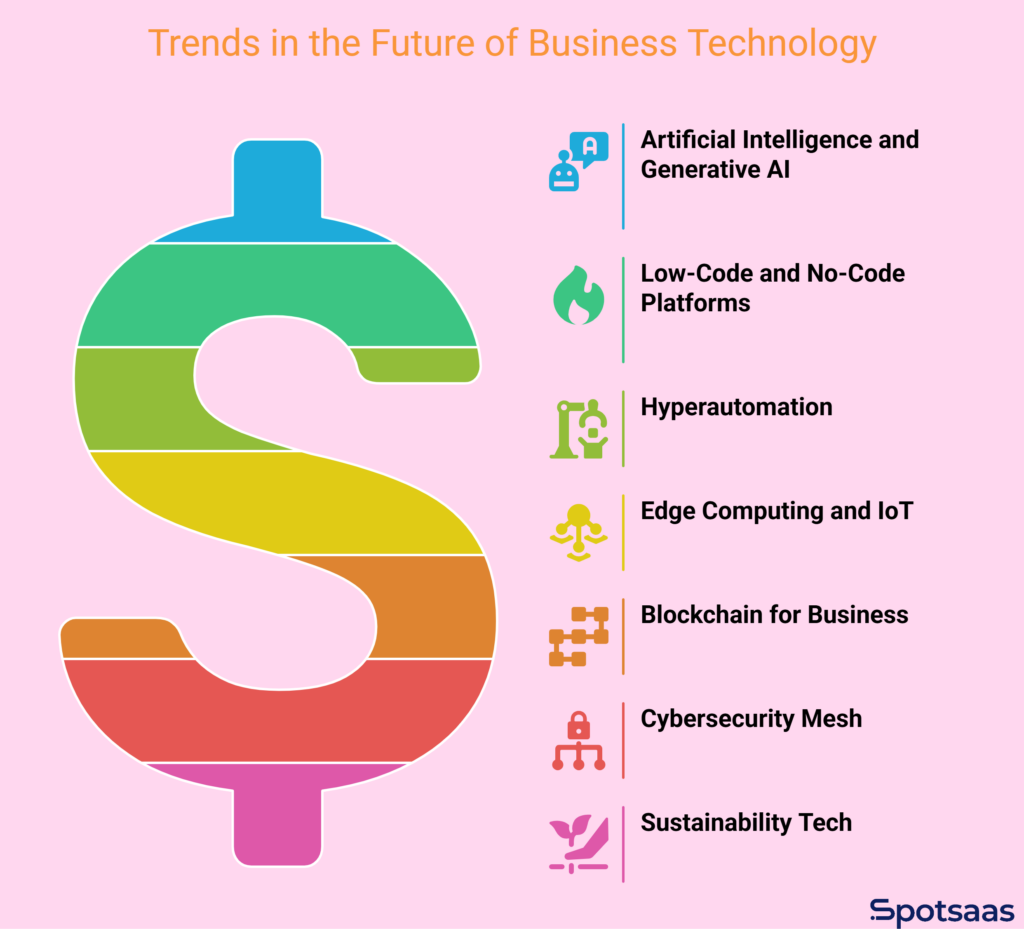
Artificial Intelligence and Generative AI
AI is becoming a core part of everyday tools, from chatbots and recommendation engines to data analysis and content creation. Generative AI tools can produce reports, automate replies, and even generate marketing copy.
To ensure this content reads naturally and passes AI detection, many businesses use solutions designed to humanize AI text by refining tone, flow, and clarity.
This helps businesses save time, scale faster, and offer more personalized experiences. As these tools become more accessible, companies of all sizes can use AI to boost productivity without needing in-house expertise.
Low-Code and No-Code Platforms
Building apps no longer requires a full team of developers. Low-code and no-code platforms like Airtable, Webflow, and Bubble allow non-technical teams to create internal tools, customer portals, or automations in less time.
This speeds up innovation and gives teams more control. It’s especially valuable for small businesses looking to move quickly without heavy tech investment.
Hyperautomation
Hyperautomation goes beyond basic automation by combining AI, machine learning, and robotic process automation (RPA) to simplify entire workflows. It’s used to automate complex, multi-step processes like onboarding, billing, or data validation.
Businesses that adopt hyperautomation can reduce costs, increase speed, and improve accuracy across departments. It’s a step toward building a more self-operating business model.
Edge Computing and IoT
Edge computing allows data to be processed closer to the source like on a device or sensor—rather than relying solely on the cloud.
This speeds up performance and supports real-time decision-making, which is especially useful in industries like manufacturing, logistics, and retail. Paired with IoT devices, it enables smarter operations, predictive maintenance, and faster service.
Blockchain for Business
Blockchain is evolving beyond cryptocurrency. It’s being used to secure transactions, validate contracts, and improve transparency in supply chains.
Businesses benefit from increased trust, data integrity, and reduced friction in processes like payments, audits, and recordkeeping. While still emerging, it’s gaining traction in industries like finance, healthcare, and logistics.
Cybersecurity Mesh
As businesses grow more digitally connected, cybersecurity strategies are becoming more flexible. A cybersecurity mesh architecture decentralizes protection, so every device, platform, or endpoint has its own layer of defense.
This is especially important for remote teams and cloud-based businesses. It allows companies to scale without compromising on data protection.
Sustainability Tech
Technology is also driving better environmental performance. Businesses are using carbon tracking software, energy-efficient data centers, and digital solutions to reduce paper waste and emissions.
Similarly, sustainable technology is addressing water waste through digital water management to conserve energy.
Customers increasingly expect brands to act responsibly, and sustainability tech helps companies align with those values while also cutting operational costs.
How Businesses Can Adapt
Business technology continues to evolve, and adapting to it doesn’t mean overhauling everything at once. Instead, it’s about making thoughtful, strategic moves that align with where your business is and where you want it to go.
The table below offers a quick comparison of key actions businesses can take to successfully adopt new technology.
It breaks down each step, the tools commonly used, who should be involved, and the impact it can have on your operations. Whether you’re planning a new rollout or refining your current setup, this table gives you a clear, actionable overview to guide your next move.
| Action | Tools | Who’s Involved | Impact |
|---|---|---|---|
| Define Clear Goals | KPI trackers, planning boards | Leadership | Focused investments, clear direction |
| Choose Scalable Tools | Cloud software, modular platforms | IT, Ops | Flexible growth, cost control |
| Train Employees | LMS, tutorials, live sessions | HR, Team Leads | Faster adoption, fewer tech headaches |
| Secure Your Systems | Encryption, access control | IT, Compliance | Data safety, customer trust |
| Review Performance | Dashboards, reports | Finance, Execs | Smart decisions, proven ROI |
| Involve the Team | Demos, surveys, pilot runs | Department Leads | Better fit, higher engagement |
| Plan the Rollout | Project boards, timelines | PMs, IT | Smooth transition, less chaos |
Start with Clear Business Goals
Before bringing in any new tech, take a step back and ask: What specific problem are we trying to solve? Is the goal to speed up processes, improve customer service, or increase sales?
Having well-defined goals helps you choose tools that solve real challenges, not just look impressive on paper. It also gives you a benchmark to measure results. This makes it easier to evaluate ROI and justify future investments. Tech should always support the bigger picture—not distract from it.
Choose Scalable, Flexible Tools
Not all technology grows well with your business. That’s why it’s smart to choose tools that are modular, cloud-based, and easy to expand or adapt. This gives you the flexibility to start small, test what works, and build from there without switching platforms later.
Whether it’s adding new team members, opening new locations, or expanding online, scalable tools help your systems grow without slowing you down. Flexibility also protects your investment. This reduces the need for costly migrations.
Prioritize Employee Training and Support
Even the best software can fall flat if people don’t know how to use it. Successful tech adoption depends heavily on your team. That’s why it’s important to offer more than just a product demo create space for hands-on training, provide resources like videos or how-to guides, and encourage feedback.
When employees feel supported and involved, they adopt tools faster and more confidently. A well-trained team is more productive and more likely to uncover new ways the tech can benefit your business.
Focus on Data Security from the Start
Every new tool you bring in handles some form of sensitive data—whether it’s customer information, financial records, or internal documents. That makes data protection a must from day one.
Choose software providers with strong security credentials, encryption protocols, and privacy policies. Set up user permissions, use two-factor authentication, and ensure regular backups. Prioritizing security reduces risk, and builds trust with customers, partners, and your own team.
Stay Informed and Open to Change
Technology doesn’t stand still—and neither should your business. Keeping up doesn’t mean chasing every trend, but it does mean staying aware of new tools, updates, and shifts in your industry.
Set aside time each quarter to evaluate your tech stack and identify gaps or outdated tools. Encourage your team to share feedback and insights from their daily work. A culture that stays open to change is better equipped to adapt quickly, stay competitive, and take advantage of new opportunities.
Conclusion
Business technology is no longer optional it’s a growth tool. From smoother operations to better customer experiences, the right tools help you work smarter and stay competitive.
The key is choosing solutions that align with your goals and scale with your business. Start small, stay focused, and keep your team involved. With the right approach, technology doesn’t just support your business—it pushes it forward.
For businesses exploring the latest software solutions in 2026, find them on our SaaS marketplace.
Frequently Asked Questions
What is Business Technology?
Business technology refers to tools, software, and systems that help companies run more efficiently. It improves productivity, customer experience, and decision-making.
How does tech help small businesses?
Business technology gives them access to powerful tools once limited to big companies. This helps them stay competitive and scale faster.
What challenges should I expect?
Common issues include integration, training, cost tracking, and security. With planning and support, these can be managed effectively.
How do I choose the right tech?
Start with your goals and pain points. Involve your team, try pilot programs, and choose tools that offer long-term value.
Compare alternatives to the tools in this post
Related Articles
SaaS Insights
The Software Behind Tokenized Assets: How Stocks, Funds and Gold Move On-Chain
Continue reading →
SaaS Insights
Employee Data Broker Removal 2026: Verified Pricing and the Per-Head Math for Teams
Continue reading →
SaaS Insights
Credential Breach Monitoring for Business 2026: Verified Pricing and Cost Per Domain
Continue reading →
SaaS Insights
Employment Background Check Software 2026: Published Prices vs Quote-Based Vendors
Continue reading →