

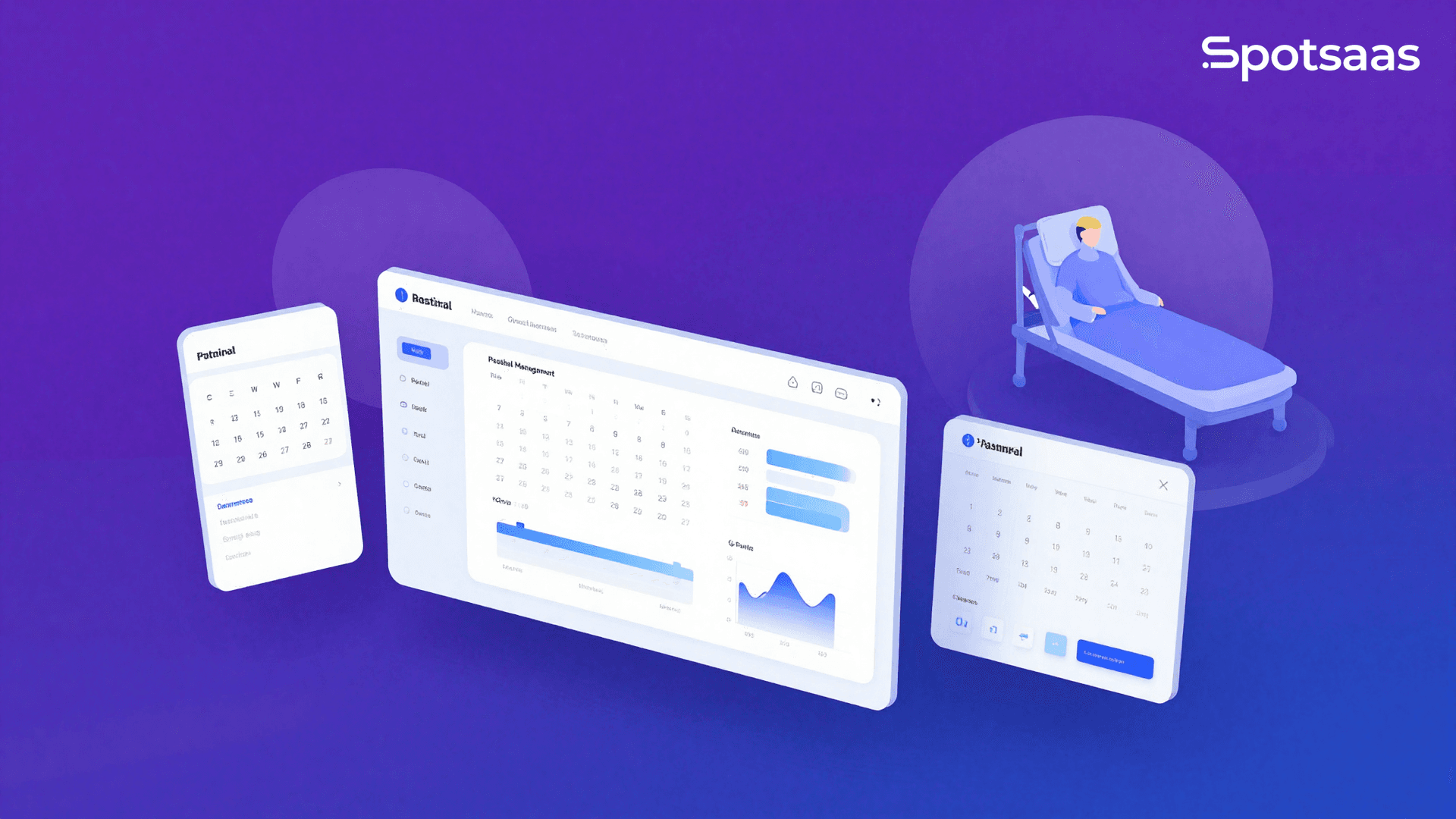
Running a hospital involves dozens of interdependent systems — patient admissions, bed management, billing, pharmacy inventory, lab orders, HR, and financials — all running simultaneously. When these systems don’t talk to each other, staff waste time on manual reconciliation, billing errors slip through, and patient care suffers. A hospital management system (HMS) connects these operations into a single platform so your administrative and clinical teams work from the same data.
Best pick: Epic — the most complete HMS for large health systems, with deep EHR integration, strong analytics, and the widest interoperability network in the US market.
This guide covers the 8 best hospital management software platforms in 2026, including both global solutions and regional options built for South Asia, the Middle East, and Southeast Asia — markets where the choice between cloud-based SaaS and on-premise deployment is still a real operational decision.
What Is a Hospital Management System?
A hospital management system is software that coordinates every administrative and operational function of a healthcare facility. It handles patient registration and appointment scheduling, inpatient admissions and bed allocation, billing and insurance claims, pharmacy and inventory management, laboratory and radiology order tracking, HR and payroll, and financial reporting — all under one system.
HMS is often confused with EHR (Electronic Health Record) software, but they’re different in scope. An EHR focuses on the clinical record: diagnoses, medications, lab results, and care plans for individual patients. An HMS covers the whole hospital operation: who’s admitted, which beds are occupied, what’s been billed, how much surgical gauze is in stock, and whether payroll processed correctly. Most modern HMS platforms include a built-in EHR module, but a standalone EHR doesn’t give you bed management or inventory control.
According to a 2023 report by Grand View Research, the global hospital management software market was valued at $35.8 billion and is expected to grow at a CAGR of 12.5% through 2030, driven by digitization mandates across Asia-Pacific and the Middle East.
Hospitals ranging from 20-bed district facilities to 2,000-bed academic medical centers use HMS. The right platform depends on your size, ownership model (government vs. private), deployment preference, and whether you’re in a regulated market with specific compliance requirements like HIPAA (US), NABH (India), or JCI (international).
Who Needs Hospital Management Software?
- Hospital administrators and C-suite at mid-to-large facilities who need real-time visibility into bed occupancy, revenue cycle performance, and department-level cost centers
- Clinic owners and practice managers running multi-specialty outpatient centers who need appointment scheduling, billing, and basic inventory without an enterprise budget
- IT and operations leads at hospital chains managing multiple branches who need centralized data, consolidated reporting, and role-based access across locations
- Government health departments and healthcare networks in emerging markets digitizing paper-based workflows and moving toward cashless patient billing
Key Features to Look For in Hospital Management Software
Patient Registration and Appointment Scheduling
Every HMS starts here. Look for duplicate patient detection (using Aadhaar, national ID, or phone number), multi-channel booking (walk-in, phone, online portal), and queue management displays for OPD. Systems that auto-assign appointment slots based on doctor availability save significant front-desk time.
Inpatient Management and Bed Allocation
This is where HMS earns its keep. Real-time bed status dashboards, admission/discharge/transfer (ADT) workflows, and ward round documentation should be standard. Some platforms add housekeeping integration so bed turnaround time is tracked automatically.
Billing and Revenue Cycle Management
End-to-end billing covers OPD consultation billing, inpatient package billing, insurance pre-authorization, claims submission, and patient payment collection. Look for support for your local insurance ecosystem — TPA integrations matter a lot in India and the Gulf; payer EDI matters in the US.
Pharmacy and Inventory Management
Drug dispensing tied to physician orders, with automatic deduction from inventory. The system should flag drug interactions, track batch numbers and expiry dates, and generate purchase orders when stock falls below par levels.
Laboratory and Radiology Information System (LIS/RIS)
Orders placed by clinicians should flow directly to the lab or radiology department, with results auto-posting back to the patient record. Barcode-based sample tracking reduces manual entry errors.
Reporting and Analytics
Departmental P&L, MIS reports, ALOS (average length of stay), bed occupancy rate, and revenue leakage reports are the minimum. Better systems add configurable dashboards and export to Excel or BI tools.
Integration and Interoperability
Whether you’re connecting to government health exchanges, diagnostic equipment (HL7/DICOM), or third-party EHRs, the HMS should have documented API support. In the US, FHIR R4 compliance is increasingly required.
Best Hospital Management Software in 2026
Epic
Epic is the most widely deployed HMS/EHR platform in the US, used by over 350 health systems including the Mayo Clinic, Cleveland Clinic, and Kaiser Permanente. It covers the full clinical and operational stack: EHR, inpatient management, scheduling, billing, revenue cycle, pharmacy, lab, and patient engagement through its MyChart patient portal.
Best for: Large health systems, academic medical centers, and integrated delivery networks in the US and internationally
Key features:
- MyChart patient portal with 200M+ enrolled patients in the US
- Comprehensive revenue cycle management with AI-assisted coding
- FHIR-based interoperability with external health exchanges and third-party apps
Pricing: Contact for pricing (enterprise contracts; typically multi-million dollar implementations)
Oracle Health (Cerner)
Oracle Health, formerly Cerner, is Epic’s main enterprise competitor. It’s used by government hospital networks, VA systems, and large private health systems globally. Oracle acquired Cerner in 2022 and has been integrating cloud infrastructure and AI capabilities from Oracle’s broader tech stack into the platform.
Best for: Large hospitals needing integrated EHR, HMS, and analytics — particularly government and defense health systems
Key features:
- Millennium platform covering clinical, operational, and financial workflows
- Oracle Cloud Infrastructure integration for scalable data analytics
- Strong footprint in US federal health (US DoD, VA)
Pricing: Contact for pricing
View Oracle Health on Spotsaas →
Insta HMS
Insta HMS is a modular hospital management system designed for hospitals and multi-specialty clinics that want to start with core modules and expand over time. It’s popular across India and the Middle East, with deployments in over 40 countries. The platform covers OPD/IPD workflows, billing, pharmacy, lab, radiology, and HR.
Best for: Hospitals and multi-specialty clinics needing a modular, scalable HMS that can be deployed on-premise or in the cloud
Key features:
- Modular architecture — deploy only the modules you need initially
- Integrated clinical and administrative workflows with a single patient record
- Multi-currency and multi-language support for regional deployments
Pricing: Contact for pricing
SoftClinic
SoftClinic is a clinic and hospital management system widely used by small to mid-sized facilities across India, the UAE, Saudi Arabia, and other South Asian and Middle Eastern markets. It offers both a free edition for single-doctor clinics and a paid enterprise version for hospitals with multiple departments.
Best for: Small to mid-sized clinics, nursing homes, and specialty hospitals in South Asia and the Middle East looking for an affordable HMS with local support
Key features:
- Free basic edition covering OPD billing, prescription management, and patient records
- Modules for IPD, pharmacy, lab, radiology, blood bank, and canteen management
- Available as on-premise or cloud-hosted deployment
Pricing: Contact for pricing
Medstar HIS
Medstar HIS (Hospital Information System) targets mid-to-large hospitals that need tight integration between clinical departments and administrative functions. It covers the full ADT workflow, OPD and IPD management, integrated pharmacy and lab, and a billing engine built to handle complex insurance claim scenarios common in the Gulf and South Asian markets.
Best for: Hospitals needing integrated clinical and administrative modules with insurance TPA support for Middle Eastern and South Asian markets
Key features:
- Unified clinical and administrative record from admission to discharge
- TPA and insurance claims management built for regional payers
- Reporting dashboards for bed occupancy, department revenue, and inventory
Pricing: Contact for pricing
View Medstar HIS on Spotsaas →
Uniwide HIMS
Uniwide HIMS is designed for hospital groups and healthcare chains that need centralized oversight of multiple branches from a single platform. The system handles patient data consolidation across locations, centralized procurement and inventory control, and group-level financial reporting — all while allowing each branch to operate its own clinical workflows.
Best for: Multi-branch hospital groups and healthcare chains that need centralized management with branch-level autonomy
Key features:
- Centralized patient master index across all branches
- Group-level procurement, inventory, and financial consolidation
- Role-based access control for branch-level staff and corporate management
Pricing: Contact for pricing
View Uniwide HIMS on Spotsaas →
eHospital Systems
eHospital Systems is a fully web-based HMS designed for hospitals that want browser-accessible clinical and administrative tools without installing software on every workstation. It covers the standard HMS modules — OPD/IPD, billing, pharmacy, lab, HR — along with a patient portal and telemedicine capabilities.
Best for: Hospitals wanting a fully integrated, web-based HMS with telemedicine capabilities and no on-premise software installation
Key features:
- 100% web-based with role-specific dashboards accessible from any browser
- Integrated telemedicine and patient portal for outpatient consultations
- HR and payroll module alongside clinical workflow management
Pricing: Contact for pricing
View eHospital Systems on Spotsaas →
PrimeCare
PrimeCare targets the lower end of the market — small clinics, nursing homes, and day-care centers in emerging markets that need basic patient management, billing, and prescription tracking without the complexity or cost of an enterprise HMS. The interface is intentionally simplified for facilities with limited IT support staff.
Best for: Small clinics, nursing homes, and single-specialty centers in emerging markets needing a simple, affordable HMS
Key features:
- Simplified OPD management, appointment scheduling, and patient history tracking
- Basic billing and receipt generation with cash and insurance payment modes
- Low hardware requirements suitable for facilities with limited IT infrastructure
Pricing: Contact for pricing
HMS Pricing Guide
Hospital management software pricing varies enormously depending on deployment model, facility size, and the number of modules licensed.
On-premise HMS typically involves a one-time license fee plus annual maintenance. For a 100-bed hospital, on-premise HMS solutions in India or the Middle East commonly run between $10,000 and $80,000 for the initial license, with 15-20% annual maintenance charges. Enterprise platforms like Epic and Oracle Health in the US range into multi-million dollar contracts when you factor in implementation, customization, and training.
Cloud-based SaaS HMS usually charges per bed per month, per user per month, or as a flat monthly subscription. Regional SaaS HMS products for small clinics may start as low as $50-200/month. Mid-market cloud HMS platforms typically run $500-5,000/month depending on module count and facility size.
What drives the price up:
- Number of active modules (lab, radiology, pharmacy add-ons each cost more)
- Number of concurrent users or licensed beds
- Implementation, data migration, and training services
- Local regulatory compliance modules (NABH, HIPAA, JCI)
- Integration work with diagnostic equipment or third-party systems
Always ask vendors to quote implementation cost separately — it can equal or exceed the software license cost for large facilities.
How to Choose a Hospital Management System
Match the platform to your actual size. Epic and Oracle Health are built for health systems with dedicated IT teams and large implementation budgets. If you’re running a 50-bed hospital in India, a regional solution like Insta HMS or SoftClinic will deploy faster and cost a fraction of the price.
Decide on deployment model before evaluating vendors. If your facility is in a location with unreliable internet connectivity, on-premise is still the right call. If you’re building a new facility or expanding a chain, cloud-based HMS gives you faster deployment, easier updates, and no server management overhead.
Check local compliance and integration requirements. In India, ABDM (Ayushman Bharat Digital Mission) integration is increasingly required. In the Gulf, MOH compliance varies by country. In the US, HIPAA compliance and FHIR interoperability aren’t optional. Shortlist only vendors that already support your regulatory environment.
Insist on a live demo with your actual workflows. Ask the vendor to walk through a patient admission, an OPD billing cycle, and a pharmacy dispensing workflow using your department structure. Generic demos hide gaps in module depth.
Factor in training and go-live support. The best HMS implementation failures happen not because the software was wrong but because staff weren’t trained. Get the number of training days, go-live support hours, and post-go-live helpdesk response times in writing before signing.
Compare all 37 hospital management software tools on Spotsaas →
Comparisons
HMS vs. EHR Software
This is the most common source of confusion when evaluating healthcare IT. Here’s a direct comparison:
| Dimension | HMS | EHR |
|---|---|---|
| Primary focus | Hospital operations (billing, inventory, HR, bed management) | Patient clinical records (diagnoses, medications, care plans) |
| Users | Administrators, billing staff, pharmacists, HR | Clinicians, nurses, physicians |
| Covers financials? | Yes — full revenue cycle, payroll, department P&L | No |
| Covers patient records? | Partially — basic clinical notes, discharge summaries | Yes — full longitudinal clinical record |
| Example platforms | Insta HMS, Medstar HIS, Uniwide HIMS | Epic (with EHR module), Oracle Health |
Most enterprise HMS platforms bundle an EHR module. But a standalone EHR like a basic practice management system does not replace an HMS for inpatient facilities.
Cloud-Based HMS vs. On-Premise HMS
| Factor | Cloud-Based | On-Premise |
|---|---|---|
| Upfront cost | Low (subscription) | High (license + hardware) |
| Internet dependency | Required | Not required |
| Updates | Automatic | Manual (vendor or IT team) |
| Data control | Vendor’s servers | Your servers |
| Best for | New builds, multi-branch chains | Facilities with connectivity constraints or strict data residency requirements |
For hospital chains in emerging markets, a hybrid model — cloud-based HMS with local caching for offline resilience — is increasingly common.
Frequently Asked Questions
What is hospital management software?
Hospital management software is an integrated platform that automates and coordinates the administrative, financial, and operational functions of a hospital or clinic. It connects patient registration, scheduling, billing, pharmacy, lab, inventory, and HR into a single system so data flows between departments without manual re-entry.
How much does a hospital management system cost?
Pricing ranges from free (for basic single-clinic tools) to multi-million dollar enterprise contracts for platforms like Epic. Regional HMS solutions for mid-sized hospitals typically run between $10,000-$80,000 for on-premise licenses, or $500-$5,000/month for cloud-based subscriptions. Implementation and training costs are separate and can be substantial for large deployments.
What’s the difference between HMS and EHR software?
An EHR (Electronic Health Record) focuses on the patient’s clinical record — diagnoses, medications, lab results, and treatment history. An HMS (Hospital Management System) manages hospital operations — billing, bed management, pharmacy inventory, HR, and financials. Most enterprise HMS platforms include an EHR module, but a standalone EHR does not replace an HMS for inpatient hospital operations.
What features does hospital management software include?
Core features include patient registration and appointment scheduling, inpatient admission/discharge/transfer management, bed allocation, billing and revenue cycle management, pharmacy and inventory control, lab and radiology order management, HR and payroll, and financial reporting. Advanced platforms add patient portals, telemedicine, business intelligence dashboards, and regulatory compliance modules.
Can small clinics use hospital management software?
Yes. Several platforms — SoftClinic, PrimeCare, and others — are specifically designed for small clinics and nursing homes with simplified interfaces and lower price points. SoftClinic even offers a free basic edition for single-doctor practices. The key is choosing a system scaled to your actual patient volume and department complexity rather than paying for enterprise features you won’t use.
Is cloud-based HMS better than on-premise?
It depends on your infrastructure and operational context. Cloud-based HMS offers lower upfront cost, automatic updates, easier multi-branch access, and no server management. On-premise works better for facilities in locations with unreliable internet, strict data residency requirements, or existing server infrastructure. In markets like India and the Middle East, many hospitals still prefer on-premise for data control reasons, though cloud adoption is growing rapidly.
Conclusion
A hospital management system is the operational backbone of any healthcare facility that’s moved beyond paper-based workflows. The right platform depends on your facility size, geography, deployment preference, and budget — there’s no single best HMS for everyone. Epic and Oracle Health serve large health systems with complex integration needs; Insta HMS, SoftClinic, and Medstar HIS are built for the operational realities of South Asian and Middle Eastern hospitals; eHospital and Uniwide HIMS fill specific niches around web-based access and multi-branch management.
Start by mapping your current workflow gaps, decide on deployment model, and shortlist two or three vendors for a live demo before committing.
Compare alternatives to the tools in this post

- Independent picks for exactly what you just read about
- Matched to your team size & needs
- Vendors don't pay for placement
Step 1 of 4
How big is your team?
We tailor recommendations to companies your size.















Related Articles
Applicant Tracking Software
Best ATS for Retail and Hospitality Hiring in 2026: 5 Tools for High-Volume Recruiting
Continue reading →
Best Tools
Best EHR Software in 2026: Top Electronic Health Record Systems for Clinics and Practices
Continue reading →
Buyers guide
What Is EHR Software? Electronic Health Records Guide for 2026
Continue reading →
Best Tools
Best Veterinary Software in 2026: Top Practice Management Systems for Veterinary Clinics
Continue reading →