
Modern HR software has changed how companies manage their workforce in 2026. Teams are no longer reliant on spreadsheets and manual processes. Instead, these platforms act as central hubs for hiring, payroll, employee engagement, and compliance, and they keep adjusting as the work environment changes.
As remote and hybrid work grows, companies want HR software with AI automation, analytics, strong compliance features, and integrations that connect their other tools. The goal is to save time and give employees a better experience.
This guide covers 10 features to look for in HR software that help organizations keep pace. Whether your priority is productivity, employee retention, or compliance, these capabilities make a real difference when you pick the right system.
Key Takeaways
- HR software in 2026 should go beyond basic admin, with AI-driven automation, predictive analytics, and integrations to other systems.
- AI-powered recruitment and applicant tracking speed up hiring, reduce bias, and improve candidate selection.
- Payroll automation and compliance management ensure accurate salary processing, tax calculations, and adherence to labor laws.
- Employee engagement tools, chatbots, and DEI analytics help create a more inclusive and productive workplace.
- Self-service HR portals and mobile access let employees handle routine tasks and cut the admin workload for HR teams.
- Blockchain-based record-keeping adds security and keeps employee data tamper-proof.
- Scalable, easy-to-use, and customizable HR software supports business growth and workforce efficiency.
Who Needs HR Software in 2026?
Businesses of every size use HR software to simplify processes, reduce the admin burden, and manage their workforce more effectively. Across hiring, payroll, compliance, and employee engagement, an efficient HR system saves time, cuts down on errors, and supports better decision-making.
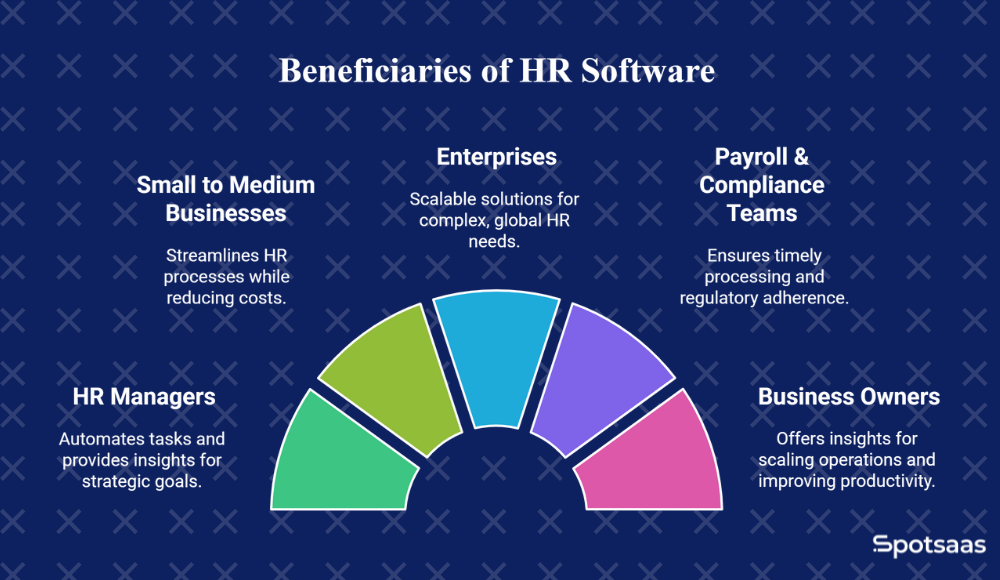
Here’s who benefits the most:
HR Managers & Directors
HR professionals juggle many responsibilities, from recruiting to managing employee engagement and retention. Strong HR software automates admin tasks, centralizes employee data, and surfaces useful insights, so HR leaders can focus on goals like talent retention and company culture.
Small to Medium Businesses (SMBs)
For growing businesses, HR work can get overwhelming without the right tools. HR software helps SMBs simplify hiring, track performance, automate payroll, and stay compliant, all while reducing costs. With self-service portals and AI-powered analytics, even small teams can manage HR well.
Enterprises with Complex HR Needs
Larger organizations need scalable systems for multi-location workforces, varied payroll structures, and global compliance rules. Advanced HR software connects with existing business systems and adds real-time workforce insights, predictive analytics, and automated workflows to keep large operations running.
Payroll & Compliance Teams
HR software helps payroll and compliance teams with on-time salary processing, tax compliance, benefits administration, and regulatory adherence. Built-in compliance checks keep businesses current with labor laws and help avoid costly penalties and legal risks.
Business Owners & Executives
For decision-makers, HR software gives a clear view of workforce performance, hiring trends, and employee satisfaction. With automated processes, owners can focus on growth, productivity, and employee experience instead of admin tasks.
Why Modern Businesses Can’t Operate Without HR Software in 2026
With remote teams, AI integration, and changing compliance rules, businesses need HR tools that are efficient, data-driven, and built to last. For a startup or a multinational, HR software supports workforce efficiency, compliance, and a smooth employee experience at every stage of growth.
10 Key Features Every HR Software Should Offer in 2026
As workforce dynamics shift, HR software should be more than a management tool. It should simplify operations, improve the employee experience, and support decision-making. Here are 10 features every good HR system should have in 2026:
| Feature | Why It Matters | Key Benefits | Real-World Use |
|---|---|---|---|
| AI-Powered ATS | Speeds up hiring, reduces bias. | Automates screening, scheduling, and ranking. | Retail company filters applications for seasonal hiring. |
| Onboarding & Offboarding | Ensures smooth employee transitions. | Automates documents, IT access, and compliance. | Global tech firm speeds up new hire setup. |
| Payroll & Benefits | Automates payroll, tax compliance. | Handles deductions, direct deposits, benefits. | Multinational HR team manages cross-border payroll. |
| Employee Engagement | Improves workplace morale. | AI-driven sentiment analysis and surveys. | Financial firm tracks well-being via AI surveys. |
| Performance Management | Supports continuous improvement. | Real-time feedback, goal setting. | SaaS company identifies leadership potential. |
| Learning & Development | Personalized training for training. | AI-driven course recommendations. | E-commerce brand suggests career-growth training. |
| Compliance & Legal | Ensures regulatory adherence. | Automates tracking, audits, policy updates. | Healthcare firm manages certification compliance. |
| Self-Service HR Portals | Gives employees self-service access. | Instant access to HR tools and records. | Logistics firm provides mobile HR app. |
| Workforce Analytics | Optimizes hiring and retention. | Predicts workforce trends, turnover risks. | Manufacturing company forecasts seasonal hiring. |
| Business Tool Integration | Improves efficiency. | Connects CRM, payroll, and project tools. | Consulting firm improves workflow tracking. |
1. AI-Powered Recruitment & Applicant Tracking System (ATS)
Why It’s Essential in 2026
AI is transforming HR software and pushing businesses toward smarter tools that identify top talent faster, reduce hiring bias, and improve the candidate experience. An ATS with AI handles job postings, automates resume screening, and ranks candidates by skill match.
How It Benefits HR Teams
- Automates resume parsing, interview scheduling, and candidate assessments.
- Matches applicants to job roles using AI-driven insights.
- Improves hiring speed and reduces manual screening efforts.
Real-World Use Case
A retail company hiring seasonal workers can use AI-powered ATS to automatically filter and rank thousands of applications. This ensures quick placements while maintaining hiring quality.
2. Employee Onboarding & Offboarding Automation
Why It’s Essential in 2026
With remote and hybrid workforces, businesses need a smooth onboarding and offboarding process so that employees can start their roles well and exit the company professionally when the time comes.
How It Benefits HR Teams
- Automates document collection, digital signatures, and compliance verification.
- Reduces manual workload by integrating new hires into payroll and benefits automatically.
- Ensures a structured exit process, including asset returns, feedback collection, and knowledge transfer.
Real-World Use Case
A global tech company hires employees across different time zones. Automated onboarding software ensures that each new hire receives training materials, IT setup, and compliance documents without HR intervention.
3. Integrated Payroll & Benefits Management
Why It’s Essential in 2026
Payroll errors and compliance issues can lead to financial losses and employee dissatisfaction over time. A centralized payroll platform ensures accurate salary processing and reliable benefits administration.
How It Benefits HR Teams
- Automates tax deductions, direct deposits, and benefits enrollment.
- Provides a self-service portal for employees to access pay stubs and manage benefits.
- Reduces manual errors and ensures compliance with tax laws.
Real-World Use Case
An HR team managing a workforce in multiple countries uses automated payroll software to calculate region-specific tax rates, deductions, and compliance regulations, avoiding penalties.
4. AI-Driven Employee Engagement & Experience
Why It’s Essential in 2026
Employee satisfaction directly impacts both retention and productivity. Employee engagement tools help businesses track workforce sentiment over time and improve the overall workplace culture.
How It Benefits HR Teams
- Uses sentiment analysis to measure employee morale.
- Conducts pulse surveys and real-time feedback.
- Provides AI-driven insights for improving workplace engagement.
Real-World Use Case
A financial services firm tracks employee well-being through AI-powered pulse surveys. This allows managers to address concerns and boost morale proactively.
5. Advanced Performance Management & 360-degree Feedback
Why It’s Essential in 2026
Traditional annual performance reviews are giving way to real-time feedback systems that support continuous growth and accountability throughout the year.
How It Benefits HR Teams
- Enables goal setting, OKRs (Objectives & Key Results), and real-time feedback.
- Supports peer, manager, and self-assessments for a well-rounded evaluation.
- AI-powered insights recommend training and development opportunities.
Real-World Use Case
A SaaS company integrates 360-degree feedback tools to identify high-potential employees and tailor leadership training.
6. Learning & Development (L&D) Module
Why It’s Essential in 2026
With rapid industry changes, employees need continuous learning opportunities to build new skills and keep pace with rivals in their roles.
How It Benefits HR Teams
- AI-powered Learning Management System (LMS) offers personalized training paths.
- Tracks skill progress and certifications for career development.
- Integrates with external learning platforms like LinkedIn Learning and Udemy.
Real-World Use Case
A growing e-commerce brand uses an AI-powered L&D system to suggest training courses based on employees’ career paths. This improves retention and skills development.
7. Compliance Management & HR Legal Support
Why It’s Essential in 2026
With evolving labor laws and data regulations, businesses must stay compliant on an ongoing basis to avoid legal risks and costly penalties.
How It Benefits HR Teams
- Automates document tracking, policy updates, and compliance audits.
- Ensures adherence to GDPR, labor laws, and tax regulations.
- Provides automated alerts for regulatory changes.
Real-World Use Case
Healthcare companies use compliance software to track employee certifications and generate compliance reports. This ensures legal adherence.
8. Self-Service HR Portals & Mobile App Access
Why It’s Essential in 2026
Employees expect instant access to HR-related tasks and information without relying on HR teams for every small request.
How It Benefits HR Teams
- Allows employees to update personal data, access payroll, and request time off.
- Provides HR teams with real-time workforce insights.
- Improves employee satisfaction by offering mobile accessibility.
Real-World Use Case
A logistics company with a large field workforce provides a mobile HR app. This allows employees to access schedules and update their personal details anytime.
9. AI-Powered Workforce Planning & Analytics
Why It’s Essential in 2026
Businesses need data-driven workforce planning to optimize their talent strategies, forecast future needs, and minimize turnover risks before they become costly.
How It Benefits HR Teams
- Uses predictive analytics to forecast hiring needs and turnover trends.
- Provides AI-driven insights for talent retention strategies.
- Helps HR teams optimize workforce budgets based on data.
Real-World Use Case
A manufacturing company uses AI-driven workforce analytics to identify seasonal hiring trends. This reduces understaffing and overtime costs.
10. Integration with Other Business Tools
Why It’s Essential in 2026
HR systems must connect smoothly with the other business applications a company already runs, so that data moves between them and workflow efficiency improves.
How It Benefits HR Teams
- Integrates with CRM, accounting, and productivity tools like Slack and Microsoft Teams.
- Reduces data silos and improves interdepartmental collaboration.
- Improves automation and reporting capabilities.
Real-World Use Case
A consulting firm integrates HR software with its project management tool for smooth time tracking and payroll processing.
Final Thoughts: Is Your HR Tech Stack Ready for 2026?
HR software in 2026 needs to be intelligent, automated, and highly adaptable. The right tools save time, improve day-to-day efficiency, and give employees more control over their own information. For a small business or a large enterprise, these 10 features make for a future-ready HR system.
How to Choose the Best HR Software for Your Business in 2026
Choosing the best HR software is not just about ticking off feature lists. It is about finding a system that fits your company’s needs, scales with growth, and simplifies workforce management. Here are the key factors to weigh:
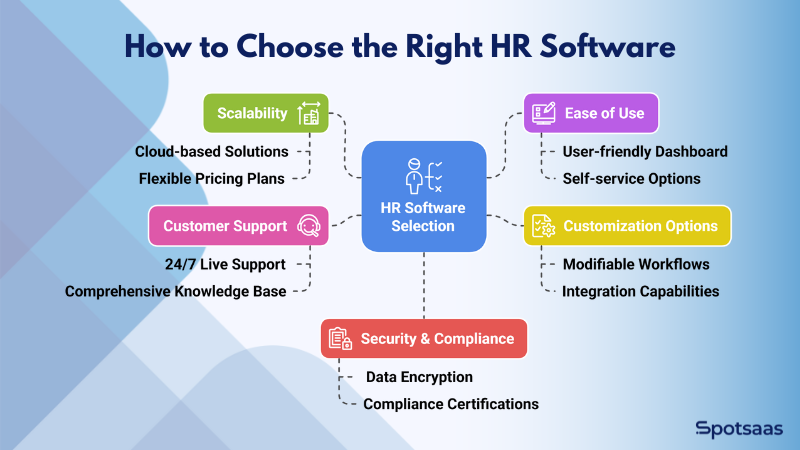
Scalability – Can It Grow with Your Business?
Your HR software should keep up with the pace of your growing tech startup. As your team scales, the system needs to manage more employee data, support complex payroll processes, and stay aligned with changing compliance demands.
Look for: Cloud-based HR solutions with flexible pricing plans that support additional users and features as your team expands.
Ease of Use – Is the UI Intuitive?
An HR system should be simple, easy-to-use, and require minimal training. If employees struggle to navigate the interface, adoption rates will drop, leading to inefficiencies.
Look for: A clean, well-organized dashboard with self-service options for employees and automation tools for HR teams.
Customization Options – Can You Tailor Workflows?
No two businesses operate the same way, so HR software should offer customizable workflows with proper pricing guides to match unique processes. From tailored approval hierarchies to custom reporting and role-based access, flexibility is key.
Look for: HR platforms that allow modifications in workflows, reports, and integrations with other business tools.
Customer Support – Is 24/7 Support Available?
HR issues like payroll discrepancies or compliance concerns can arise anytime. Reliable customer support ensures smooth issue resolution when needed.
Look for: Providers offering 24/7 live chat, phone, and email support, along with a complete knowledge base or AI-powered chat assistance.
Security & Compliance – Does It Offer Data Protection Features?
HR systems handle sensitive employee data, payroll information, and legal documents, so security is a top priority. Data encryption, role-based access controls, and compliance certifications are non-negotiable.
Look for: GDPR, SOC 2, and HIPAA-compliant software with features like two-factor authentication, automated compliance updates, and audit logs.
Top HR Software Implementation Challenges (and How to Overcome Them)
Implementing HR software can significantly improve workforce management, but businesses often face hurdles during adoption. Understanding these challenges and preparing for them ensures a smoother transition and gets the most value from the software.
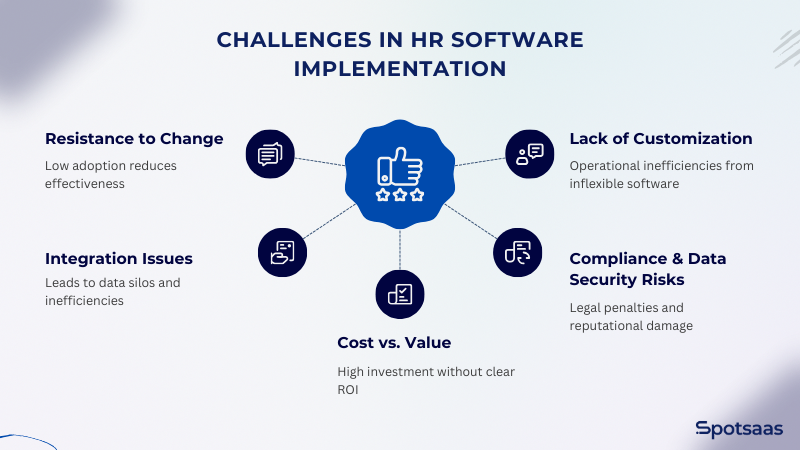
Resistance to Change – Ensuring Employee Adoption
Many employees and HR teams are used to manual processes or legacy systems, which makes it hard to embrace new software. Without proper training and engagement, low adoption rates can reduce the system’s effectiveness.
How to Overcome It:
- Involve HR teams and key employees in the selection process to increase buy-in
- Offer complete training and provide easy-to-access tutorials
- Communicate the benefits clearly, such as reduced workload and improved efficiency
- Introduce the software gradually with a phased rollout approach
Integration Issues – Ensuring Compatibility with Existing Systems
Businesses often use multiple tools for payroll, accounting, and workforce management. If the new HR software doesn’t integrate well with existing systems, it can lead to data silos, inefficiencies, and manual workarounds.
How to Overcome It:
- Choose software that offers pre-built integrations with commonly used tools (CRM, payroll, accounting)
- Look for API support for custom integrations if necessary
- Test integrations before full deployment to identify potential issues early
- Ensure smooth data migration to prevent information loss or duplication
Cost vs. Value – Finding a Solution That Offers Long-Term ROI
HR software can be a significant investment, especially for small and medium businesses. The challenge is selecting a solution that justifies its cost by delivering measurable benefits like automation, time savings, and improved decision-making.
How to Overcome It:
- Make a comparison checklist and assess the total cost of ownership (TCO), including setup, training, and ongoing subscription fees
- Choose a scalable solution that fits your business today and supports future growth
- Consider free trials or demos to evaluate usability and effectiveness before committing
- Measure ROI by tracking efficiency improvements, reduced errors, and employee satisfaction
Compliance & Data Security Risks
Handling sensitive employee data comes with security risks, especially with increasing compliance regulations like GDPR and HIPAA. Failure to ensure compliance can lead to legal penalties and reputational damage.
How to Overcome It:
- Select HR software with built-in compliance tracking and data encryption
- Ensure it provides controls to restrict data access
- Regularly update security protocols and conduct compliance audits
Lack of Customization – Adapting Software to Unique Business Needs
Every company has different HR processes, approval workflows, and reporting needs. Off-the-shelf HR software may lack flexibility, leading to operational inefficiencies.
How to Overcome It:
- Choose software that allows custom workflows, role-based permissions, and personalized reporting
- Look for platforms that offer modular features so businesses only pay for what they need
- Test customization options during the trial phase to ensure they align with HR processes
Future Trends in HR Tech for 2026 and Beyond: AI, Blockchain & More
HR technology is evolving quickly, driven by AI, automation, and data security advances. As businesses face new workforce challenges, HR software in 2026 will go beyond traditional functions and focus on predictive analytics, blockchain security, and better employee engagement.
Here’s what’s shaping the future of HR technology:
AI-Driven Predictive Hiring & Automation
Recruitment is becoming more data-driven and automated. This allows HR teams to make smarter hiring decisions. AI-powered analytics can predict candidate success rates, assess cultural fit, and automate resume screening, interview scheduling, and skill assessments.
What’s Changing?
- AI will analyze historical hiring data to recommend top candidates
- Automated chatbots will conduct preliminary interviews and skill evaluations
- Predictive insights will help reduce employee turnover by identifying at-risk employees
Example: A tech firm uses AI-driven hiring tools to match job descriptions with top candidates, cutting recruitment time by 40 percent.
HR Chatbots for Employee Queries & Engagement
HR chatbots are becoming virtual HR assistants, giving instant responses to employee questions about leave policies, payroll, benefits, and company guidelines.
Why It Matters?
- Reduces HR workload by automating FAQs and routine employee requests
- Improves response time, which keeps faster issue resolution
- Improves employee engagement by offering real-time assistance via Slack, Teams, or mobile apps
Example: A global retail company deploys an AI-based chatbot that handles 90 percent of HR queries, freeing up HR teams for strategic tasks.
Blockchain for Secure Employee Record-Keeping
Data security is a growing concern, and blockchain technology offers a solution by creating tamper-proof, decentralized HR records.
Key Benefits:
- Ensures secure storage of employee credentials, payroll records, and compliance documents
- Eliminates risks associated with data breaches and unauthorized modifications
- Improves transparency for background checks, promotions, and contract agreements
Example: A financial services firm uses blockchain to verify employee certifications. This prevents resume fraud and unauthorized record alterations.
Advanced Data-Driven DEI (Diversity, Equity & Inclusion) Tools
Companies are prioritizing diversity and inclusion, and HR software now includes AI-driven DEI tools to support fairer workplaces.
How It’s Transforming HR:
- AI detects unconscious bias in hiring and promotions
- HR analytics measure representation, pay equity, and employee sentiment across demographics
- Automated compliance tracking ensures adherence to DEI policies
Example: A multinational company uses AI-powered diversity reports to track gender and racial equity in leadership hiring. This ensures equal opportunity initiatives are met.
What’s Next for HR Software? Future-Proofing Your Workforce Strategy
HR technology is moving toward a data-centric, automation-driven future where AI, blockchain, and DEI tools improve efficiency, security, and inclusivity. Businesses that invest in these tools will simplify HR operations, improve employee experiences, and keep a competitive edge in a changing job market.
Conclusion: Choosing HR Software That Grows With You
HR software is no longer just a tool. It is a necessity for efficient workforce management, automation, and compliance. The 10 features in this guide help businesses handle hiring, payroll, engagement, and performance tracking in 2026.
The right HR software saves time, reduces errors, and frees HR teams to focus on strategic work instead of manual tasks. As businesses grow, scalability, security, and smooth integration with existing tools matter even more.
FAQ’s: Choosing, Using, and Scaling HR Software in 2026
What is the most important feature to look for in HR software?
A comprehensive Applicant Tracking System (ATS) and payroll automation are essential, but the right choice depends on your business size, needs, and future scalability.
How does AI improve HR software in 2026?
AI improves hiring efficiency, employee engagement, and workforce planning by automating tasks like resume screening, sentiment analysis, and predictive analytics for talent retention.
Can HR software integrate with other business tools?
Yes, most modern HR platforms offer smooth integrations with CRM, accounting, and productivity tools like Slack, Microsoft Teams, and payroll systems.
How does HR software ensure compliance with labor laws?
HR platforms include automated compliance tracking, policy updates, and audit-ready reporting, helping businesses stay aligned with local and international labor laws.

- Independent picks for exactly what you just read about
- Matched to your team size & needs
- Vendors don't pay for placement
Step 1 of 4
How big is your team?
We tailor recommendations to companies your size.















Related Articles
Applicant Tracking Software
monday.com for HR and Recruiting (2026): Hiring Pipelines, Onboarding and When You Need an ATS
Continue reading →
HR software
Gusto vs QuickBooks Payroll 2026: Prices, Features and Verdict
Continue reading →
Best Tools
Best PEO for Small Business in 2026: 8 Providers, Prices and Certification
Continue reading →
HR software
Gusto vs Paychex 2026: Published Prices vs Quote-Based Payroll
Continue reading →