
Superscripts and Subscripts – 7 Powerful Ways to Use Them in Digital Content in 2026

🚨 Why This Blog Matters
Superscripts and subscripts may look small, but they play a big role in making academic, scientific, and digital content clear and accurate. Whether in math, chemistry, linguistics, or citations, using them correctly prevents misinterpretation and ensures professionalism in communication.
🧠 What You’ll Learn Here
This guide explains the difference between superscripts and subscripts, their uses across fields like mathematics, science, programming, and typography, and how to format them using Word, Google Docs, LaTeX, HTML, and Unicode. You’ll also discover their types, importance, and software support for error-free content creation.
🎯 Who Should Read This
Ideal for students, academics, technical professionals, programmers, and writers who want to create precise and professional content using superscripts and subscripts effectively across various platforms.
Those tiny numbers or letters that sit slightly above or below the regular text line aren’t just decoration, even though they’re easy to overlook when skimming a page.
They’re superscripts and subscripts, and despite looking like minor formatting details, they carry real weight in mathematics, science, and typography, where getting the position wrong can change what a formula actually means.
Superscripts sit above the baseline and typically show up in exponents (e.g., 5²), ordinal indicators (e.g., 1ˢᵗ), or footnotes.
Subscripts sit below the baseline instead, and show up most often in chemical formulas (e.g., H₂O) or mathematical expressions (e.g., x₁, x₂).
Knowing the difference between the two matters for accurate communication in academic, technical, and professional writing, since mixing them up can genuinely confuse a reader. This guide walks through their uses, why they matter, and how to format them across different platforms and tools.

Key Takeaways: Why Superscripts and Subscripts Matter in Writing
- Superscripts sit above the baseline, subscripts below it, both in a smaller size than the surrounding text.
- Superscripts show up in math, physics, and citations; subscripts show up in chemistry, indices, and phonetics.
- Both improve clarity by telling similar-looking elements apart in technical writing.
- Word, Google Docs, and HTML all support them, using
<sup>for superscripts and<sub>for subscripts. - Used well, they make complex data and equations easier to read in professional writing.
Why Superscripts and Subscripts Are Crucial for Clear Communication
Superscripts and subscripts add clarity and precision across a range of fields. They separate out text elements that carry specific meaning, which makes them hard to do without in scientific, mathematical, and technical writing where a single misplaced character can change the result.
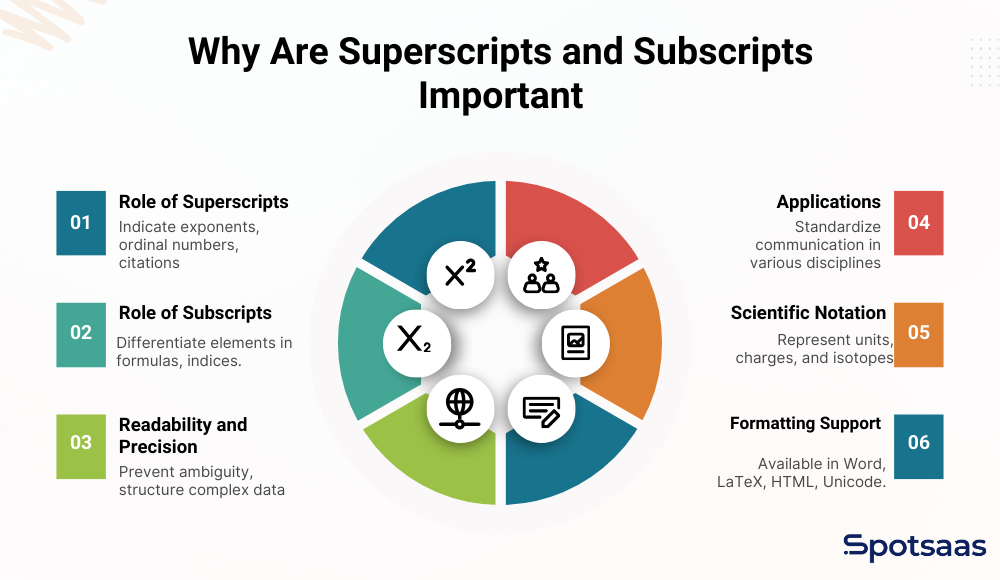
Role of Superscripts: Essential Uses in Math, Science, and Writing
Superscripts are raised characters that sit above the baseline. They typically mark mathematical exponents, ordinal indicators, and references in academic texts. In physics and engineering, they define powers and units of measurement, keeping equations and formulas accurate.
Role of Subscripts: Key Applications in Chemistry and Coding
Subscripts sit below the baseline and show up constantly in chemical formulas, variable indices, and phonetics. They keep elements distinct in scientific notation, which heads off misinterpretation in chemistry, biology, and computer science.
How Superscripts and Subscripts Enhance Readability and Precision
Using superscripts and subscripts organizes information more efficiently, which improves readability. They cut down on ambiguity in technical writing, so complex data comes across clearly. Their structured format lets professionals and students read equations, formulas, and references without second-guessing them.
Where Superscripts and Subscripts Are Used Across Different Fields
From mathematics and science to linguistics and engineering, superscripts and subscripts are tools that show up everywhere. They keep academic and professional documents consistent, helping convey information in a format that’s standardized and widely understood.
Scientific Notation: Using Superscripts and Subscripts for Accuracy
Superscripts and subscripts matter in scientific notation for representing units, atomic charges, and isotopes. Physics and chemistry use them to express elemental charges like Na⁺ and O²⁻ and isotopes such as U²³⁸ and C¹⁴, keeping elements and compounds clearly differentiated.
That usage standardizes complex scientific formulas and prevents misreadings in research and technical documents.
Formatting Superscripts and Subscripts: Tools and Software Support
Superscripts and subscripts are widely supported across platforms like Microsoft Word, Google Docs, LaTeX, and HTML, so integrating them into digital and print materials is straightforward. Unicode encoding keeps rendering consistent across devices, while OpenType fonts add consistent typographic quality.
That broad support makes it easier to hold onto accuracy in mathematical, scientific, and academic writing.
Top Fields Where Superscripts and Subscripts Are Commonly Used
Superscripts and subscripts matter across a range of disciplines, since they help organize information, keep it clear, and support accuracy in communication. Here’s a closer look at where they turn up most:
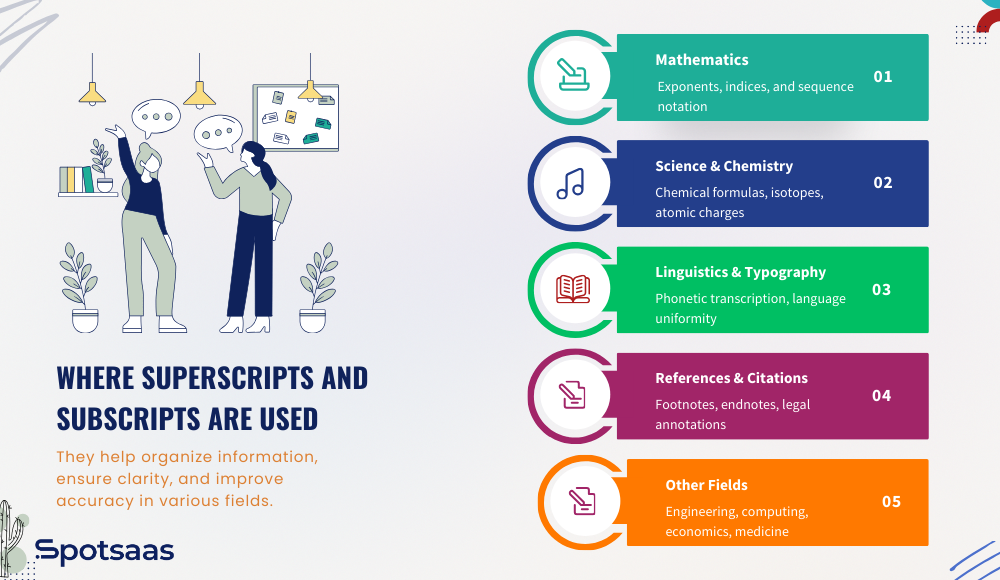
Superscripts and Subscripts in Mathematics: Exponents and Indices Explained
In mathematics, superscripts mark exponents and powers, while subscripts tell variables and indices apart in sequences and equations.
They’re central to algebra, calculus, and statistics for expressing mathematical ideas without needing extra words. Superscripts commonly signal repeated multiplication by a given number, while subscripts define sequences, coordinate points, and series.
Superscripts and Subscripts in Science and Chemistry
Subscripts are common in chemical formulas, where they represent the number of atoms in a molecule. In physics and chemistry, superscripts describe isotopes and atomic charges, giving notations a way to tell elements with different properties apart.
This notation keeps scientific formulas understood the same way across different studies.
Superscripts and Subscripts in Linguistics and Typography
Linguists often use superscripts in phonetic transcriptions to mark specific pronunciation patterns. In typography, they show up in abbreviations for ordinals, keeping written language consistent.
These phonetic and tonal markers help distinguish meaning in language studies, sharpening the analysis.
Using Superscripts for References and Citations
Superscripts mark footnotes and endnotes in academic and professional writing, making it easy to trace where an idea came from.
They let readers check additional information without breaking up the flow of the main text. While superscripts handle most citations, subscripts sometimes show up in legal and technical contexts to structure citations and annotations too.
Other Key Fields Using Superscripts and Subscripts
Superscripts and subscripts also show up regularly in engineering, computer science, economics, and medical notation.
They help structure formulas, index variables, and clarify dense technical documentation, keeping academic and professional writing accurate and consistent.
Subscript and Superscript: Clear Definition and Practical Uses
Superscripts and subscripts are characters positioned above or below the baseline, and each serves a different purpose in formatting text.
What Is a Subscript? Definition, Uses, and Examples
A subscript is a smaller character or number placed below the baseline of standard text, distinct from the regular flow of a sentence. Across fields like chemistry, mathematics, and programming, it adds meaning, indicates an amount, or tells one element apart from another that looks similar at a glance.
In practice, it fills the gap for clarity and correctness in technical writing or scientific documents.
Practical Uses of Subscripts in Chemistry, Math, and Programming
1. Chemistry
Subscripts are essential in chemistry for writing chemical formulas. They show how many atoms of each element make up a molecule, keeping chemically different compounds clearly distinguished.
Leaving them out risks misreading a chemical formula, which can create confusion in scientific communication.
For instance, in H₂O, the subscript denotes two hydrogen atoms with one oxygen, forming water. Similarly, CO₂ indicates carbon dioxide, while CO is a distinct compound with different properties.
2. Mathematics
In mathematics, subscripts label variables, show indices, or mark elements in sequences, which makes mathematical expressions more structured and easier to follow.
They help tell apart other variables, elements in a set, and terms in an equation.
For example, subscripts like x₁, x₂, x₃ differentiate values in a series, as seen in sequences like Fibonacci (F₀, F₁, F₂). They also define matrix positions, such as a₁₂, indicating the first row and second column.
3. Programming and Computing
In computer science and programming, subscripts get used for indexing and structuring data in arrays. Arrays are essentially ordered collections of elements, and subscripts locate the individual component a programmer needs.
For example, in programming languages like Python, Java, and C++, array indices use subscripts (e.g., array[0] for the first element). This allows systematic data retrieval, manipulation, and storage, which matters for database management and algorithm design.
Types of Subscripts: Dropped and Aligned Examples
Dropped Subscripts
These are the most common variety. They sit below the standard text line in a distinctive way, and show up regularly in mathematics, chemistry, and scientific notation for clarity.
Here, the subscript sits clearly apart from the body text for maximum legibility. This type works well for both print and digital work, and it requires accurate notation.
Aligned Subscripts
Unlike dropped subscripts, aligned subscripts sit at the same height as the surrounding text but appear slightly smaller.
This style is common in digital and typographic design, where line height matters a great deal for legibility. It keeps the subscript from disrupting the overall flow of the text.
In UI or mobile app design, for instance, aligned subscripts can achieve visual harmony while still staying distinguishable from standard text.
Some fonts and formatting styles use this approach purely for appearance, while other modern typesetting relies on it for a clean, organized look.
Why Subscripts Are Vital for Accurate Scientific and Technical Writing
Subscripts matter in technical writing, academic research, and digital text formatting. They add precision that heads off ambiguous interpretation in scientific formulas, mathematical equations, and programming structures.
Using them correctly keeps communication clear and consistent across fields, which is why they’re embedded so deeply in structured, professional writing.
What IS a Superscript? Meaning, Uses, and Real-World Examples
A superscript is a smaller character or number that appears above the standard text line, set apart from the rest of the sentence. It shows up regularly in mathematics, academic writing, and ordinal numbering to convey precise information compactly, without needing extra words to explain it.
Superscripts improve readability, cut down on misreadings, and help structure information more effectively.
Top Uses of Superscripts in Math, Science, and Academic Writing
1. Mathematics
Superscripts show up in mathematics mainly for exponents and powers, and can shorten how multiplication gets represented, making calculation, reading, and understanding easier.
They also appear in scientific notation for very large or very small numbers, which comes in handy for physics and engineering. Superscripts aimed at simplifying mathematical expressions turn up throughout algebra, calculus, and physics equations.
Example: In 3⁴, the superscript “4” means that 3 is multiplied by itself four times (3 × 3 × 3 × 3 = 81).
2. Footnotes and Citations
Superscripts mark footnotes and citations, which is useful when reading research papers, books, and legal documents. The main body of text stays uncluttered, letting authors point to sources without breaking the reading flow.
Footnotes are typically numbered in superscript, directing readers toward additional information or references in the footer or appendix. This is standard practice in academic writing styles such as APA, MLA, or Chicago.
Example: “This theory has been widely accepted in recent studies⁵.”
3. Ordinal Numbers
Superscripts show up in ordinal numbers, which indicate rank or order, and this is common in formal writing, sports rankings, or lists of events.
Lifting the suffix “st” in 1ˢᵗ or “nd” in 2ⁿᵈ keeps the number in the main text while still improving readability. Most word processors and publishing tools automatically format ordinal numbers with superscripts for consistency.
Example: “She finished 1ˢᵗ in the competition,” where the superscripted st clearly distinguishes the ordinal number from the main text.
4. Science and Engineering
A superscript in physics, chemistry, and engineering marks an abbreviation for a unit of measurement, an atomic charge, or a special notation. Einstein’s equation E = mc², for instance, uses the superscript “2” to indicate squaring.
In chemistry, superscripts denote ion charges: Na⁺, O²⁻. That specificity is what scientific documentation depends on.
Types of Superscripts: Standard and Extended Explained
1. Standard Superscripts
Standard superscripts rise slightly above the baseline but stay within normal text height. They’re used in citations, ordinal indicators, and typical scientific equations.
Like other standard superscripts, they add emphasis without hurting the readability of the surrounding text.
Example: E = mc² (where “²” is a standard superscript denoting squaring in Einstein’s energy equation).
2. Extended Superscripts
Extended superscripts rise above the standard text height, and usually show up in more complex expressions or scientific notation when more than one superscript is stacked. They’re common in advanced algebra, physics, and related fields.
Example: In tensor algebra or set theory, expressions like xⁱʲ (where both i and j are superscripts) might be used to denote multi-level indices.
Why Superscripts Are Essential for Professional and Academic Writing
Superscripts play a real role in structuring written information, keeping it precise, and preserving readability. They separate different mathematical values, mark references in academic writing, and organize ranked data efficiently.
Used correctly, they prevent misinterpretation and keep scientific, technical, and professional communication consistent. Understanding when and how to use them helps writers and researchers make their work clearer and more effective.
The table below lays out the differences between superscripts and subscripts side by side, showing how each is used in different contexts to support readability and precision in writing across math, science, typography, and code.
| Feature | Superscript | Subscript |
|---|---|---|
| Position | Raised above baseline | Lowered below baseline |
| Common Uses | Exponents, footnotes, ordinal numbers, ion charges | Chemical formulas, indices, phonetics, programming arrays |
| Mathematics | Powers & exponents (x2, 103) | Variables & indices (x1, an) |
| Science | Atomic charges, units (Na+, E = mc2) | Molecular formulas, isotopes (H2O, CO2) |
| Typography | Ordinal indicators (1ˢᵗ, 2ⁿᵈ), footnotes (Text5) | Phonetic transcription, linguistic notation |
| Programming | Occasionally in algorithms & data structures | Array indexing, variable differentiation (array[0], a1) |
| HTML Formatting | <sup> tag (x<sup>2</sup>) | <sub> tag (H<sub>2</sub>O) |
| Readability | Denotes hierarchy in expressions | Differentiates elements in structured data |
Examples of Superscript and Subscript Alignment in Writing
Superscripts and subscripts turn up in all sorts of contexts, from scientific notation to mathematical equations. A few examples of what that alignment looks like:
In chemistry, the formula for water is written as H2O, where the “2” appears as a subscript to show there are two hydrogen atoms. Mathematical notation offers another example, such as writing exponents or indices.
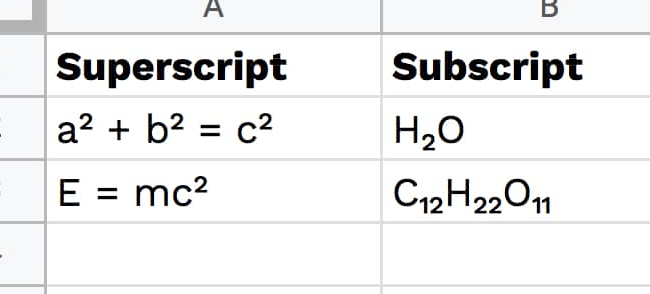
Similarly, 3^4 represents three raised to the power of four, with the “4” written as a superscript above the “3”. These examples show how superscripts and subscripts carry specific information within different fields.
Best Software for Superscript and Subscript Formatting Support
Plenty of software and platforms include built-in support for superscripts and subscripts, which makes applying these formatting styles simpler across document editing, web development, academic publishing, and typography.
These features help preserve the clarity and accuracy of text, especially in scientific, mathematical, and technical writing.
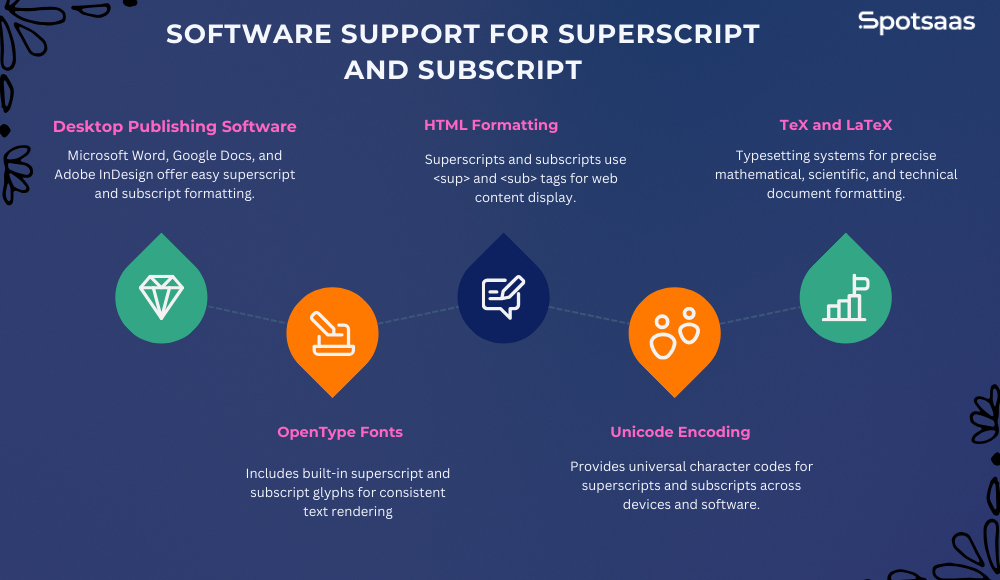
Desktop Publishing Software
Desktop Publishing Software applications like Microsoft Word, Google Docs, and Adobe InDesign let users apply superscripts and subscripts in just a few clicks. These tools include formatting options that keep text alignment and readability intact.
- In Microsoft Word, users can select text and use the Font settings or shortcut keys (
Ctrl+Shift++for superscript andCtrl+=For subscript) to format text instantly. - Google Docs offers the same formatting under the Format > Text > Superscript/Subscript menu, which keeps it accessible for cloud-based document editing.
- Adobe InDesign offers professional-grade text formatting with precise control over typographic elements, making it a preferred choice for publishing and design professionals.
These software programs make sure superscripts and subscripts appear clearly without disrupting the document layout.
HTML Formatting
For web development, superscripts and subscripts can be applied using HTML tags, so they display correctly in web browsers.
- Superscripts: The
<sup>tag raises text above the baseline. Example:E = mc<sup>2</sup>appears as E = mc². - Subscripts: The
<sub>tag lowers text below the baseline. Example:H<sub>2</sub>Oappears as H₂O.
These tags are common in online scientific articles, mathematical explanations, and technical documentation. Since every modern browser supports them, they’re a reliable way to format text for web content.
TeX and LaTeX
TeX and LaTeX are widely used typesetting systems built for producing high-quality scientific, mathematical, and technical documents.
These systems offer extensive support for superscripts and subscripts, so complex equations and chemical notations display correctly.
- Superscripts: Written using the caret (
^) symbol. Example:x^2renders as x². - Subscripts: Written using the underscore (
_) symbol. Example:H_2Orenders as H₂O.
LaTeX shows up constantly in research papers, academic journals, and university theses because it delivers professional-quality formatting and keeps mathematical and scientific notation consistent.
Unicode Encoding
Unicode provides dedicated character codes for superscripts and subscripts, so they display consistently across different platforms, devices, and software.
Unlike basic text formatting, Unicode characters stay intact even when copied between applications or shown in systems that don’t support rich text formatting.
- Superscript Unicode examples: ¹ (U+00B9), ² (U+00B2), ³ (U+00B3)
- Subscript Unicode examples: ₁ (U+2081), ₂ (U+2082), ₃ (U+2083)
This makes Unicode especially useful in digital publishing, data encoding, and programming, wherever standardized text representation matters.
Unicode superscripts and subscripts also show up in scientific databases and digital communication tools to keep text display consistent.
OpenType Fonts
Modern OpenType fonts include built-in support for superscripts and subscripts, keeping them scaled, aligned, and readable across different text styles and sizes. OpenType fonts show up widely in:
- Professional publishing: keeping typographic representation high-quality in books, reports, and journals.
- Graphic design: creating visually consistent text with formatted numbers and variables.
- User interfaces: letting applications support superscripts and subscripts within text rendering engines.
Some OpenType fonts include specialized glyphs for superscripts and subscripts, accessible through font settings in word processors, design software, or coding environments.
That makes them useful anywhere text clarity and precision matter.
Why Software Support for Superscripts and Subscripts Is Crucial
Supports Multiple Formats
Superscripts and subscripts get used across word processors, web content, and digital media alike. Proper formatting keeps them appearing consistently, whether in printed documents, on websites, or in mobile apps.
Ensures Professional Presentation
A structured, polished document matters in academic, corporate, and technical writing. Correctly formatting mathematical expressions, citations, and specialized notation adds to the professional look of reports, scientific papers, and presentations.
Cross-Platform Compatibility
With different operating systems and software handling text in their own ways, proper formatting keeps superscripts and subscripts clear and correctly displayed across devices and applications. Whether viewed on a desktop, tablet, or smartphone, well-formatted text keeps its meaning and readability.
Enhances Usability in Various Fields
Superscripts and subscripts matter across publishing, programming, engineering, and typography. They help define indices in arrays and data structures for coding and software development.
They also allow precise representation of chemical formulas and mathematical variables in scientific research. Using them consistently across fields keeps communication clear.
Prevents Formatting Errors
Incorrect formatting can lead to misinterpretation, especially in technical and scientific writing. A misplaced exponent or chemical notation, for instance, can change the meaning of a formula entirely, leading to errors in calculations or scientific interpretation.
Software that handles superscripts and subscripts correctly helps prevent that kind of mistake by keeping characters placed and represented accurately.
Facilitates Seamless Content Creation
Knowing how different software handles superscripts and subscripts makes text structuring more efficient. Whether you’re using Microsoft Word, LaTeX, HTML, or Unicode, knowing the right formatting method helps you build well-structured content with less effort.
That matters especially in academic research, publishing, and digital documentation, where precision counts.
Conclusion: Mastering Superscripts and Subscripts for Better Writing
Understanding superscripts and subscripts matters for clear, precise communication in mathematics, science, academic writing, and technology, and that matters whether you’re a student, a researcher, or just someone formatting a technical document. These typographic tools separate text elements, improve readability, and support accuracy across disciplines.
With support built into software like Microsoft Word, Google Docs, LaTeX, and HTML, applying superscripts and subscripts is now straightforward and accessible. Used correctly, they prevent misreadings and strengthen how information is structured.
Getting superscripts and subscripts right makes your writing more professional, organized, and easy to follow, whether you’re working with scientific equations, citations, or chemical formulas, and it’s a small habit that pays off every time someone else has to read your work.
FAQs About Superscripts and Subscripts
What is the difference between superscript and subscript?
Superscript appears as a small line of type above the standard text level, while subscript refers to tiny letters or numbers written below the standard text layout.
How does using superscript or subscript affect writing style?
Superscript and subscript contribute significantly to the writing conventions of specific fields such as mathematics or chemistry by providing an effective textual representation of complex ideas in these subjects.
Are there specific rules for document formatting involving superscripts and subscripts?
Yes, the correct use of superscripts and subscripts follows specific document formatting standards, including where they must be placed relative to regular text: above for superscripts, below for subscripts.
How do I make a character appear as a descender with subscript in terms of font style?
Using your chosen font style, you can produce characters called ‘descenders’ through subscripting; this shifts them downward from regular baseline typographical arrangements.
Compare alternatives to the tools in this post

- Independent picks for exactly what you just read about
- Matched to your team size & needs
- Vendors don't pay for placement
Step 1 of 4
How big is your team?
We tailor recommendations to companies your size.















Related Articles
Accounting Software
Xero vs QuickBooks 2026: Pricing, Payroll and Who Each Suits
Continue reading →
Accounting Software
FreshBooks vs QuickBooks 2026: Pricing, Clients, Users and Payroll Compared
Continue reading →
Accounting Software
AI for Accounting in 2026: 8 Use Cases, Tools and Controls for Finance Teams
Continue reading →

Accounting Software
Best QuickBooks Alternatives in 2026: 5 Competitors Compared on Price (Including Free)
Continue reading →