
Why this post matters
The 401(k) rule changes for 2026 put new work on payroll, plan administration, and plan documents. Under the SECURE 2.0 Act, high earners must now make catch-up contributions as Roth, and most plans must be amended by December 31, 2026.
What you’ll learn here
A 2026 employer checklist covering Roth catch-up payroll setup, ages 60–63 super catch-up, mandatory auto-enrollment, long-term part-time eligibility, 2026 testing thresholds, startup tax credits, and the plan amendment deadline.
Who should read this
HR leaders, payroll administrators, and small business owners who sponsor a 401(k) plan and own 401(k) compliance for the 2026 plan year.
Most SECURE 2.0 provisions are already in place, but 2026 is the year several of them land on payroll and plan documents at once. High earners must make catch-up contributions as Roth, contribution limits have risen again, and most plans must adopt their SECURE 2.0 amendments by December 31, 2026.
This guide is the employer compliance checklist for 2026: what plan sponsors, HR, and payroll teams need to set up, test, and document. For a provision-by-provision explanation of the law, see our guide to SECURE 2.0 Act key tax changes.
Overview of key 401(k) rule changes employers must act on in 2026
The changes come from the SECURE 2.0 Act and the IRS limits announced for 2026. For employers, they fall into three groups: payroll setup (Roth catch-ups, new limits, the ages 60 to 63 catch-up), eligibility rules (auto-enrollment and long-term part-time workers), and plan governance (testing thresholds and the amendment deadline).
2026 401(k) changes and their impact on employer responsibilities
Each change below affects how your 401k plan is run day to day. The lists under each heading are the actions to complete.
Mandatory Roth catch-up for high earners starts in 2026
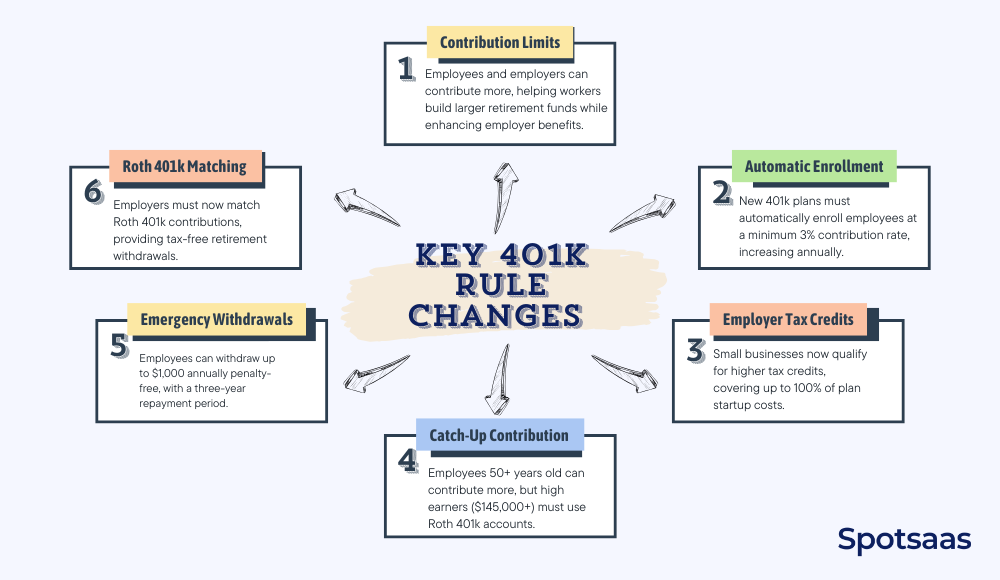
From 2026, employees age 50+ whose prior-year FICA wages from your company exceeded $150,000 must make catch-up contributions as Roth 401k contributions. The final regulations allow good-faith compliance in 2026 and apply in full from 2027.
Employer Impact:
- Flag employees whose 2025 FICA wages exceeded $150,000 and route their 2026 catch-ups to Roth in payroll.
- Add a Roth option if your plan offers catch-ups but not Roth, so affected employees can keep making catch-ups.
- Confirm your recordkeeper and payroll provider handle the wage test and the Roth routing the same way.
Ages 60–63 super catch-up administration
Employees who turn 60, 61, 62, or 63 during the year can make a catch-up of $11,250 instead of the standard $8,000, for a total deferral of up to $35,750 in 2026.
Employer Impact:
- Set payroll to apply the higher catch-up cap by birth year, and drop it back to the standard cap the year an employee turns 64.
- Apply the Roth catch-up rule to super catch-ups for employees above the $150,000 wage threshold.
Update payroll for 2026 contribution limits
For 2026, the employee deferral limit is $24,500, the age 50+ catch-up is $8,000, and total annual additions are capped at $72,000. The full tables are in our guide to 2026 401(k) contribution limits.
Employer Impact:
- Update payroll systems with the 2026 deferral and catch-up caps.
- Tell employees the new limits before open enrollment or year-end elections.
- Check that employer matching formulas stay within the $72,000 annual additions limit.
Automatic enrollment for 401(k) plans established after 2022
New 401k plans established after December 29, 2022 must use automatic enrollment for plan years from 2025. The default rate is 3% to 10%, rising 1% a year to at least 10% and no more than 15%. Businesses with 10 or fewer employees, businesses under 3 years old, and church and government plans are exempt.
Employer Impact:
- Confirm whether your plan’s establishment date puts it under the mandate.
- Set default and escalation rates in plan documents and payroll.
- Send clear notices on opt-out rights and the escalation schedule.
Long-term part-time employee eligibility
For plan years from 2025, employees who work 500 or more hours in each of 2 consecutive years must be allowed to make deferrals, even if they never reach full-time hours.
Impact on Employers:
- Track hours for part-time and seasonal workers each plan year.
- Enroll newly eligible long-term part-time employees on time and send them plan notices.
Startup tax credits for small business 401(k) plans
Employers with 50 or fewer employees can claim a credit of up to 100% of plan administration costs for the first 3 years. A separate employer contribution credit is worth up to $1,000 per employee.
Employer Impact:
- Estimate the credits before choosing a plan design and provider.
- Work with your tax advisor to claim both credits correctly.
Emergency withdrawals and Roth employer contributions
Two optional features remain available. Since 2024, plans can allow one penalty-free emergency withdrawal per year of up to $1,000. Since 2023, employers can let employees receive employer-matching and nonelective contributions as Roth.
Employer Implication:
- Decide whether to offer each feature and record the choice in your plan amendments.
- If you offer them, set up tracking for withdrawals and Roth employer contributions.
Summary of 2026 401(k) changes: what employers need to do
Route high-earner catch-ups to Roth, apply the 2026 limits and the ages 60 to 63 catch-up, confirm auto-enrollment and part-time eligibility, and amend plan documents by December 31, 2026.
2026 401(k) administrative and compliance updates for employers
Beyond payroll, the 2026 changes affect plan documents, testing, and HR policy. Benefits teams should review each area with their payroll systems and plan provider.
SECURE 2.0 plan amendment deadline: December 31, 2026
Most non-governmental plans must adopt SECURE 2.0 amendments by December 31, 2026. Until then, plans can operate under the new rules, but the written plan must match how the plan has run by the deadline. Keep records of the operational choices you made, such as Roth catch-ups and optional withdrawals, so the amendment reflects them. Review Department of Labor (DOL) ERISA guidance alongside IRS rules.
2026 thresholds for nondiscrimination testing
Use the 2026 figures when running ADP/ACP and top-heavy tests:
- Highly compensated employee threshold: $160,000.
- Compensation limit for plan calculations: $360,000.
- Key employee threshold for top-heavy testing: $235,000.
HR policy updates for 401(k) compliance in 2026
HR and benefits departments must:
- Update plan documents for Roth catch-ups, auto-enrollment, and any optional features you adopt.
- Set up payroll for Roth catch-ups, the super catch-up, and student loan matching (allowed since 2024) if you offer it.
- Explain opt-out rights, Roth catch-up rules, and withdrawal options in plain guides and Q&A sessions.
- Monitor participation and opt-out rates and adjust defaults where needed.
Benefits of the 2026 401(k) rules for employers and employees
Higher limits let employees save more, auto-enrollment raises participation, and startup credits lower plan costs for small employers. Clean compliance with regulations also protects the plan’s tax status. Emergency withdrawals give employees an option short of 401k loans.
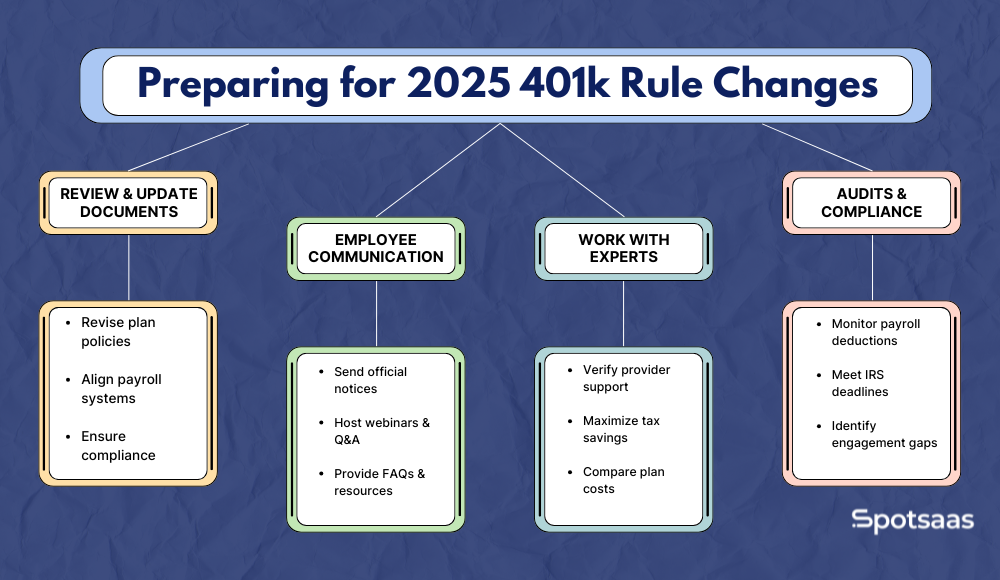
2026 employer compliance checklist: step-by-step
Work through these steps in order. Step 1 has a hard deadline of December 31, 2026.
Step 1: Amend 401(k) plan documents by December 31, 2026
Work with your 401k providers, ERISA counsel, and recordkeeper to adopt SECURE 2.0 amendments. Cover:
- Roth catch-up and, if needed, a new Roth option.
- Automatic enrollment and escalation, if your plan is subject to the mandate.
- Long-term part-time eligibility.
- Optional features you adopted, such as emergency withdrawals and Roth employer contributions.
Step 2: Set up payroll for 2026 rules
Make payroll systems match the plan:
- Apply the 2026 deferral and catch-up caps, including the $11,250 catch-up for ages 60 to 63.
- Run the $150,000 prior-year FICA wage test and route those employees’ catch-ups to Roth.
- Apply auto-enrollment defaults and annual escalation.
Step 3: Communicate 401(k) rule changes clearly to employees
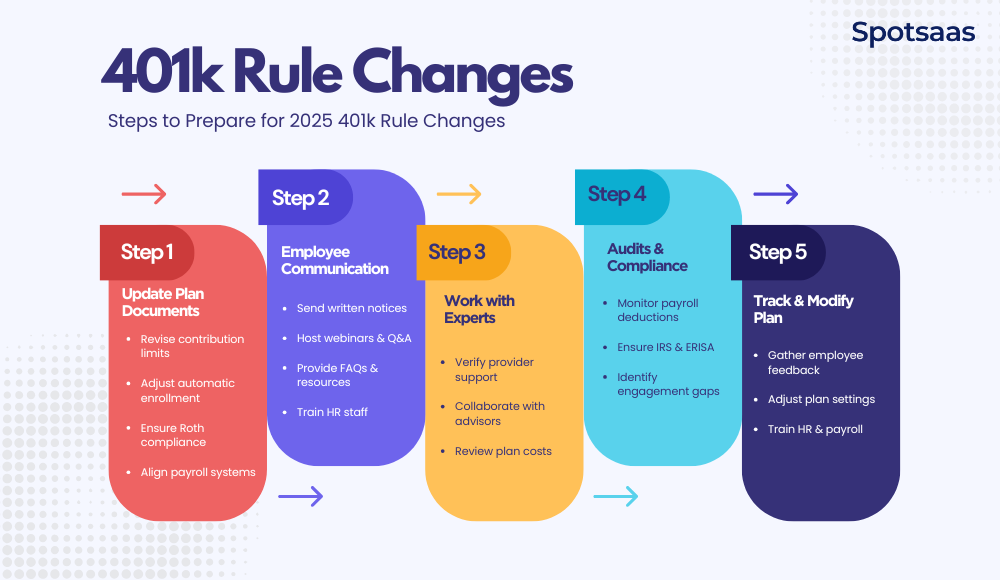
- Send written notices on new limits, Roth catch-up rules, and opt-out procedures.
- Hold short Q&A sessions and give HR staff answers to common questions.
Step 4: Confirm provider support
- Confirm your 401k providers support Roth catch-ups, the super catch-up, and automatic escalation.
- Compare fees, investment options, and admin capabilities when renewing.
Step 5: Run testing and internal compliance audits
Regular audits confirm compliance with reporting and plan operation:
- Run nondiscrimination testing with the $160,000 HCE threshold and $360,000 compensation limit.
- Check payroll deductions, matches, and long-term part-time hours for accuracy.
- Prepare 2026 W-2s for workers by February 1, 2027.
Conclusion: Navigating 401(k) rule changes in 2026 with confidence
The 2026 work for employers is concrete: Roth catch-up payroll, new limits, eligibility tracking, testing with 2026 thresholds, and plan amendments by December 31, 2026. Teams that finish these steps now start 2027, when the Roth catch-up regulations fully apply, with clean records and a plan document that matches practice.
Frequently asked questions
What are the key 401k rule changes for employers in 2026?
Employees whose prior-year FICA wages exceeded $150,000 must make catch-up contributions as Roth, the ages 60 to 63 super catch-up of $11,250 continues, and most plans must adopt SECURE 2.0 amendments by December 31, 2026. Payroll must also apply the 2026 limits of $24,500 for deferrals and $8,000 for age 50+ catch-ups.
How do the automatic enrollment rules affect employers?
401(k) and 403(b) plans established after December 29, 2022 must auto-enroll eligible employees for plan years from 2025, at a default rate of 3% to 10% that rises 1% a year to at least 10% (maximum 15%). Businesses with 10 or fewer employees, businesses under 3 years old, and church and government plans are exempt.
What are the new catch-up contribution requirements?
From 2026, employees age 50+ whose prior-year FICA wages from your company exceeded $150,000 must make catch-up contributions as Roth. Plans with catch-ups need a Roth option so these employees can keep contributing. 2026 is a good-faith compliance year, and the final regulations fully apply in 2027.
Are there employer tax credits for starting a 401(k) plan?
Yes. Employers with 50 or fewer employees can claim a startup credit of up to 100% of plan administration costs for the first 3 years, plus an employer contribution credit of up to $1,000 per employee.
How should employers prepare for the 2026 changes?
Adopt SECURE 2.0 plan amendments by December 31, 2026, set up payroll to route catch-ups for employees above the $150,000 wage threshold to Roth, update contribution caps, track long-term part-time hours, and run nondiscrimination testing with the $160,000 HCE threshold and $360,000 compensation limit.

- Independent picks for exactly what you just read about
- Matched to your team size & needs
- Vendors don't pay for placement
Step 1 of 4
How big is your team?
We tailor recommendations to companies your size.















Related Articles
401K Providers
Best 401(k) Providers for Small Businesses in 2026: 5 Picks Compared
Continue reading →
401K Providers
5 Best 401k Plans for Freelancers and Gig Workers in 2026
Continue reading →
401K Providers
IRS Tax Code Changes for 2026: Brackets, Deductions and Credits
Continue reading →
401K Providers
Betterment vs Guideline 401k: Which Retirement Plan Is Best for Your Small Business?
Continue reading →