
Why This Guide Matters
The SECURE 2.0 Act changes how savers and individual taxpayers handle retirement money in 2026. The biggest new rule this year: high earners must make 401(k) catch-up contributions as Roth. This guide explains what applies now, what is coming in 2027 and 2033, and how each change affects what you save or owe.
What You’ll Learn Here
This guide covers the provisions that touch your own return: the mandatory Roth catch-up, the ages 60 to 63 super catch-up, RMD age rules, penalty-free emergency withdrawals, student loan matching, Roth employer contributions, and the Saver’s Match.
Who Should Read This
This is written for employees with a workplace plan, savers aged 50 and over, retirees, workers repaying student loans, and tax advisors who want to plan 2026 contributions and withdrawals around the rules now in force.
The SECURE 2.0 Act, signed December 29, 2022, builds on the SECURE Act of 2019. It rolls out in stages, with provisions that started in 2023, 2024 and 2025, a major catch-up change in 2026, the Saver’s Match in 2027, and a second RMD age increase in 2033.
For individual taxpayers, the law raises how much older workers can save, moves some contributions to Roth, delays mandatory withdrawals, and opens new ways to reach retirement money in an emergency.
Quick Summary: SECURE 2.0 Act at a Glance
- From 2026, catch-up contributions for workers with prior-year FICA wages above $150,000 must go in as Roth.
- Workers aged 60 to 63 can make a super catch-up of $11,250 in 2026.
- The Required Minimum Distribution (RMD) age is 73 and rises to 75 in 2033.
- New 401(k) and 403(b) plans auto-enroll employees, who can still opt out.
- The Saver’s Match, a federal deposit of up to $1,000 into your retirement account, starts in tax year 2027.
Several provisions are already in effect: the RMD age of 73 since 2023, Roth employer contributions since 2023, emergency withdrawals and student loan matching since 2024, and the super catch-up since 2025. The mandatory Roth catch-up starts in 2026, the Saver’s Match follows in 2027, and the RMD age climbs again in 2033.
Top SECURE 2.0 Act Provisions That Affect Your Finances
The SECURE 2.0 Act tax implications for individuals center on how much you can put away, whether it goes in pre-tax or Roth, and when you must take it out.
Automatic Enrollment for Retirement Plans
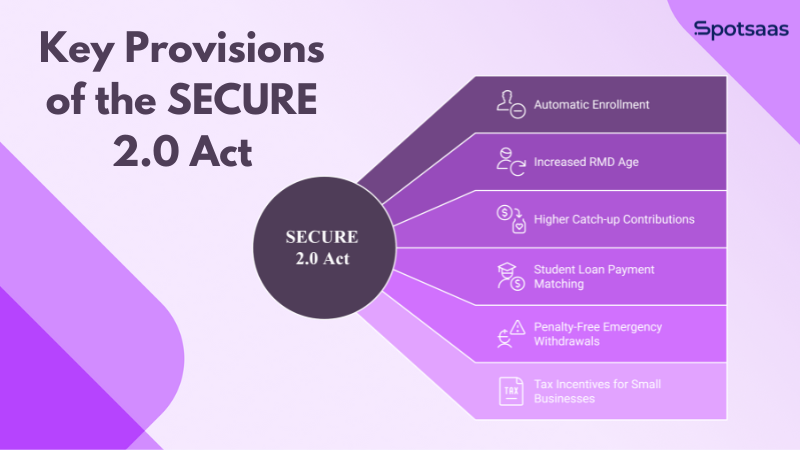
401(k) and 403(b) plans established after December 29, 2022 must automatically enroll eligible employees for plan years starting in 2025. The starting rate is between 3% and 10% of pay, and it rises by 1% a year until it reaches at least 10%, capped at 15%.
You can opt out or choose a different rate at any time. Because default contributions are usually pre-tax, they lower your taxable wages from your first paycheck. Small businesses with 10 or fewer employees, businesses less than 3 years old, and church and government plans are exempt.
Increased RMD (Required Minimum Distribution) Age
Previously, individuals had to start withdrawing from their retirement accounts at age 72. The SECURE 2.0 Act raised this to 73 from 2023, so savings can stay invested and grow tax-deferred for longer.
In 2033, the required minimum distribution (RMD) age rises again to 75. Which age applies to you depends on your birth year, so check it before you plan withdrawals or Roth conversions.
Higher Catch-up Contributions for Older Savers
Workers aged 50 and older can add catch-up contributions on top of the standard limit. Since 2025, workers aged 60 to 63 get a larger “super catch-up,” which is $11,250 for 2026.
From 2026, if your prior-year FICA wages from your employer were above $150,000, every catch-up dollar must go in as Roth. You pay tax on it now, and qualified withdrawals later come out tax-free. Final IRS regulations apply in full from 2027, with good-faith compliance expected from plans in 2026.
Student Loan Payments Count Toward Employer Matching
Since 2024, plans can treat your student loan payments as if they were retirement contributions for employer matching purposes. Your employer deposits a match into your retirement account even when your spare cash goes to the loan.
This helps younger workers who would otherwise choose between paying down debt and collecting the match. Ask HR whether your plan offers it, since it is optional for employers.
Penalty-Free Emergency Withdrawals
Withdrawals before age 59½ usually carry a 10% penalty on top of income tax. Since 2024, you can take one emergency personal expense withdrawal a year of up to $1,000 without the penalty. Income tax still applies.
You can repay the withdrawal within three years. Until you repay it, or make equal new contributions, further emergency withdrawals are restricted. Some employers also offer emergency savings accounts linked to the retirement plan, funded with after-tax money up to a set cap.
Roth Employer Contributions
Since 2023, plans can let you take employer matching and nonelective contributions as Roth instead of pre-tax. Roth employer money counts as taxable income in the year it is deposited, and qualified withdrawals in retirement are tax-free. It suits savers who expect a higher tax rate later. Your plan has to offer the option.
Saver’s Match Arrives in 2027
Starting with tax year 2027, the Saver’s Credit becomes the Saver’s Match: a federal contribution of up to $1,000 deposited straight into your retirement account instead of a credit on your return. For 2026, the existing Saver’s Credit still applies, with AGI limits of $80,500 for married filing jointly, $60,375 for head of household, and $40,250 for single filers.
How SECURE 2.0 Affects Individual Tax Filers and Retirement Strategies
For 2026 returns, the provisions below decide how much of your income is taxed now, how much later, and how much you can reach early without a penalty.
| Provision | Key Changes | Tax Implications |
|---|---|---|
| Changes in RMDs | RMD age 73 (since 2023), rising to 75 (2033) | Delays taxable distributions, allowing more tax-deferred growth |
| Mandatory Roth Catch-up | From 2026, catch-ups must be Roth if prior-year FICA wages exceeded $150,000 | No upfront deduction on catch-ups; qualified withdrawals are tax-free |
| Super Catch-up (Ages 60-63) | $11,250 catch-up for 2026 | Reduces taxable income if contributed pre-tax |
| New Emergency Withdrawal Rules | One withdrawal a year up to $1,000 without penalty | Income tax still applies; repayment option within 3 years |
| Student Loan Benefits | Employers can match student loan payments with retirement contributions | Employer contributions not taxed when made; taxable upon retirement withdrawal |
| Saver’s Match | Up to $1,000 deposited into your account from tax year 2027 | Replaces the Saver’s Credit |
Together, these rules give you more control over when your retirement income is taxed.
Changes in RMDs and Tax Implications
Retirees now begin required minimum distributions at 73, and the age rises to 75 in 2033. That gives you extra years in which your money keeps growing tax-deferred before withdrawals become mandatory.
Withdrawals from traditional IRAs and 401k accounts are taxed as ordinary income. If you have other income in early retirement, delaying RMDs, or using those years for partial Roth conversions, can help you stay in a lower tax bracket for longer.
The trade-off: a larger balance at RMD age means larger required withdrawals, which can raise taxable income later in retirement.
Mandatory Roth Catch-up for High Earners in 2026
2026 is the first year the Roth catch-up rule applies. If your FICA wages from your employer in 2025 were above $150,000, your 2026 catch-up contributions go in as Roth, so they no longer reduce your taxable income this year. Savers at or below that threshold can still choose pre-tax catch-ups, which lower taxable income in the year they are made. If your plan has no Roth option, ask HR how it is handling catch-ups.
For 2026, the 401(k) deferral limit is $24,500, the age 50+ catch-up is $8,000 (a $32,500 total), the ages 60 to 63 catch-up is $11,250 (a $35,750 total), and the IRA limit is $7,500 plus a $1,100 catch-up. Full tables are in our 2026 401(k) contribution limits guide, and our 401k or IRAs comparison explains which account fits you.
New Emergency Withdrawal Rules
An emergency personal expense withdrawal of up to $1,000 a year avoids the 10% early withdrawal penalty, though the amount is still taxed as income. You can repay it within three years. Until you do, further emergency withdrawals are restricted.
Student Loan Benefits and Tax Reporting
Many employees put student debt ahead of contributions to a retirement plan and miss out on the employer match. Student loan matching closes that gap.
For tax purposes, these contributions are treated like standard employer matches: they are not taxable income when made, unless you elect Roth employer contributions, and they are taxed like other traditional plan withdrawals in retirement.
What to Check Before You File in 2027
When you file your 2026 return, confirm whether your catch-ups were made as Roth, whether any employer contributions were made as Roth and reported as income, and whether you took an emergency withdrawal. Someone in their early 40s gains little from the higher RMD age, while a 61-year-old high earner should plan around both the super catch-up and the Roth rule.
SECURE 2.0 Act for Employers: Tax Credits, Payroll & Compliance Explained
Employers carry the plan-side work, including auto-enrollment notices, payroll setup for the Roth catch-up, tax reporting, changes to their tax filing process, and compliance issues such as the December 31, 2026 plan amendment deadline for most plans. Employers with 50 or fewer employees can claim a 100% tax credit on plan startup costs plus up to $1,000 per employee for contributions, and our 2026 401(k) employer compliance guide walks through each step.
Smart Tax Planning Tips Using SECURE 2.0 Provisions
The SECURE 2.0 Act gives individual savers several levers for 2026: how much to contribute, whether to use pre-tax or Roth, and when to draw down.
| Strategy | How It Works | Tax Benefit |
|---|---|---|
| Maximizing 401(k) & IRA Contributions | Higher limits for those over 50; super catch-up at ages 60-63 | Pre-tax contributions reduce taxable income; Roth contributions grow tax-free |
| Planning for the Roth Catch-up | Required from 2026 if prior-year FICA wages exceeded $150,000 | Builds tax-free retirement income |
| Delaying Required Minimum Distributions (RMDs) | RMD age 73 (since 2023), rising to 75 (2033) | Allows savings to grow tax-deferred longer, reducing taxable income |
| Penalty-Free Emergency Withdrawals | Up to $1,000 per year can be withdrawn without penalty | Avoids the 10% early withdrawal penalty |
| Choosing Roth Employer Contributions | Take employer match as Roth where the plan allows | Taxed now; qualified withdrawals tax-free |
| Using the Saver’s Match | Up to $1,000 deposited into your account from tax year 2027 | Boosts savings for lower- and moderate-income workers |
How Individuals Can Optimize Contributions and Tax Deductions
Individuals can reduce taxable income by maximizing pre-tax 401k and IRA contributions, with higher limits from age 50 and a larger catch-up at 60 to 63. Delaying required minimum distributions (RMDs) until 73 (75 from 2033) lets savings grow tax-deferred longer.
High earners making catch-up contributions in 2026 must use Roth, so those withdrawals come out tax-free later. The penalty-free $1,000 emergency withdrawal adds flexibility, with the option to repay within three years.
Retirement Planning Considerations Under New Rules
Delaying RMDs gives retirees more time to withdraw funds and manage taxable income. Balancing pre-tax and Roth money, through Roth catch-ups and Roth employer contributions, gives you more choice over which bucket to draw from each year.
A tax or financial advisor can help you apply the SECURE 2.0 Act’s specific requirements to your own situation.
5 Action Steps to Maximize Tax Benefits from SECURE 2.0 Act
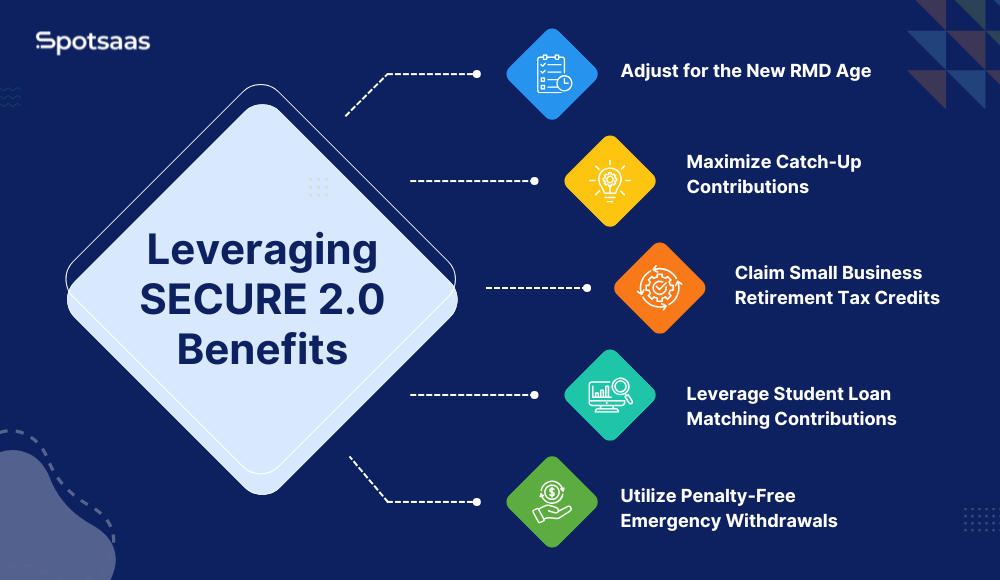
Here are five steps to put these changes to work for your 2026 taxes.
Step 1: Adjust for the New RMD Age
The required minimum distribution (RMD) age is 73 and rises to 75 in 2033. Retirees can delay withdrawals and let retirement funds grow tax-deferred longer.
Planned withdrawals can help reduce taxable income and avoid large tax bills later. Consider a Roth conversion to shift pre-tax savings into a tax-free account.
Step 2: Maximize Catch-Up Contributions
Individuals aged 50 and older can contribute extra to their 401k, 403b, and IRA accounts. In 2026, those aged 60 to 63 can add a super catch-up of $11,250 to a 401(k).
If your 2025 FICA wages from your employer were above $150,000, your 2026 catch-ups must be Roth. Adjust payroll elections early in the year so contributions are spread across every paycheck.
Step 3: Decide on Roth Employer Contributions
If your plan allows it, you can take employer match and nonelective contributions as Roth. You pay tax on them now in exchange for tax-free qualified withdrawals later.
This works best if you expect a higher tax rate in retirement. Check that the extra taxable income fits your 2026 withholding.
Step 4: Use Student Loan Matching Contributions
Since 2024, employers can match student loan payments with contributions to an employee’s retirement account. Employees paying off loans can still build retirement savings.
Ask HR whether your plan offers it and what proof of loan payments it needs.
Step 5: Utilize Penalty-Free Emergency Withdrawals
Individuals can withdraw up to $1,000 per year from retirement accounts without the usual 10% penalty for emergencies. If the amount is not repaid within three years, further emergency withdrawals will be restricted.
Some employers offer emergency savings accounts linked to retirement plans for additional flexibility. Track withdrawals so the income tax on them is not a surprise at filing time.
Final Thoughts: Why SECURE 2.0 Act Matters for 2026 Tax Planning
For individual savers, 2026 brings the mandatory Roth catch-up for high earners alongside the super catch-up for ages 60 to 63, the RMD age of 73, penalty-free emergency withdrawals, student loan matching, and Roth employer contributions.
Review your contribution elections now, check whether the Roth catch-up rule applies to you, and plan for the Saver’s Match in 2027 and the RMD age of 75 in 2033. Because provisions keep phasing in through 2033, revisit your approach each year. A tax professional can confirm the plan fits your situation.
Frequently Asked Questions About the SECURE 2.0 Act
How does the SECURE 2.0 Act impact required minimum distributions (RMDs)?
The RMD age rose from 72 to 73 in 2023 and will rise to 75 in 2033, so retirees can delay withdrawals and keep their savings invested longer. This can lower taxable income in early retirement. The exact age that applies to you depends on your birth year.
What is the Saver’s Match and when does it start?
The Saver’s Match replaces the Saver’s Credit starting with tax year 2027. Eligible savers receive a federal contribution of up to $1,000 deposited directly into their retirement account. For 2026, the Saver’s Credit still applies, with AGI limits of $80,500 for married filing jointly, $60,375 for head of household, and $40,250 for single filers.
How do student loan payments now count toward retirement savings?
Since 2024, employers can match an employee’s student loan payments with contributions to their retirement plan. This allows employees to pay off debt while still building retirement savings, even if they do not directly contribute to a 401(k) or similar plan.
What are the new penalty-free withdrawal rules for emergencies?
Individuals can take one emergency withdrawal a year of up to $1,000 from retirement accounts without the 10% early withdrawal penalty. Income tax still applies. If the amount is not repaid within three years, additional emergency withdrawals are restricted until repayment is completed. Some employers also offer linked emergency savings accounts funded with after-tax money.
When do the new catch-up contribution limits take effect?
The ages 60 to 63 super catch-up started in 2025 and is $11,250 for 2026. From 2026, workers whose prior-year FICA wages exceeded $150,000 must make all catch-up contributions as Roth, meaning contributions are taxed upfront but qualified withdrawals are tax-free.

- Independent picks for exactly what you just read about
- Matched to your team size & needs
- Vendors don't pay for placement
Step 1 of 4
How big is your team?
We tailor recommendations to companies your size.















Related Articles

401K Providers
Best 401(k) Providers for Small Businesses in 2026: 5 Picks Compared
Continue reading →

401K Providers
5 Best 401k Plans for Freelancers and Gig Workers in 2026
Continue reading →
401K Providers
IRS Tax Code Changes for 2026: Brackets, Deductions and Credits
Continue reading →

401K Providers
Betterment vs Guideline 401k: Which Retirement Plan Is Best for Your Small Business?
Continue reading →