

3D printing has moved from a prototyping niche into a production method used across automotive, aerospace, healthcare, and consumer goods. If you are trying to judge where the technology is headed, the numbers matter more than the marketing. This guide pulls together the market-size figures, adoption rates, and the five trends shaping additive manufacturing in 2026 and beyond — what is driving growth, where the technology is being adopted first, and which advances are moving from the lab onto production lines.
The short version: the market is growing at double digits every year, roughly two-thirds of manufacturers are already using or piloting the technology, and metal printing plus AI-assisted design are the two developments doing the most to widen where it makes economic sense.
Key Takeaways
- The global 3D printing market is on track to exceed $30 billion, growing more than 18% a year between 2020 and 2028.
- Around two-thirds of companies already use or are evaluating 3D printing for production parts or prototypes.
- Digital supply chain integration lets manufacturers print on demand and closer to the point of use, cutting inventory and shipping.
- Quality-assurance tooling has matured enough for printed parts to meet repeatable industrial standards.
- Sustainability gains come from printing only the material a part needs and reusing powder and feedstock.
- Metal 3D printing is the fastest-growing segment, enabling complex geometries with less waste.
Key 3D Printing Statistics
Three numbers tell most of the story: how fast the market is growing, how widely the technology has been adopted, and what it saves the companies that use it.
Market growth and forecasts
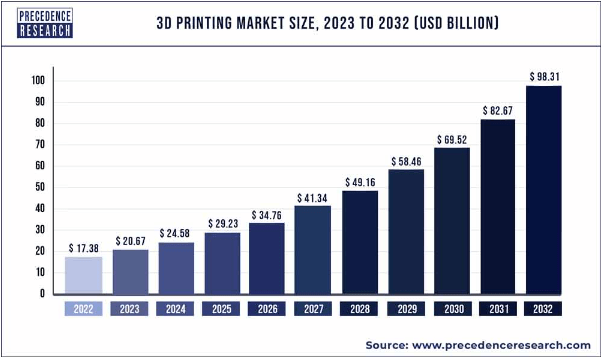
Analysts put the global 3D printing market on an annual growth rate of more than 18% between 2020 and 2028, pushing its value past $30 billion. That expansion is broad rather than concentrated in one sector — automotive, aerospace, and healthcare are all scaling their use at once.
Two forces sit behind the growth. On the supply side, printers and materials have become cheaper and more capable, so more parts are economical to print. On the demand side, buyers increasingly want customized or low-volume products that traditional tooling makes expensive to produce.
Adoption and usage statistics
Adoption has climbed steadily. In recent industry surveys, close to two-thirds of companies reported that they already use 3D printing or are actively evaluating it for production parts and custom prototypes — a sign the technology has moved past experimentation for many manufacturers.
The range of applications explains the breadth of adoption. Aerospace teams print lightweight brackets and ducting, automotive suppliers print jigs and fixtures, and medical device makers print patient-specific parts. As the catalog of proven use cases grows, the decision to adopt gets easier for the next company in each sector.
The hardware numbers back this up: annual printer shipments have risen year over year, and so has the volume of feedstock consumed — a more reliable signal of real production use than unit sales alone.
Economic benefits of 3D printing
The clearest financial case is tooling. Because a printer builds a part directly from a file, companies avoid the molds, dies, and fixtures that traditional manufacturing requires up front — a saving that matters most for low volumes and frequent design changes.
On-demand production adds a second saving: parts can be printed when needed instead of stocked, which lowers inventory carrying costs and the risk of obsolescence. Faster prototyping is the third benefit — design iterations that once took weeks to tool can be printed and tested in days, shortening development cycles.
Major Trends in 3D Printing for 2026
Five developments are doing the most to expand where 3D printing is used: a wider set of applications, tighter supply-chain integration, better quality assurance, sustainability improvements, and the rise of metal printing.
Increasing range of use cases
The set of things worth printing keeps widening. What began with prototypes now includes end-use parts, production tooling, and short-run manufacturing where traditional methods are too slow or too expensive to set up.
Improvements in materials and print precision are the reason. Engineers can now produce parts with tight tolerances and predictable strength, which makes printing viable for functional components rather than models alone. Each new proven part expands the addressable market for the technology.
Digital supply chain integration
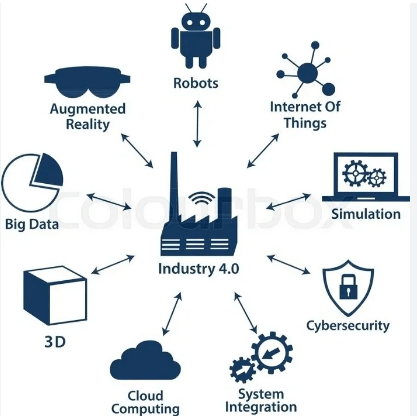
Connecting printers to a digital supply chain is one of the more consequential shifts. When a design lives as a file, it can be sent to whichever printer is closest to where the part is needed, rather than manufactured centrally and shipped.
That changes the economics of distribution. Companies can hold designs instead of physical stock, produce spare parts near the point of use, and update a design without retooling a factory. The practical payoff is shorter lead times and less capital tied up in warehoused inventory.
For manufacturers with global operations, this is often where 3D printing pays for itself: a printer on each continent can serve local demand from a shared design library instead of relying on long shipping routes.
Quality assurance in industrial printing
For printed parts to be used in regulated or safety-critical products, they have to be consistent from one run to the next. Quality assurance is the discipline that makes that possible, and it has matured significantly.
In-process monitoring, standardized test methods, and post-build inspection now let manufacturers catch defects before a part ships and prove that a batch meets specification. That repeatability is what moved 3D printing from prototyping into certified production in industries like aerospace and medical devices.
Sustainability initiatives
Sustainability is becoming a reason to adopt rather than a side effect. Additive manufacturing builds a part layer by layer, so it uses close to the exact amount of material the part requires — a contrast with machining, which cuts away material as waste.
Beyond material efficiency, companies are recycling unused powder, testing biodegradable feedstocks, and running printers on cleaner energy. These steps lower the footprint of production and increasingly factor into buyers’ supplier decisions.
Rise of metal 3D printing
Metal printing is the segment growing fastest, driven by processes that can now build metal parts with the precision production demands. Aerospace, automotive, and medical manufacturers use it for everything from prototypes to certified end-use components.
Its main advantage is geometry: metal printing can produce internal channels, lattices, and consolidated assemblies that are impossible to machine or cast in one piece. That capability reduces part counts and weight, which is why it has taken hold first in industries where weight carries a direct cost.
Recent Technological Advances in 3D Printing

Under those market trends sit specific technical advances — AI-assisted printing, generative design, print optimization, medical applications, and greener production — that are raising quality and lowering cost.
AI-assisted printing
Software that monitors a print in real time is improving both yield and consistency. By analyzing sensor data as a part is built, these systems can flag anomalies and adjust parameters mid-print, which cuts failed builds and reduces wasted material.
The result is higher accuracy and more repeatable output, which matters most for production runs where every part has to match. As these tools improve, they lower the expertise needed to run a printer reliably — a barrier that has held back wider adoption.
Generative design
Generative design uses software to produce part geometries from a set of constraints — load, material, weight target — rather than having an engineer draw them by hand. The software explores many options and returns designs optimized for the stated goals.
Paired with 3D printing, this often yields parts that are lighter and stronger than a conventionally designed equivalent, because printing can actually build the organic shapes the software proposes. It is particularly valuable in aerospace and automotive, where shaving weight has measurable payoffs.
Print optimization
Print optimization is the tuning of the settings that determine how a part is built — layer thickness, infill density, orientation, and speed. Getting these right reduces both material use and print time without sacrificing the finished part’s specification.
Increasingly this tuning is handled by software rather than trial and error, using historical print data to recommend settings for a given part. That automation makes production more predictable and lowers the cost per part, especially at volume.
Medical industry innovations
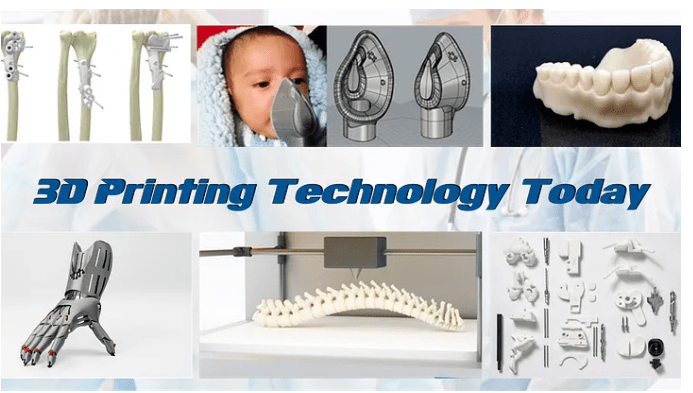
Healthcare is one of the most active areas of applied 3D printing. Because printers build from a digital model, they can produce implants and prosthetics matched to an individual patient’s anatomy, which tends to improve fit and outcomes over standard sizes.
Printing also produces anatomical models from a patient’s scans, which surgeons use to plan and rehearse complex procedures before an operation. Reducing time in the operating room lowers both risk and cost.
The frontier is bioprinting — depositing living cells layer by layer to build tissue. It remains largely research-stage, but it points toward printed tissue for testing and, eventually, transplantation.
Sustainability practices
On the production floor, sustainability shows up as concrete practices: recycling unused powder back into the process, choosing biodegradable or recycled feedstocks, and minimizing scrap through better print planning.
These measures cut both waste and cost, and they increasingly help win business — buyers with their own environmental targets favor suppliers who can document a lower-footprint process.
Conclusion: The Outlook for 3D Printing
The direction is consistent across every measure in this guide: a market growing at double digits, adoption spreading past pilots into production, and technical advances that keep widening the set of parts worth printing. The five trends — broader use cases, supply-chain integration, quality assurance, sustainability, and metal printing — are the ones to watch through 2026.
For a business deciding whether to invest, the question is no longer whether the technology works but where it fits your specific parts and volumes. Start with the applications where printing already has a clear cost advantage — tooling, spares, and customized low-volume parts — and expand from there.
Frequently Asked Questions (FAQs)
What is the current state of 3D printing?
3D printing is now used for production parts, not just prototypes, with the fastest growth in industrial and metal printing across aerospace, automotive, healthcare, and manufacturing.
What are the top trends to watch in 2026 and beyond?
The main trends are wider use cases, digital supply-chain integration, stronger quality assurance, sustainability gains, and the continued rise of metal printing and bioprinting.
How fast is the 3D printing market growing?
Analysts estimate annual growth of more than 18% between 2020 and 2028, taking the global market past $30 billion, as more businesses adopt the technology for part production.
How has industrial 3D printing changed over time?
It has progressed from basic prototype models to certified end-use parts, with advances in metal printing and bioprinting opening new use cases such as patient-specific implants.
How does supply chain disruption affect 3D printing usage?
Disruption has pushed companies toward local, on-demand production with methods like 3D printing, which shortens lead times and reduces the cost and risk of long overseas shipping.
Related Articles
Buyers guide
Twilio Alternatives 2026: 6 Compared and What They Cost
Continue reading →

Finance & Billing Software
Best Payroll Software for Contractors and Freelancers in 2026
Continue reading →

Buyers guide
How To Choose The Best Auto Dialer Software For 2026
Continue reading →

Buyers guide
How To Choose The Best Freelance Platforms For 2026
Continue reading →