
Maximize Healthcare with PointClickCare EHR Software – Ratings and Competitive Pricing 2026

Choosing the right software is one of the harder decisions healthcare providers face, and the wrong pick can slow down an entire facility. PointClickCare has become a widely used cloud-based option built specifically for long-term and post-acute care.
This article looks at the software’s current features and pricing so you can weigh whether it fits your organization.
Key Takeaways
- PointClickCare is a cloud-based platform built for long-term and post-acute care, with an emphasis on Transitions of Care, patient health outcomes, financial management, and ongoing product innovation.
- The platform uses a customizable pricing model so different types of healthcare facilities can pay for what they need, and it supports cross-continuum care through billing systems and electronic health records.
- Alternatives worth reviewing include eMenuCHOICE for nutritional management, Caremerge for communication, myUnity for BPCI Advanced initiatives, Cliniconex for appointment scheduling, and MatrixCare for its medication management tools.
- User feedback points to PointClickCare’s straightforward interface and how easily it fits into existing workflows as the two benefits that most affect patient care delivery.
- Comparing PointClickCare against other options shows how its 2024 feature set stacks up, which helps providers match a tool to the specific challenges their operation faces.
Overview of PointClickCare: A Leading Cloud-Based Healthcare Software Provider
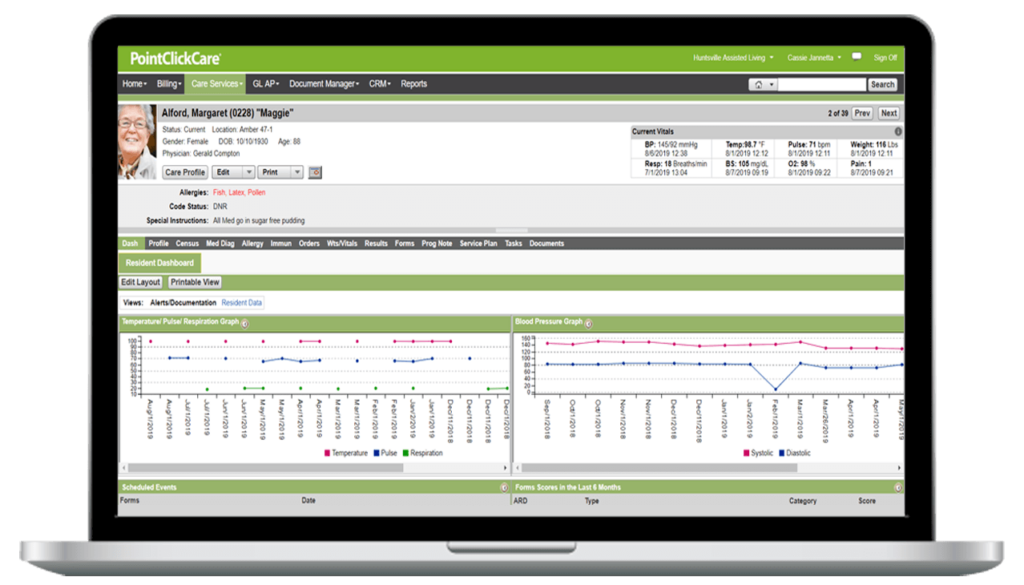
PointClickCare is one of the better-known names in digital healthcare, built around integrated cloud software for long-term and post-acute care (LTPAC). Rather than a general hospital system, it is aimed at the settings where LTPAC providers actually work.
Its focus is on the quality of care in senior living centres, skilled nursing facilities, and similar environments, and on helping clinicians coordinate as patients move across the continuum of care. That coordination across settings is the problem the platform is designed to solve.
The company treats continued product development as a core part of what it offers to healthcare management teams, so the toolset keeps expanding rather than staying fixed.
The suite covers a broad set of day-to-day functions inside a healthcare organization. It supports transitions between levels of care and adds precision to medication management, taking on tasks that used to require heavy manual work from providers.
The value goes past operational savings. Because it is built to support value-based care delivery, the platform ties directly into two goals providers care about most: better patient outcomes and stronger financial health management.
PointClickCare Features
PointClickCare’s feature set groups into four areas: transitions of care, health outcomes, financial health management, and continued innovation across the product. Each one maps to a distinct part of running a care facility.
Transitions of Care
Transitions of Care in PointClickCare give providers a structured way to keep services continuous at the moments most likely to go wrong. Those moments happen when a patient moves between settings, such as from a hospital to a skilled nursing facility, or from long-term care to support at home.
How well a facility handles these handoffs is a direct factor in patient health and in whether the patient ends up readmitted.
The platform gives facilities tools that automate the exchange of patient information, which cuts down on errors and keeps caregivers aligned. Everyone involved can see current data, including medication lists, treatment histories, and personalized care plans, instead of chasing records after a transfer.
Having that shared view improves cross-continuum care coordination, which shows up as smoother delivery and better results for patients moving through different levels of care.
Improved Health Outcomes
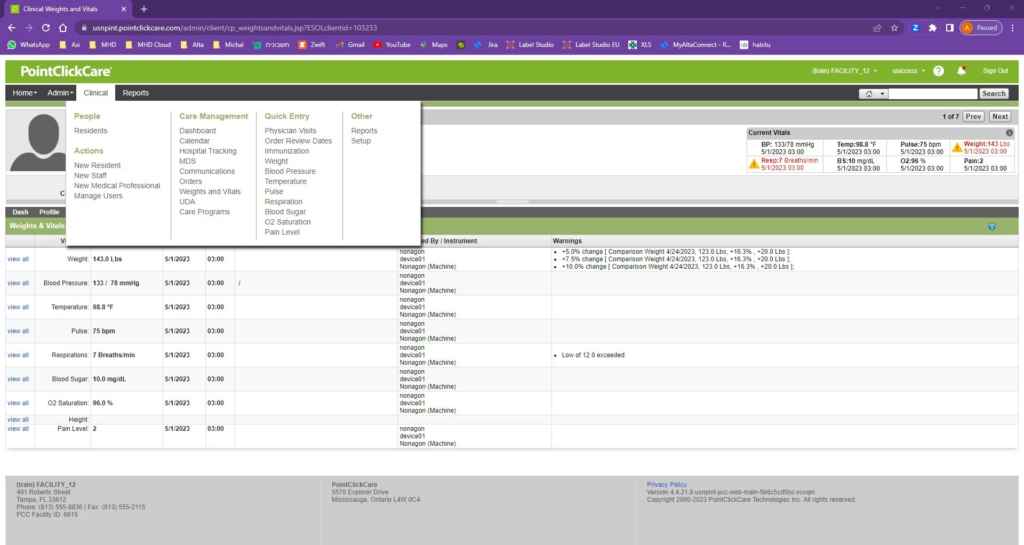
On top of smoother transitions, PointClickCare includes tools aimed at improving patient outcomes directly. It supports accurate tracking of patient progress and gives clinicians current data to base decisions on, rather than acting on stale information.
Features such as medication management and custom care plans let staff address individual patient needs rather than applying a single template to everyone.
Its cross-continuum care approach keeps treatment and recovery connected across settings. The platform also applies analytics to flag potential health risks earlier, before they turn into critical problems.
Catching those risks early gives clinics and hospitals a way to raise their level of service while keeping each patient’s wellbeing at the center of the work.
Financial Health Management
PointClickCare puts real weight on financial health management, giving long-term and post-acute care facilities a way to run their revenue cycle without a patchwork of separate systems. Billing, claims processing, and financial reporting all live in the same place.
It surfaces real-time insights into reimbursement rates, cash flow projections, and regulatory compliance, so leaders can make decisions from current numbers as they operate in a value-based care environment.
For skilled nursing and senior living centers, these financial tools are meant to protect revenue while lowering exposure to payment denials and compliance problems that quietly drain margins.
Fostering Innovation
Continued innovation matters in healthcare software because the needs of providers, caregivers, and patients keep shifting. Applying newer technology, such as artificial intelligence and machine learning, opens up gains in managing patient care, handling administrative work, and improving day-to-day efficiency.
A vendor that tests and iterates can keep refining its product against the specific problems of long-term and post-acute care instead of shipping once and standing still.
User-friendly interfaces paired with clear functionality are part of that same effort. As technology moves quickly, the goal for developers is to build experiences that help staff work rather than slow them down with unnecessary complexity.
Collaborative partnerships across stakeholders add to it as well, since sharing knowledge tends to surface fresh ideas that push a product forward.
The payoff of that work reaches the whole healthcare ecosystem: better patient outcomes, lower operating costs, and wider access to quality care.
Investment in digital transformation is what carries those improvements into long-term and post-acute care across senior living centers, and it supports better health equity along the way.
Taken together, these advances make it more realistic to deliver care that is tailored to the patient in front of you than it has been in the past.
PointClickCare Pricing Structure
PointClickCare uses a flexible pricing model shaped around the type of facility buying it, whether that is long-term and post-acute care, skilled nursing, or a senior living center.
The cloud-based software is built to support value-based care and to help organizations manage the moving parts of healthcare operations. PointClickCare’s pricing structure is set up to align with BPCI Advanced and to support care that spans the full continuum.
With electronic health records, medication management, and healthcare collaboration tools at its core, the platform is meant to tie those functions into one workflow instead of several disconnected apps.
Reading the pricing correctly matters for any organization shopping for a full digital healthcare system. The work is to weigh what each package actually delivers against your own goals for patient outcomes, then decide which one is worth the spend.
PointClickCare Top Alternatives in 2024
If you want to compare PointClickCare against other 2024 options, five worth a look are eMenuCHOICE, Caremerge, myUnity, Cliniconex, and MatrixCare. Each overlaps with PointClickCare in some areas of healthcare management and specializes in others.
eMenuCHOICE
eMenuCHOICE focuses on dining in healthcare facilities, with a digital platform for menu planning, meal ordering, and nutritional management. Staff can tailor menus to each resident’s dietary needs and preferences, which supports both satisfaction and wellbeing.
The system also handles inventory management and cost control and helps keep facilities within regulatory standards. Its interface and feature depth are aimed at the operational realities of long-term care settings.
Because it connects with electronic health records (EHR), it makes tracking each resident’s nutritional intake simpler and supports interdisciplinary teams working from the same information.
Caremerge
Caremerge is a healthcare collaboration platform built to improve communication and care coordination in long-term and post-acute settings. It serves skilled nursing facilities, nursing homes, and senior living centers looking to run more efficiently, lift patient outcomes, and keep transitions of care clean.
Its value-based care tools line up with where the industry is heading, helping providers put technology-driven, person-centered care into practice rather than treating it as a future goal.
The cloud-based platform brings medication management, electronic health records (EHR), and cross-continuum coordination together so workflows connect and staff can act on decisions sooner.
As digital healthcare keeps advancing, Caremerge’s pitch stays consistent: give organizations practical tools that keep patient wellbeing first while tightening overall performance.
myUnity
myUnity is a healthcare management platform for long-term and post-acute care facilities, including skilled nursing and senior living centers. The cloud-based system covers medication management, electronic health records, healthcare collaboration, and value-based care in one place.
With myUnity, organizations can tighten their workflows, improve patient care outcomes, and run more efficiently in a fast-moving industry.
For teams adopting it, the draw is coordinated cross-continuum care and support for BPCI Advanced initiatives, which matters for facilities working under those payment models.
Cliniconex
Cliniconex handles communication inside healthcare facilities, coordinating appointments and reminders so they do not fall through the cracks. It automates patient notifications, which cuts missed appointments and takes routine outreach off staff’s plate.
It connects with electronic health records so the right information reaches patients and staff accurately and on time.
By sending personalized messages about upcoming appointments or prescription refills, Cliniconex keeps patients engaged, and that steadier engagement tends to translate into better outcomes, satisfaction, and retention.
MatrixCare
MatrixCare is a healthcare management platform serving long-term and post-acute care settings, including skilled nursing facilities and senior living centers.
It covers medication management, electronic health records, healthcare collaboration, and value-based care support. Its cross-continuum focus is meant to help organizations connect their workflows and lift patient outcomes through digital tools rather than manual processes.
For providers, the appeal is concrete: run more efficiently, coordinate patient care across teams, and keep up with the changing demands of the healthcare industry.
Reviews & Feedback on PointClickCare
Users regularly single out PointClickCare’s ease of use and how cleanly it fits into existing healthcare workflows. Its medication management feature in particular draws strong reviews from clinicians, who credit it with cutting medication errors and simplifying administration.
Reviewers also point to the electronic health records system, saying it has made their data more accurate and easier to reach across the organization.
Providers report satisfaction with how the platform supports care coordination across departments and specialties. They value the way it keeps care team members communicating, which they tie back to better patient outcomes.
The overall pattern in the feedback is consistent: the software has a positive effect on operational efficiency, clinical decision-making, and the quality of care in long-term and post-acute settings.
Conclusion
Keeping up with current pricing, features, and alternatives for healthcare software in 2024 is part of staying competitive as healthcare technology keeps moving.
By understanding what PointClickCare offers and setting it against alternatives like eMenuCHOICE, Caremerge, myUnity, Cliniconex, and MatrixCare, healthcare teams can make choices that push innovation forward and improve patient care.
Working through cloud-based healthcare options comes down to weighing each platform’s strengths against your own priorities, so senior living centres and the patients across their continuum of care end up better served.
(Image credit: PointClickCare)

- Independent picks for exactly what you just read about
- Matched to your team size & needs
- Vendors don't pay for placement
Step 1 of 4
How big is your team?
We tailor recommendations to companies your size.















Related Articles
Buyers guide
How To Choose The Best Mental Health Software For 2026
Continue reading →
Applicant Tracking Software
Best ATS for Retail and Hospitality Hiring in 2026: 5 Tools for High-Volume Recruiting
Continue reading →
Best Tools
Best EHR Software in 2026: Top Electronic Health Record Systems for Clinics and Practices
Continue reading →
Buyers guide
How To Choose The Best Patient Engagement Software For 2026
Continue reading →