
OKRs (Objective and Key Results)- Set Goals with accurate OKR Definition and Examples

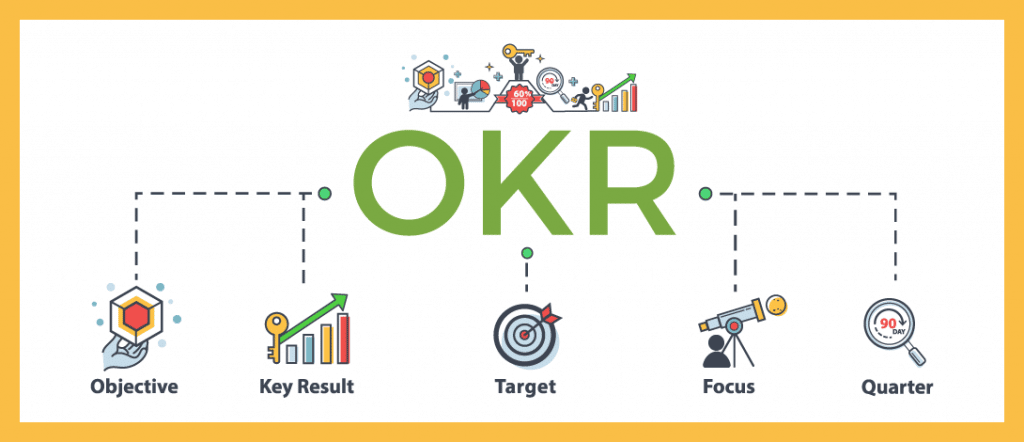
If you’re tired of setting vague, uninspiring goals that never seem to go anywhere, it’s time to get serious about OKRs. No, it’s not a typo – OKRs stands for Objectives and Key Results, a goal-setting framework that helps individuals and teams turn broad ambitions into concrete, trackable work.
Organizations that use OKRs report being up to 56% more likely to achieve their goals than those that don’t.
Below, we cover what OKRs are, their different types, some real-life examples, and the benefits of putting this goal-setting & management framework to work.
By the end, you’ll know how to write objectives that are specific, challenging, and measurable.
OKR (Objective and Key Results) Meaning 👇
OKR stands for Objectives and Key Results. It is a goal-setting framework used by individuals and organizations to define and track progress towards achieving specific objectives or goals.
Intel made the OKR methodology popular in the 1970s. Andy Grove at Intel took the idea of MBO from Peter Drucker and upgraded it with the concept of Key Results (OKR), and companies like Google, LinkedIn, and Twitter later adopted it. Setting specific, quantifiable goals that are consistent with the company’s overall strategy and periodically monitoring progress toward those goals are the fundamental ideas underpinning OKRs.
Overall, they are an effective tool for defining goals and monitoring progress toward completing certain tasks. With the help of the OKR framework, people and organizations can establish specific, quantifiable goals that complement their overall plan and track their advancement on a regular basis.
OKR Working To Set Goals
Here’s how OKRs work:
- Objectives: An objective is a specific and measurable goal that an individual or team wants to achieve. Objectives should be clear, concise, and tied to the company’s overall strategy. Objectives should be ambitious and should challenge individuals or teams to push beyond their comfort zone.
- Key Results: Key Results are the specific metrics used to measure your progress towards achieving the objective. They should be measurable, specific, and quantifiable. Key Results should be linked to the objective and should demonstrate progress towards achieving it.
- Setting and Reviewing OKRs: They are usually set on a quarterly basis and reviewed on a regular cadence. Setting them involves identifying and prioritizing objectives, defining key results, and assigning ownership to individuals or teams. Reviewing OKRs involves tracking progress towards achieving objectives, updating key results as needed, and making adjustments to strategies as necessary to ensure that goals are achieved.
OKR Components 📌
The OKR (Objectives and Key Results) framework has two main components. In practice, they work together as a pair: one names the destination, the other proves you got there.
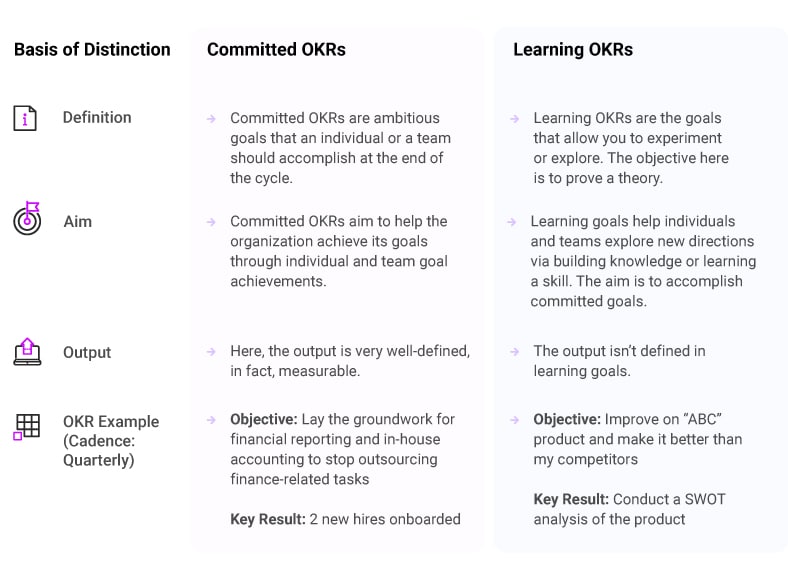
Objective: a short, qualitative statement of what you want to accomplish. A good objective is written in plain language a new hire could understand in one read, gives the team a reason to stretch past its comfort zone, and ties directly back to the company’s broader strategy rather than standing on its own.
Key Result: the number that proves the objective happened. Each key result is a measurable checkpoint — a percentage, a count, a dollar figure, or a pass/fail milestone — attached to that objective. Most objectives carry two to four key results, and hitting all of them is what “achieving the objective” actually means.
OKR Examples
Here are some real-life examples of organizations that have implemented the OKR system:
- Google: Google is one of the most well-known companies that use the OKR system. For example, one of Google’s objectives could be to increase the number of users on its cloud platform. The key results could be the number of new sign-ups, the number of customers who renew their subscriptions, and the amount of revenue generated from the cloud platform.
- LinkedIn: LinkedIn uses OKRs to focus on specific business goals. For example, one of LinkedIn’s objectives could be to improve the engagement of its users. The key results could be the number of users who return to the platform on a daily or weekly basis, the amount of time spent on the platform, and the number of articles or posts shared by users.
- Twitter: Twitter uses OKRs to align individual and team goals with the company’s overall strategy. For example, one of Twitter’s objectives could be to increase the number of active users on its platform. The key results could be the number of new sign-ups, the number of users who return to the platform on a daily or weekly basis, and the number of tweets or retweets generated.
- Amazon: Amazon uses them to set specific business goals for different departments and teams. For example, one of Amazon’s objectives could be to improve the delivery time for its products. The key results could be the number of orders fulfilled within a specific time frame, the number of products shipped without any issues, and the customer satisfaction rating.
These are just a few examples of how organizations have implemented the OKR system to align their efforts with specific business goals and measure progress towards achieving them. The key to the success of the OKR system is to ensure that objectives are specific and challenging, and that key results are quantifiable.
Types Of OKRs For Setting Business Goals 📝
There are different types of OKRs that organizations can use, depending on their specific needs and goals. Here are some of their common types:
- Company-level OKRs: These are broad goals that are established by the leadership team of the firm and are intended to bring everyone on board with the vision and strategy of the business. These goals frequently encompass a wide range of topics, including revenue development, client happiness, and employee involvement.
- Team-level OKRs: These are goals that are established by corporate teams or departments and are compatible with the company-level OKRs. Team-level OKRs are intended to make sure that everyone is pursuing the same objectives and that individual efforts are in line with the business’s overall plan.
- Individual OKRs: These are goals established by each employee that are in line with the team- and corporate-level OKRs. Individual OKRs are intended to help each employee focus on how they specifically contribute to the team’s success while also ensuring that they understand their part in accomplishing the company’s goals.
- Stretch OKRs: These are stretch goals created to push people or groups to go beyond what they ordinarily would. Stretch OKRs are intended to motivate people or teams to go beyond their comfort zones and accomplish challenging goals that they may not have previously believed were feasible.
- Rolling OKRs: Rolling OKRs are those that are established and evaluated on a regular basis, such every quarter or month. Rolling OKRs are intended to guarantee that objectives are frequently revised and altered to account for modifications to the business environment or the organization’s strategy.
Benefits Of OKRs For Goal Management
The OKR framework offers several benefits to organizations, including:
- Focus: OKRs help organizations to focus on the most important objectives and key results, which can help to prioritize efforts and ensure that everyone is working towards the same goals.
- Alignment: OKRs help to align individual and team goals with the company’s overall strategy, which can improve communication and collaboration within the organization.
- Clarity: OKRs provide clarity and transparency, making it easier for individuals and teams to understand their roles and responsibilities in achieving specific goals.
- Measurement: OKRs provide a way to measure progress towards achieving specific objectives & key results, which can help to track performance and identify areas for improvement.
- Motivation: OKRs can motivate individuals and teams to push beyond their comfort zones and achieve ambitious goals, which can lead to greater job satisfaction and a sense of accomplishment.
- Agility: OKRs can help organizations to be more agile and responsive to changes in the business environment or the company’s strategy, as they can be adjusted and updated on a regular basis.
- Accountability: OKRs help to create a sense of accountability, as individuals and teams are responsible for achieving specific objectives & key results, which can lead to greater ownership and commitment to achieving the goals.
OKR v/s KPI
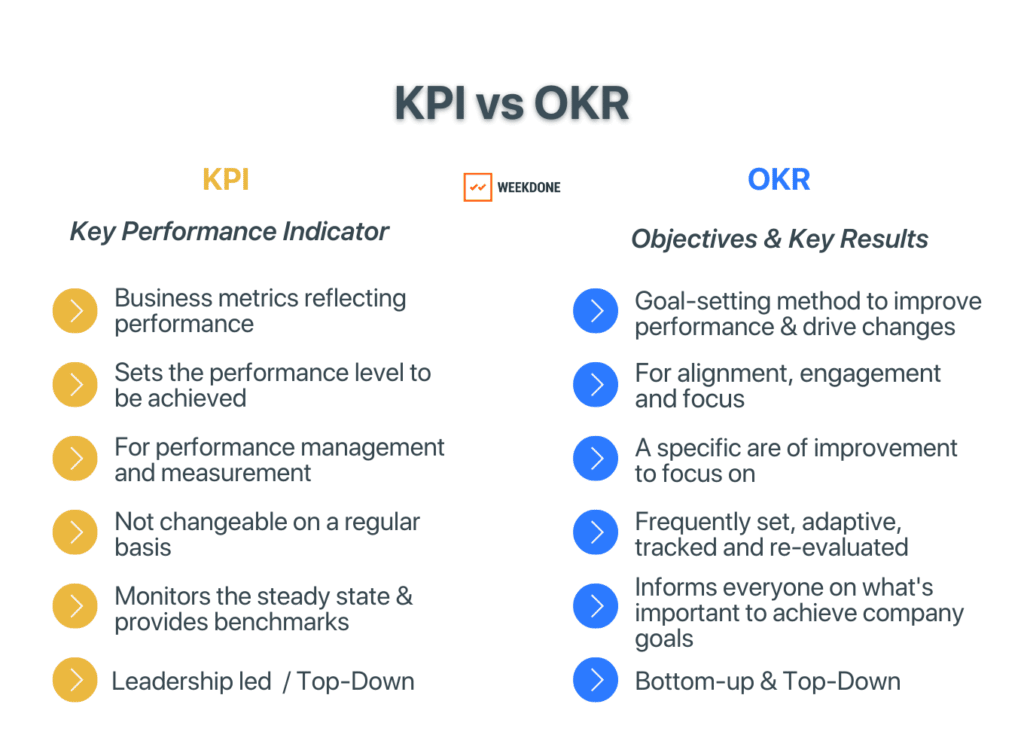
OKR (Objectives and Key Results) and KPI (Key Performance Indicators) are both tools used by organizations to measure and track progress towards achieving specific business objectives. However, there are some key differences between the two:
| Point Of Difference | OKR | KPI |
|---|---|---|
| Focus | typically focused on setting and achieving specific business objective | focused on measuring performance against specific metrics |
| Timeframe | set for a specific period of time | can be measured on an ongoing basis |
| Scope | cover a wide range of areas, such as revenue growth, customer satisfaction, or employee engagement | typically more narrowly focused on specific metrics, such as sales, customer retention, or website traffic |
| Flexibility | designed to be flexible and adaptable | typically more static |
| Alignment | designed to align individual and team goals with the company’s overall strategy | more focused on individual or team performance |
Tips To Write Good OKRs For Goal Setting ⌛️
Here are some genuine tips for writing a great OKR:
- Be precise: An effective OKR should be precise and state expectations clearly. To gauge development, speak in explicit terms and offer precise metrics or data.
- Be ambitious: OKRs ought to be difficult yet doable. Establishing challenging objectives can inspire people and groups to go beyond their comfort zones and accomplish more than they thought possible.
- Be pertinent: OKRs should be pertinent to the overall strategy and mission of the firm. Align your OKRs with the mission and objectives of your business, and make sure they are pertinent to your team’s contribution to attaining those objectives.
- Be measurable: An effective OKR should be measurable in order to allow for the tracking and evaluation of progress. Specify precise metrics or important outcomes that will be used to gauge the objective’s progress.
- Be time-bound: A successful OKR ought to have a deadline for completion. As a result, the goal has a deadline and a sense of urgency is heightened.
- Include stakeholders: Include stakeholders in the process of developing and assessing OKRs, including team members and leadership. This makes it easier to make sure that everyone is on the same page and dedicated to accomplishing the goals.
- Regularly review and update: To keep your OKRs relevant and in line with the business plan, evaluate and update them frequently. This enables changes to be made to better reflect shifting priorities or circumstances.
Conclusion
OKRs work because they force a plain-language answer to two questions: what are we trying to do, and how will we know we did it? A clear definition, a handful of types to pick from depending on your situation, and the tracking discipline that comes with quarterly review is most of what it takes to get started.
Set the objective, write the key results that would prove it happened, put a date on it, and review it on a regular cadence. That review habit — not the framework itself — is what separates teams that actually hit their goals from teams that just wrote them down once and moved on.
While you learn about OKRs to grow your business, read these amazing books on how to grow & establish a startup in the present times:
Best Startup Books For Entrepreneurs To Read In 2023
Read More
5 Best Remote Work Software In 2023
Book on OKR by John Doerr : Measure What Matters: OKRs: The Simple Idea that Drives 10x Growth 📚
Frequently Asked Questions (FAQs)
What are OKR tools?
Tools for setting and monitoring goals using the Objectives and Key Results (OKR) methodology are a href= https://www.tability.io/odt/articles/the-best-okr-software-for-startups data-type= link data-id= https://www.tability.io/odt/articles/the-best-okr-software-for-startups mark style= background-color:rgba(0, 0, 0, 0) class= has-inline-color has-vivid-red-color OKR software /mark . /a A framework for creating goals called OKRs enables both individuals and teams to specify precise, quantifiable goals as well as the key outcomes that will contribute to achieving those goals.
Is OKR replacement of KPI?
No, OKR (Objectives and Key Results) is not a replacement for KPI (Key Performance Indicators). br br KPIs are specialized measures that are used to assess performance in a given area, such as sales income, client satisfaction, or worker productivity. Although KPIs are frequently used to track ongoing performance and pinpoint areas that need improvement, they typically have a smaller scope than OKRs. br br On the other hand, OKRs are a framework for goal-setting that aids both individuals and teams in establishing specific, quantifiable objectives and the key results necessary to attain those objectives. OKRs are frequently used to link team and individual goals with the overarching organizational goals because they are more concentrated on advancing specific goals.
Is OKR a framework?
Yes, OKR (Objectives and Key Results) is a goal-setting framework used by individuals and organizations to set and track progress towards specific goals.
Which company used OKR first?
The OKR (Objectives and Key Results) framework was first developed by Andy Grove, the former CEO of Intel Corporation, in the late 1970s. Grove introduced the OKR framework to Intel in order to align the company’s goals and objectives with its overall mission and vision, and to help individual employees and teams set and achieve their own specific goals.
Why is Andy Grove?
Andy Grove (1936-2016) was a Hungarian-American engineer, businessman, and author. He is best known for his role as the CEO of Intel Corporation, one of the world’s largest and most successful semiconductor companies. He was thr first to introduce the concept of OKRs at Intel Corporation.

- Independent picks for exactly what you just read about
- Matched to your team size & needs
- Vendors don't pay for placement
Step 1 of 4
How big is your team?
We tailor recommendations to companies your size.















Related Articles

Project Management
Best Project Management Software for Small Business in 2026: 8 Tools Compared
Continue reading →
Project Management
ClickUp vs Asana (2026): Which PM Tool Is Right for Your Team?
Continue reading →
Project Management
11 Best Asana Alternatives in 2026 (Cheaper, Simpler, or More Powerful)
Continue reading →
Project Management
How to Use Doodle Polls for Fast, Group Scheduling 2026 Guide
Continue reading →