

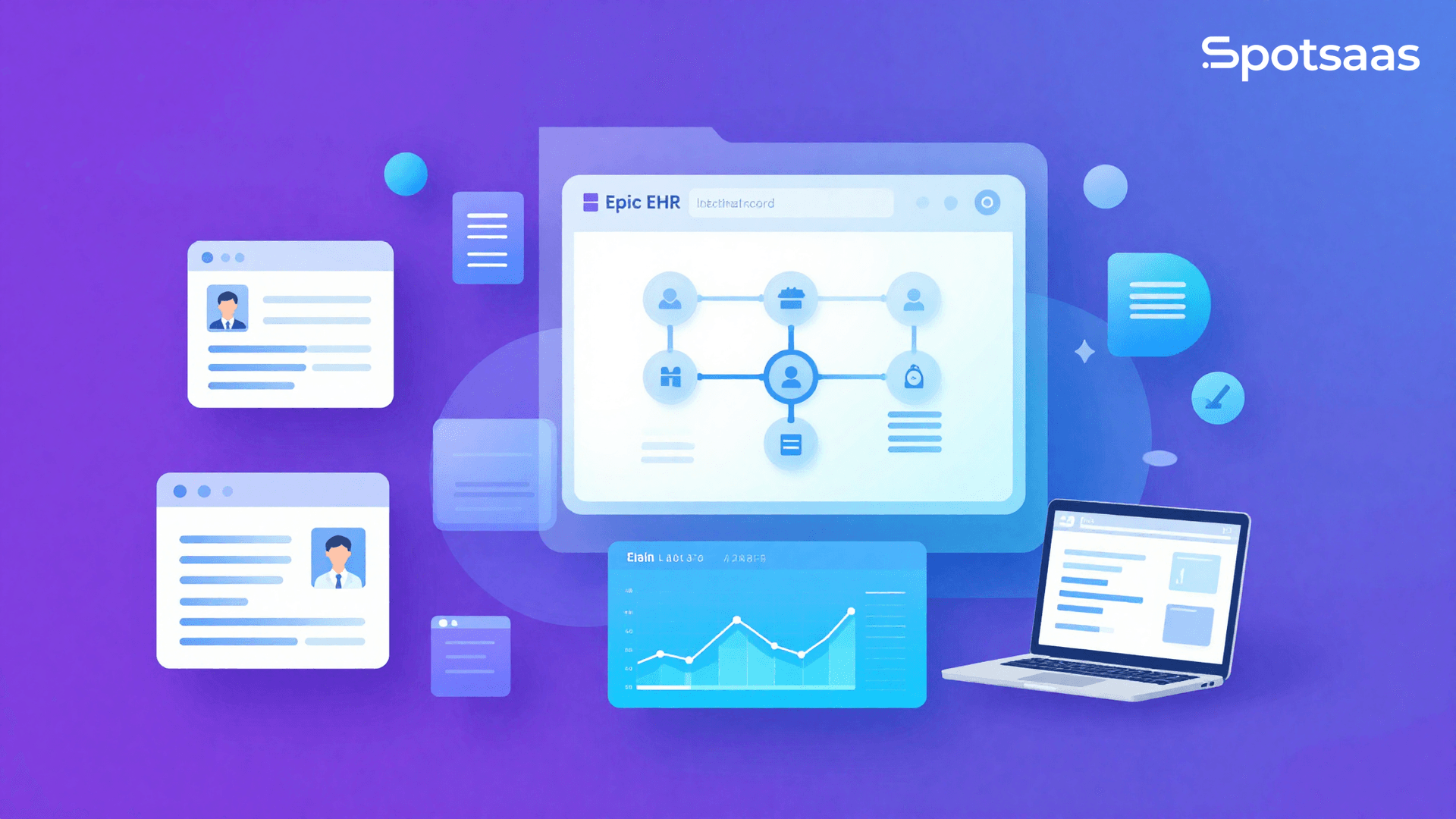
If your health system is evaluating electronic health records at scale, Epic comes up in every conversation. It runs clinical operations at more than 1,000 health systems across the US and holds records for over 310 million patients.
This Epic EHR review breaks down what the platform actually delivers, what it costs, how long implementation takes, and whether it’s the right fit for your organization or overkill for what you need.
Verdict: Epic is the gold standard for large health systems and academic medical centers. It’s deeply capable, widely interoperable, and built for complex, multi-site operations. But it’s expensive, slow to implement, and demands significant internal IT resources. Smaller practices and community hospitals should look elsewhere before signing.
What Is Epic EHR?
Epic Systems Corporation is a privately held healthcare software company founded in 1979 by Judy Faulkner. Its flagship product, Epic EHR, is an integrated electronic health record platform used primarily by large hospitals, academic medical centers, and integrated delivery networks.
Epic covers inpatient and outpatient care, clinical documentation, order management, revenue cycle, population health, and patient engagement through its consumer-facing portal, MyChart. Unlike modular EHR vendors, Epic sells an all-in-one platform. You don’t assemble it from third-party components.
According to KLAS Research, Epic consistently ranks as the top inpatient EHR in the US by market share, holding approximately 37% of hospital beds. The American Hospital Association reports that Epic is live in the majority of the largest US health systems. For organizations at scale, that market dominance matters: it affects interoperability with referral networks, recruitment of staff already trained on Epic, and access to a broad app ecosystem through the Epic App Orchard.
Key Features
MyChart Patient Portal
MyChart is Epic’s patient-facing portal and one of its most recognized assets. Patients can schedule appointments, view test results, message care teams, request prescription refills, and complete pre-visit intake forms. During the COVID-19 pandemic, MyChart became a primary channel for vaccination scheduling and telehealth visits across major health systems. The portal integrates directly with Apple Health and Google Health, enabling bidirectional data sharing with wearables and consumer health apps.
Clinical Decision Support
Epic’s clinical decision support (CDS) tools surface real-time alerts, order sets, care pathways, and best practice advisories during clinical workflows. Physicians see drug-drug interaction warnings, dosing recommendations, and evidence-based order sets at the point of care. Health systems can configure custom CDS rules tied to their own protocols and quality programs. The depth of configuration is a genuine strength, though it is also a source of alert fatigue when it isn’t managed deliberately.
Interoperability and Care Everywhere
Epic’s Care Everywhere network enables health information exchange between Epic organizations and non-Epic systems. Clinicians can pull outside records, such as hospital summaries, medication lists, and imaging results, directly into the patient chart. Epic supports FHIR-based APIs and complies with the 21st Century Cures Act information-blocking rules. For health systems with large referral networks, this interoperability is operationally significant.
Revenue Cycle Management
Epic’s integrated revenue cycle tools handle charge capture, coding assistance, claims management, denial management, and patient billing. Because clinical documentation and billing live in the same system, charge capture accuracy tends to improve versus disconnected systems. Epic’s Resolute module handles both hospital and professional billing, reducing the need for separate billing software.
Population Health and Analytics
Healthy Planet, Epic’s population health module, supports care gap identification, chronic disease registries, risk stratification, and care management workflows. The integrated analytics platform, Cogito, provides pre-built dashboards and supports custom reporting. For organizations running value-based care contracts, these tools provide visibility into attributed populations that would otherwise require separate analytics infrastructure.
Specialty Modules
Epic offers deep specialty-specific workflows for oncology (Beacon), operating rooms (OpTime), anesthesia (Anesthesia), cardiology, radiology, and more. Academic medical centers benefit from purpose-built research and clinical trial management functionality. This breadth means clinicians in specialized settings get workflows designed for their work instead of generic templates.
Telemedicine and Virtual Care
Epic’s integrated telehealth capabilities connect directly to MyChart, allowing patients to join video visits from the portal without a separate app download. Clinicians document the encounter in the same chart as in-person visits, maintaining a continuous longitudinal record. The integration eliminates the dual-documentation problem common with bolt-on telehealth tools.
Pricing
Epic does not publish pricing. All contracts are negotiated directly with Epic Systems. The figures below are based on publicly reported implementation costs, industry analyst estimates, and health system budget disclosures.
Epic pricing scales with organizational size and the modules implemented. There is no per-seat SaaS subscription model. Epic licenses its software under a perpetual or subscription arrangement with significant upfront implementation costs.
Typical total cost of ownership:
| Organization Size | Estimated Implementation Cost | Timeline |
|---|---|---|
| Large academic medical center / IDN (500+ beds) | $100M – $1.6B | 2–5 years |
| Regional health system (200–500 beds) | $15M – $100M | 1.5–3 years |
| Community hospital / smaller system (under 200 beds) | $5M – $15M | 12–24 months |
Implementation costs include software licensing, implementation services (either Epic-trained consultants or in-house), hardware and infrastructure, staff training, go-live support, and ongoing maintenance. Epic charges an annual maintenance fee, typically 15–20% of the software license, after go-live.
Hidden costs to plan for:
- Third-party implementation consulting (Epic-certified partners bill $150–$400/hour)
- Dedicated Epic IT team (typically 1 FTE per 100–150 physicians at steady state)
- Interface development for legacy or specialty systems not covered by Epic
- Downtime revenue impact during go-live
- Ongoing optimization and build work post-implementation
If you need exact pricing for your organization, contact Epic directly or engage an independent HIT advisory firm to scope the investment accurately before beginning contract negotiations.
Pros
Comprehensive, integrated platform. Clinical, operational, and financial workflows run in a single system. Data doesn’t need to flow across integrations to get from documentation to billing; it’s already there. This reduces reconciliation work and improves data integrity across the organization.
Market-leading interoperability. Care Everywhere and FHIR-based APIs mean Epic health systems can share records with a significant portion of US healthcare. If you’re in a dense referral market, that network effect has direct clinical value.
MyChart adoption and patient engagement. MyChart has more than 200 million active users. The brand recognition and consumer familiarity drive higher portal adoption rates compared to lesser-known patient portals. High portal adoption reduces phone call volume and improves patient satisfaction scores.
Deep specialty functionality. Academic medical centers and complex health systems don’t have to compromise on specialty workflows. Oncology, surgical, and cardiology teams get purpose-built tools instead of generic EHR templates.
Staff familiarity at scale. Because Epic holds the largest share of the large-system market, experienced Epic-trained clinicians and informaticists are available in the workforce. Recruiting into Epic environments is easier than recruiting into niche EHR platforms.
Cons
Cost is prohibitive for most organizations. A $5M floor for smaller implementations, before ongoing costs, puts Epic out of reach for independent practices, small clinics, and many community health centers. The financial commitment shapes the entire implementation experience.
Implementation takes years, not months. A 1–3 year implementation timeline means the organization is simultaneously running legacy systems and preparing for Epic, which strains IT, clinical informatics, and frontline staff. Go-live disruptions are common even with strong project management.
Requires dedicated internal IT expertise. Epic is not a managed service you hand off. Health systems need Epic-certified analysts to build, maintain, and optimize the environment. That talent is expensive and competitive in the market.
Alert fatigue is a documented issue. Epic’s CDS capabilities generate significant alert volume when not carefully tuned. Clinicians override the majority of alerts at many organizations. That’s a problem that requires ongoing governance to manage, not a one-time configuration fix.
Customization complexity compounds over time. Epic’s build flexibility is also a maintenance burden. Highly customized environments become harder to upgrade and harder to staff, since custom build knowledge concentrates in a small number of analysts.
Who Epic Is Best For, and Worst For
Best for:
- Large health systems and IDNs (500+ beds): The platform’s scale, interoperability, and breadth justify the cost and complexity when spread across a large patient population and revenue base.
- Academic medical centers: Research modules, complex specialty workflows, and graduate medical education tools make Epic the standard choice for AMCs.
- Organizations in competitive referral markets: Care Everywhere interoperability with other Epic organizations provides a referral network advantage in markets where Epic is dominant.
- Health systems pursuing value-based care contracts: Population health tools and integrated analytics support the reporting and care management workflows those contracts require.
Worst for:
- Independent physician practices: The cost-to-value ratio doesn’t work. A solo or small group practice has no business evaluating Epic.
- Community health centers and FQHCs: Budget constraints and IT capacity make Epic implementation unsustainable. Purpose-built CHC solutions are better fits.
- Organizations without dedicated IT and informatics staff: Epic requires ongoing internal expertise. Health systems that lack that capacity will struggle post go-live regardless of implementation quality.
- Organizations needing a fast deployment: If your timeline is under 12 months, Epic is the wrong choice.
Alternatives to Epic EHR
Oracle Health (Cerner)
Oracle Health (formerly Cerner) is Epic’s closest large-system competitor. It serves mid-to-large hospitals and health systems with a comparable breadth of inpatient and ambulatory functionality. Oracle’s acquisition of Cerner in 2022 brought cloud infrastructure and data capabilities into the mix. Oracle Health is often evaluated head-to-head with Epic for large health system deals, and some organizations prefer its government and federal health experience.
Best for: Mid-to-large hospitals wanting Epic-comparable capabilities, particularly in federal and government health settings.
View Oracle Health on Spotsaas
Meditech Expanse
Meditech has repositioned its Expanse platform as a cloud-based, mobile-first EHR targeting community hospitals and critical access hospitals. It’s more affordable than Epic or Oracle Health, has a faster implementation timeline, and has made genuine progress on interoperability. For community hospitals that don’t need Epic’s depth, Expanse is a credible option.
Best for: Community hospitals and critical access hospitals with limited IT resources and tighter budgets.
View Meditech Expanse on Spotsaas
athenahealth
athenahealth serves physician practices and ambulatory care networks with a cloud-based EHR and practice management platform. Its revenue cycle model charges a percentage of collections instead of a flat fee, which aligns vendor incentives with practice performance. It’s not built for hospital inpatient care, but for ambulatory networks it’s a strong choice with lower implementation overhead than any inpatient EHR.
Best for: Physician practices and ambulatory care networks, especially those prioritizing revenue cycle performance.
Allscripts EHR
Allscripts (now Veradigm in some product lines) serves mid-sized physician groups and community health organizations. It offers more flexibility in configuration and pricing than Epic, with a lighter implementation footprint. It’s not the right choice for complex inpatient environments, but for multispecialty groups that need a capable ambulatory EHR without an enterprise price tag, it’s worth evaluating.
Best for: Mid-sized physician groups needing flexible EHR with manageable implementation scope.
View Allscripts EHR on Spotsaas
AdvancedMD
AdvancedMD bundles EHR, practice management, medical billing, patient engagement, and telehealth in a single subscription aimed at independent practices. At $429/provider/month entry pricing, it’s accessible to practices that Epic will never serve. The feature set doesn’t match enterprise EHRs, but it covers the core workflows a smaller practice actually needs.
Best for: Independent practices wanting an all-in-one EHR, practice management, and telehealth solution at a predictable monthly cost.
Pricing: From $429/provider/month
Compare all EHR software options side by side on Spotsaas → EHR Software Category
Comparison Table
| EHR Platform | Best For | Pricing Model | Implementation Timeline | Interoperability |
|---|---|---|---|---|
| Epic EHR | Large health systems, AMCs | Custom (enterprise) | 1–5 years | Excellent (Care Everywhere) |
| Oracle Health (Cerner) | Mid-to-large hospitals | Custom (enterprise) | 1–3 years | Strong |
| Meditech Expanse | Community hospitals | Custom (mid-market) | 12–18 months | Good |
| athenahealth | Physician practices | % of collections | 3–6 months | Good |
| Allscripts EHR | Mid-sized physician groups | Custom | 3–9 months | Moderate |
| AdvancedMD | Independent practices | From $429/provider/mo | 1–3 months | Moderate |
Pricing shown is approximate; check vendor websites for current rates.
FAQ
What is Epic EHR?
Epic EHR is an integrated electronic health record platform developed by Epic Systems Corporation. It covers clinical documentation, order management, revenue cycle, patient engagement (via MyChart), population health, and specialty workflows across inpatient and outpatient settings. It is used primarily by large US health systems, academic medical centers, and integrated delivery networks.
How much does Epic EHR cost?
Epic does not publish standard pricing. Total implementation costs range from $5–15 million for smaller community hospitals to $100 million or more for large academic medical centers and health systems. Costs include software licensing, implementation services, infrastructure, training, and ongoing maintenance fees (typically 15–20% of the license annually). Contact Epic directly for organization-specific pricing.
How long does Epic implementation take?
Epic implementations typically take 12 months at minimum for smaller organizations and 2–5 years for large health systems implementing across multiple facilities. Timeline depends on the number of sites, modules deployed, data migration complexity, and internal IT capacity. Most organizations plan for a phased rollout instead of a single go-live.
Is Epic EHR good for small practices?
No. Epic is designed and priced for health systems, hospitals, and large multispecialty groups. Independent practices, small clinics, and solo providers should look at ambulatory-focused EHRs like athenahealth, AdvancedMD, or DrChrono, which are built and priced for smaller settings.
How does Epic compare to Cerner (Oracle Health)?
Epic and Oracle Health (Cerner) are the two dominant enterprise inpatient EHRs in the US. Epic holds the larger market share among top US health systems and academic medical centers. Oracle Health has stronger penetration in government and federal healthcare. Both require significant implementation investment and dedicated IT staff. KLAS Research consistently rates Epic higher on overall satisfaction among large hospital users, though Oracle Health is competitive and actively investing post-acquisition.
What are the main criticisms of Epic EHR?
The most common criticisms are cost (prohibitive for most organizations), implementation duration (years, not months), alert fatigue from clinical decision support overload, physician documentation burden (which contributes to burnout), and the significant ongoing IT staffing requirements to maintain and optimize the environment. Epic also has a reputation for being less flexible on custom integrations with third-party vendors outside its App Orchard ecosystem.
Verdict
Epic is the most capable inpatient EHR on the market for large health systems, and the most demanding. The platform’s interoperability, clinical depth, and population health tools are genuine strengths that justify the investment at scale. But scale is the operative word. If your organization has fewer than 200 beds, limited IT staff, or a timeline measured in months rather than years, Epic will consume more resources than it returns.
For large academic medical centers, integrated delivery networks, and health systems already embedded in Epic referral networks, it remains the default enterprise choice. For everyone else, the alternatives above offer better cost-to-value ratios without the implementation burden.
Before signing anything, get an independent read on your own organization’s size, IT staffing, and timeline against the ranges above. Epic’s sales process is built around a large, sophisticated buyer, and a second opinion from an advisory firm with no stake in the outcome is worth the cost for a decision this size.
Compare alternatives to the tools in this post

- Independent picks for exactly what you just read about
- Matched to your team size & needs
- Vendors don't pay for placement
Step 1 of 4
How big is your team?
We tailor recommendations to companies your size.















Related Articles

Buyers guide
How To Choose The Best Mental Health Software For 2026
Continue reading →
Applicant Tracking Software
Best ATS for Retail and Hospitality Hiring in 2026: 5 Tools for High-Volume Recruiting
Continue reading →
Best Tools
Best EHR Software in 2026: Top Electronic Health Record Systems for Clinics and Practices
Continue reading →
Buyers guide
How To Choose The Best Patient Engagement Software For 2026
Continue reading →