
Why This Blog Matters
Automatic enrollment in 401(k) plans has become a go-to strategy for improving employee retirement savings. By reducing behavioral inertia and getting employees participating earlier, it strengthens financial wellness while helping employers meet compliance mandates and lift plan engagement. This guide covers how automatic enrollment reshapes modern retirement planning.
What You’ll Learn Here
How automatic enrollment works in a 401(k), including default contribution settings, automatic escalation, and re-enrollment strategies. You’ll see the pros and cons from both the employer’s and the employee’s side, walk through implementation best practices, and learn how to raise participation without overloading HR teams.
Who Should Read This
Built for HR managers, business owners, and benefits administrators who want to streamline 401(k) participation, meet legal requirements, and build long-term employee savings. If you’re planning to adopt or improve 401(k) auto-enrollment, this blog is your roadmap.
With automatic enrollment, employees are placed into a 401k plan — usually at a fixed contribution rate and default investment selection — unless they opt out or choose to change their contributions. Each worker sees automatic deductions from their salary go straight into the fund, which takes the conscious sign-up decision out of the equation and gets more employees saving from the start, rather than leaving retirement savings to whenever an employee finally gets around to filling out a form.
Automatic enrollment has reshaped how companies set up retirement programs. It’s an effective way to build long-term employee savings because it relies on the default choices that behavioral finance research consistently shows people tend to stick with, instead of asking every new hire to make an active financial decision in their first week on the job.
A small automatic action turns into a lasting financial habit. That said, the approach comes with real advantages alongside a few genuine challenges for both employers and employees, and understanding both sides is what separates a plan that quietly works from one that just exists on paper.
This article looks at the benefits, drawbacks, and best practices of automatic enrollment in 401k plans, to help both employers and employees make informed, deliberate retirement savings decisions rather than leaving the outcome to chance.
What Is Automatic Enrollment in 401(k) Plans and How It Works
Automatic enrollment is designed to make saving for retirement easier by removing the need for employees to take any action. Instead of requiring workers to actively opt in to a 401k plan, employers enroll eligible employees automatically and start them at a default contribution rate, so saving begins from the first paycheck rather than months or years down the line.
Employees still keep full control over their participation. They can increase or decrease their contributions, or opt out entirely, whenever they choose — automatic enrollment sets the starting point, not the final answer.
How Does Automatic Enrollment in 401(k) Plans Work?
Automatic enrollment in 401k plans lets employers enroll employees by default, deducting a set percentage of their salary for retirement savings.
Automatic Enrollment: Default Contributions and Onboarding Process
Employers enroll new employees in the company 401k plan automatically, with a default contribution rate of 3%–6% deducted from paychecks. Employees who previously opted out may be re-enrolled during specific enrollment periods.
Default Investment Options in Auto-Enrolled 401(k) Plans
If employees don’t choose investments themselves, contributions go into default options like target-date funds or balanced portfolios, so the money still gets professional management.
How to Opt Out or Adjust 401(k) Contributions After Auto-Enrollment
Employees can opt out or adjust contributions whenever they need to. Anyone who wants a more personalized strategy can change their investment selections at any time.
Employer Responsibilities in Automatic 401(k) Enrollment Management
Employers oversee plan administration, keep the plan ERISA compliant, and often match employee contributions (for example, a 50% match up to 6%), which adds directly to retirement savings on top of what the employee puts in themselves.
By structuring these processes well, employers make retirement planning simpler and more encouraging for their workforce.
Different Types of Automatic Enrollment in 401(k) Plans
Employers can choose from a few different automatic enrollment strategies, each built to raise retirement savings participation while still leaving room for employee flexibility.
What Is Basic Automatic Enrollment in a 401(k) Plan?
- The most common approach: employees are automatically enrolled in the 401k plan at a default contribution rate unless they take action to opt out.
- This helps employees start saving early without needing to make an immediate decision.
What Is Automatic Escalation and How It Boosts Savings?
- This feature automatically raises an employee’s contribution rate over time, usually by 1% a year, until it reaches a preset cap (for example, 10-15% of salary).
- Employees can opt out of the escalation if they’d rather keep a fixed contribution rate.
Re-Enrollment in 401(k): How It Reinforces Retirement Participation
- Employees who previously opted out are automatically re-enrolled in the 401k plan during periodic enrollment cycles (for example, annually).
- This gives employees another chance to reconsider their decision and start saving.
Key Reasons Employers Choose Automatic Enrollment in 401(k) Plans
Automatic enrollment is gaining popularity among employers because:
- It actively brings employees into the retirement plan, especially those who would otherwise delay or forget to enroll.
- It supports long-term savings through consistent, automatic contributions.
- It removes the financial inertia that often keeps employees from signing up on their own.
- It offers tax advantages and helps employers meet state-mandated retirement plan requirements.
Understanding how automatic enrollment works, and which strategy fits, helps both employers and employees make better decisions about participating in and managing a 401k plan.
Pros and Cons of Automatic Enrollment in 401(k) Plans
Benefits of Automatic Enrollment in 401(k) Retirement Plans
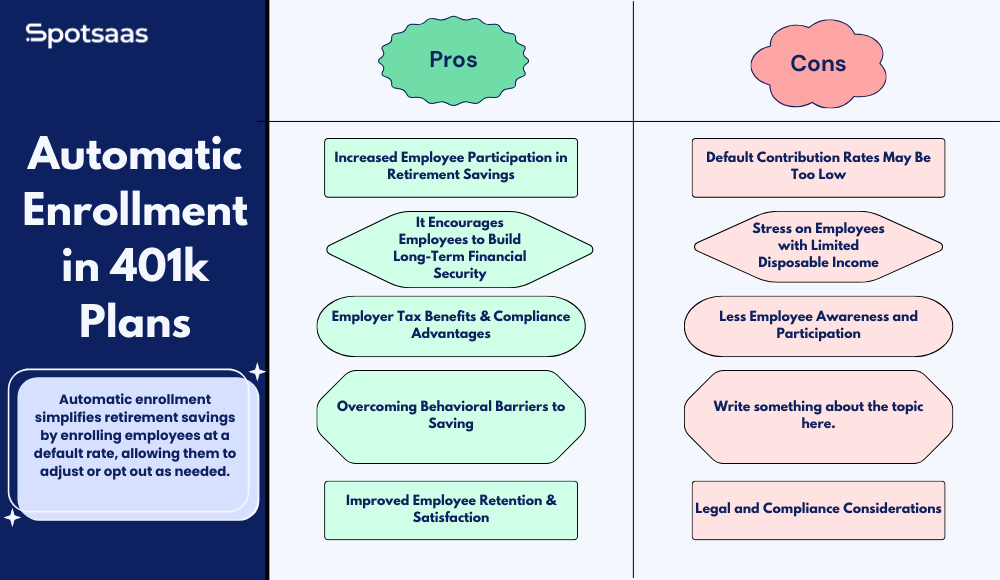
Automatic enrollment removes the barriers to 401k participation, helping employees save by default and building toward long-term financial security instead of waiting for a decision that may never come.
How Automatic Enrollment Boosts Employee Retirement Participation
Many employees, especially younger workers or those new to the workforce, don’t get around to signing up for a 401k plan on their own. Automatic enrollment removes that hurdle, so every eligible employee starts contributing from day one.
Employees can still adjust those contributions or opt out entirely. In practice, though, most employees stay in the plan once enrolled, which raises overall savings rates.
Early Contributions Help Build Financial Security for Retirement
The biggest advantage of automatic enrollment is that employees start saving earlier. Money builds up in a 401k plan faster when contributions begin right away, and with compound interest, the earlier employees start, the more they benefit over time.
Regular contributions to a 401k plan meaningfully cut the risk of financial insecurity later in life — the more employees have saved along the way, the better positioned they are for retirement.
Tax Credits and Legal Benefits for Employers Offering Auto-Enrollment
Employers who adopt auto-enrollment may qualify for tax credits meant to encourage retirement savings programs for their employees. The SECURE Act, for example, introduced tax credits for employers who add auto-enrollment to their retirement plans.
Some states also require employers to offer a retirement plan, and automatic enrollment helps meet those mandates.
How Auto-Enrollment Helps Overcome Behavioral Biases in Saving
Many employees put off financial decisions, whether from a lack of information or plain uncertainty about whether they’re making the right call. Automatic enrollment turns participation into the default, not a decision employees have to actively make.
Behavioral finance research shows people tend to stick with default choices, not opt out once they’re already enrolled. Automatic enrollment reduces decision paralysis by simplifying investment choices and nudging employees toward long-term savings.
Why Auto-Enrollment Enhances Employee Morale and Retention
A well-structured 401k plan raises employee job satisfaction and retention. Employees value benefits that support their financial future, so automatic enrollment signals that the employer is thinking ahead on their behalf.
Offering a retirement savings plan as a standard benefit also makes a company more attractive to job seekers and lifts morale internally. Employees who feel financially secure tend to be more engaged and productive, which benefits the whole workforce.
Potential Drawbacks of 401(k) Auto-Enrollment You Should Know
Automatic enrollment, including safe harbor plans, comes with real drawbacks alongside its benefits. Employers who understand these pitfalls up front are in a better position to design a plan that works for their employees.
Risks of Low Default Contribution Rates in 401(k) Plans
The biggest issue with automatic enrollment is that default contribution rates tend to run too low. Most plans start employees at 3% of salary, while a financially secure retirement typically calls for something closer to 10-15%, a gap that’s easy to overlook if nobody flags it.
Employees may assume the default rate is already enough and never adjust it, treating the number the employer picked as if it were a personalized recommendation. The result is chronic under-saving, leaving employees financially unprepared once retirement actually arrives.
Challenges for Low-Income Workers Under Auto-Enrollment
For low-income workers or anyone facing financial hardship, any deduction from a paycheck can be a real strain. Automatic enrollment encourages saving, but some employees genuinely struggle to contribute while covering essential living costs.
It’s also possible some workers are never clearly reminded that they can change their contribution rate or opt out. Poor communication leaves employees confused about automatic enrollment, which adds stress for those already struggling financially.
Reduced Engagement and Awareness from Automatic Enrollment
Automatic enrollment simplifies participation, but it can also lead to passive engagement, where employees don’t actively manage their investments. Many are unaware of how their contributions are invested or how those choices line up with their goals.
On top of that, employees often don’t fully understand how to get the most out of the plan — things like employer matching or tax benefits — simply because financial literacy on these topics tends to be limited.
Administrative Burden and Higher Costs for Employers
From the employer’s side, automatic enrollment adds cost and administrative work. As more employees stay in the plan, employer matching expenses rise too, and that can add up quickly.
There’s also more paperwork to manage — tracking who joined, who opted out, and any compliance issues that come up — plus the ongoing work of educating employees about the plan, their options, and the materials that support that education.
ERISA Compliance and Legal Issues with 401(k) Auto-Enrollment
Employers have to follow legal and regulatory requirements when offering automatic enrollment, including ERISA regulations and any additional compliance rules a given state imposes.
There’s legal exposure if employees aren’t properly notified or if contributions are mishandled. Employees can also contest their automatic enrollment if they can show they weren’t adequately informed about the plan or how it worked.
How to Implement Automatic Enrollment in a 401(k) Plan in 5 Key Steps
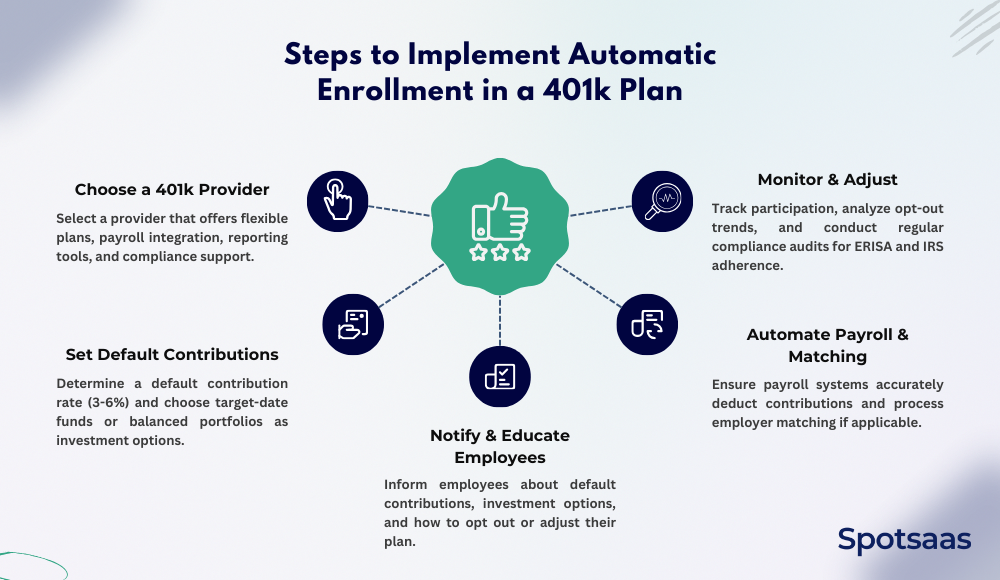
Employers who want to add automatic enrollment to their 401k plan need a clear process to stay compliant and roll it out smoothly. Here are five key steps.
Choose the Right 401(k) Provider with Auto-Enrollment Features
When choosing a provider, employers should weigh plan flexibility, investment options, administrative support, and compliance features. A good provider offers straightforward payroll integration, reporting tools, and automatic escalation options — all of which help improve retirement savings over time.
Set Smart Defaults: Contribution Rates and Investment Strategies
One of the biggest decisions in automatic enrollment is what default contribution rate to set. Most employers land somewhere between 3 and 6 percent of an employee’s salary.
Target-date funds, balanced portfolios, or managed accounts tend to work well as default investments, helping employees invest sensibly without needing to make complex financial decisions on their own.
How to Notify and Educate Employees About Auto-Enrollment
Employers must notify employees about automatic enrollment, including:
- The default contribution rate and payroll deduction.
- The investment options used for employees who don’t make an election.
- How employees can opt out or change their contribution or investment options.
Webinars, FAQs, and one-on-one financial education sessions all help raise general awareness of the program and make it easier for employees to engage with the plan voluntarily, without treating the notice as just another piece of paperwork to skim past.
Automating Payroll Deductions and Employer Match Contributions
For enrollment to run smoothly, payroll has to correctly and automatically deduct employee contributions, integrated with the payroll system in place. Where employer matching applies, that same system needs to calculate and deposit the match accurately.
Monitor Participation and Stay Compliant with 401(k) Rules
After rollout, employers should track participation levels and watch opt-out trends to see how well automatic enrollment is working.
Staying ERISA and IRS-compliant also matters here. Regular reviews and audits of the plan help employers keep proper documentation, contributions, and legal standing in order.
Best Practices for Employers Using 401(k) Auto-Enrollment
When rolling out automatic enrollment in a 401k plan, employers need to balance what’s good for employees with what works for the organization. A well-structured plan encourages savings, improves participation, and strengthens financial security.
Automatic enrollment alone isn’t enough, though — a few best practices make the difference between a plan that works and one that just checks a compliance box.
Increase Default Rates and Use Escalation to Improve Savings Outcomes
Many plans set default contribution rates at 3%, which usually isn’t enough for long-term retirement security. Employers should consider starting at 5-6% instead, so employees build stronger savings from the beginning instead of needing to catch up later in their careers.
Automatic escalation — where contributions gradually rise each year — is another way to get employees saving more without requiring them to make active adjustments, since the increase happens quietly in the background unless an employee chooses to opt out of it.
Clear Communication and Financial Education for Employees
One of the biggest challenges with automatic enrollment is making sure employees actually understand the plan and their options. Without clear communication, employees may not realize they can adjust contributions or investment choices. Employers should provide easy-to-understand materials that explain:
- How automatic enrollment works
- Contribution rates and employer matching
- Investment options and the long-term benefits of saving
Offering Multiple Investment Options in Auto-Enrolled 401(k) Plans
Not every employee has the same risk tolerance or investment preferences. Employers should make sure 401k plans include a range of well-diversified investment options, including:
- Target-date funds for employees who prefer automatic asset allocation
- Risk-based portfolios for employees who want investments matched to their comfort level
- Managed funds for employees who prefer expert-managed options
Let Employees Adjust 401(k) Contributions and Opt-Out Easily
Automatic enrollment simplifies saving, but employees should still have the flexibility to adjust their contributions, not feel locked into a default rate. Employers should:
- Make it easy for employees to increase, decrease, or pause contributions as needed
- Make sure employees understand they can change their contribution rate at any time
- Provide a straightforward opt-out process for those who choose not to participate
By offering that flexibility, employers let employees take control of their retirement savings while still benefiting from the automatic enrollment structure underneath.
Continuously Improve Your Auto-Enrollment Plan Based on Data and Feedback
Employee needs and engagement change over time, so employers should regularly review and refine their automatic enrollment strategy. That includes:
- Tracking participation rates to assess how well the plan is working
- Gathering employee feedback on contribution levels and investment options
- Adjusting default settings, communication strategies, and education programs based on how employees actually behave
Final Thoughts on Automatic Enrollment in 401(k) Plans
Automatic enrollment in 401k plans by providers boosts retirement savings, but how well it works depends on proper implementation. Employers should set higher default contribution rates, provide educational resources, and offer a range of investment options so employees can make informed decisions instead of drifting along on a default that was never meant to be the final word.
Giving employees room to adjust their contributions, paired with ongoing plan monitoring, helps raise participation and strengthen long-term financial security. Employers who stay proactive help their people build a solid retirement, which in turn creates a more financially secure and engaged workplace overall.
A well-managed plan doesn’t just benefit employees — it strengthens the company’s reputation as a supportive employer. Encouraging financial well-being builds employee loyalty, productivity, and overall job satisfaction, and it signals to prospective hires that retirement planning is treated as a serious part of the benefits package rather than an afterthought.
FAQs About Automatic Enrollment in 401(k) Plans
What is automatic enrollment in a 401k plan?
Automatic enrollment is a feature that allows employers to enroll employees in a 401k plan by default, deducting a preset percentage of their salary for retirement savings unless they choose to opt-out.
How does automatic enrollment benefit employees?
It simplifies the process of saving for retirement, removes the need for employees to take action, and helps them start building long-term financial security. It also ensures they don’t miss out on employer-matching contributions.
What happens if an employee doesn’t want to participate?
Employees can opt out of automatic enrollment if they do not wish to contribute to their 401k plan. They can also adjust their contribution rate or investment selections at any time.
What investment options are available under automatic enrollment?
Most plans use target-date funds or balanced portfolios as default investment options. Employees can switch to other investment choices based on their risk tolerance and preferences.

- Independent picks for exactly what you just read about
- Matched to your team size & needs
- Vendors don't pay for placement
Step 1 of 4
How big is your team?
We tailor recommendations to companies your size.















Related Articles
401K Providers
Top 5 Best 401k Providers for Small Businesses in 2026
Continue reading →

401K Providers
5 Best 401k Plans for Freelancers and Gig Workers in 2026
Continue reading →
401K Providers
IRS Tax Code Changes for 2026: Key Updates That Could Save or Cost You Thousands
Continue reading →
401K Providers
Betterment vs Guideline 401k: Which Retirement Plan Is Best for Your Small Business?
Continue reading →