
Hiring has moved past manual resume scans and gut-call decisions. AI now handles many of the tasks that used to eat up hours, adding more precision at each stage of recruitment. From sourcing candidates to scheduling interviews, it’s helping hiring teams move faster and more accurately without a full workflow overhaul. Teams that once relied on spreadsheets and manual tracking are finding that these tools fit into their existing process rather than replacing it outright.
Applicant Tracking Systems (ATS) have changed a lot. What began as basic resume databases now run algorithms that screen, match, and flag bias with little manual input. This isn’t limited to large enterprises either; companies of every size are adopting these tools to stay efficient and competitive. Even small hiring teams now have access to capabilities that used to be reserved for companies with a dedicated recruiting operations function.
What You’ll Find in This AI Hiring Guide
- A quick overview of 5 AI features transforming hiring workflows
- Insights into who benefits most from each feature: recruiters, HR teams, or growing startups
- Measurable improvements these tools bring to speed, accuracy, and candidate experience
- A pros and cons table to weigh value against limitations
- Real-world examples showing how teams are applying these features
- Answers to common questions hiring teams ask about AI in recruitment
- A practical checklist to help you choose the right AI-powered software
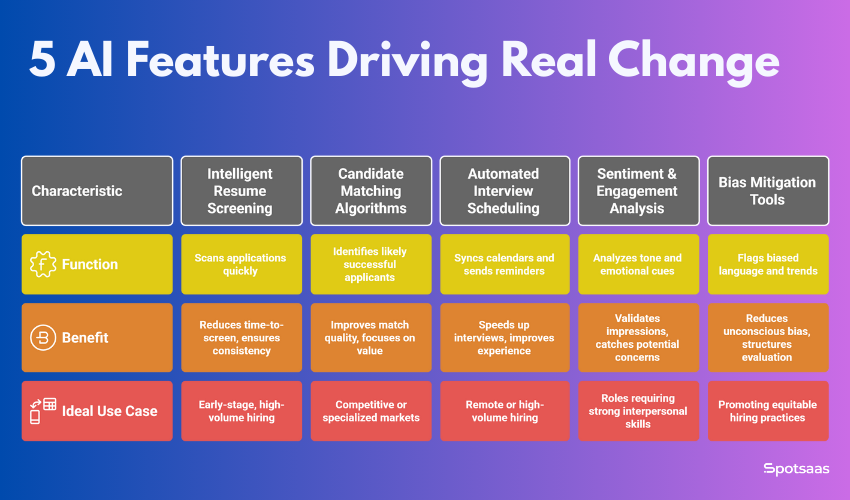
Below are five AI-powered features that are changing how teams approach hiring, with practical use cases showing where AI makes a real difference and how your team can put it to work. Each one addresses a different part of the hiring process, from the first resume scan through to the final interview.
Why AI in Recruitment Is Becoming Essential for Modern Hiring
Hiring looks different than it used to. Teams now juggle tight deadlines, a flood of applications, and pressure to hire both fairly and quickly. Manual work, like sorting resumes or coordinating interviews, can’t keep up, which is where AI steps in.
Here’s what’s pushing more companies to adopt AI in recruitment:
- High-volume hiring: AI filters thousands of resumes in minutes.
- Bias reduction: Algorithms help minimize unconscious bias in screening.
- Resume fatigue: Automated tools surface top-fit candidates without guesswork.
- Scheduling overload: Smart calendars handle interview coordination automatically.
For hiring teams that want to stay competitive, AI is becoming less of an option and more of a requirement.
5 AI Recruitment Features That Improve Speed, Accuracy, and Hiring Outcomes
AI Resume Screening: How It Speeds Up Hiring and Improves Candidate Fit
AI-powered resume screening tools can work through hundreds, sometimes thousands, of applications in a fraction of the time a recruiter would need. They look at job titles, skill keywords, education, and years of experience to score and rank candidates automatically. That lets recruiters spend their attention on the applicants most likely to be a fit, rather than reading every submission by hand.
This cuts time-to-screen significantly while helping ensure strong candidates don’t get missed. It matters most in early-stage hiring, when teams are buried in volume. It also brings more consistency to how candidates are narrowed down to a working list, reducing human error and unconscious filtering.
Smart Candidate Matching Algorithms for Better Hiring Decisions
These algorithms do more than match keywords. They look at patterns from successful hires, job requirements, and candidate profiles to flag applicants likely to perform well, not just the ones who look good on paper.
This works well for companies hiring in competitive or specialized markets, where the right fit isn’t obvious at a glance. Over time these systems learn from hiring outcomes and improve match quality. The focus shifts from volume to value, surfacing candidates who fit both the role and the company culture. That kind of fit is hard to judge from a resume alone, which is where pattern-based matching adds real value.
AI-Powered Interview Scheduling to Save Time and Reduce No-Shows
Chasing candidates and internal teams for open time slots slows hiring down and frustrates everyone involved. AI tools automate this by syncing calendars, suggesting times that work for both sides, and sending reminders to cut down on no-shows.
They handle multiple time zones and adjust for conflicts automatically, without a recruiter needing to step in. That speeds up interviews and improves the candidate experience, especially in remote or high-volume hiring environments where scheduling tends to bottleneck everything. Fewer back-and-forth emails also tends to leave candidates with a better first impression of the hiring process itself.
Using AI for Candidate Sentiment & Engagement Analysis During Interviews
Some AI tools look past the resume entirely, analyzing how candidates come across in interviews, from tone and confidence to enthusiasm and other emotional cues. That gives recruiters a read on not just what a candidate says but how they say it.
This is most useful for roles that lean on interpersonal skills or customer-facing communication. It doesn’t replace human judgment, but this layer of behavioral data can confirm impressions or flag concerns earlier in the process. That extra signal tends to matter most when a hiring team is weighing several similarly qualified candidates against each other.
AI Tools for Reducing Hiring Bias and Promoting Fair Recruiting
AI can support fairer hiring by flagging biased language in job postings and tracking patterns in how applicants move through the process. If certain groups consistently drop off at the same stage, the system can flag it for the hiring team to look into.
These tools also help build evaluation criteria around what a role actually requires, rather than subjective preference. By pushing for consistent, data-backed decisions, AI reduces the influence of unconscious bias without forcing a full process overhaul. Over time, that kind of consistent, criteria-based evaluation also makes hiring decisions easier to explain and defend if they’re ever questioned.
Who Benefits Most from AI Hiring Tools?
AI-powered hiring features aren’t reserved for big corporations. They show up across cross-functional hiring and companies of every size, from growing startups to global enterprises, each with different goals around efficiency, fairness, or candidate experience. Which specific features matter most tends to depend on which of these groups is doing the hiring.
- Recruitment Teams: Automate screening and scheduling, freeing up time for strategic hiring work and candidate relationships.
- HR Departments: Build consistency across departments with structured workflows and smarter evaluation tools.
- Startups and Scaling Teams: Speed up hiring cycles and cut manual workload, useful for lean teams competing for top talent.
- Enterprise Organizations: Manage high-volume hiring at scale with centralized dashboards, automation, and actionable insights.
- Hiring Agencies: Match candidates to diverse client needs quickly using AI-powered recommendations and candidate lists.
How Recruitment Teams Benefit Most from AI Hiring Tools
Recruitment agencies often manage dozens of open roles at once, each with its own timeline and expectations. AI tools help them prioritize the best-fit applicants, automate screening, and handle smart scheduling without juggling spreadsheets or a flooded inbox. With AI handling the repetitive work, recruiters get more time for strategic tasks, like building relationships with high-potential candidates. That shift in where time gets spent is often the biggest change agencies notice after adopting these tools.
How HR Departments Improve Hiring Consistency with AI
For HR teams managing the full employee journey, AI simplifies early-stage hiring tasks while improving consistency across roles and departments. These tools let HR standardize processes like resume evaluation and interview scoring.
Platforms like Sense HR, BambooHR, and Freshteam, all user-friendly HR software, help teams manage applications, rank candidates, and track progress. This creates a more structured, scalable hiring process that saves time and supports consistent decision-making as companies grow.
The result is a structured hiring process that scales as the company grows while maintaining quality and compliance. It also makes onboarding new team members easier, since the hiring process itself is documented and consistent rather than dependent on individual habits.
Why Startups Use AI Hiring Tools to Compete with Larger Companies
Startups can’t afford bad hires or drawn-out hiring processes. With limited staff and resources, AI tools help them compete with larger companies by speeding up hiring cycles and surfacing better candidates faster. Affordable platforms with flexible features suit fast-growing teams that need quick results without a complicated setup. For a small team without a dedicated recruiting function, that simplicity can matter as much as the feature list itself.
AI in Enterprise Hiring: How Large Companies Manage High-Volume Recruitment
In larger companies managing hundreds of open roles, AI tools bring clarity to high-volume workflows. They help keep teams consistent, improve team collaboration among stakeholders, and deliver insights at scale. Whether hiring spans departments or geographies, these tools add structure and speed without sacrificing quality. At that scale, even small gains in consistency add up to a meaningful drop in time-to-hire across the organization.
AI in Recruitment Agencies: Matching Talent Faster Across Diverse Clients
Staffing firms and recruitment agencies juggle multiple clients with different needs. AI features let them sift through candidate pools quickly, match profiles to roles, and deliver accurate, timely candidate lists. This becomes a competitive advantage, helping agencies place top talent faster and more efficiently. For agencies juggling several open searches at once, that extra speed can be the difference between placing a candidate and losing them to a competing offer.
AI in Hiring: Pros, Limitations, and Key Considerations
| Pros | Considerations |
|---|---|
| ✅ Speeds up screening and candidate list process | ❌ May require some training for teams new to AI |
| ✅ Improves quality-of-hire by surfacing better-fit candidates | ❌ Candidate sentiment analysis can be misread without context |
| ✅ Automates repetitive tasks like scheduling and follow-ups | ❌ Some tools may be costly for very small teams |
| ✅ Helps reduce unconscious bias in screening decisions | ❌ Requires oversight to avoid over-reliance on algorithms |
| ✅ Offers insights and analytics to refine hiring strategies | ❌ Effectiveness depends on quality of input data |
Real-World Examples of AI in Hiring: How Teams Use It Today
- Retail company speeding up seasonal hiring: A national retailer used AI resume screening and automated scheduling to cut seasonal hiring time in half, moving from 10 days down to under 5 days per candidate.
- SaaS firm finding culture-fit engineers: A growth-stage SaaS company used candidate matching algorithms to identify engineers who fit both technical requirements and company values, improving retention after 90 days.
- Healthcare organization avoiding scheduling delays: A large healthcare network adopted AI-powered interview scheduling to cut coordination time across departments, speeding up hiring for critical patient-facing roles.
- Remote-first startup reducing candidate dropout: A remote hiring team used sentiment analysis and engagement tracking to better gauge candidate interest and cut down on early-stage ghosting during the hiring process.
How to Choose the Best AI Hiring Software for Your Team
With so many AI-powered hiring tools on the market, picking the right one can feel overwhelming. It doesn’t have to be. The key is focusing on features that support your team’s actual day-to-day needs, not just what looks impressive in a demo.
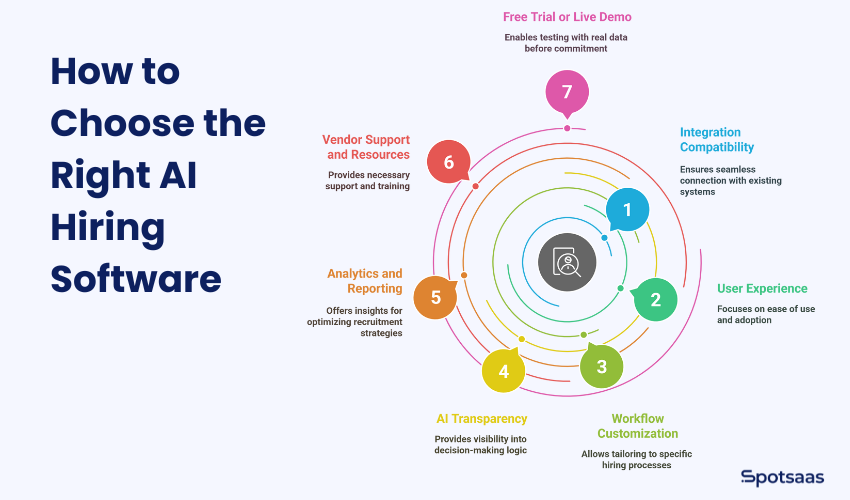
When evaluating platforms, consider:
Integration Compatibility
Does the platform connect with your existing hiring stack? Look for tools that integrate cleanly with your Applicant Tracking System (ATS), Human Resource Information System (HRIS), calendar apps like Google or Outlook, and communication tools like Slack or Teams. Fewer manual workarounds is better, since every extra manual step is a place where data can go stale or get entered incorrectly.
User Experience
Ease of use gets underestimated a lot. A clean, intuitive interface makes a real difference in whether a team actually adopts the tool. If recruiters and hiring managers can’t figure it out within the first 15 minutes, it will slow things down instead of speeding them up.
Workflow Customization
Every company approaches hiring differently. Some need structured scorecards, others rely on flexible evaluations. The right software should let you customize workflows, interview stages, resume scoring rules, and candidate matching criteria as you hire at scale, per hiring at scale comparisons.
AI Transparency
AI shouldn’t operate as a black box. Make sure the tool explains how it evaluates or ranks candidates. Platforms that show their decision-making logic build trust and make it easier for teams to justify their choices during internal review.
Analytics and Reporting
The best ATS tools do more than automate; they inform. Look for platforms with visual dashboards and detailed reports on time-to-hire, candidate conversion rates, funnel drop-offs, and diversity metrics. These insights help you keep refining your recruitment strategy.
Vendor Support and Resources
Even the best tool won’t succeed without solid support behind it. Choose your ATS that offers responsive onboarding, live demos, video tutorials, and ongoing account management. Extra credit if they provide templates, training for hiring managers, or onboarding checklists that save time.
Free Trial or Live Demo
Before committing, see how the tool performs in a real scenario. A live demo using your own candidate data can show whether the software actually fits your workflow, and help surface any hidden costs before you sign a contract.
Choosing the right AI hiring tool isn’t about picking the most advanced software. It’s about picking one that supports smart hiring, fits your team’s needs, scales with growth, and makes your process faster, more consistent, and more effective.
Most importantly, look for platforms offering a free trial or live demo with real candidate data, so you can see how it performs in your actual workflow before committing.
Implementation Tips
Rolling out AI-powered hiring tools might sound like a big change, but done right, it can be smooth, low-risk, and even energizing for your team. Most modern platforms are built to integrate quickly, work alongside your current tools, and support gradual adoption, which tends to matter more for actual adoption than the specific feature list. Here’s how to make that transition smooth:
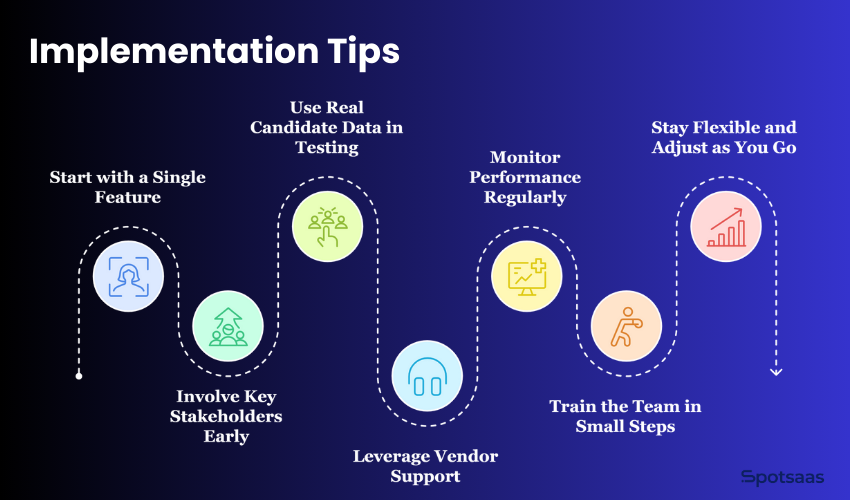
Start with a Single Feature
Start by picking one high-impact feature, such as resume screening, candidate matching, or interview scheduling. Focusing on a single use case lets your team test the tool in a real environment, evaluate performance, and build confidence before expanding. This staged rollout avoids overwhelm and makes early wins easier to show.
Involve Key Stakeholders Early
Bring recruitment agencies and other stakeholders into the process from day one. Their input shapes how the tool fits into existing workflows. When stakeholders feel involved in the decision, they’re more likely to support adoption and champion the tool internally. Early involvement also surfaces specific needs or constraints that affect setup.
Use Real Candidate Data in Testing
A tool that looks great in a generic demo may not hold up in your actual hiring funnel. That’s why it matters to test with real data from current or recent job openings. This shows you how the software handles your candidate volume, hiring criteria, and evaluation steps, giving you confidence it will deliver the results you need.
Leverage Vendor Support
Don’t go it alone. Most AI hiring platforms offer onboarding support ranging from self-serve tutorials to a full implementation guide. Use these resources: ask for templates, onboarding playbooks, or guided sessions for hiring managers. Good vendors are invested in your success and will help iron out technical or training hiccups.
Monitor Performance Regularly
Once the tool is live, track key metrics to understand its impact. Review analytics weekly or monthly to spot trends, inefficiencies, or areas to improve. Metrics like time-to-hire, candidate drop-off rates, or feedback from hiring managers help you fine-tune both the tool’s use and your hiring strategy.
Train the Team in Small Steps
Not everyone needs a full training session. Create quick guides or short video walkthroughs for different roles, since what recruiters need to know differs from what a hiring manager needs. Focus on the benefits to each role rather than just explaining how the software works. The goal is confidence, not overwhelm.
Stay Flexible and Adjust as You Go
As with any new process, stay open to iteration. You may find that some hiring workflows need tweaking, or that one feature delivers more value than expected. Regular feedback loops between users and HR leaders help fine-tune how the tool is applied and keep it matching your evolving hiring needs.
By starting small, staying strategic, and involving your team early, you get the benefits of AI without disrupting what’s already working. The right approach turns implementation from a technical upgrade into a long-term competitive advantage.
AI Hiring Software Checklist: What to Ask Before You Buy
Use this checklist during product demos, internal discussions, or when comparing platforms side by side. It keeps the focus on functionality, usability, and long-term value.
Core Features
- Supports resume screening, candidate matching, and interview scheduling
- Offers AI tools for engagement tracking or sentiment analysis
- Includes bias detection or fairness insights in candidate evaluation
Integration & Compatibility
- Syncs with existing ATS, HRIS, calendar tools, and communication platforms
- Supports SSO or role-based access for hiring teams
- Provides API or Zapier connections for custom workflows
Usability & Customization
- Easy to use without deep technical knowledge
- Allows workflow adjustments to match your hiring process
- Enables customizable scoring or evaluation criteria
Support & Setup
- Includes onboarding support, tutorials, or a knowledge base
- Offers live chat, email, or a dedicated account manager
- Available documentation or templates for quick rollout
Insights & Reporting
- Provides analytics dashboards for team performance and hiring metrics
- Tracks diversity or bias indicators (if required)
- Helps measure improvements in time-to-hire or quality-of-hire
Trial & Scaling
- Offers a free trial and features with real data
- Scales easily for growing hiring needs
- Transparent pricing with flexible plans
Final Thoughts: Why AI in Hiring Matters in 2026
AI in hiring isn’t just a trend. It’s a steady shift in how teams attract, evaluate, and hire top talent. By automating repetitive work and surfacing what matters most, AI tools give recruiters more time to focus on people, not just process. That shift in focus is often what teams notice first once a new tool beds in.
Whether you’re trying to speed up resume screening, improve interview scheduling, or reduce bias in hiring, the right software makes a measurable difference. It’s not about finding the most advanced platform. It’s about finding the one that fits your team, solves your real challenges, and grows with you.
As you explore tools and compare features, keep your goals front and center. Start small, test with real data, and build from there. The shift in how teams hire is already underway.
AI Hiring FAQs: Answers to Common Questions About AI in Recruitment
What is AI hiring software?
AI hiring software uses machine learning to automate and improve parts of the recruitment process, like screening, matching, and scheduling.
Can AI replace recruiters?
No, it supports recruiters by handling repetitive tasks, not replacing the human element of hiring.
Is it hard to implement AI in hiring?
Most tools are plug-and-play and come with onboarding support, making setup simple.
Are AI hiring tools suitable for small teams?
Yes, many platforms offer flexible pricing and features designed for startups and growing teams.
What’s the most significant benefit of using AI in hiring?
It saves time, improves the quality of hire, and adds consistency across the hiring process.
Compare alternatives to the tools in this post
Related Articles
AI Software
How AI-Powered ATS Tools Boost Diversity in Hiring — Real DEI Use Cases (2026)
Continue reading →
AI Software
How To Choose The Best Image Recognition Software For 2026
Continue reading →
AI Software
Best AI Resume Screening Tools in 2026 to Hire Faster
Continue reading →
AI Software
AI Matching in ATS: What It Is, How It Works and Why It Matters for Hiring
Continue reading →