

Finding top talent has become one of the hardest parts of recruiting. Studies show that 72.8% of employers struggle to find skilled candidates. This post walks through ten modern strategies for sourcing the best candidates effectively.
Below are ten proven methods you can put to work to source better candidates and improve your recruitment process from start to finish.
Key Takeaways
- Use social media platforms like LinkedIn, Facebook, and Twitter to connect with potential candidates and share job opportunities.
- Run employee referral programs to tap into the networks of current employees for high-quality hires who are more likely to stay long-term.
- Attend industry-related events to network with professionals, pick up insights, and build connections with talented individuals.
Essential Candidate Sourcing Strategies
Use social media to reach a wider candidate pool and engage with potential hires.
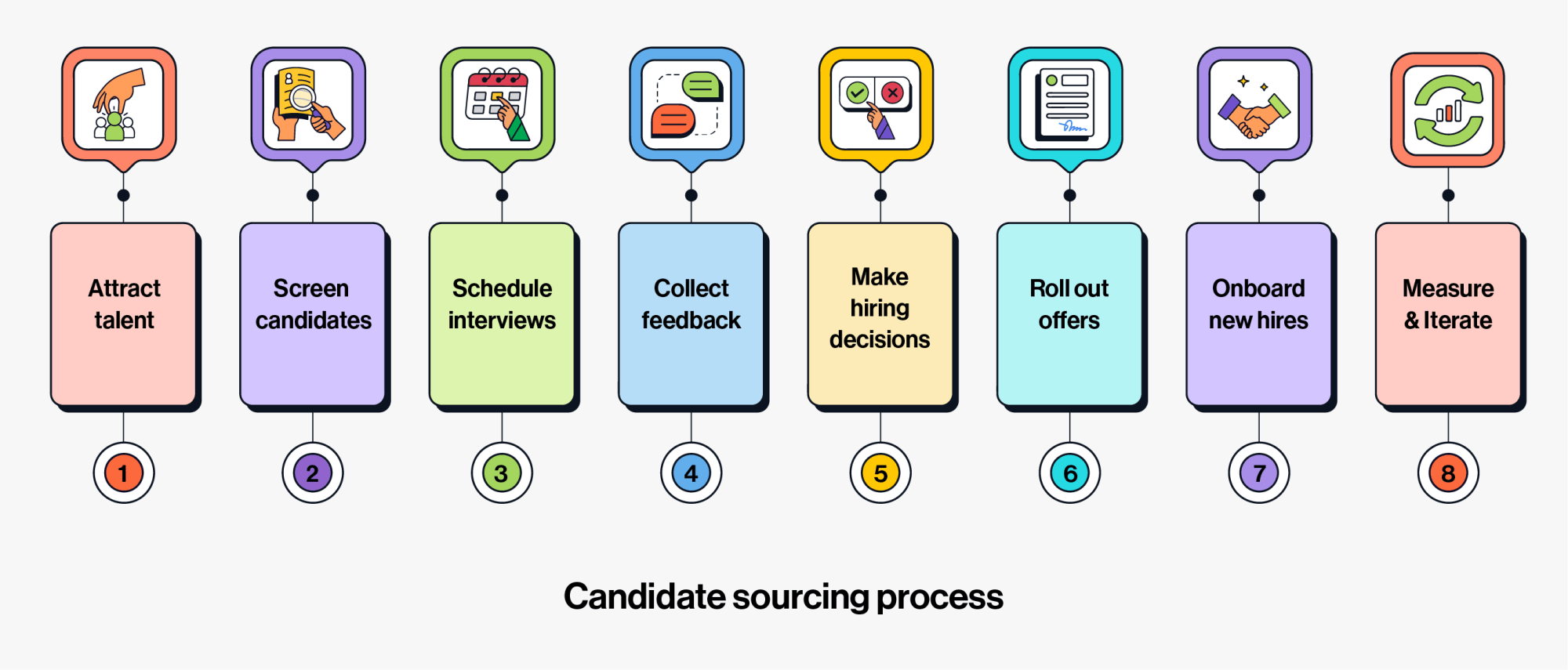
Utilize social media
Social media is a strong sourcing channel for recruiters. Platforms like LinkedIn, Facebook, and Twitter open up endless ways to connect with potential candidates. They also give you a clear view of a candidate’s professional background and personal interests, which helps you gauge fit before you ever reach out.
Featuring job openings on your company’s social pages can attract passive candidates who are not actively looking but stay open to new roles. Posting content about your corporate culture also gives applicants a glimpse of your work environment. That glimpse makes people more curious about your team and encourages them to explore openings at your company.
Use employee referral programs
Recruiters can source strong candidates through employee referral programs. The idea is simple: tap into the networks of your current employees to identify potential candidates for open roles, since good people tend to know other good people in the same field.

By rewarding employees for referring qualified people, companies reach a pool of talent that traditional recruitment methods often miss. Referral programs work well because referred hires tend to be high quality, and because they already come with a personal recommendation, they are more likely to stay with the company long-term.
This approach also builds engagement across the team. Existing employees become ambassadors for the organization, and every referral they make strengthens your employer brand a little more.
Attend industry-related events
Attending industry-related events is a good way to connect with potential candidates. These events let you network with professionals who are already active and engaged in your field.
At conferences, trade shows, and workshops, recruiters can learn about current trends and developments in the field while making genuine connections with talented individuals face-to-face.
Relationships built at these events can lead to future recruitment opportunities and referrals down the line, helping recruiters find strong, top-notch talent for their organizations well after the event itself has ended.
Expand your search
Look beyond the usual channels to find the best candidates for your openings. Do not limit yourself to online platforms and job boards. Consider attending industry-related events, conferences, and career fairs where you can meet potential candidates face-to-face.
Work with universities and professional organizations to tap into their talent pools. Use offline methods like print advertising or direct mail campaigns to reach a wider audience.
The more varied your sourcing channels, the better your chances of finding qualified candidates. Some of the best people are not actively searching for jobs at all, but they stay open to the right new opportunity when it reaches them through a channel they trust.
Craft effective outreach messages
Good outreach messages get the attention of potential candidates. Use clear, concise language that highlights the benefits of the opportunity.
Personalize each message by mentioning relevant skills or experience from the candidate’s profile, so it reads as written for them rather than sent to a list. A clear call-to-action and your contact information make it easy for candidates to respond.
Keep your messages professional, friendly, and tailored to each individual candidate. That extra effort is what separates outreach that gets ignored from outreach that gets a reply.
Importance of Candidate Experience
A positive candidate experience matters for recruiters. When candidates have a good experience during hiring, they view the company more favorably and feel more enthusiastic about joining.
That translates into higher candidate engagement and, ultimately, better hires. A positive experience comes down to a few basics: clear communication at each stage, timely feedback after interviews, and treating candidates with respect and professionalism throughout.
It also means a simple, user-friendly application process that does not frustrate candidates. By prioritizing candidate experience, recruiters build a strong employer brand and attract top talent to their organizations.
Candidates have more options than ever when choosing where to work. By creating a strong candidate experience, recruiters can stand out from other employers and improve their chances of attracting top-tier talent.
A good experience benefits individual applicants and improves the organization’s overall reputation as an employer of choice. Recruiters should make every interaction meaningful and impactful, so that even candidates who are not selected for a position walk away with a positive impression of both the recruiter and the company as a whole. Those candidates often talk to their peers, so the goodwill you build carries well beyond a single hire.
Investing in Recruiting Tools
Investing in recruiting tools can strengthen your talent acquisition efforts. The right tools help you simplify your recruitment process, find qualified candidates faster, and improve hiring outcomes.
Applicant Tracking Systems (ATS) are one such tool that can make a real difference. An ATS automates and manages many parts of hiring, including resume screening, candidate tracking, interview scheduling, and communication.
With an ATS, you save time and effort while making sure no promising candidate slips through the cracks.
Job boards are another valuable tool. They give you access to a large pool of candidates who are actively seeking work right now. Posting openings on relevant job boards, or on specialized niche boards aimed at your industry, improves your chances of finding qualified candidates who are a good fit for your organization.
Social media recruiting tools also help you reach larger networks and put your job postings and employer brand messaging in front of a much wider audience than job boards alone can reach.
In short, investing in recruiting tools is essential for recruiters who want to stay competitive in the talent market. Tools like applicant tracking systems and social media recruiting platforms make sourcing qualified candidates faster and more effective.
With smart investments in these tools, you can improve your recruitment efforts and attract top talent for your organization without wasting valuable time or resources on manual, repetitive work that software can handle for you.
Creative Career Pages
Creative career pages help recruiters attract and engage top talent. These pages give candidates a look at your company culture, values, and what it is like to work there.
By showing your employer brand through visually appealing designs, employee testimonials, and interactive features, you can make a lasting impression on candidates. Career pages are also a chance to highlight unique perks, such as flexible work arrangements or professional development programs, that set your organization apart from competitors in the job market.
With the right approach and attention to detail, these pages become a strong way to attract qualified candidates who are excited to join your team.
Conclusion
Recruiters have many ways to source candidates effectively. By using social media and employee referral programs, attending industry-related events, expanding their search, and crafting strong outreach messages, recruiters can find highly qualified talent.
Investing in recruiting tools and building creative career pages are also key to successful sourcing in the digital age. With these strategies in place, recruiters are well equipped to navigate a competitive job market and attract top-quality candidates.
Measuring Whether Your Sourcing Is Working
Sourcing tactics are easy to list and hard to evaluate. These four numbers tell you which channels deserve more of your time.
Response Rate by Channel
Track replies against outreach sent, split by source. A well-targeted message to a relevant candidate typically outperforms a generic one by a wide margin, and the gap shows up within about fifty sends. If one channel sits far below the others, the problem is usually targeting or message quality, not the channel itself.
Source of Hire, Not Source of Applicant
Channels that produce many applicants often produce few hires. Measuring applications flatters wide-distribution job boards and undercounts referrals, which generally convert at a much higher rate from a much smaller pool. Record where each hired person actually came from and weight your effort accordingly.
Time from First Contact to Offer
Sourced candidates move differently from applicants. Someone who was not looking needs longer to decide but faces less competition from other processes. If sourced candidates consistently stall at one stage, that stage is where your process is losing them.
Pipeline Conversion by Stage
Look at the drop between stages, not just the total. Losing most candidates between screen and first interview points to a mismatch between how the role was pitched and what it actually is. Losing them at offer points to compensation or to a process that ran too long.
Common Sourcing Mistakes
Templated outreach at scale. Volume messaging trains good candidates to ignore recruiters. A smaller number of messages referencing something specific about the person’s work produces more replies in less total time.
Sourcing before the brief is settled. Starting outreach while the hiring manager is still deciding what they want wastes the candidates you contact first, and those are usually the best ones on your list.
Treating referrals as passive. Referral programmes that only exist as a policy produce little. Asking named employees about named target companies produces referrals; a standing bonus offer generally does not.
Ignoring the silver medallists. Candidates who reached final stages for a previous role are the cheapest pipeline you have. They know the company, they were nearly good enough, and most recruiters never contact them again.
Building a Repeatable Sourcing Habit
Most sourcing fails because it happens in bursts when a role opens and stops when it closes. Teams that fill roles quickly treat it as continuous work.
Block a fixed hour or two each week for outreach regardless of open roles. Keep a running list of people worth knowing in the two or three functions you hire repeatedly. Re-contact former finalists before posting anything publicly, since they are the warmest pipeline you have and cost nothing to reach.
The compounding effect is real: a recruiter with an existing list fills a role in days, while one starting from an empty search takes weeks. The difference is not skill on the day, it is the work done in the months before.
Two Numbers Worth Tracking Weekly
Outreach sent and replies received. That is enough to know whether sourcing is functioning, and both take a minute to record.
If outreach drops, the habit has lapsed and the pipeline will thin out in about a month. If replies drop while outreach holds steady, the targeting or the message has drifted. Everything else in sourcing analytics is refinement on top of those two.
Related reading: for the cost side of sourcing, see what job postings actually cost and our guide to ATS pricing by team size.
FAQs
1. What are some candidate sourcing strategies used by modern recruiters?
Modern recruiters use many strategies such as inbound recruiting, collaboration with universities, and effective use of job boards to acquire talent and find qualified candidates.
2. How can an Applicant Tracking System (ATS) aid in candidate search?
An ATS simplifies the job search process by gathering candidate data, creating a candidate persona, and managing employee referrals to source top talent.
3. What is the role of social media recruitment in modern recruiting techniques?
Social media recruitment gives recruiters new ways to reach out to potential candidates directly, adding to traditional search techniques.
4. Can you explain inbound recruiting strategies?
Inbound recruiting focuses on building an engaging employer brand that attracts talented individuals. It is one of the key tactics for successful candidate sourcing in the digital age.
5. Why should modern recruiters collaborate with universities during talent sourcing?
Collaborating with universities opens up effective sourcing channels and gives access to fresh candidates who can bring new skills into the business.
Related Articles

Applicant Tracking Software
ATS Tools for Small Teams: Hire Faster and Smarter with Less Effort
Continue reading →

Applicant Tracking Software
How Collaborative ATS Tools Improve Internal Hiring Communication
Continue reading →

Applicant Tracking Software
How To Choose The Best Job Board Software For 2026
Continue reading →
Applicant Tracking Software
Best Tools for Cross-Functional Hiring Across Teams and Departments
Continue reading →