

Semantic Kernel by Microsoft Review: Is It The Right AI Agent For Your Team?
Best for SMB teams
 SOC 2
SOC 2Add to compare
Overview
Features
Buyer feedback
Alternatives
Media
Security & Compliance
FAQ
Blogs
What is Semantic Kernel by Microsoft?
Semantic Kernel is a lightweight, open-source development kit designed to simplify the creation of AI agents and the integration of cutting-edge AI models into C#, Python, or Java codebases. Acting as an efficient middleware, it enables developers to rapidly build and deploy enterprise-grade AI solutions, accelerating the delivery of advanced capabilities across various applications.
Best For
Best suited for small teams and solo users
Security & Compliance
SOC 2Data residency:Global
Platform
Web-based — no mobile app
Installed - Windows
Installed - Mac
Semantic Kernel by Microsoft Screenshots
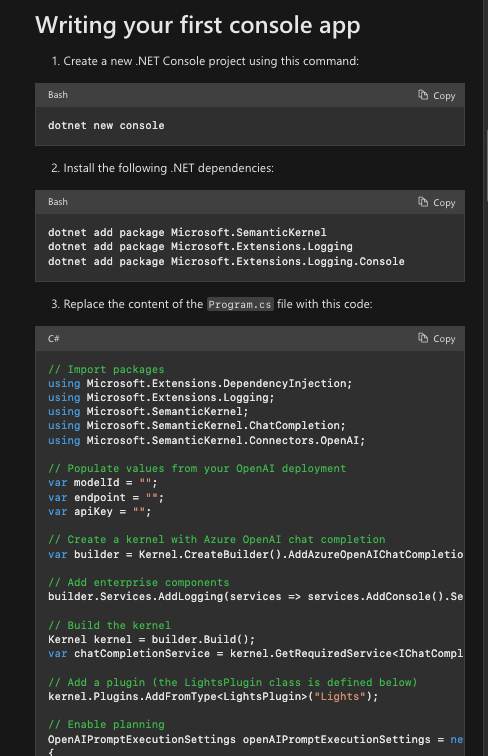


Semantic Kernel by Microsoft was reviewed internally using user feedback, in-house testing, and market research to assess its performance, reliability, and user experience. Learn how we review products and our evaluation process.

Who should consider Semantic Kernel by Microsoft
- Use cases
- Martech, Revtech, Fintech
- Team types
- Typical users encompass roles such as Data Scientists, Software Engineers
- Company size
- 100 to 1,000 employees
Why teams choose Semantic Kernel by Microsoft
By acting as a middleware, it streamlines the integration of advanced AI models, reducing the complexity involved in connecting AI capabilities to applications.
It’s tailored for building robust, scalable AI solutions that can be deployed across enterprise-level applications, ensuring reliability and performance.
The toolkit is designed to speed up the creation and deployment of AI agents, which helps reduce time-to-market for new AI-driven features or solutions.
Is Semantic Kernel by Microsoft right for you?
What buyers should know before choosing Semantic Kernel by Microsoft
Semantic Kernel is an open-source, cross-platform development kit that enables developers to integrate cutting-edge AI models into their applications written in C#, Python, or Java. The tool acts as a middleware, allowing for rapid creation and deployment of enterprise-grade AI solutions.
While it significantly accelerates the AI development process and offers flexibility through its open-source nature, it may present challenges in terms of a learning curve and limited pre-built models. For developers looking to create highly customized AI-driven applications, Semantic Kernel is an excellent choice, but those needing out-of-the-box solutions might find it a bit demanding.
Semantic Kernel by Microsoft pros and cons
- Semantic Kernel by Microsoft pros
By acting as a middleware, it streamlines the integration of advanced AI models, reducing the complexity involved in connecting AI capabilities to applications.
It’s tailored for building robust, scalable AI solutions that can be deployed across enterprise-level applications, ensuring reliability and performance.
The toolkit is designed to speed up the creation and deployment of AI agents, which helps reduce time-to-market for new AI-driven features or solutions.
- Semantic Kernel by Microsoft cons
Being open-source, support might be limited to community forums or user-generated content, which could pose a challenge for teams needing dedicated or more structured assistance.
Developers may face challenges in debugging AI models integrated through the middleware, especially when issues arise between the AI layer and the rest of the application code.
Ready to try it?
Get started with Semantic Kernel by Microsoft
Connect with the team for a personalised demo.
Still comparing?
See how it stacks up
Compare Semantic Kernel by Microsoft side-by-side with top AI Agent alternatives.


What is the pricing of Semantic Kernel by Microsoft?
Weighing your options?
Not sure if Semantic Kernel by Microsoft fits your budget?
Semantic Kernel by Microsoft reviews and ratings
What buyers like
- By acting as a middleware, it streamlines the integration of advanced AI models, reducing the complexity involved in connecting AI capabilities to applications.
- It's tailored for building reliable, production-ready AI solutions that can be deployed across enterprise-level applications, ensuring reliability and performance.
- The toolkit speeds up the creation and deployment of AI agents, which helps reduce time-to-market for new AI-driven features or solutions.
Common complaints
- Being open-source, support might be limited to community forums or user-generated content, which could pose a challenge for teams needing dedicated or more structured assistance.
- Developers may face challenges in debugging AI models integrated through the middleware, especially when issues arise between the AI layer and the rest of the application code.
- As a middleware layer, there could be performance trade-offs when integrating Semantic Kernel into certain systems, especially for real-time applications with stringent latency requirements.
Be the first to review Semantic Kernel by Microsoft
You'll help thousands of buyers make a smarter decision.

- See if Semantic Kernel by Microsoft fits your business
- Real pricing — no sales pressure
- A demo or quick answers, your call
Step 1 of 4
How big is your team?
We tailor recommendations to companies your size.














What are the features of Semantic Kernel by Microsoft?
AI-assisted development is a cutting-edge feature that is redefining the way software is created. It combines the power of artificial intell…
AI-Assisted Planner is a breakthrough feature that utilizes artificial intelligence to provide users with an efficient and effective plannin…
Semantic Kernel by Microsoft security and data handling
Key compliance certifications and security features for IT and security teams evaluating Semantic Kernel by Microsoft.
Certifications

Developer & data
Alternatives to Semantic Kernel by Microsoft


Real-Time Support for Enhanced ...


Why buyers keep looking beyond Semantic Kernel by Microsoft
Lacks customization options for non-Microsoft AI frameworks — teams building with LangChain, Hugging Face, or custom models typically switch
Open-source requirement — organizations avoiding vendor lock-in choose LlamaIndex, LangChain, or Ollama for full environment control
Missing specialized libraries for domain-specific tasks — teams in healthcare NLP, computer vision, or financial modeling add LlamaIndex or Hugging Face Transformers
Limited community resources compared to LangChain — smaller user base means fewer Stack Overflow answers, fewer third-party integrations, and slower issue resolution
Frequently Asked Questions About Semantic Kernel by Microsoft
Common questions buyers ask before choosing Semantic Kernel by Microsoft.
Semantic Kernel by Microsoft is a AI Agent. Semantic Kernel by Microsoft offers AI-Assisted Planner and many more functionalities.
Buyers commonly note the following limitations of Semantic Kernel by Microsoft: Being open-source, support might be limited to community forums or user-generated content, which could pose a challenge for teams needing dedicated or more structured assistance.; Developers may face challenges in debugging AI models integrated through the middleware, especially when issues arise between the AI layer and the rest of the application code.; As a middleware layer, there could be performance trade-offs when integrating Semantic Kernel into certain systems, especially for real-time applications with stringent latency requirements..
Some top alternatives to Semantic Kernel by Microsoft includes Bunch.ai, Lyzr, Hive Data, Wethos AI and Lorikeet AI.
Semantic Kernel by Microsoft offers pricing model
The starting price is not disclosed by Semantic Kernel by Microsoft. You can visit Semantic Kernel by Microsoft pricing page to get the latest pricing.
Ready to try it?
Get started with Semantic Kernel by Microsoft
Get connected with the team for a personalised demo.
About the reviewer
Rajat Gupta is the founder of Spotsaas. Over the past two years, he has reviewed 2,000+ tools across CRM, HR, AI, and finance — applying hands-on product research and a background in commerce and the CFA program to evaluate software through a business and ROI lens. His goal: help teams make software decisions they won't regret.
Disclaimer: This research has been collated from a variety of authoritative sources. We welcome your feedback at [email protected].