
Amazon Relational Database Service (RDS) vs Clerk Comparison

Amazon Relational Database Service (RDS)
Starting at Contact for pricing
- Free Trial
- Free Version
- Large Enterprises
- Small Business
Amazon Relational Database Service (RDS) is a software platform that simplifies management, operation, and scalability of cloud databases. Designed for various database engines, Amazon RDS includes pre-set parameters and…

Clerk
Starting at $20 /month
- Free Version
- Large Enterprises
- Medium Business
Clerk is a simple, comprehensive user management system designed to help companies of all sizes. It features pre-built frontends that can be customized with APIs and a secure dashboard to monitor user activity. With its…
Amazon Relational Database Service (RDS) leads on user satisfaction with a 4.4-star rating across 240 reviews.
Amazon Relational Database Service (RDS) vs Clerk — at a glance
| Feature | Amazon Relational Database Service (RDS) | Clerk |
|---|---|---|
| Rating | 4.4 / 5 | — |
| Reviews | 240 | — |
| Starting price | Contact for pricing | $20 /month |
| Free trial | Yes | No |
| Free version | Yes | Yes |
| Best for | Large Enterprises, Small Business, Medium Business | Large Enterprises, Medium Business, Small Business |
| Category | Database as a Service (DBaaS) Provider | Customer Identity and Access Management (CIAM) Software |
| Integrations | — | 6+ apps |
| Platforms | Browser Based (Cloud) | SaaS/Web/Cloud |
| API | — | Available |
| Support modes | Online | Online |
Key differences between Amazon Relational Database Service (RDS) and Clerk
- Pricing: Clerk starts at $20 /month. Amazon Relational Database Service (RDS) pricing is not publicly listed.
- Free trial: Amazon Relational Database Service (RDS) offers a free trial; Clerk does not.
- Deployment: Amazon Relational Database Service (RDS) supports Browser Based (Cloud); Clerk supports SaaS/Web/Cloud.
Amazon Relational Database Service (RDS) vs Clerk — find the better fit before you commit.
Which tool fits your team best
Which is actually cheaper for your team size
Where each product wins, per real buyers
Most Database as a Service (DBaaS) Provider tools look identical on paper. This comparison cuts to the differences that matter — pricing structure, team fit, and what real buyers found after signing up.
Biggest differences
Features
Pricing
Buying details
Security
Buyer feedback
Integrations
Product tour
Other options
Talk to an expert Talk to an expert | Talk to an expert Talk to an expert |
Free PDF comparison
Download this Amazon Relational Database Service (RDS) vs Clerk comparison
Get the full side-by-side as a PDF — these picks plus the top Database as a Service (DBaaS) Provider tools, with verified ratings, pricing and features.
- Side-by-side on pricing, features & ratings
- Plus the category top 10, scored & ranked
- Emailed to you — no on-screen download
No file downloads on screen — we email it to you. One-click unsubscribe anytime.
Amazon Relational Database Service (RDS) vs Clerk: Biggest differences
Start here before you go deeper into features.
Amazon Relational Database Service (RDS)
Best for scalable, managed cloud databases integrated with AWS services.
- You need a managed database service with automated backups and scaling.
- Your applications require support for multiple database engines in the cloud.
- You want integration within the AWS ecosystem for enterprise workloads.
- You require on-premises or hybrid database deployments outside AWS cloud.
- Your team lacks AWS expertise or needs granular control over infrastructure.
Best for developers needing quick, secure user management with modern auth features.
- You want fast implementation using prebuilt UI components and APIs.
- You need support for multiple modern authentication methods like social logins and MFA.
- You prefer a developer-friendly platform with strong SDKs and documentation for React and Next.js.
- You require highly customized, advanced enterprise-grade identity management features.
- You need full control over your authentication infrastructure and self-hosting capabilities.
Amazon Relational Database Service (RDS): Best for scalable, managed cloud databases integrated with AWS services. Clerk: Best for developers needing quick, secure user management with modern auth features.
Description | Amazon Relational Database Service (RDS) is a software platform that simplifies management, operation, and scalability of cloud databases. Designed for various database engines, Amazon RDS ... Read More about Amazon Relational Database Service (RDS) | Clerk is a simple, comprehensive user management system designed to help companies of all sizes. It features pre-built frontends that can be customized with APIs and a secure dashboard to ... Read More about Clerk |
|---|---|---|
Entry Level Pricing |
|
|
Free Trial Availability |
|
|
User RatingsBased on verified Spotsaas reviews | ||
Best Company Size | 51-500 employees500+ employees | 1-200 employeesMedium Business |
Get pricing help | Get pricing help |
Where each option fits best
See where each product is strongest, which teams it fits, and what causes buyers to keep looking — before you commit.
Based on buyer reviews and verified product data collected by Spotsaas.
Key strengths
- Built-in user management tools: Beyond authentication, Clerk includes dashboards and APIs for managing users, sessions, and permissions. This helps product teams monitor accounts, control access, and maintain secure user management systems without building custom administrative tools.
- Strong developer ecosystem: Clerk integrates well with modern web frameworks such as React and Next.js. Its developer-focused documentation, SDKs, and APIs make it easier for engineering teams to manage user authentication and build secure web applications.
- Multiple authentication methods: Clerk supports several authentication options including email/password login, social sign-in providers, passkeys, and multi-factor authentication. This flexibility allows applications to offer secure and convenient login experiences while adapting to different user preferences.
Best fit
- 51–200
- Authentication Software, Identity & Access Management (IAM), Developer Tools, SaaS Infrastructure, Cybersecurity, Cloud Software
- Software Developer, Full-Stack Developer, Backend Developer, DevOps Engineer, Product Engineer, Startup Founder, CTO, Software Architect, Engineering Manager, Security Engineer
Reasons buyers look elsewhere
- Certain tools focus on specific authentication technologies such as passwordless login, passkeys, or biometric authentication. Developers who want these specialized capabilities may prefer platforms built specifically around those authentication models.
- Some authentication platforms offer larger ecosystems with deeper integrations across enterprise software, identity providers, and compliance tools. Organizations with complex system architectures may choose platforms designed to support large enterprise environments.
- Certain development teams prefer authentication platforms that allow self-hosting or full control over user data and infrastructure. Open-source solutions or self-managed authentication systems provide more flexibility and avoid dependence on a third-party service.
Software Demo
Demo |
|---|
Need a second opinion?
Get decision help from a software advisor
Share your priorities, budget, and team needs, and we’ll help you narrow the options and understand the tradeoffs before you talk to vendors.

- Independent advice — matched to your business
- Understand the tradeoffs before you talk to vendors
- Free 15-min call with a software advisor.
Step 1 of 4
How big is your team?
We tailor recommendations to companies your size.















How do Amazon Relational Database Service (RDS) and Clerk Compare on Features?
Total Features | 6 Features | 12 Features |
|---|---|---|
Unique Features | No unique features | No unique features |
Get Quote | Get Quote |
Compare Amazon Relational Database Service (RDS) and Clerk on pricing
Review starting price, plan structure, and free-trial access side by side so you can see which option fits your budget and buying process.
Pricing Option | ||
|---|---|---|
Starting From |
|
|
Pricing Plans |
|
|
Pricing Page | Pricing information not available | 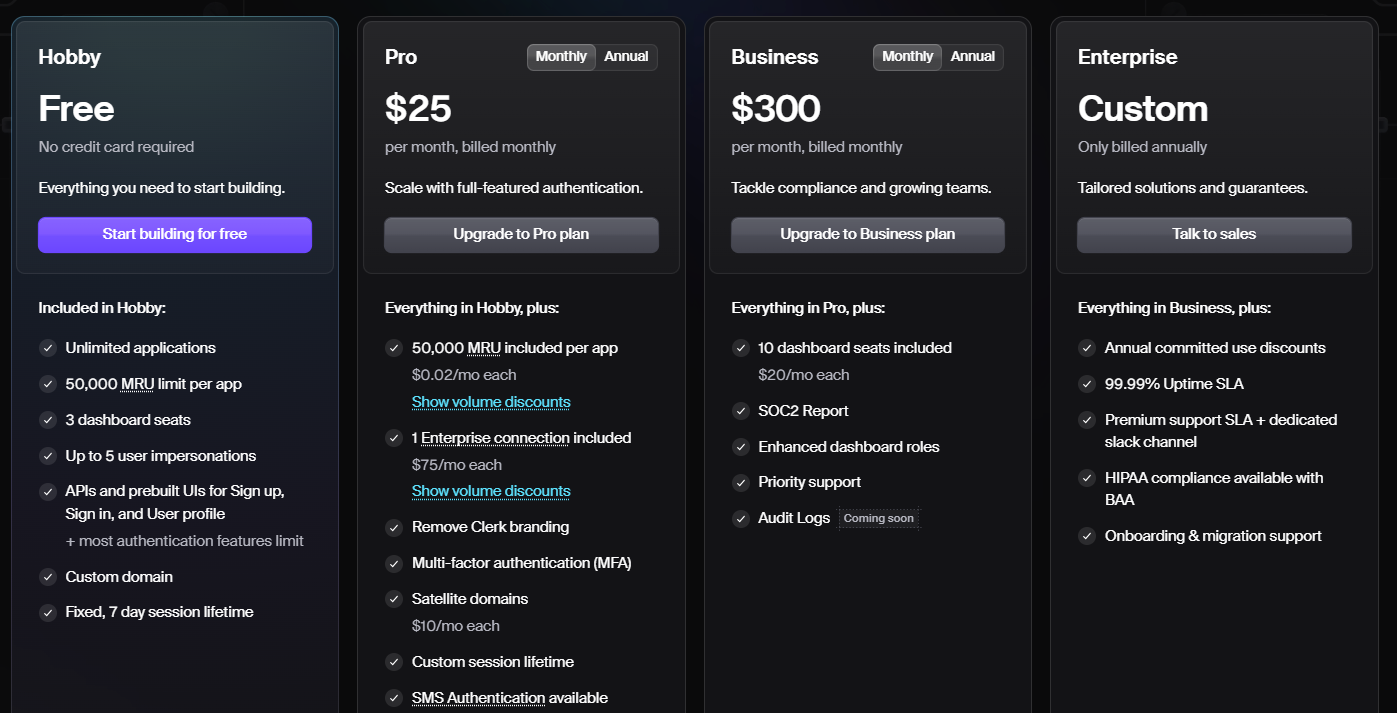 |
Amazon Relational Database Service (RDS) vs Clerk: Other Details
Organization Types supported |
|
|
|---|---|---|
Platforms Supported |
|
|
Modes of support |
|
|
API Support |
|
|
Get help choosing | Get help choosing |
Amazon Relational Database Service (RDS) User Reviews & Rating Comparison
User Ratings | 4.4 (based on 240 reviews) | No reviews available for the product |
|---|---|---|
Rating Distribution | No reviews available for this product | |
Spotsaas Editor’s POV generated by AI | Buyer sentiment Overall positive sentiment highlights ease of use and integration, with some concerns about pricing complexity and control limitations. What buyers like
Common complaints
| Buyer sentiment Users appreciate Clerk’s ease of integration and modern authentication features but express concerns about cost scalability and limited enterprise capabilities. What buyers like
Common complaints
|
Pros and Cons |
|
|
Integrations
Integration with other apps | No Integration information available. |
|---|


Amazon Relational Database Service (RDS) and Clerk Customers
Customers |  Oracle  Cathay Pacific  Amazon Aurora |  Openart |
|---|
Media and Screenshots
Screenshots | No screenshots available. |  3 Screenshots |
|---|---|---|
Videos |  3 Videos |  2 Videos |
Top Alternatives to Amazon Relational Database Service (RDS) and Clerk in 2026
Alternatives |
|---|


Add another option to compare side by side
Search by product name to compare pricing, fit, and buyer feedback in one view.Compare similar software options




Related Blogs and Articles for Customer Identity And Access Management Ciam Software
Disclaimer: This research has been collated from a variety of authoritative sources. We welcome your feedback at [email protected].
Frequently asked questions
- Which is better, Amazon Relational Database Service (RDS) or Clerk?
- Amazon Relational Database Service (RDS) has a user rating of 4.4, while Clerk has no user ratings yet. The right choice depends on your team size, budget, and specific Customer Identity and Access Management (CIAM) Software needs.
- Do Amazon Relational Database Service (RDS) and Clerk offer a free trial?
- Amazon Relational Database Service (RDS) offers a free trial. Clerk does not.
- What is the starting price of Amazon Relational Database Service (RDS) vs Clerk?
- Amazon Relational Database Service (RDS) starts at Contact for pricing. Clerk starts at $20 /month.
- What are the top alternatives to Amazon Relational Database Service (RDS)?
- Top alternatives to Amazon Relational Database Service (RDS) include Amazon Neptune, Amazon DocumentDB, DataStax Enterprise, Azure Cosmos DB, CockroachDB.
- What are the top alternatives to Clerk?
- Top alternatives to Clerk include Kinde, LoginRadius, Frontegg, Amazon Cognito, FusionAuth.
- Where does Amazon Relational Database Service (RDS) fall short?
- Amazon Relational Database Service (RDS) rates highly on the following: simplifies database management with pre-configured settings; supports multiple database engines for diverse needs. The common criticisms: pricing can be complex and varies by usage; limited control over underlying infrastructure. It does not include Collaboration and Analytics (ROI Tracking), which would need a separate product.
- What are the limitations of Clerk?
- Two things to weigh on Clerk. It does these well: prebuilt UI components and APIs enable fast implementation of authentication workflows; supports multiple modern authentication methods including social logins and multi-factor authentication. These are the trade-offs: costs can increase significantly as active user count grows; relies on Clerk’s infrastructure, limiting control over user identity systems. It does not cover Onboarding and Customizable Branding.
More Customer Identity and Access Management (CIAM) Software comparisons
Side by side breakdowns of the same products against other options in this category.
- Amazon Relational Database Service (RDS) vs Kinde
- Amazon Relational Database Service (RDS) vs LoginRadius
- Amazon Relational Database Service (RDS) vs Frontegg
- Amazon Relational Database Service (RDS) vs Amazon Cognito
- Amazon Relational Database Service (RDS) vs FusionAuth
- Amazon Relational Database Service (RDS) vs Auth0
- Amazon Relational Database Service (RDS) vs Akamai Identity Cloud
- Amazon Relational Database Service (RDS) vs OneWelcome
- Amazon Relational Database Service (RDS) vs ClearDil
- Amazon Relational Database Service (RDS) vs Userfront