
Sniffie is a dynamic pricing tool built for e-commerce and retail businesses. It uses machine learning to set prices based on what customers are actually willing to pay, rather than fixed rules or manual guesswork.
The software doesn’t just pick numbers at random. It reads market signals and adjusts prices deliberately, so companies can protect their margins during quieter periods and improve profits when demand is high. Instead of leaving pricing to a spreadsheet and a manager’s judgment, it grounds each price in data.
Think of a marketplace where every price tag updates on its own so sellers get a fair return while buyers still find the product worth buying. That is the job Sniffie does online.
Its role goes past setting individual prices. It gives retailers a structured, repeatable way to stay competitive in a market where prices shift daily and where a single mispriced product line can eat into a whole quarter’s margin. That is what separates a pricing platform from a manual approach: consistency at scale.
This article covers how businesses of every size, from small startups to large enterprises, use Sniffie’s features. That includes price monitoring that tracks what competitors charge, automation tools that adjust prices without manual work, and integrations with platforms such as WooCommerce and Shopify that keep pricing in sync with the store itself.
Users have rated the software highly for improving their pricing workflows and for responsive support, and that feedback comes from a range of industries rather than a single niche. Reviewers point to the mix of automation and hands-on help as the reason the tool sticks in their routine.
It has its rough edges too. Some users report tricky product matching, where the software struggles to pair their items with competitors’ listings, and others mention small text in the interface that makes long sessions harder. Even so, after more than 14 years of recommending pricing solutions, with offices in both the US and Spain, Sniffie holds its own against competitors like PriceEdge and Price2Spy.
Below, we walk through user reviews, comparisons with other tools, the benefits of its integrations, and the features included at each subscription level, which start at €389/month. A free trial is available and does not require a credit card, so you can test the platform before you spend anything.
Here is what you need to know about the tool before choosing a pricing solution for your store.
Key Takeaways
- Sniffie is a dynamic pricing optimization platform that uses machine learning to help businesses set competitive prices based on real-time market trends, consumer demand, and competitor analysis.
- The tool integrates with e-commerce platforms like WooCommerce and Shopify and supports English, Finnish, and Swedish for wider accessibility.
- Pricing plans start at €389.00 per month, with options that scale from small businesses to large enterprises, including automated price monitoring and portfolio management.
- You can test Sniffie through a free trial with no credit card required, giving you a way to check its fit before you pay.
- Feedback is mostly positive on the interface and support, though some users flag a steep learning curve and limited customization in reports.
Understanding Sniffie: The Basics
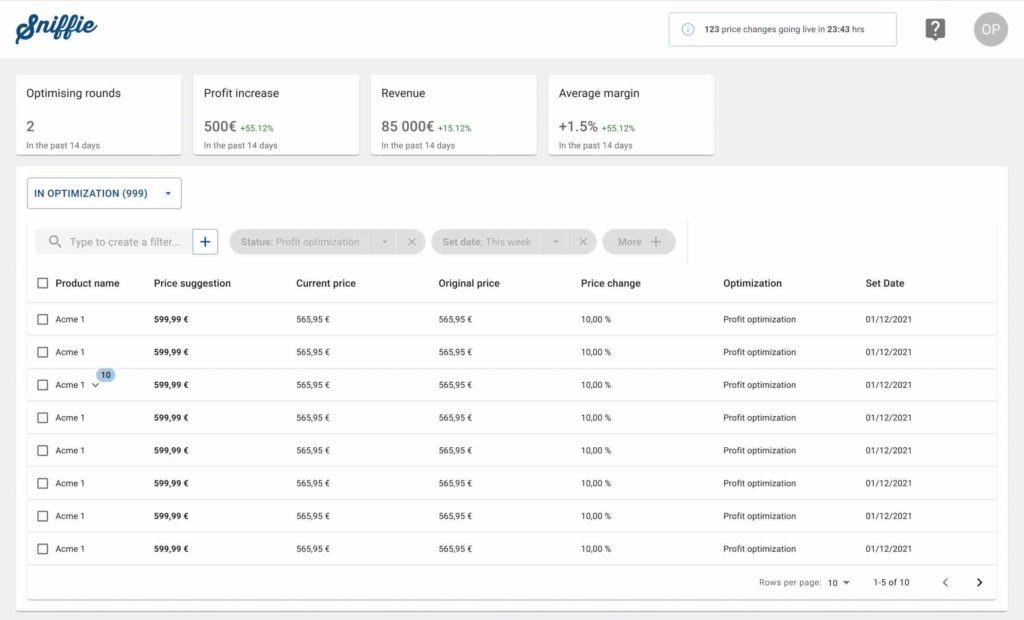
At its core, Sniffie is a price optimization platform for businesses that want a sharper competitive position. It turns market data into pricing decisions, which makes it useful for any company that wants to price with evidence instead of instinct. For teams that once set prices by copying a rival or adding a fixed markup, this shifts the work toward something measurable and repeatable.
What is Sniffie?
Sniffie focuses on pricing optimization and dynamic pricing for eCommerce and retail. It uses machine learning models that help businesses set prices based on real consumer demand and willingness to pay.
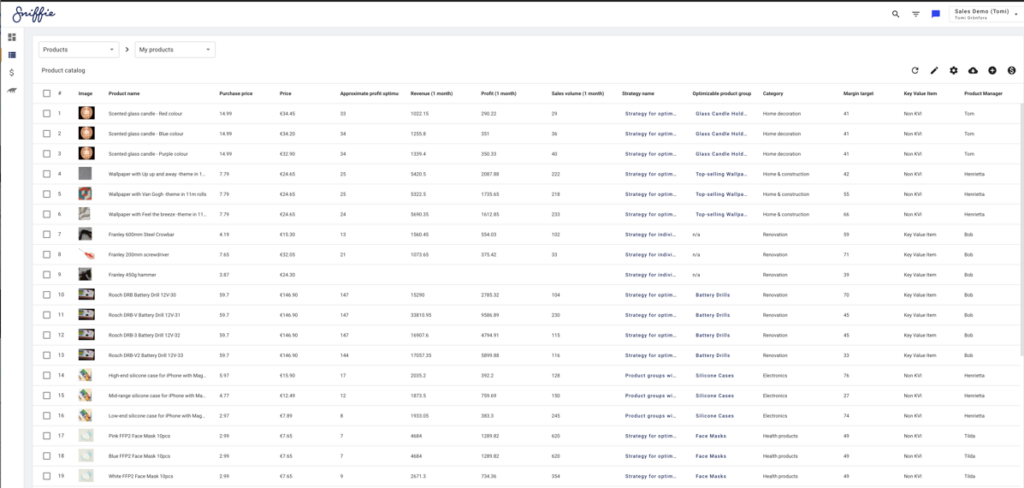
The tool tracks competitor pricing and gives users portfolio management features, so each product sits at a price that fits current market trends. Rather than checking one product at a time, a retailer can manage pricing across a full catalog from a single view.
Getting started is straightforward. You can try the full set of features without paying up front, thanks to a free trial that does not ask for credit card details, which lowers the barrier to seeing whether the tool suits your catalog.
Once you decide to continue, paid plans start at €389.00 per month. Integration with platforms like WooCommerce and Shopify means Sniffie fits into most online selling setups without a heavy rebuild, and it supports English, Finnish, and Swedish language environments, which widens the pool of teams that can use it in their own language.
Key benefits of using Sniffie for businesses
The features add up to clear benefits for businesses. From small startups to large enterprises, companies use Sniffie’s tools to sharpen their competitive position and tidy up their pricing process.
- Automated Price Monitoring: Sniffie watches competitors’ prices and helps businesses stay competitive by adjusting their own prices as the market moves.
- Dynamic Pricing: Companies can adjust prices to match demand, capturing more margin during peak periods and staying attractive when demand drops.
- Machine Learning for Pricing: The models analyze large amounts of data to support pricing decisions that can lift margins.
- Portfolio Optimization: Manage a full product portfolio with tools built to set prices across a wide range of items.
- Free Trial: Businesses can test the platform through a free trial with no credit card required, so evaluation carries no cost.
- Fits Every Business Size: Whether you run a small local shop or a large enterprise, Sniffie offers plans matched to different needs.
- E-commerce Integrations: WooCommerce and Shopify connect with Sniffie, so online stores can put detailed pricing strategies to work.
- Customer Support: Several support channels help users get answers when they need them, which keeps operations moving.
Sniffie’s Features at a Glance
Sniffie’s main features center on price monitoring and pricing automation, the two functions that shape how businesses set prices online. One watches the market; the other acts on what it sees.
The toolset is built to support e-commerce and retail operations with precise, data-backed pricing decisions, so that the prices a store shows reflect current conditions rather than last month’s assumptions.
Price Monitoring Capabilities
Sniffie’s price monitoring gives businesses a full view of market pricing trends. Users can track competitor pricing across the products they care about and respond quickly when a rival raises or drops a price.
This keeps companies competitive because decisions rest on current price data rather than stale numbers. When you know where you sit against the market, you can decide whether to match a competitor, hold your price, or move on margin with more confidence.
Sniffie also offers automated pricing adjustments through its machine learning models, which analyze large data sets and recommend prices. That reduces the need for constant manual review, freeing staff from checking prices by hand every day.
Price management shifts from guesswork toward deliberate actions that drive sales and improve competitiveness.
Pricing Automation Tools
Sniffie’s automation tools change how businesses run their pricing. With machine learning at the core, the software adjusts prices based on real-time data and market trends.
You can set rates that respond to shifts in consumer behavior or competitor moves, without editing each price by hand. As demand or a rival’s price changes, the software can act within your set boundaries rather than waiting for someone to notice.
Companies cut down manual work by folding automation into their process. They can roll out pricing strategies that stay responsive because the software learns from many variables and refines its price models over time, which means the recommendations tend to improve the longer the tool runs against a catalog.
This helps businesses hold their ground in competitive markets while protecting margins through decisions backed by data.
Price Optimization Features
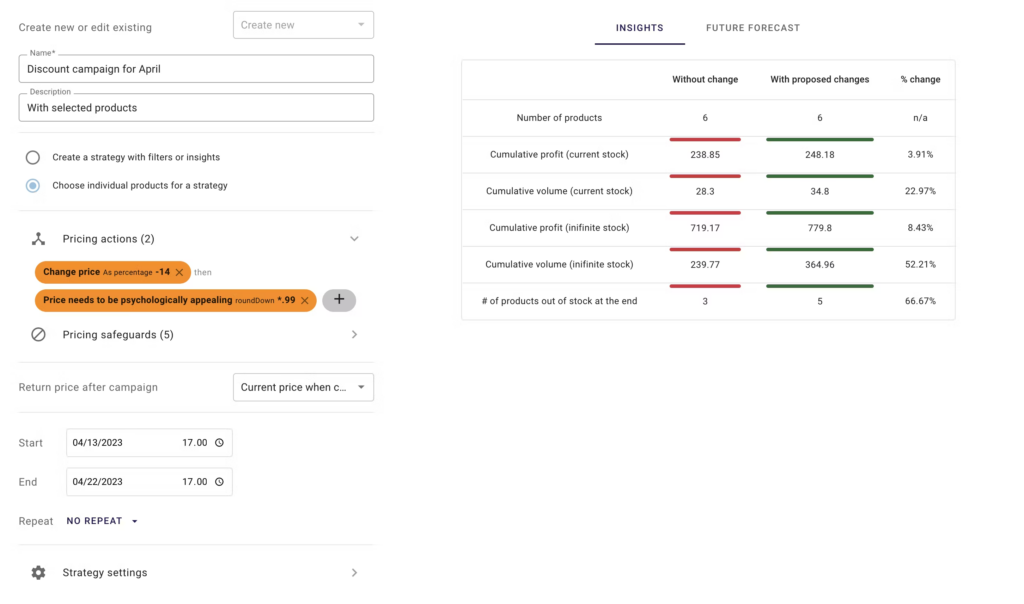
Sniffie handles price optimization with machine learning algorithms that work out the best prices for your products. These models study customer pricing behavior and market trends, then adjust prices in real time for better competitiveness and profit, so a price can shift as demand or a competitor’s price shifts rather than staying fixed until someone changes it.
The result is a pricing tool that reacts quickly to market changes, so you stay a step ahead instead of catching up after a competitor has already moved.
Reviews praise the platform for its value for money and its effectiveness, two points that come up often in user feedback. Sniffie supports English, Finnish, and Swedish, and it connects with major e-commerce platforms like WooCommerce and Shopify, so the optimization work happens close to where the store already lives.
Retailers can build a pricing strategy on data-driven insights that serve both their business goals and their customers’ expectations, aiming for prices that hold margin without pushing shoppers away.
Detailed Sniffie Pricing Overview
Sniffie is dynamic pricing software that uses machine learning to help e-commerce and retail businesses price their products around what customers are willing to pay. This section breaks down its plans and costs so you can match a tier to your budget and scale.
The system adjusts prices deliberately rather than at random, so companies can hold or grow their margins even as the market around them moves.
Picture a marketplace where each price tag updates on its own to give sellers a fair return while buyers still see value in the purchase. Sniffie does that work online, across a store’s whole catalog.
Its purpose runs deeper than single price tags. It gives businesses a repeatable method for staying competitive as prices move in the online retail sector, which matters most when a catalog is large enough that manual pricing can no longer keep up.
Below, we look at how businesses of all sizes, from small startups to large enterprises, use Sniffie’s features. That covers price monitoring for tracking rivals, automation tools for acting on that data, and integrations with WooCommerce and Shopify for keeping everything connected to the storefront.
Users have rated the software well for improving their pricing workflows and for prompt support, and those ratings span many industries rather than a single type of seller.
It is not flawless. Some users note tricky product matching, where items are hard to pair with competitors’ listings, and small text in the interface. Still, after more than 14 years of recommending pricing solutions from offices in the US and Spain, Sniffie remains a strong option next to competitors like PriceEdge and Price2Spy.
This section covers user reviews, comparisons with other tools, the benefits of its integrations, and the features at each subscription level, which begin at €389/month, plus a free trial that needs no credit card.
Here is the plan-by-plan detail.
Sniffie Pricing Plans
Sniffie’s pricing optimization and dynamic pricing software comes in plans built for different business sizes and needs. Here is an overview of what each plan offers:
| Plan | Price (€/month) | Features | Best for |
|---|---|---|---|
| Starter | 389.00 | – Access to core price monitoring features- Basic price change alerts- Email support | Small businesses looking to enter price optimization |
| Professional | Contact for details | – Advanced monitoring and alerts- Pricing automation tools- API access- Dedicated customer success manager | Growing businesses needing more comprehensive tools |
| Enterprise | Contact for details | – Custom price optimization solutions- Full feature access – Priority support– Custom integrations | Large enterprises requiring tailored solutions |
| Custom | Contact for details | – Bespoke features and tools- Personalized onboarding and training- Strategic consultancy services | Businesses with unique needs that demand a custom approach |
Each Sniffie plan carries a distinct set of features and services matched to a business size and need, all on a subscription model that spreads the cost across the year rather than a large one-time fee. The free trial lets prospective users test the platform first, so a business can gauge the tool’s impact on its pricing before committing to a paid tier and see whether the features it needs sit within reach of its budget.
What You Get With Each Plan
Knowing what each Sniffie plan includes matters when you are choosing a pricing tool. Every tier offers a different level of functionality and support, matched to the needs and budgets of e-commerce and retail companies. Here is what each plan provides:
| Plan | Price (€/month) | Features | Support |
|---|---|---|---|
| Starter | €389.00 | Basic price monitoring, limited product tracking | Email/Help Desk, Knowledge Base |
| Professional | Contact Sales | Advanced price monitoring, increased product tracking, API access | Chat Support, Phone Support, Live Online Training |
| Enterprise | Contact Sales | All Professional features, unlimited product tracking, full API access, custom reporting | Dedicated Account Manager, 24/7 Support, Professional Services |
The Starter plan lets businesses get into competitive price monitoring with a straightforward set of tools, which suits a smaller store testing the waters. Companies that need more can move up to Professional or Enterprise, which add capabilities and stronger support as their catalog and their pricing demands grow. That range means a small online store or a large retail chain can each pick a plan that fits its pricing needs without paying for features it will not use.
The Professional plan opens up more of Sniffie’s features, such as higher product tracking limits and API access for integration with the systems a growing business already runs. Larger businesses tend to choose Enterprise, which delivers the full feature set, including unlimited tracking, custom reports, and a dedicated account manager who can help tune the setup to the company’s own pricing goals.
When you weigh which plan to pick, balance functionality against cost. Transparent pricing and the free trial give you a low-risk way to see how Sniffie affects your pricing strategy. With the right plan, a company can both watch competitor prices and act on them, using Sniffie’s AI-driven insights to make informed decisions.
The next section turns to user experiences and feedback from businesses that have adopted Sniffie.
Evaluating Sniffie: User Reviews and Feedback
User reviews show both what Sniffie does well and where it falls short, which helps set realistic expectations for anyone weighing the tool. Marketing claims only go so far; the accounts from people running the software day to day tend to be more useful.
The accounts below reflect hands-on experience and give useful benchmarks for businesses considering it, covering both the praise and the complaints so you get a balanced picture.
Positive User Experiences
Sniffie draws steady praise from users, and many businesses report growth after adding it to their e-commerce operations. The points below come up repeatedly in that positive feedback.
- Users value Sniffie’s AI-driven price optimization, which helps them stay competitive by adjusting prices to market trends.
- E-commerce platforms benefit from a straightforward integration process that fits Sniffie into existing workflows.
- Customer support earns high marks for being attentive and helping users get the most from the tool.
- The interface is often called user-friendly, which puts complex pricing strategies within reach of more users.
- A free trial with no credit card required lets businesses explore the features at no risk.
- Support for English, Finnish, and Swedish widens the tool’s reach across a diverse client base.
- Clients point to Sniffie’s real-time data analytics as a driver of better decisions.
- Users share results such as improved sales figures and better-tuned pricing models after adopting the tool.
Critiques and Common Issues
Not every review is positive. Some users report problems that potential buyers should weigh before choosing Sniffie, and knowing them up front helps you plan around them rather than discover them later.
- Font Size Concerns: Some users find the small font in Sniffie’s interface hard to read, which makes navigation more of a strain.
- Product Matching Problems: A few reviews mention issues with the product matching feature, which can cause inaccuracies when monitoring competitors’ prices and weaken pricing strategies.
- Learning Curve: New users may face a steep learning curve. The range of features is an advantage, but it takes time to master.
- Limited Customizations: In some cases, the customization available in reports and alerts does not meet every user’s needs, which can hold back specific decisions.
Sniffie vs. Competitors: A Comparative Analysis
Sniffie has its place in the market with tools built for dynamic pricing, but how does it compare with rivals? No single pricing tool is best for every business, so it helps to see the trade-offs. This section shows where Sniffie is strong and which alternatives may suit different needs.
How Sniffie Stands Out
Among many pricing tools, Sniffie stands out for its machine learning models. These algorithms help businesses set prices that stay competitive and line up with what customers are willing to pay, which is a harder balance to strike than simply matching the lowest price in the market.
That focus on the buyer’s decision gives retailers an advantage when they build strategies to drive sales and protect margins, because a price tuned to willingness to pay tends to sell without leaving money on the table.
Sniffie’s real-time data analytics also set it apart. E-commerce platforms get current information, so they can react quickly to market trends and competitor moves instead of working from data that is already out of date.
Multilingual support extends that reach across borders, letting users in different regions manage their pricing in their own language rather than working around an English-only interface. For teams outside English-speaking markets, that lowers the friction of adopting the tool.
Popular Alternatives to Sniffie
Sniffie is not the only pricing automation tool available. Businesses in the technology sector often compare several options before settling on one that fits their pricing needs, since each tool leans toward a particular type of user. The table below lists popular alternatives, each with its own features and focus.
| Tool | Core Features | Target Users | Unique Selling Points |
|---|---|---|---|
| PriceEdge | Dynamic pricing, Price optimization, AI-driven insights | Large enterprises, Industries with complex pricing scenarios | Advanced AI capabilities, Customizable pricing strategies |
| Price2Spy | Competitor price tracking, Pricing analytics, Repricing alerts | E-commerce platforms, Retailers of all sizes | Robust reporting tools, Real-time pricing data |
| Competera | Price management, Market-driven pricing, Promotion analysis | Retailers seeking competitive intelligence, Brands focused on market share | Market adaptive pricing, Actionable insights |
| PriceShape | Automated repricing, Competitor monitoring, MAP compliance | Online retailers, Brands with Minimum Advertised Price policies | User-friendly interface, Supports MAP monitoring |
Each platform serves a particular part of the market with its own take on pricing challenges, from enterprise-grade AI to straightforward repricing for smaller stores. Weigh your specific requirements and resources, including catalog size and the platforms you already use, before choosing the best fit for your pricing work.
The Advantages of Sniffie for E-Commerce and Retail
Sniffie helps e-commerce and retail businesses stay competitive by refining their pricing with precision. It tracks market trends and speeds up decisions on price changes, which affects both profitability and market position, since the timing of a price change often matters as much as the change itself.
Boosting Pricing Strategy
Sniffie sharpens e-commerce and retail pricing with real-time price monitoring and competitive pricing analytics. Its machine-learning-based dynamic pricing lets businesses respond quickly to market changes and set prices for better profitability.
The tool tracks competitors’ prices and shows how to position products in the market, which helps retailers decide where to sit on price relative to the rest of the field.
Integration with eCommerce platforms like WooCommerce and Shopify makes Sniffie useful for online retailers who want to simplify their pricing work. With those integrations, pricing automation is easier to set up because the data already flows between the store and the tool, and product portfolios stay well managed across the catalog.
Retailers gain an edge with a data-driven approach that adjusts prices from detailed price intelligence, which supports sales and customer loyalty.
Enhancing Market Competitiveness
E-commerce and retail are competitive markets where strategy matters. Sniffie applies machine learning models to help your business set competitive prices that appeal to shoppers.
You can adjust prices in real time and keep pace with the competition rather than lagging a step behind. That gives you a dynamic approach that tracks market changes as they happen and lets you respond while the change still matters.
With AI-driven optimization, businesses set prices from data instead of hunches, which removes much of the guesswork from a decision that directly affects revenue. Retail analytics and market intelligence give firms the insights to find their place in a crowded market and hold it.
This is not just about cutting prices. It is about aligning them with consumer expectations and competitor moves, which keeps you at the front of your segment and protects margin instead of chasing the lowest price on the market.
The Downsides: Potential Drawbacks of Using Sniffie
Sniffie has strong pricing features, but no tool is perfect. Some businesses will run into limits that affect their decision.
Limitations to Consider
Despite its strengths, users have hit some limits in Sniffie’s interface and functionality. The small font size can be hard to read, which weakens the experience.
Product matching sometimes causes issues that need manual correction to keep the data accurate, which can add work for teams with large or varied catalogs where automatic pairing is harder.
Working around these issues matters for anyone who wants to use Sniffie well. Weigh these drawbacks against the benefits before you fold the tool into your pricing routine, and decide whether the extra checks are worth the automation you gain in return.
Understanding the limits lets you set realistic expectations and plan around them.
When Sniffie Might Not Be the Best Fit
Some businesses will find that Sniffie does not match their needs. If you manage a wide range of products, the product matching problems could be a real obstacle.
Users note that trouble pairing products with those of competitors can reduce the accuracy of competitive analysis and market research, and when the matches are off, the pricing recommendations built on them will be off too.
The interface matters too. Anyone who needs larger text for clarity may struggle with Sniffie’s small fonts, and an interface should be both functional and accessible.
Without those elements in place, such as clean data integration and a clear UI, Sniffie may not improve your pricing strategy or your retail analytics as much as you hoped.
Core Integrations That Enhance Sniffie’s Usability
Sniffie becomes more useful with its core integrations, which connect parts of the e-commerce stack to simplify workflows and improve data analysis. A pricing tool works best when it plugs into the store and systems a business already relies on.
These connections extend what Sniffie can do, letting users sync market insights with the tools they already run for a complete approach to pricing rather than a separate, disconnected step.
List of Sniffie Integrations
Sniffie connects with several platforms that support e-commerce and online retail. These integrations help businesses manage inventory, run market research, and set prices.
- WooCommerce Integration: Sniffie works with WooCommerce so online stores can sync product data and track competitor pricing in one place. This lets users adjust prices as the market moves while protecting margins.
- Shopify Partnership: Through its Shopify integration, Sniffie gives retailers access to data analytics tools. Store owners can use these insights for competitive intelligence and better pricing decisions.
- Magento Open Source Connection: For Magento Open Source users, Sniffie pairs its price optimization with Magento’s flexible platform, giving sellers usable data for smarter pricing.
- API for Custom Integrations: Sniffie offers an API for further custom integrations, so companies can link it with other applications they use day to day.
Benefits of Integration Features
The integrations add real value to eCommerce and retail operations. By connecting with platforms like WooCommerce and Shopify, Sniffie fits into existing setups and adds to what they can do without forcing a business to change how it already sells.
That integration changes how a business prices its products, using machine learning to adapt to market changes in real time and to keep prices current across the storefront as conditions shift.
Users get more flexibility through third-party connections that extend functionality past the core features. As businesses add these connections, they can improve their pricing strategies and portfolio management, keeping decisions data-driven and aimed at profitability.
Because Sniffie fits into different software systems with little friction, it works well for companies that want to simplify processes and improve how they manage price. The less setup a tool demands, the sooner a team can put it to work on real pricing decisions.
Sniffie’s Role in Pricing Automation and Optimization
Sniffie gives retailers and e-commerce businesses tools to automate and optimize their pricing. It turns market data into usable insight, so companies can make quick, informed decisions that support profit and a competitive position, and it does so at a scale that manual pricing cannot match once a catalog grows.
How Sniffie Transforms E-Commerce Pricing
With Sniffie’s price monitoring software, e-commerce businesses can track product prices across many online stores in real time. That helps retailers make pricing decisions quickly and stay competitive as the market changes, since they are working from what rivals charge right now rather than a snapshot from last week.
The platform’s dynamic pricing adjusts prices automatically based on set rules and algorithms, so businesses stay both competitive and profitable.
These tools lead to pricing strategies that reflect current market conditions. Companies can apply discounts when demand needs a push or premium pricing when it is strong, timing each move to support sales while protecting margins rather than discounting across the board.
The subscription model starting at €389.00/month allows for scaling as a business grows, and support for English, Finnish, and Swedish keeps the tool accessible across regions and for teams that do not work in English.
Real-World Applications and Success Stories
Users across industries report solid results with Sniffie, which backs up its standing as a pricing tool for e-commerce and retail.
- A home electronics retailer refined its dynamic pricing with Sniffie and increased profits by 15% in the first quarter.
- Fashion outlets credit Sniffie’s competitive pricing analysis with helping them adjust prices quickly, which improved customer retention.
- Small business owners find the price tracking and monitoring features useful for keeping pace with competitors without spending hours each day.
- Several online stores say Sniffie’s AI-driven pricing simplified complex pricing structures, which saved time and made operations more efficient.
- Pharmacies have used Sniffie’s WooCommerce integration to manage inventory while holding their profit margins.
- A sporting goods store reported a marked improvement in its retail pricing strategy after adopting Sniffie’s automated tools.
- User feedback often points to easy access to data that supports better decisions. One user described how the insights helped rework their promotional strategy.
- A bookstore chain used Sniffie’s eCommerce pricing tools to make real-time adjustments during high-traffic events like Black Friday, which drove record revenue.
Getting the Most Out of Sniffie: Tips and Tricks
To get real value from Sniffie, it helps to know a few practical strategies. The tool is only as good as the way it is set up and used. With these in hand, users can make better use of the platform and keep up with the market rather than fall behind it.
Best Practices for Sniffie Users
Getting the most from Sniffie takes a plan. These practices will help you get results and refine your pricing strategy.
- Start by connecting Sniffie to your e-commerce platforms, such as WooCommerce or Shopify. This keeps data in sync so price changes show up across all sales channels.
- Use Sniffie’s price monitoring regularly to track competitor prices. Staying on top of market trends lets you adjust your prices and hold a competitive position.
- Let Sniffie’s machine learning models set prices that meet the competition while staying profitable. The algorithms analyze large data sets to support informed pricing.
- Set a routine for reviewing Sniffie’s analytics. The insights help you read customer behavior and adjust your pricing accordingly.
- Build pricing workflows around your business using Sniffie’s portfolio management features. Efficient workflows let you respond quickly to market shifts and automate complex tasks.
- Use machine-learning-based dynamic pricing for real-time optimization. It adapts to changing conditions right away, which matters in fast-moving retail.
- Explore the full range of features, from basic tools to advanced options, whether you are a small business or a large enterprise. Knowing all the functions helps you apply the tool across different situations.
- Train your staff on how to use the platform. Informed team members will contribute more toward your pricing goals.
- Use Sniffie’s customer support and online resources to troubleshoot issues or learn new techniques in price intelligence.
Maximizing ROI with Sniffie
With those best practices set, here is how they drive a return on investment. Sniffie’s machine learning pricing models let retail businesses set prices that attract customers and improve margins, which is where the subscription cost starts to pay for itself.
Sniffie’s portfolio management tools let companies monitor and adjust pricing in real time, which keeps them aligned with market trends and competitors across the whole catalog rather than a handful of watched items.
To make the most of the tool, retailers should use customer pricing data well. By feeding that data into price-setting algorithms, firms can match consumer demand while improving revenue, turning information they already collect into sharper pricing decisions.
Sniffie’s insights make competitive pricing easier to apply. Retailers can both react to the market and shape their eCommerce pricing for stronger financial results.
FAQs: Common Queries About Sniffie Answered
This section answers the questions people ask most about Sniffie, with clear responses to help you decide. Whether your question is about subscriptions and billing or the tool’s technical capabilities, the goal is to give you a solid understanding of how Sniffie fits your pricing needs before you commit.
Licensing and Subscription Questions
Sniffie runs on a subscription model with pricing options for different business sizes and needs. Plans start at €389.00/month, which gives companies an entry point to the platform.
Technical and Support Inquiries
When you hit a technical problem or need help, Sniffie’s support team is available. Whether your question is about competitor tracking, data analysis tools, or the user interface, help is an email or call away.
Key Terms and Definitions
Understanding the language of eCommerce pricing helps you read the market with more confidence. Here are the essential terms used by Sniffie and others in the industry:
Understanding Pricing Strategies and Techniques
Knowing e-commerce pricing strategies matters for any business in the digital market. Sniffie’s dynamic pricing lets retailers adjust prices in real time based on market conditions, competitor activity, and consumer demand.
Upcoming Features and Updates
Sniffie keeps building out its pricing automation and optimization. Retailers and e-commerce businesses can look for updates that improve their pricing strategies, several of which are outlined below.
The Evolving Landscape of E-Commerce Pricing
E-commerce pricing keeps getting more dynamic. Retailers now rely on algorithms and machine learning models like those in Sniffie to gauge customer price sensitivity more accurately.
1. What does Sniffie do?
Sniffie helps businesses track and analyze market prices automatically.
2. Who can benefit from using Sniffie?
Retailers, e-commerce shops, and brands that want to stay competitive with pricing can benefit from using Sniffie.
3. How much does it cost to use Sniffie?
The cost depends on the plan you choose; visit their website for current price details.
4. What are some features of Sniffie?
Sniffie offers features like price monitoring, competitor analysis, and market trend tracking.
5. Are there any alternatives to Sniffie?
Yes, there are alternatives such as Price2Spy, Prisync, and Competitor Monitor that also offer similar services.

- Independent picks for exactly what you just read about
- Matched to your team size & needs
- Vendors don't pay for placement
Step 1 of 4
How big is your team?
We tailor recommendations to companies your size.















Related Articles

Buyers guide
How To Choose The Best Marketplace Software For 2026
Continue reading →
Buyers guide
How To Choose The Best E-Commerce Tools For 2026
Continue reading →
E-commerce Platforms
Top 13 Best ACA Reporting Software Tools in 2026 for IRS Compliance & Benefit Tracking
Continue reading →
Buyers guide
How To Choose The Best Product Analytics Software For 2026
Continue reading →