
Many online retailers struggle to judge how well their store is actually performing. Tracking a handful of specific metrics gives you the data you need to make better decisions. This article covers the e-commerce metrics that matter most, from conversion rates to customer acquisition costs, so you can act on evidence rather than guesswork.
Here is what to measure and why each number counts.
Key Takeaways
- Metrics such as sales conversion rate, average order value, and customer acquisition costs give online retailers a clear read on performance.
- These numbers highlight where a business can improve and support decisions backed by data rather than assumptions.
- Analytics tools like Google Analytics or Shopify Analytics, combined with tracking codes on your site, let you measure e-commerce metrics accurately.
Key E-commerce Metrics for Online Retailers
The core e-commerce metrics for online retailers are the sales conversion rate, average order value, customer lifetime value, customer acquisition costs, and shopping cart abandonment rate.
Sales conversion rate
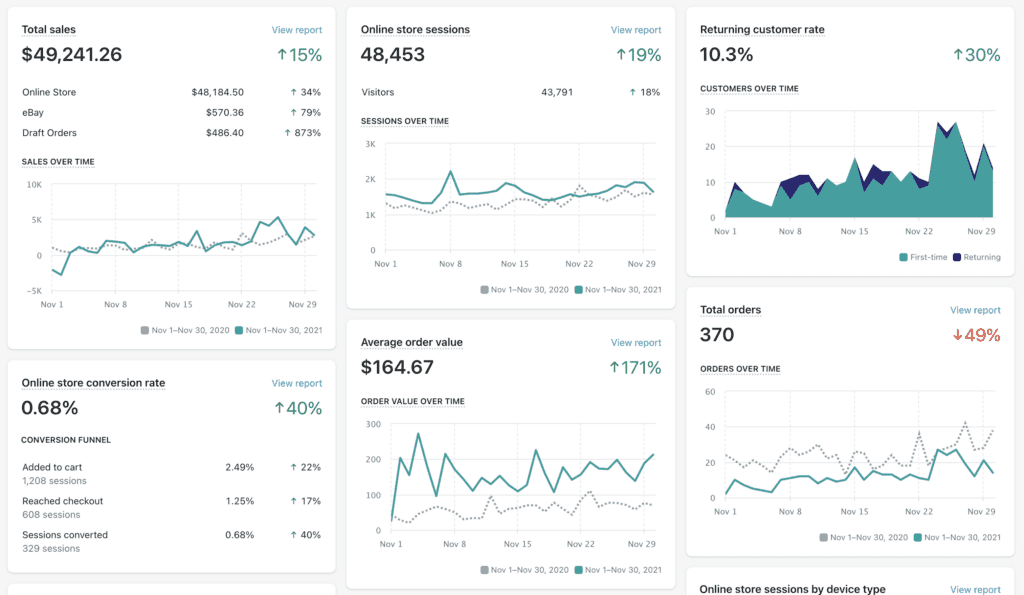
The sales conversion rate measures the percentage of website visitors who make a purchase. A high rate points to effective marketing and a site that is easy to use, where customers find what they need without friction.
You can raise this rate by improving product pages, cutting steps out of checkout, and offering personalized product recommendations.
This metric tells you how your store performs online and shows exactly where sales are slipping away, so you can fix those points and grow revenue. Because it ties directly to how many visitors turn into buyers, it is one of the clearest signals of whether your marketing and your site are working together.
Average order value
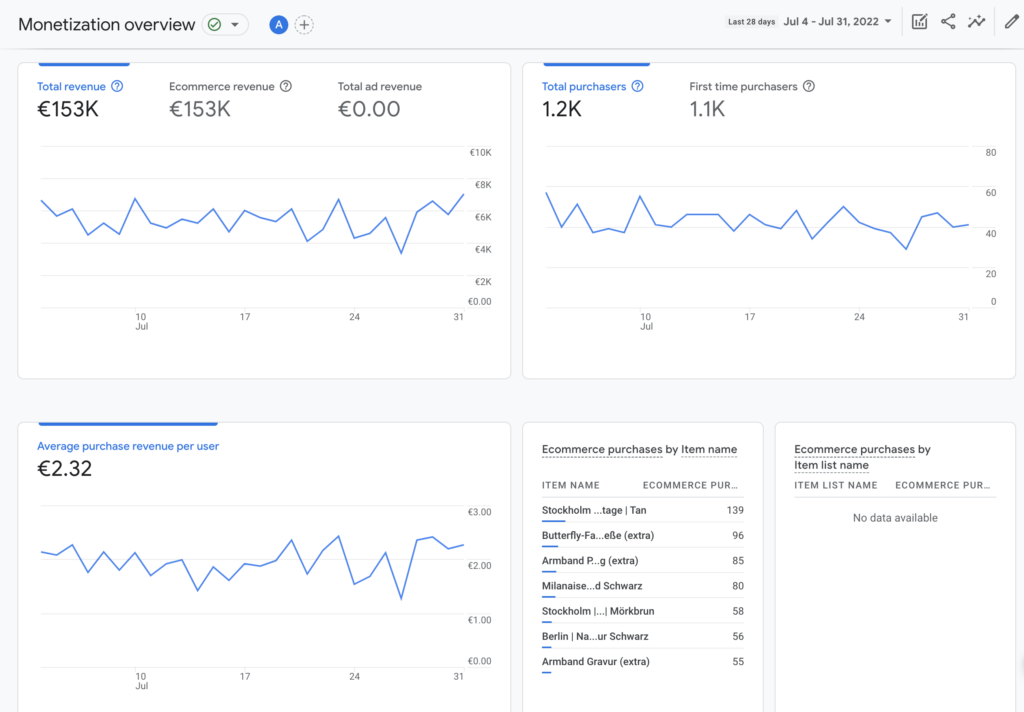
Average order value is a metric online retailers should track to judge how well their sales tactics work. It is the average amount a customer spends per transaction.
Watching this number tells you how customers buy and where revenue can grow. A high average order value means customers spend more each time they purchase, which lifts profit.
A low average order value can signal a need for targeted campaigns or upselling to encourage bigger baskets. By studying and improving this metric, online retailers can push sales volume higher and strengthen their bottom line. It also pairs well with the sales conversion rate: converting more visitors matters more when each order is worth more, so the two numbers are best read side by side.
Customer lifetime value
Customer lifetime value measures the total value a customer brings to your business over the whole relationship. It counts not just the first purchase but repeat orders and the room for upselling or cross-selling.
Calculating it shows how much revenue each customer generates, which guides your choices on marketing, pricing, and retention.
Knowing this figure helps you focus on your most valuable customers and spend your resources where they pay off over the long run. When you compare it against what you pay to acquire a customer, it also tells you whether a given channel brings in buyers who are worth keeping.
Customer acquisition costs
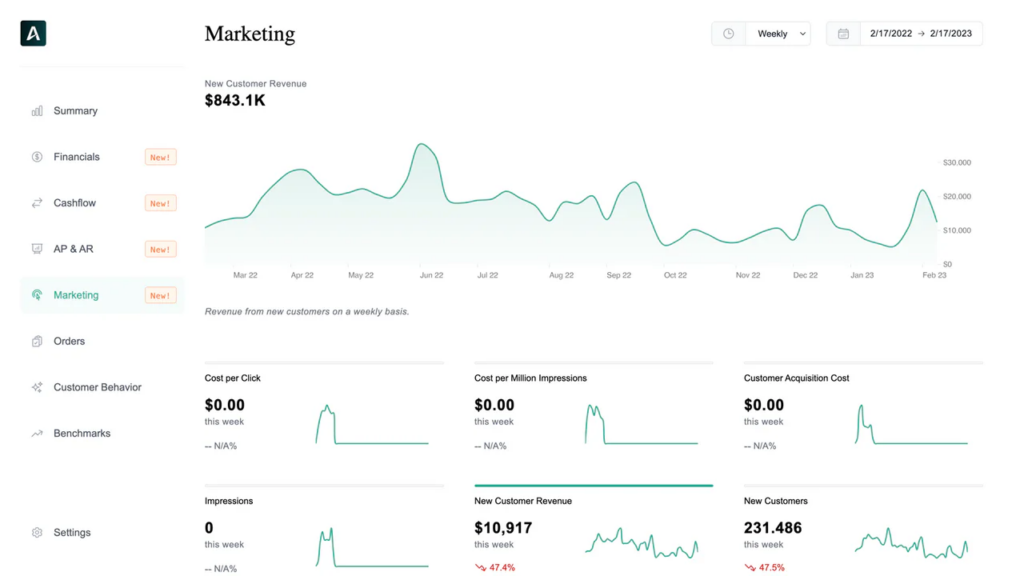
Working out and watching customer acquisition costs matters for online retailers. These are the expenses of drawing new customers to your store.
By measuring them, you learn how much you spend to win each customer. That figure lets you judge your marketing choices and set budgets that make sense.
Understanding acquisition costs shows which channels and campaigns actually pay off, so you can direct spending toward them and lift your return on investment (ROI). Left unchecked, a rising cost to win each customer can quietly eat into margins even when sales look healthy, which is why this number deserves regular review.
Shopping cart abandonment rate
The shopping cart abandonment rate is an important metric for online retailers. It measures the percentage of shoppers who add items to their cart but leave the site without buying.
Tracking it reveals where the checkout breaks down so you can fix it and lose fewer sales. A high abandonment rate often means hidden fees, a complicated checkout, or doubts about the site’s security.
Studying and improving this metric can raise your conversion rates and, in turn, your sales revenue. Since shoppers who reach the cart have already shown intent to buy, recovering even a share of those abandoned carts is often cheaper than winning a brand-new customer.
Importance of E-commerce Metrics for Business Success
E-commerce metrics matter to online retailers because they supply the data you need to read performance, forecast more accurately, and study how visitors use your site.
Understand performance
Reading the performance of your store is central to running it well. Looking at sales conversion rate, average order value, customer lifetime value, and customer acquisition costs shows you how the store is doing.
Together these numbers reveal how well your marketing drives sales and brings in new customers. With that picture in hand, you can make data-driven choices and tune your approach to improve profit and grow.
Improve forecasting
Better forecasting lets online retailers predict future sales and plan inventory to match. Analyzing metrics such as sales conversion rate, average order value, customer lifetime value, and customer acquisition costs surfaces patterns in how customers behave.
That data supports sharper decisions about marketing, the products you carry, and how you price them. With stronger forecasts, retailers can run tighter operations and keep pace with competitors in a fast-moving digital market.
Analyze website engagement
To judge how well your online store works, study website engagement. Looking at how users behave and interact on your site shows how it performs and where it needs work.
Check metrics such as page views, time on site, bounce rate, and click-through rates to measure engagement. They show how visitors move through your site and whether they stay interested or leave too quickly. Read together, they point to the pages that hold attention and the ones that lose it, which tells you where a redesign or clearer navigation would help most.
How to Track E-commerce Metrics
To track e-commerce metrics, online retailers can use analytics tools such as Google Analytics to collect and analyze data on sales, user engagement, and website traffic.
Platforms like Shopify also include built-in analytics that report on key metrics. Adding tracking codes to your site lets you follow customer behavior and gauge how well your marketing campaigns work.
Utilize analytics tools
Use analytics tools to track and measure your e-commerce metrics. They report on site performance, user engagement, and sales conversion rates.
Reviewing data such as website traffic, average order value, and customer acquisition costs helps you make choices that improve your store. With a tool like Shopify Analytics or tracking codes in place, you can keep watch over your key performance indicators (KPIs) and spot what needs work.
Data analysis is one of the strongest ways to drive results in e-commerce, so put it to work rather than relying on hunches about what customers want or how the store is doing.
Use Shopify Analytics
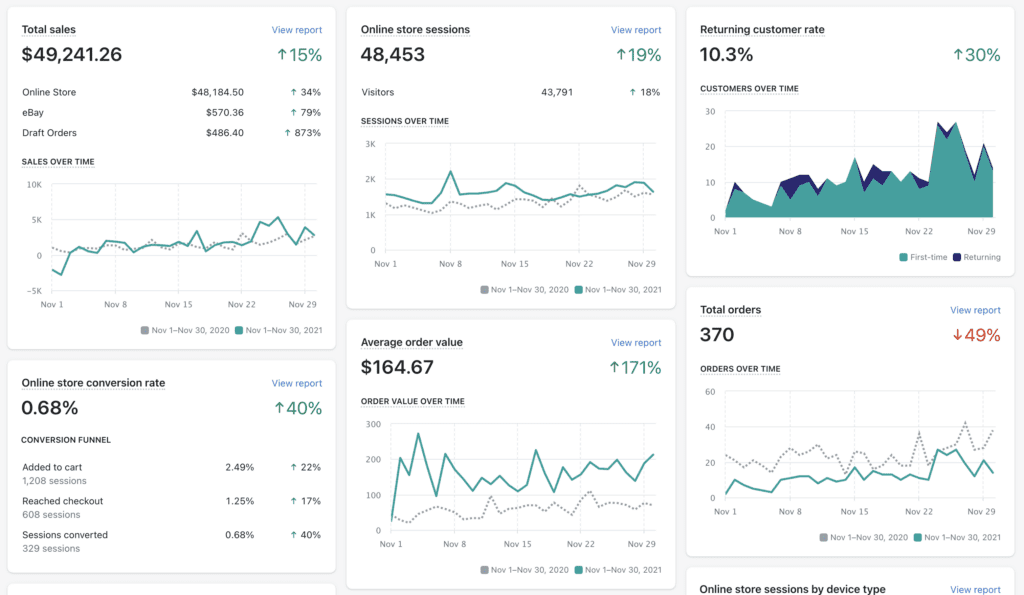
To track and analyze your e-commerce metrics, consider Shopify Analytics. The tool reports on how your online store performs.
With Shopify Analytics, you can follow key metrics such as sales conversion rate, average order value, and customer lifetime value. It also tracks customer acquisition costs and shows your shopping cart abandonment rates.
Using Shopify Analytics, you can make informed choices that sharpen your e-commerce strategy and grow the business.
Implement tracking codes
Tracking codes let online retailers gather accurate, complete data about their visitors. Embedded in your site’s HTML or JavaScript, they record user behavior, register conversions, and show how well your marketing campaigns land.
With tracking codes from tools like Google Analytics or Facebook Pixel, you can measure key metrics such as page views, click-through rates, and conversion rates. That data guides your decisions on site performance and on your wider online retail strategy.
Conclusion
Tracking e-commerce metrics gives online retailers the read on performance they need to decide well. Watching data points like sales conversion rate, average order value, customer lifetime value, and shopping cart abandonment rate lets businesses refine their strategy and perform better.
Analytics tools and tracking codes are the practical way to measure these metrics accurately. Review them on a regular schedule, and keep an eye on your e-commerce metrics to grow the store and hit your business goals.
Frequently Asked Questions
1. What are e-commerce metrics?
E-commerce metrics are data points used by online retailers to track sales performance, customer retention rate, average order value (AOV), customer acquisition cost (CAC) and return on investment (ROI).
2. Why is tracking e-commerce KPIs important?
Tracking e-commerce Key Performance Indicators (KPIs) such as user engagement metrics, conversion rate optimization, and average transaction value helps businesses monitor their marketing effectiveness and financial health.
3. How can an eCommerce metrics dashboard improve my business performance?
An eCommerce metrics dashboard provides a clear overview of your website traffic analysis, email opt-in rates, and other key data points that help in making informed decisions to enhance your online retail operations.
4. Can eCommerce analytics increase customer loyalty?
Yes! E-commerce analytics that focuses on customer lifetime value(CLTV), retention rates, and email marketing effectiveness can greatly help in improving customer loyalty.
5. What’s the role of performance tracking in managing e-commerce financial metrics?
Performance tracking allows online retailers to optimize their budget allocation by giving insights into ROI while also keeping tabs on important aspects like Customer Acquisition Cost(CAC), aiding effective management of e-commerce financial Metrics.
Compare alternatives to the tools in this post

- Independent picks for exactly what you just read about
- Matched to your team size & needs
- Vendors don't pay for placement
Step 1 of 4
How big is your team?
We tailor recommendations to companies your size.















Related Articles

Buyers guide
How To Choose The Best Marketplace Software For 2026
Continue reading →

Buyers guide
How To Choose The Best E-Commerce Tools For 2026
Continue reading →
E-commerce Platforms
Top 13 Best ACA Reporting Software Tools in 2026 for IRS Compliance & Benefit Tracking
Continue reading →

Buyers guide
How To Choose The Best Product Analytics Software For 2026
Continue reading →