

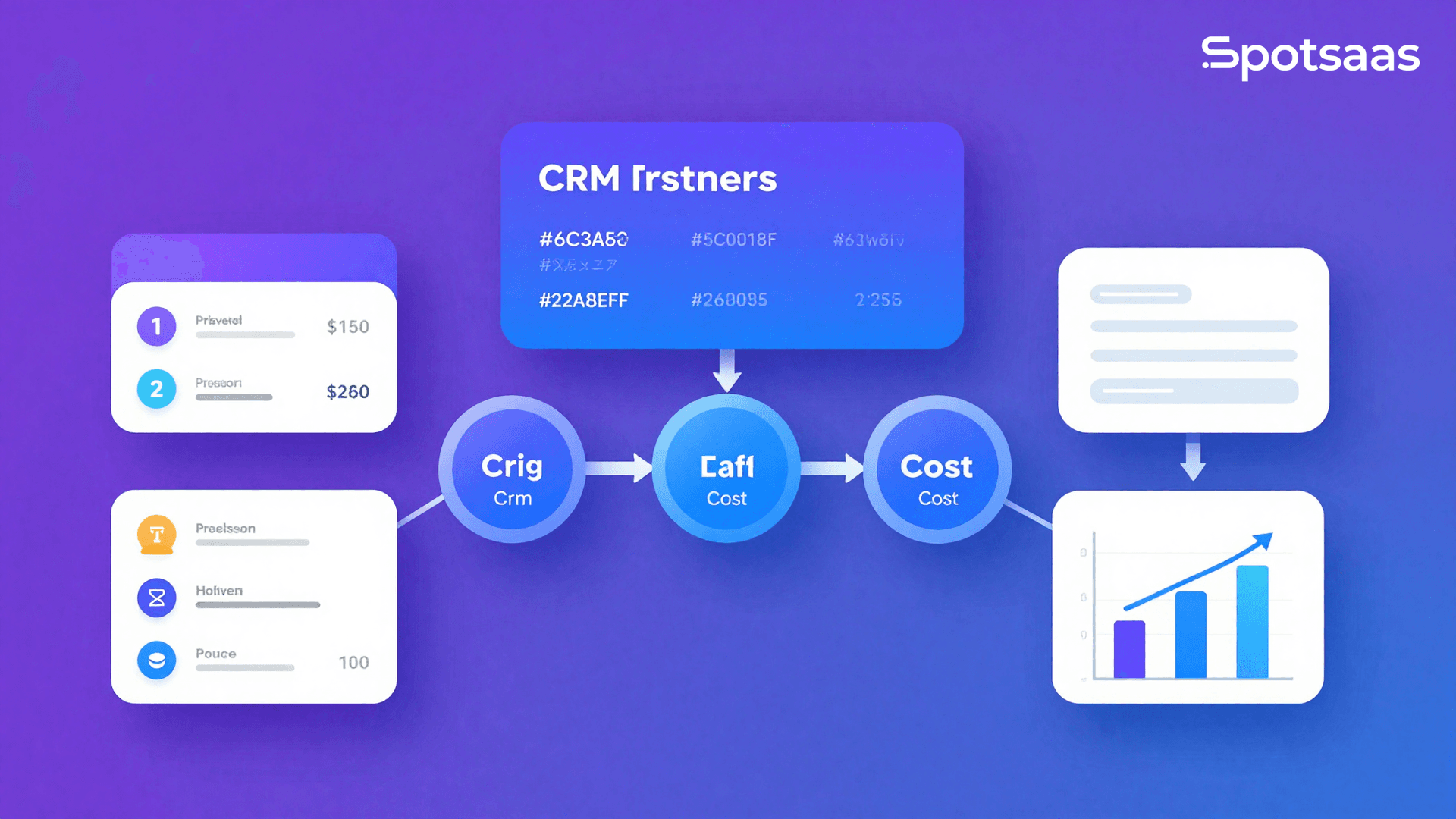
Most teams shopping for a CRM hit the same wall: one vendor charges $15/user/month, another quotes $300+/user/month, and neither makes it obvious why. The gap isn’t random. CRM pricing reflects pipeline complexity, automation depth, AI features, and the support you’ll get after signing.
Quick answer: Most SMBs pay $15–50/user/month. Mid-market teams land between $50–100/user/month. Enterprise CRMs — Salesforce, HubSpot Enterprise, Microsoft Dynamics — typically run $100–300/user/month before you add implementation and training.
This guide breaks down every pricing model, compares eight leading CRM platforms with real numbers, flags the hidden costs most buyers miss, and gives you a framework for building an accurate budget.
CRM Pricing Models: How Vendors Charge
Before comparing dollar amounts, you need to understand how CRM vendors structure their pricing — because the model shapes the total cost as much as the headline rate.
Per-User, Per-Month (Most Common)
The default model: you pay for each seat on a monthly or annual basis. Annual contracts usually knock 15–25% off the monthly rate. This model scales predictably but gets expensive fast once your team grows past 20–30 users.
Flat-Rate / Team Pricing
Some vendors (Close, for example) sell access tiers by team size rather than individual seats. A flat $59/month covers up to three users. Useful for small teams where a per-seat model would be inefficient.
Freemium + Paid Add-Ons
HubSpot and Zoho both offer genuine free tiers. The catch: you hit feature walls — automation limits, reporting caps, API call limits — and upgrade paths can jump steeply. Free works for solo operators or very early-stage teams. Once you need sequences, advanced reporting, or more than a handful of pipelines, paid tiers become necessary.
Contact-Based / Usage-Based
Some marketing-adjacent CRMs charge by the number of contacts in your database, not users. This matters if you carry a large prospect list — costs scale with data volume, not team size.
Platform + Module Pricing
Salesforce and Microsoft Dynamics use modular pricing. You buy the base platform, then add Sales Cloud, Marketing Cloud, Service Cloud, or Einstein AI as separate line items. The base price looks reasonable; the total cost after adding necessary modules rarely is.
CRM Pricing Tiers: What Each Budget Gets You
| Tier | Typical Range | What’s Included | Best For |
|---|---|---|---|
| Starter | $0–$25/user/mo | Contact management, basic pipelines, email logging, limited automation | Freelancers, startups, teams under 10 |
| Mid-Market | $25–$100/user/mo | Advanced automation, AI-assisted scoring, reporting dashboards, integrations, multiple pipelines | Growing SMBs, regional sales teams |
| Enterprise | $100–$300+/user/mo | Custom objects, advanced permissions, dedicated support, SSO, SLA, sandbox environments | Enterprise, regulated industries, complex deal cycles |
What drives upgrades from Starter to Mid-Market: automation (sequences, workflows, lead scoring), reporting depth, and API access. Most teams move up when they hire their third or fourth salesperson and manual processes break down.
What drives upgrades from Mid-Market to Enterprise: custom data models, territory management, compliance features (HIPAA, SOC 2), and the need for a dedicated customer success manager. These aren’t vanity features — enterprise teams that skip them tend to outgrow the product within 18 months.
CRM Software Pricing: 7 Leading Platforms in 2026
HubSpot CRM
HubSpot built its CRM reputation on a genuinely free tier that doesn’t expire. The free plan covers unlimited users, contact management, deal pipelines, and basic email tracking — a better starting point than most competitors offer at $10–15/user/month. The cost step-up comes when you need automation, sequences, and advanced reporting.
Best for: SMBs and growing teams that want to start free and scale gradually.
Pricing:
- Free: Unlimited users, 1 pipeline, 2,000 emails/month
- Starter: $20/seat/month — removes HubSpot branding, adds simple automation
- Professional: $100/seat/month — adds sequences, custom reporting, predictive lead scoring
- Enterprise: $150/seat/month — adds custom objects, advanced permissions, sandboxes
Salesforce
Salesforce is the benchmark enterprise CRM. It’s the most customizable platform on the market, but that flexibility comes with a steep price and a steep learning curve. Almost every deployment requires a Salesforce admin (a $90–150k/year hire or a consulting partner).
Best for: Enterprise teams with complex, multi-stage sales processes and dedicated admin resources.
Pricing:
- Starter Suite: $25/user/month — basic CRM, limited automation
- Pro Suite: $100/user/month — full Sales Cloud, workflow automation, forecasting
- Enterprise: $165/user/month — API access, advanced customization, custom objects
- Unlimited: $330/user/month — premier support, additional AI features
Zoho CRM
Zoho delivers the widest feature set per dollar in the CRM market. At $40/user/month for the Enterprise tier, you get capabilities that Salesforce and HubSpot charge $100–165/user/month for. The trade-off is a more complex UI and a steeper initial setup.
Best for: Cost-conscious teams that need feature breadth without enterprise-level spend.
Pricing:
- Standard: $14/user/month — scoring rules, workflows, multiple pipelines
- Professional: $23/user/month — SalesSignals, inventory management, Google Ads integration
- Enterprise: $40/user/month — AI assistant (Zia), custom modules, territory management
- Ultimate: $52/user/month — advanced analytics, dedicated database
Pipedrive
Pipedrive is built around a visual sales pipeline and nothing else. There’s no bloat from marketing or service modules — every feature exists to help sales reps track deals and close faster. It’s the most intuitive option for teams that want to get reps productive in under a day.
Best for: Sales-focused SMBs where deal-pipeline visibility is the top priority.
Pricing:
- Essential: $14/user/month — unlimited pipelines, basic reporting
- Advanced: $34/user/month — email sync, automation, scheduling
- Professional: $49/user/month — AI-powered deal insights, revenue forecasting
- Power: $64/user/month — project planning, phone support
- Enterprise: $99/user/month — unlimited customization, premium support
Freshsales
Freshsales stands out by bundling a built-in phone system and two-way email sync at pricing that doesn’t demand an enterprise budget. Teams running high-volume outreach — SDRs making 50+ calls per day — get more value here than from a CRM that treats calling as a paid add-on.
Best for: Inside sales and SDR teams that need call + email outreach without a separate dialer subscription.
Pricing:
- Free: Basic contact + deal management
- Growth: $15/user/month — AI contact scoring, visual pipeline
- Pro: $39/user/month — multiple pipelines, time-based workflows, custom modules
- Enterprise: $69/user/month — custom roles, IP whitelisting, dedicated account manager
Monday CRM
Monday CRM is built on the Monday.com Work OS, which means it feels familiar to any team already using Monday for project tracking. Deal and project data live in the same platform — no context switching. The trade-off is that it’s less deep on pure sales features than Pipedrive or Freshsales.
Best for: Teams already using Monday.com who want CRM and project management unified.
Pricing:
- Basic: $15/seat/month — unlimited contacts, pipelines, boards
- Standard: $20/seat/month — email integration, automations (250 actions/month)
- Pro: $33/seat/month — time tracking, sales forecasting, Google Calendar sync
- Enterprise: Contact for pricing — advanced security, custom analytics, dedicated CSM
Close
Close targets inside sales teams that live on the phone. The platform bundles a predictive dialer, call recording, SMS, and email sequences into a single interface. Pricing is structured around team tiers rather than per-seat for smaller teams, making it cost-effective for compact, high-velocity sales operations.
Best for: Inside sales teams with heavy call volume who want all outreach channels in one tool.
Pricing:
- Startup: $59/month (up to 3 users) — calling, email, SMS, basic reporting
- Professional: $109/user/month — advanced calling features, predictive dialer, custom roles
- Enterprise: Contact for pricing — custom onboarding, API access, dedicated support
Compare all CRM platforms side by side on Spotsaas: https://www.spotsaas.com/category/crm-software
Hidden Costs in CRM Pricing
The per-user monthly rate is almost never the full number. Here’s where budgets routinely run over:
Implementation and Onboarding
Enterprise CRM deployments (Salesforce, HubSpot Enterprise, Microsoft Dynamics) regularly cost $10,000–$100,000+ in professional services fees — on top of licensing. Even mid-market deployments requiring data migration and custom workflows can add $2,000–15,000. If you’re told the product is “plug and play,” ask what that actually includes.
Data Migration
Moving contact records, deal history, and notes from a legacy system (or a spreadsheet) takes time. If you’re hiring a consultant, expect $50–150/hour. If the vendor offers migration as a service, it’s often sold as an add-on at $500–5,000 depending on data volume and complexity.
Integrations
Most CRMs charge extra for native integrations beyond a handful of core tools. Connecting your ERP, billing system, or marketing automation platform can mean additional per-month fees or third-party middleware (Zapier, Make) that adds $20–100+/month to your stack.
Training
Vendors often sell training packages separately from licensing. For Salesforce specifically, expect $1,500–5,000 in training costs per admin. Even for simpler CRMs, factor in lost productivity during ramp-up — typically 2–6 weeks before a team is operating at full efficiency.
Storage and API Overages
Salesforce caps storage at 10 GB per org by default. HubSpot limits API calls per plan tier. If you’re building heavy integrations or storing documents inside the CRM, storage overage fees can add $125–250/month per additional 500 MB (Salesforce) or force a plan upgrade.
Support Tiers
Standard support (community forums, email tickets with 48-hour SLA) is usually included. Phone support, a dedicated CSM, or a sub-4-hour SLA typically requires a paid support tier or an Enterprise contract.
How to Build an Accurate CRM Budget
1. Start with your actual user count — not your projected headcount. License costs compound. Price out what you need today, then model what year 2 looks like at a 30% team growth rate.
2. Map your must-have features before looking at pricing pages. Decide which features are non-negotiable (sequences, custom fields, API access, specific integrations) before anchoring on a price. A $15/user/month plan that doesn’t include your required features costs more than a $40/user/month plan that does.
3. Calculate annual vs. monthly. Most vendors offer 15–25% discounts for annual billing. On a 10-person team at $40/user/month, that’s $960–$1,200 in savings. If your cash flow supports it, annual billing is almost always the better deal.
4. Request a pilot or free trial, and test with real data. Most vendors offer 14–21 day trials. Don’t test with dummy contacts — import actual deals, run actual workflows, and pressure-test the reporting. Edge cases surface fastest with real data.
CRM Pricing Comparison Table
| CRM | Entry Price | Mid Tier | Top Tier | Pricing Model |
|---|---|---|---|---|
| HubSpot | Free | $100/user/mo | $150/user/mo | Per seat |
| Salesforce | $25/user/mo | $165/user/mo | $330/user/mo | Per user + modules |
| Zoho CRM | $14/user/mo | $40/user/mo | $52/user/mo | Per user |
| Pipedrive | $14/user/mo | $49/user/mo | $99/user/mo | Per user |
| Freshsales | Free | $39/user/mo | $69/user/mo | Per user |
| Monday CRM | $15/seat/mo | $33/seat/mo | Custom | Per seat |
| Close | $59/mo (3 users) | $109/user/mo | Custom | Team + per user |
Pricing shown is approximate; check vendor websites for current rates.
Frequently Asked Questions About CRM Pricing
How much does CRM software cost?
CRM software ranges from $0 to $300+ per user per month depending on the vendor and tier. Most SMBs end up paying $15–50/user/month on a mid-tier plan. Enterprise teams using Salesforce or HubSpot Enterprise typically pay $100–165/user/month for licensing alone, before adding implementation, training, and integrations.
Is there a free CRM?
Yes — HubSpot CRM and Freshsales both offer free plans with no time limit. HubSpot’s free tier covers unlimited users, basic contact management, and one deal pipeline. Zoho CRM also has a free plan for up to three users. Free plans work well for solo operators or very early-stage teams, but most growing teams hit feature limits (automation, advanced reporting, API access) within 6–12 months.
What is included in CRM pricing?
Basic tiers typically include contact management, deal tracking, email logging, and a single pipeline. Mid-tier plans add workflow automation, sequences, custom fields, and reporting dashboards. Enterprise plans layer in custom objects, territory management, advanced permissions, SSO, dedicated support, and sandbox environments. Add-ons like phone dialers, marketing automation, and premium integrations are often sold separately.
Why is Salesforce so expensive?
Salesforce’s price reflects its customization depth, enterprise-grade reliability, and the size of its partner/integration ecosystem. The platform supports almost any sales process — but that flexibility requires configuration, which means admin time (internal or contracted). When you factor in licensing, implementation, admin overhead, and necessary add-ons like Einstein AI, total Salesforce cost of ownership for a 25-person team often runs $150,000–$250,000 in year one. Teams pay that premium because no other platform matches Salesforce’s customizability at scale.
How does HubSpot CRM pricing work?
HubSpot structures its CRM as a “hub” model: Sales Hub, Marketing Hub, Service Hub, and Content Hub each have their own pricing tiers (Free, Starter, Professional, Enterprise). You buy the hubs your team needs. The Starter tier begins at $20/seat/month for Sales Hub. Professional jumps to $100/seat/month and is where most growing teams end up, since it unlocks sequences, custom reporting, and predictive lead scoring. Bundles that combine multiple hubs are available at a slight discount.
What hidden costs should I watch for in CRM pricing?
Four costs catch buyers off guard most often: (1) implementation fees — enterprise CRM deployments regularly cost $10,000–$100,000+ in professional services on top of licensing; (2) data migration — expect $500–5,000 to move data cleanly from a legacy system; (3) premium support — faster SLAs and dedicated CSMs are typically only available on Enterprise plans or paid support packages; (4) storage and API overages — heavy integrations or document storage can trigger overage fees if you’re not monitoring usage. Always ask vendors for a full total-cost-of-ownership estimate, not just the per-seat rate.
Conclusion
CRM pricing ranges from $0 to $300+/user/month — and almost every number in that range is the right price for someone. The actual question is whether the price aligns with the complexity of your sales process, your team size, and what you genuinely need the software to do. For most SMBs, a $15–49/user/month plan from Zoho, Pipedrive, or Freshsales covers the full use case. For teams with complex deal cycles or large sales orgs, HubSpot Professional or Salesforce Enterprise earns its premium. Start with what you need today, pressure-test with real data during the trial, and model the year-two cost before you sign an annual contract.
Compare alternatives to the tools in this post

- Independent picks for exactly what you just read about
- Matched to your team size & needs
- Vendors don't pay for placement
Step 1 of 4
How big is your team?
We tailor recommendations to companies your size.















Related Articles
Buyers guide
How To Choose The Best Experience Management software For 2026
Continue reading →
Best Tools
Best Salesforce Alternatives in 2026: Top CRMs When You’re Ready to Switch
Continue reading →
CRM Software
Best CRM Alternatives in 2026: Top Picks for Every Budget and Use Case
Continue reading →
Buyers guide
How to Choose CRM Software: A Complete Buyer’s Guide (2026)
Continue reading →