

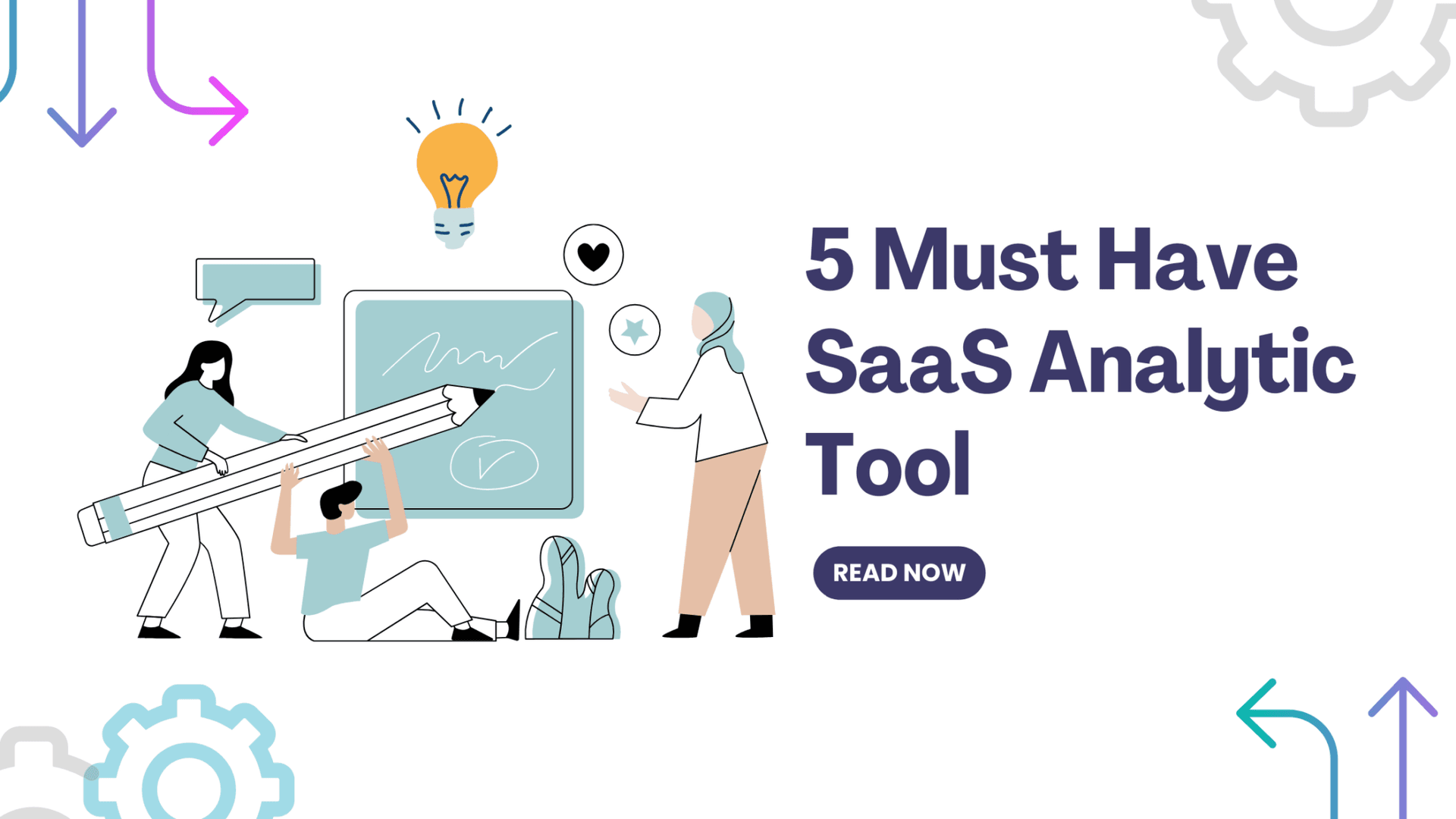
A great product alone doesn’t boost SaaS success — you also need deep, actionable data about how people actually use what you’ve built. Analytics tools are the backbone of smart decision-making, user retention, and sustainable revenue growth in a crowded SaaS market. Without them, even experienced SaaS teams end up guessing instead of knowing.
According to McKinsey Global Institute, data-driven organizations are 23 times more likely to acquire customers and 19 times more likely to be profitable. That’s a significant advantage, and it starts with having the right analytics stack in place.
In this article, we walk you through five must-have analytics tools for SaaS websites: Google Analytics, Mixpanel, Amplitude, Heap Analytics, and Kissmetrics. We break down what each tool does, how it benefits SaaS companies, and how real-world businesses use them to scale smarter.
Whether you’re a bootstrapped startup or a scaling SaaS enterprise, these tools will help you understand your users, sharpen your product strategy, and stay ahead of the competition.
Why Analytics Tools Are Non-Negotiable for SaaS Companies
SaaS businesses run on subscription models, where customer retention matters just as much as acquisition. According to Bain and Company, a mere 5% increase in customer retention can boost profits by 25% to 95%. Hitting that kind of number means understanding how users interact with your product at every touchpoint.
Analytics tools give SaaS companies the ability to track user journeys, identify friction points, measure feature adoption, and optimize conversion funnels. Without this visibility, it’s nearly impossible to make confident product or marketing decisions.
The five tools below each serve a distinct purpose. Many SaaS companies use a combination of them to build a comprehensive, scalable data strategy that supports every team, from product and engineering to marketing and customer success.
1. Google Analytics
What Is Google Analytics?
Google Analytics is a free web analytics platform offered by Google that tracks and reports website traffic. It lets website owners measure performance, understand user behavior, and evaluate the effectiveness of marketing campaigns. For SaaS companies, it serves as a foundational layer of data intelligence.
With the rollout of Google Analytics 4 (GA4), the platform now uses an event-based tracking model rather than the older session-based approach. This shift gives SaaS teams a far more granular view of how users move through their product and marketing funnels.
You can learn more and get started at the official Google Analytics website.
Key Benefits for SaaS Companies
- Track acquisition channels to understand where your best-fit users come from
- Measure on-site behavior including session duration, page depth, and drop-off points
- Set up conversion goals to monitor free trial signups, demo requests, and plan upgrades
- Integrate with Google Ads and Search Console for a unified marketing picture
- Use audience segmentation to analyze cohorts by geography, device, or traffic source
How SaaS Teams Use Google Analytics in Practice
A typical SaaS marketing team uses Google Analytics to see which blog posts or landing pages are driving the most free trial signups. By setting up goal completions tied to specific URL paths, they can attribute revenue influence to individual content assets.
Product teams use GA4’s funnel exploration reports to identify where users abandon the onboarding flow. Fixing even one major drop-off point can meaningfully improve activation rates and reduce churn in the first 30 days.
2. Mixpanel
What Is Mixpanel?
Mixpanel is a product analytics platform built specifically for tracking user interactions within web and mobile applications. Unlike Google Analytics, which focuses heavily on website traffic, Mixpanel is designed to help product teams understand what users actually do inside your SaaS product.
It uses event-based tracking to capture granular actions — button clicks, feature usage, workflow completions — and ties them back to individual users. That makes it valuable for understanding product engagement at a deep level.
Visit the official Mixpanel website to explore plans and features.
Key Benefits for SaaS Companies
- Build detailed funnel reports to see exactly where users drop off before converting
- Create retention cohorts to measure how product changes affect long-term engagement
- Use A/B testing insights to validate product decisions with real behavioral data
- Segment users by plan type, company size, or behavior to personalize outreach
- Get real-time event streams to monitor product performance as it happens
How SaaS Teams Use Mixpanel in Practice
A SaaS company launching a new feature can use Mixpanel to track adoption rates within the first week. If adoption is low, the team can drill into which user segments are engaging and which are not, then tailor in-app messaging or onboarding prompts accordingly.
Retention analysis in Mixpanel helps customer success teams spot users who are at risk of churning before they actually cancel. That gives teams a chance to step in early with personalized outreach or targeted feature education.
3. Amplitude
What Is Amplitude?
Amplitude is an enterprise-grade product analytics platform that helps SaaS companies understand user behavior, optimize the product experience, and drive growth through data. It’s widely used by product managers, growth teams, and data analysts who need powerful querying and visualization capabilities.
Amplitude’s strength lies in its ability to connect product analytics with revenue outcomes. It lets teams trace a direct line from specific product behaviors to subscription upgrades, expansions, and renewals.
Explore pricing and features at the official Amplitude website.
Key Benefits for SaaS Companies
- Use behavioral cohorting to group users by actions taken and analyze downstream outcomes
- Leverage predictive analytics to forecast which users are likely to convert or churn
- Build cross-platform analytics that unify web, mobile, and desktop product data
- Collaborate across teams with shared dashboards and chart libraries
- Integrate with data warehouses like Snowflake and BigQuery for advanced analysis
How SaaS Teams Use Amplitude in Practice
Growth teams at mid-market SaaS companies often use Amplitude’s North Star metric framework to align the entire organization around a single key indicator of product value. That creates focus and keeps every team optimizing for outcomes that actually matter to users.
Product managers use Amplitude’s pathfinder reports to discover unexpected user journeys. Sometimes users find value in a feature through a completely different path than the one designed, and that insight can unlock entirely new onboarding strategies.
4. Heap Analytics
What Is Heap Analytics?
Heap Analytics is a digital insights platform that automatically captures every user interaction on your website or app, without requiring manual event instrumentation. That means SaaS teams can analyze any past user action retroactively, even if they didn’t set up tracking for it in advance.
This retroactive capability is a major differentiator. Most analytics tools require you to decide upfront what to track. With Heap, you can ask new questions about historical data at any time, which speeds up product discovery and experimentation cycles considerably.
Key Benefits for SaaS Companies
- Eliminate the engineering overhead of manual event tracking with autocapture technology
- Retroactively analyze any click, scroll, or form interaction from historical data
- Use session replay alongside analytics for qualitative context behind the numbers
- Identify conversion bottlenecks with automated funnel suggestions powered by machine learning
- Connect behavioral data to CRM records for a unified view of each customer
How SaaS Teams Use Heap Analytics in Practice
A SaaS company undergoing a website redesign can use Heap to retroactively analyze which elements on the old site drove the most conversions. That data informs the new design rather than relying on guesswork or stakeholder opinions.
Heap’s machine learning-powered signals feature automatically surfaces the interactions most correlated with conversion or retention. That lets smaller teams without dedicated data scientists still uncover high-value product insights quickly.
5. Kissmetrics
What Is Kissmetrics?
Kissmetrics is a behavioral analytics and engagement platform built for SaaS and e-commerce businesses. Its core strength is connecting website and in-app behavior back to individual users across multiple sessions and devices, giving you a complete picture of each customer’s journey from first visit to paid conversion.
While Google Analytics tells you what is happening in aggregate, Kissmetrics tells you who is doing it and how their behavior changes over time. This person-level tracking is essential for understanding the full customer lifecycle in a subscription business.
Key Benefits for SaaS Companies
- Track individual user behavior across sessions, devices, and time periods
- Build customer lifecycle funnels from first touch to paid plan and beyond
- Measure the impact of marketing campaigns on actual revenue, not just traffic
- Use cohort reports to compare how different user groups behave over their lifetime
- Set up automated email campaigns triggered by specific in-app behaviors
How SaaS Teams Use Kissmetrics in Practice
SaaS marketing teams use Kissmetrics to attribute revenue to specific acquisition campaigns with precision. Instead of last-click attribution, they can see the full multi-touch journey that led a user to upgrade from a free trial to a paid plan.
Customer success teams lean on Kissmetrics cohort analysis to determine which onboarding flows produce the highest long-term retention. That data shapes how new users are guided through the product in their first critical days after signup.
How to Choose the Right Analytics Stack for Your SaaS
No single tool does everything perfectly, and trying to force one to do so usually wastes time. The most effective SaaS analytics strategies combine two or more of these platforms to cover different layers of insight: website traffic, in-product behavior, revenue attribution, and customer lifecycle analysis.
Here’s a simple framework for building your analytics stack based on your stage of growth:
- Early-stage startups: Start with Google Analytics for website data and Mixpanel or Heap for in-product behavior. Keep it lean and focus on answering your most urgent growth questions.
- Growth-stage companies: Add Amplitude for deeper product analytics and cohort analysis. Begin building dashboards that connect product usage to revenue metrics.
- Scaling enterprises: Incorporate Kissmetrics for full customer lifecycle attribution and integrate your analytics stack with your CRM, data warehouse, and marketing automation tools.
According to Forrester Research, companies that invest in analytics infrastructure see a median ROI of 201% over three years. The cost of not investing in analytics is far higher than the cost of the tools themselves.
It’s also worth investing in data literacy across your teams, not just the tools themselves. Even the most powerful analytics platform delivers limited value if your team doesn’t know how to ask the right questions or interpret the results correctly. Consider running regular data reviews and creating shared dashboards that keep every team aligned on the same numbers.
Frequently Asked Questions
What does it mean to boost SaaS success with analytics?
It means using data from analytics platforms to make smarter decisions about product development, marketing, and customer retention. Rather than relying on intuition, analytics tools give you evidence-based insights that directly improve key SaaS metrics like churn rate, activation rate, and monthly recurring revenue.
Which analytics tool is best for early-stage SaaS startups?
Google Analytics combined with Mixpanel or Heap Analytics is a strong starting point. Google Analytics covers your website and marketing funnel, while Mixpanel or Heap gives you in-product behavioral data. Both offer free tiers that are well-suited for startups with limited budgets.
Is Google Analytics enough for a SaaS company?
Google Analytics is excellent for tracking website traffic and marketing performance, but it isn’t designed for deep in-product analytics. SaaS companies that want to understand how users behave inside their application will need to complement it with a tool like Mixpanel, Amplitude, or Heap.
What is the difference between Mixpanel and Amplitude?
Both are product analytics platforms, but they differ in focus and complexity. Mixpanel is generally more accessible for smaller teams and focuses on event-based funnels and retention analysis. Amplitude offers more advanced querying, predictive analytics, and enterprise-grade features, making it better suited for larger product and data teams.
How does Heap Analytics differ from other tools?
Heap’s key differentiator is its autocapture technology, which automatically records every user interaction without requiring manual event instrumentation. This means you can retroactively analyze any user action from your historical data, even if you didn’t set up tracking for it in advance.
Can I use multiple analytics tools at the same time?
Yes, and most successful SaaS companies do. Different tools serve different purposes. For example, you might use Google Analytics for marketing attribution, Amplitude for product analytics, and Kissmetrics for customer lifetime value analysis. The key is to avoid overlap and make sure each tool has clear ownership and purpose within your team.
How do analytics tools help reduce SaaS churn?
Analytics tools help you spot the early warning signs of churn by tracking engagement patterns, feature adoption, and login frequency. When a user’s behavior deviates from the patterns associated with healthy, retained customers, your customer success team can step in proactively with targeted outreach or in-app prompts.
What metrics should SaaS companies track with analytics tools?
The most important metrics include monthly recurring revenue (MRR), churn rate, customer lifetime value (CLV), net revenue retention (NRR), activation rate, feature adoption rate, and time-to-value. Analytics tools help you connect user behavior data directly to these business-level outcomes.
Is Kissmetrics suitable for small SaaS companies?
Kissmetrics is most valuable for SaaS companies that have a significant volume of users and want detailed revenue attribution and lifecycle analysis. Smaller startups may find it more than they need initially, but it becomes increasingly valuable as you scale and need deeper insight into customer behavior across long time horizons.
How long does it take to see results from implementing analytics tools?
Basic insights can be available within days of setup, especially for website analytics. Deeper insights from product analytics, such as retention cohorts and funnel analysis, typically require two to four weeks of data collection before you can draw meaningful conclusions. The sooner you implement these tools, the sooner you begin building a valuable historical dataset.
Do analytics tools integrate with CRM and marketing platforms?
Yes. Most of the tools covered in this article offer native integrations or API connections with popular CRM platforms like Salesforce and HubSpot, as well as marketing automation tools. These integrations let you enrich customer profiles with behavioral data and trigger personalized campaigns based on in-product actions.
What should I look for when evaluating a SaaS analytics tool?
Key factors include ease of implementation, the depth of behavioral tracking, data retention policies, integration capabilities, reporting flexibility, pricing transparency, and the quality of customer support. You should also consider whether the tool scales with your business and whether your team has the technical skills to use it effectively.
Conclusion
The path to sustainable SaaS growth runs directly through data. Boosting your SaaS success takes analytics tools that give you clear, ongoing visibility into every stage of the user journey, from the first website visit all the way through long-term retention and revenue expansion.
Google Analytics, Mixpanel, Amplitude, Heap Analytics, and Kissmetrics each bring something unique to the table. Together, they form an analytics ecosystem that helps every team in your organization make faster, smarter, and more confident decisions.
The SaaS companies winning in 2026 aren’t necessarily the ones with the biggest budgets — they’re the ones with the best data strategy.
Ready to find the right analytics tools for your SaaS stack? Explore and compare top SaaS analytics platforms on Spotsaas to discover the best fit for your team’s needs, budget, and growth goals.

- Independent picks for exactly what you just read about
- Matched to your team size & needs
- Vendors don't pay for placement
Step 1 of 4
How big is your team?
We tailor recommendations to companies your size.















Related Articles
Buyers guide
How To Choose The Best Marketplace Software For 2026
Continue reading →
Buyers guide
How To Choose The Best E-Commerce Tools For 2026
Continue reading →
E-commerce Platforms
Top 13 Best ACA Reporting Software Tools in 2026 for IRS Compliance & Benefit Tracking
Continue reading →
Buyers guide
How To Choose The Best Product Analytics Software For 2026
Continue reading →