
An old saying goes like this:
If you give a man a fish, he eats today. If you give him a fish net, he eats for a lifetime.
This proverb depicts the difference between short-term and long-term sustenance. Solving a problem temporarily should not always be the solution; solving the underlying causes is the key to real success.
The same idea applies to nonprofits. For them, it means shifting from one-off donations and emergency relief toward recurring revenue models built for sustainability.
Nonprofits deserve financial stability as much as businesses do. To get there, they have to shift their mindset from survival mode to intentional sustainability, with predictable income, real-time impact, and scalability as the goal.
But how?
The answer is operate more like a SaaS business.
Nonprofits often get stuck in an endless cycle of chasing one-off donations. Along the way, they run into limited resources and budget, volunteer coordination, tracking and measuring impact, inefficient data management, and a lack of scalability.

SaaS businesses, by contrast, benefit from recurring revenue that keeps them financially steady.
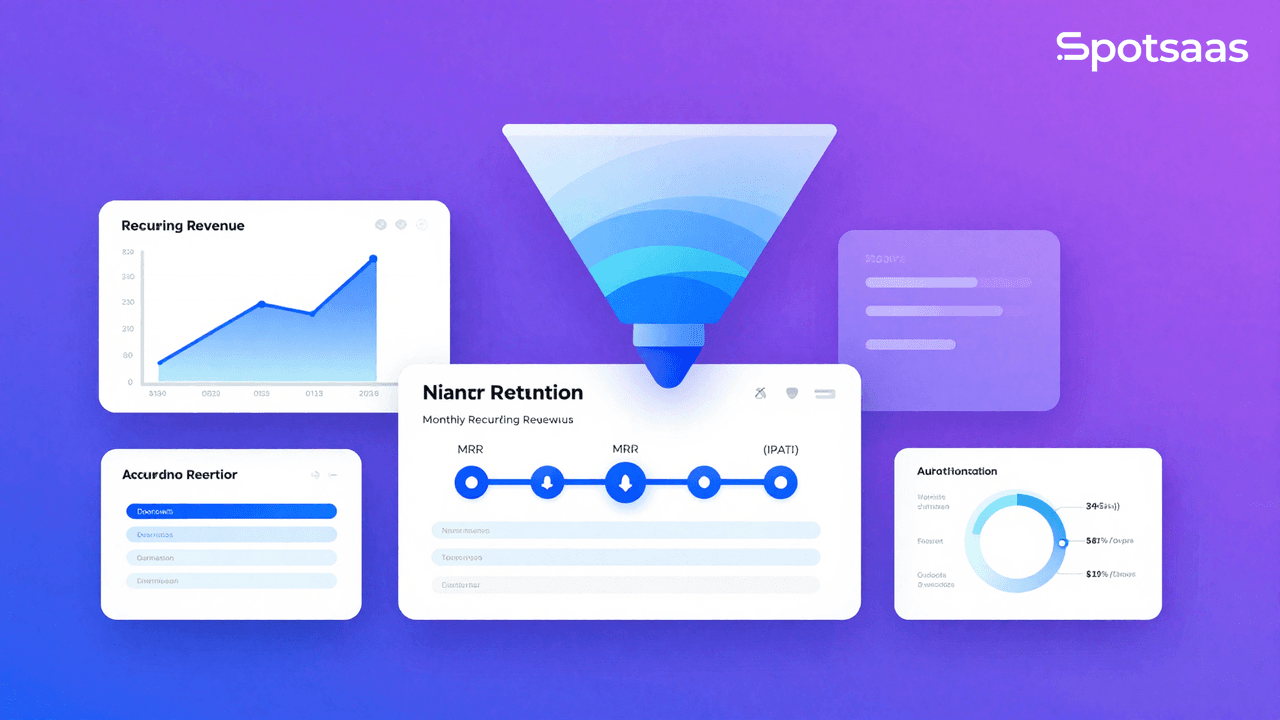
Every organization’s path to revenue looks a little different, but borrowing the core principles from SaaS improves the odds of success. Applying that thinking can change how a nonprofit generates recurring revenue, turning donations into a predictable, recurring income stream instead of a one-off event.
Software as a Service (SaaS) companies have their roots in leading technology. They lean on advanced metrics and data-rich business models, which puts them ahead of the curve on financial innovation.
So how should nonprofits operate more like SaaS businesses? Here’s what they can learn.
10 Lessons nonprofits can learn from SaaS companies
Here are ten of the most important ones:
| Characteristic Features | SaaS Companies | Nonprofits |
| Automated operations | Automate donor & event management | |
| Budgeting, compliance, and automation of accounting | Automate accounting, forecast budgets | |
| Monthly recurring revenue (MRR) | Implement recurring donation strategies | |
| Employee retention, customer engagement | Tailor communication, automate campaigns | |
| Exit interviews with leaving employees | Understand cancellation trends, approach donors | |
| Engage employees actively | Recognize and motivate the volunteer contributions | |
| Feature updates, success stories, usage reports | Regular updates, videos, success stories | |
| Easy upgrades, pausing of subscriptions | Flexible payment changes, pausing donations | |
| Listen to the customer reviews and requests | Listen to donors for input | |
| Cybersecurity measures, data privacy laws | Protect donor data, abide by the laws |
- Automating operations:
SaaS companies automate their operations, which frees up employee time for other work. Nonprofits can do the same:
- Free up staff time by automating daily tasks, such as donor management and event management
- Improve accessibility and reduce risk by centralizing data and information
- Improve collaboration and communication across regions through cloud-based platforms
- Strengthening finance:
SaaS companies plan a budget, stay compliant with laws and regulations, and automate accounting tasks.
- Nonprofits should automate their accounting too, including expense tracking, invoices, and reporting.
- They should also forecast and build budgets to keep finances stable.
- Recurring donation strategies:
SaaS companies rely on monthly recurring revenue (MRR) to forecast cash flow, which helps them plan resources and act accordingly. Nonprofits can borrow this approach too:
- Implement recurring donation strategies to track donations, average monthly gifts, and churn rates.
- Build a dashboard that shows real-time impact, which encourages monthly donations over one-time gifts and helps produce a steadier income throughout the year.
- Improving donor management:
SaaS companies already have employee retention and customer engagement strategies in place.
- Nonprofits should tailor their communication and fundraising efforts to donor preferences.
- They can automate campaign management, track donations, and send personalized thank-you messages.
- Donor management tools can also surface insights that shape better engagement strategies.
- Overcoming donor attrition rates:
SaaS companies conduct exit interviews with employees who are leaving.
- When a donor exits, nonprofits should try to understand the cancellation trend, approach the donor directly, and address any mismatch between mission and expectations.
- Keeping this data helps nonprofits understand why donors disengage and deploy retention strategies accordingly.
- Recognizing and rewarding volunteer efforts:
SaaS companies retain employees by keeping them actively engaged. Nonprofits can apply the same principle to volunteers:
- Recognize, encourage, and motivate volunteer activities and contributions.
- Track volunteer activities, manage their schedules, and make the best use of their time.
- Onboard new volunteers well, with welcome messages and encouragement.
- Reporting and storytelling:
SaaS companies keep customers around through feature updates, success stories, and usage reports.
- Nonprofits can build the same kind of connection with donors through regular updates, videos, success stories, and transparent reporting that supports recurring donations.
- Providing flexibility:
SaaS companies let customers upgrade, downgrade, pause, or cancel subscriptions without friction.
- Nonprofits should offer donors the same ease when changing payment methods, pausing donations, or adjusting amounts, so the process never feels frustrating.
- Creating feedback channels:
- SaaS companies listen closely to customer reviews, feedback, and requests to guide sales and product decisions.
- Nonprofits should do the same with donors, whose voices often go unheard. Ask donors for input to improve campaigns and program design.
- Improving digital security:
SaaS companies deploy cybersecurity measures to protect employee and company data, and they follow strict data privacy and protection laws.
- Nonprofits must protect donor data, information, payment processing, and communication just as carefully.
- They should follow the laws and regulations that already apply to them.
Tips for nonprofits to implement SaaS solutions successfully:
Start by evaluating your nonprofit’s requirements and noting the pain points. From there:
- Seek your team’s input and make sure the solution aligns with how they actually work.
- Provide adequate support and training for team members and volunteers.
- Ensure data integrity when migrating to the selected SaaS solution.
- Avoid siloed data and scattered operations; bring everything under one system.
- Monitor performance and impact against your goals on an ongoing basis.

Adoption of Artificial Intelligence (AI) in Nonprofit sectors:
AI has become part of nearly every sector and daily life.
According to The State of AI in Nonprofits: 2025 Benchmark Report on Adoption, Impact and Trends, only seven per cent of nonprofits have integrated AI. 76% lack a dedicated AI strategy, and 42% rely on individuals exploring AI tools on their own.
AI adoption can change how nonprofits handle content creation, grant marketing, data analysis, and donor management. It can automate repetitive tasks, expand outreach through analysis, and use predictive analysis for fundraising, helping increase revenue.
Concluding thoughts:
Most nonprofits chase donors. They become so focused on acquiring new ones that they lose sight of the revenue potential already within reach. Nonprofits should build a real revenue strategy around recurring income, and there is plenty to learn from other business models, including the SaaS model laid out here.
SaaS is a powerful model built around predictable, subscription-based revenue.
SaaS solutions can help nonprofit organizations operate affordably and effectively as they advance their missions. This article was written by mapping the SaaS model’s core principles, customer retention, value, and scalability, onto their nonprofit equivalents: donor retention, value, and scalability, for sustainable revenue growth.
Fundraising no longer has to be reactive. It can be proactive and sustainable on its own.
Ready to future-proof your fundraising?
Connect with us now: Link
Related Articles
Buyers guide
Twilio Alternatives 2026: 6 Compared and What They Cost
Continue reading →
Finance & Billing Software
Best Payroll Software for Contractors and Freelancers in 2026
Continue reading →
Buyers guide
How To Choose The Best Auto Dialer Software For 2026
Continue reading →
Buyers guide
How To Choose The Best Freelance Platforms For 2026
Continue reading →