
Chaos and disorganization derail more projects than most teams realize, turning a promising plan into a scramble against deadlines. Statistics indicate that 77% of high-performing projects use project management software.
This post covers the organizational strategies that keep tasks on track, improve efficiency, and help teams get results.
Key Takeaways
- Organizational strategy means creating a plan and aligning projects with company goals to keep tasks on track.
- There are five types of organizational strategy: corporate, functional, operational, simplicity, and universal.
- Project management software like monday.com can streamline communication, task coordination, and visualization of project progress.
- To keep a project on track: set clear expectations, use organization tools and apps, build individual project plans, apply visual organization methods, keep communication effective, and review progress regularly.
What Is Organizational Strategy for Project Management?

Organizational strategy for project management means aligning projects with company goals and building action plans to direct and accomplish those objectives.
Defining organizational strategy
Organizational strategy is a plan set by company leaders to guide every action and decision across the business, so the whole team pulls toward the same goal instead of working at cross purposes. That plan lays out what needs to happen, who’s responsible for it, and when it needs to be finished.
It’s what keeps a project on track with its time and resources, since every action ties back to the company’s larger goals under an organizational strategy.
Importance for businesses
Organizational strategy matters to businesses because it gives them a clear path toward their goals: making plans and using resources well, so they can accomplish more without stretching further.
A business with a plan for each project gives its team clarity on what needs doing and when, which keeps the project on track and moving toward company goals.
Companies also lean on tools like charts or apps to make that work faster and easier.
How it works
Organizational strategy starts with a plan that spells out the company’s goals, action plans, and decision-making frameworks. Each goal breaks down into clear steps, and those steps become the tasks teams actually work through.
Project managers distribute those tasks among team members, using task coordination tools to make sure everyone knows what to do and when. Tools like monday.com are built for exactly this.
The project manager also tracks time management to keep the project on schedule, and looks at how much of each resource is available versus what each task needs, a process known as resource allocation.
From there, communication becomes the priority: sharing updates with the whole team often. Making sure all of that happens correctly is essentially risk management.
Eventually comes performance evaluation, where leaders check how closely the team stuck to the original plan and met its goals, using metrics and milestones as the measuring stick.
This cycle then repeats with every new project or goal, in businesses of any size, whether that’s a small team running a single initiative or a large organization coordinating several projects at once.
Types of Organizational Strategy

There are five types of organizational strategy: corporate, functional, operational, simplicity, and universal.
The five types: corporate, functional, operational, simplicity, and universal
Organizational strategies in project management take different forms, each suited to a different purpose. Here’s how the five types break down:
| Strategy Type | Description |
| Corporate Strategy | This type of strategy focuses on the overall direction and goals of the entire organization. It involves making decisions that align with the company’s vision and mission, ensuring that projects contribute to the overarching objectives. |
| Functional Strategy | With this strategy, the focus is on specific functions or departments within the organization. It involves aligning projects with departmental goals and ensuring coordination between different functional areas. |
| Operational Strategy | Operational strategies concentrate on improving operational processes and efficiency. They seek to optimize resource allocation, streamline workflows, and enhance productivity at every level of the organization. |
| Simplicity Strategy | This approach emphasizes simplicity in project management by reducing complexity and unnecessary steps. It aims to eliminate waste, simplify processes, and improve overall efficiency. |
| Universal Strategy | The universal strategy takes a holistic approach to project management by integrating elements from multiple types of organizational strategies. It seeks to align projects with both corporate goals and functional requirements for maximum effectiveness. |
Examples of each type
Organizational strategy in project management helps businesses hit their goals and stay on track. Here’s what each type looks like in practice:
| Strategy Type | Description |
|---|---|
| Corporate Strategy | This focuses on the overall direction and goals of the company. Examples include expanding into new markets or acquiring other companies. |
| Functional Strategy | This aligns the activities of specific departments or functions within the organization with the overall corporate strategy. Examples include marketing strategies or HR strategies. |
| Operational Strategy | This involves identifying and implementing ways to improve operational efficiency and effectiveness. Examples include streamlining processes or implementing new technology. |
| Simplicity Strategy | This emphasizes reducing complexity within the organization to improve productivity and customer satisfaction. Examples include simplifying product lines or eliminating unnecessary steps in a process. |
| Universal Strategy | This involves using a combination of different strategies to meet organizational needs. It takes into account all aspects of the business and aims for a comprehensive approach. |
Using monday.com for Organizational Strategy
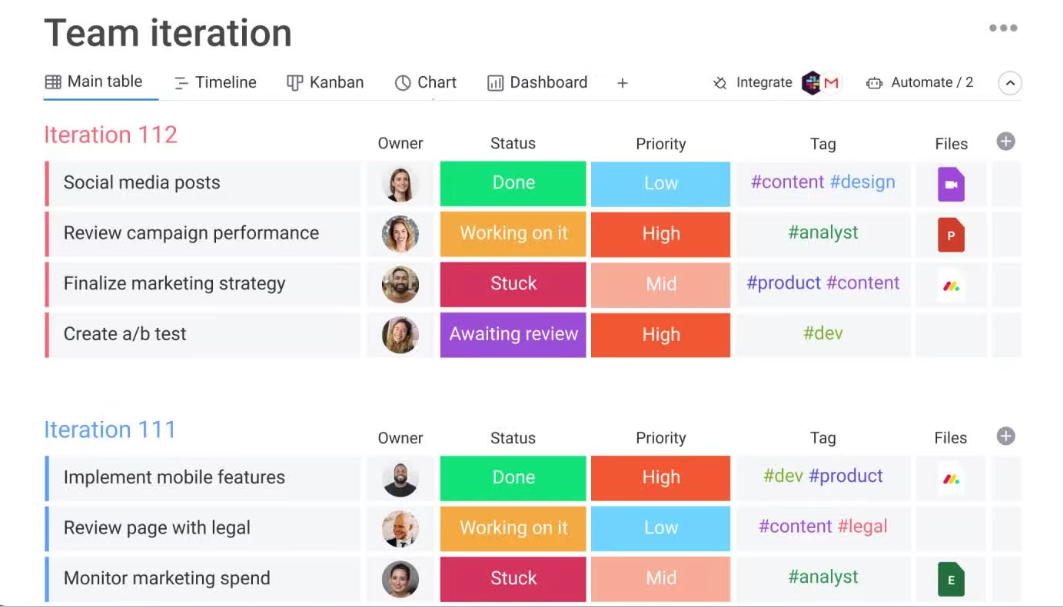
monday.com brings several benefits to building and running an organizational strategy, from streamlining communication and task coordination to visualizing project progress in one user-friendly platform.
Benefits of using monday.com
- monday.com is a project management platform built with a range of benefits for businesses.
- It streamlines project management processes and keeps projects organized.
- The platform makes collaboration and communication among team members easy.
- It gives teams a centralized location for all project-related information and documents.
- monday.com offers customizable features to fit the specific needs of different projects and teams.
- Visual tools, like charts and timelines, help track progress and milestones.
- Project managers can easily assign tasks, set deadlines, and monitor team performance.
- Analytics and reporting features help evaluate project success and support data-driven decisions.
- monday.com integrates with other popular tools and apps, connecting different workflows and systems.
- Using monday.com can improve overall productivity and efficiency in project management.
How to create an organizational strategy with monday.com
Here’s how to put an organizational strategy together with monday.com:
- Identify the company goals and objectives the project needs to accomplish.
- Determine the specific actions and tasks required to reach those goals.
- Set clear expectations for each task, including deadlines, responsibilities, and desired outcomes.
- Use monday.com’s organization features, such as boards and timelines, to map out the project and its components visually.
- Assign tasks to team members using monday.com’s collaborative tools, making sure everyone understands their role.
- Use monday.com’s communication features to keep collaboration and communication running smoothly among the team.
- Review progress regularly and make adjustments as needed, using monday.com’s tracking and reporting capabilities.
- Monitor key metrics and milestones through the project timeline to evaluate progress toward goals.
- Keep the project aligned with the overall organizational strategy by checking back against company objectives.
- Use monday.com’s data analytics tools to get insight into project performance and support data-driven decisions.
Strategies for Keeping Your Project on Track

Keeping a project on track comes down to six habits: setting clear expectations, using organizational tools and apps, building individual project plans, applying visual organization methods, keeping communication effective, and reviewing progress regularly.
Set clear expectations
Setting clear expectations right from the start matters most for keeping a project on track. Define the project’s goals and objectives clearly enough that everyone involved understands what needs to happen.
That heads off confusion and misunderstandings down the line. It also helps to spell out each team member’s role and responsibilities clearly, so everyone knows what’s expected of them.
Clear expectations give a project a solid foundation from day one, which raises its odds of success.
Utilize organization tools/apps
Organization tools and apps do a lot of the heavy lifting for staying organized and keeping a project on track. They keep all the necessary information in one place, which streamlines project management considerably.
They let you create tasks, assign them to team members, set deadlines, and track progress without much friction, so everyone stays on the same page and working toward the same goals.
They also give teams a centralized space for communication, where members can discuss updates, ask questions, and share files. With the right organization tools and apps in place, managing a project from start to finish becomes noticeably more efficient.
Create individual project plans
Individual project plans are essential for managing projects successfully and keeping them on track. A few key points to consider:
- Identify project objectives and goals: Define what you want to achieve and set specific, measurable goals.
- Break down tasks and set milestones: Divide the project into smaller tasks and build a timeline with milestones to track progress and ensure timely completion.
- Allocate resources effectively: Determine the resources, such as manpower, budget, and materials, each task in the plan needs.
- Assign responsibilities: Assign roles based on each team member’s skills and expertise, and communicate expectations clearly so everyone knows their tasks.
- Set deadlines: Establish realistic deadlines for each task. This keeps everyone accountable and progress moving efficiently.
- Anticipate risks and develop contingency plans: Identify what could derail the project and create contingency plans to mitigate those risks, so issues can be addressed promptly if they arise.
- Regularly monitor progress: Track key metrics, such as task completion rates and milestone achievements, so deviations from the plan get caught early.
Implement visual organization methods
Visual organization methods keep projects on track and add clarity to project management. A few strategies worth implementing:
| Strategy | Description |
|---|---|
| Use Charts and Diagrams | Visual representations, such as Gantt charts and flowcharts, can help project managers and teams easily understand project timelines, dependencies, and task progress. |
| Create Visual Timelines | A visual timeline allows everyone involved to see the project’s progression at a glance. It helps with identifying milestones, deadlines, and potential delays. |
| Utilize Color Coding | Assigning different colors to tasks or teams can help visually differentiate between various aspects of the project. This makes it easier to identify priorities and track progress. |
| Adopt Kanban Boards | Kanban boards provide a visual representation of tasks that need to be done, tasks in progress, and completed tasks. They help with task prioritization and workload management. |
| Employ Virtual Whiteboards | Virtual whiteboards allow team members to collaborate in real-time by adding notes, attaching files, or drawing diagrams together. This promotes clear communication and idea sharing. |
| Use Mind Maps | Mind maps are useful for brainstorming ideas, organizing information, and identifying relationships between different project elements. They provide a visual overview of complex concepts. |
Maintain effective communication
Keeping communication effective is critical for keeping a project on track. When team members aren’t clear about their roles and responsibilities, or misunderstandings creep in, delays and mistakes tend to follow.
Poor communication can also slow collaboration and decision-making. To keep communication effective, use clear, simple language when discussing project details.
Update team members regularly on task and milestone progress through tools like email or chat platforms, and encourage open dialogue by actively listening to their feedback.
Regularly review progress
Reviewing progress regularly is one of the most reliable ways to keep a project on track, since small issues are far easier to fix before they snowball. Consistently monitoring metrics and milestones lets you evaluate how the project is going and make necessary adjustments along the way.
It also surfaces issues or delays early, giving you room to take corrective action before they compound, and gives you a chance to assess resource allocation, task prioritization, and how well performance lines up with organizational goals.
Staying proactive about reviewing progress is what keeps a project on schedule and moving toward its objectives.
Conclusion
Organizational strategies are vital for keeping a project on track. Setting clear expectations, using organization tools and apps, creating individual project plans, applying visual organization methods, maintaining effective communication, and reviewing progress regularly all work together to keep a project organized and aligned with company goals.
With these strategies in place, navigating the challenges of project management and reaching your objectives becomes a lot more manageable.
Frequently Asked Questions
What are organizational strategies?
Organizational strategies are plans and methods used to manage and structure tasks, resources, and timelines in order to achieve project goals efficiently.
How can I keep my project on track?
To keep your project on track, it’s important to set clear goals, create a detailed timeline, regularly communicate with team members, monitor progress, and make adjustments as needed.
What is the role of communication in project organization?
Communication plays a crucial role in project organization as it ensures that everyone involved is aware of their responsibilities, updates on progress are shared, and any issues or obstacles are addressed promptly.
How do I prioritize tasks effectively for my project?
To prioritize tasks effectively for your project, start by identifying which tasks are most important for achieving your goals. Consider deadlines, dependencies between tasks, available resources, and potential impact on the overall project outcome when prioritizing.
Are there any tools that can help with organizing and tracking projects?
Yes, there are various tools available, such as project management software or online collaboration platforms, that can help you organize tasks, allocate resources efficiently, and track progress throughout your entire project lifecycle.

- Independent picks for exactly what you just read about
- Matched to your team size & needs
- Vendors don't pay for placement
Step 1 of 4
How big is your team?
We tailor recommendations to companies your size.















Related Articles

Project Management
Best Project Management Software for Small Business in 2026: 8 Tools Compared
Continue reading →

Project Management
ClickUp vs Asana (2026): Which PM Tool Is Right for Your Team?
Continue reading →

Project Management
11 Best Asana Alternatives in 2026 (Cheaper, Simpler, or More Powerful)
Continue reading →

Project Management
How to Use Doodle Polls for Fast, Group Scheduling 2026 Guide
Continue reading →