

Healthcare professionals know how hard it is to manage complex staff schedules. QGenda‘s award-winning solutions have changed how healthcare organizations handle this work.
This article explains those management tools and shows how they can make it easier for you to simplify and run your workforce operations.
Key Takeaways
- Qgenda’s ProviderCloud® supports healthcare administration by handling provider credentialing, cutting the time spent on complex tasks, and keeping work in line with industry compliance.
- The platform improves provider and nurse scheduling through advanced analytics, fitting shift patterns and preferences so patient care holds up without overloading medical staff.
- Room time management in QGenda tracks shifts and room usage precisely, improving both attendance accuracy and resource allocation in healthcare facilities.
- Adopting QGenda leads to significant savings by lowering labour costs through better staff deployment and simpler administrative processes.
- With over 700,000 providers trusting QGenda for workforce management, the platform shows its value in raising operational efficiency across many health organizations.
What is Qgenda and its Healthcare Workforce Management Solutions?
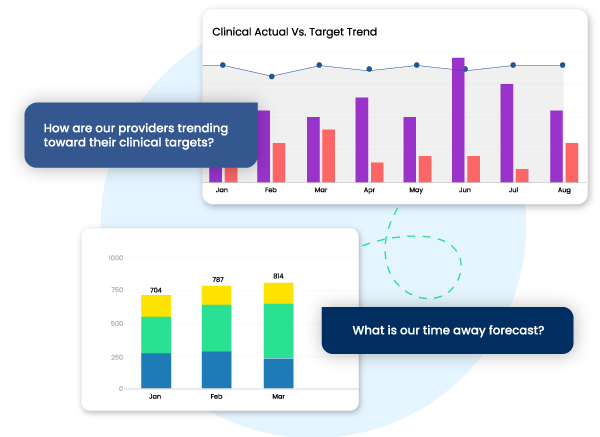
Qgenda is a well-known name in healthcare workforce management, built around a platform called QGenda ProviderCloud®. This suite is designed to simplify operations for health organizations, with tools for provider credentialing, efficient scheduling, and careful compensation management.
Putting these solutions into their daily workflow helps clinics, hospitals, and private practices address some of the most pressing challenges they face day to day.
The platform also changes how academic medical centers and managed service organizations handle their staffing needs, since it provides advanced analytics alongside built-in time-tracking capabilities.
With a set of services that includes payer enrollment and nurse staffing options, Qgenda turns complex data into actionable insights. Healthcare facilities can then deploy their resources sensibly and address issues like staff burnout or labor shortages through more strategic planning and engagement.
Features of QGenda ProviderCloud
QGenda ProviderCloud® provides broad healthcare workforce management solutions, such as provider credentialing, scheduling for both medical staff and nurses, and room time and attendance tracking.
These features are all built to simplify operations and improve day-to-day efficiency in healthcare settings.
Provider Credentialing
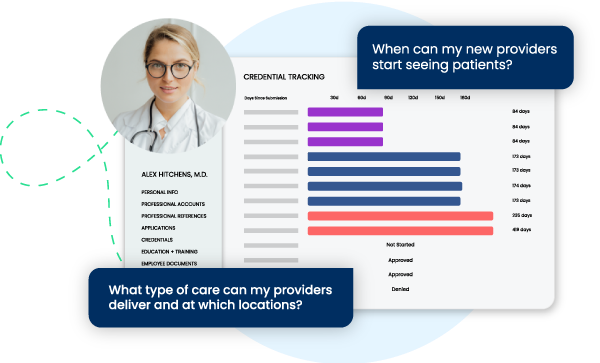
Provider Credentialing is a core part of QGenda ProviderCloud® services, handling the verification of qualifications for healthcare providers. This process supports medical staff credentialing across multiple facilities and keeps work compliant with industry standards.
The secure system simplifies documentation and helps track the progress of credentialing tasks without unnecessary complications. Providers can confidently manage their professional credentials through Qgenda’s mobile app, which allows easy updates and access to the information they need while on the go.
This automated solution saves real time by taking the heavy lifting out of hospital credentialing, so administrators can focus their attention elsewhere and raise overall productivity.
The next feature, Provider Scheduling, continues to strengthen workforce management by improving how medical professionals are assigned to their duties.
Provider Scheduling
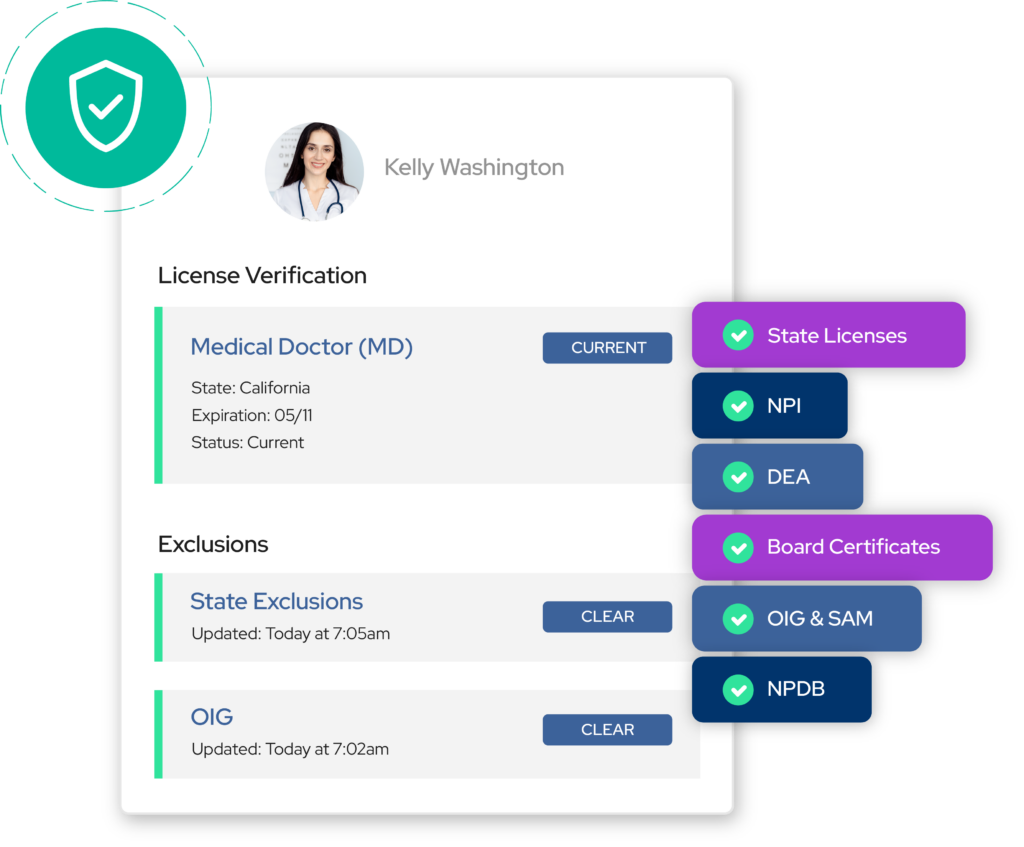
Managing a healthcare workforce well takes precision and flexibility, and that is what QGenda’s provider scheduling delivers. It makes sure the right healthcare professional is available at the correct time and place, matched to their specific skills.
This level of detail supports health systems, including academic medical centers, hospitals, managed service organizations, and private practices, by improving staff allocation.
With more than 700,000 providers across various organizations relying on the system, QGenda shows that solid provider scheduling matters for both large-scale operations and individual clinics.
The software adapts to the demands of healthcare delivery by handling varying shift patterns, provider preferences, and unexpected changes in demand. That flexibility helps medical facilities keep up high-quality patient care without overburdening their professionals.
Nurse and Staff Scheduling
Nurse and staff scheduling is a key part of QGenda’s ProviderCloud® solution, giving healthcare organizations the tools they need to manage shifts and keep staffing at the right levels.
The software offers a clear interface for creating, managing, and sharing schedules, which keeps communication among nursing staff straightforward. With features like on-call scheduling and time tracking, managers can secure adequate coverage while keeping labour costs down.
Healthcare provider scheduling means juggling various factors such as credentialing requirements, capacity management, and workforce analytics. QGenda’s platform brings these complex processes together with clear, intuitive tools that support efficient operations within healthcare facilities.
Room Time and Attendance
Room time and attendance management helps healthcare providers track shifts and make better use of rooms. With QGenda ProviderCloud®, staff can manage their schedules, clock in and out of rooms, and track their time directly from the mobile app.
This feature allows for smooth shift management, accurate attendance tracking, and better time management within healthcare facilities. On top of that, the room scheduling functionality supports efficient allocation of resources by coordinating room usage in one place.
The system’s mobile time-tracking capability gives healthcare providers flexibility and easy access while keeping precise records of room usage. This improves overall workforce management by supporting efficient staff scheduling and promoting better, optimal room use throughout healthcare facilities.
Benefits of Using Qgenda Healthcare Workforce Management Solutions
Using Qgenda’s healthcare workforce management solutions can improve efficiency, sharpen staff deployment, and reduce labor costs, which supports better patient care and operational outcomes.
With its advanced scheduling and optimization technology, Qgenda offers practical benefits for healthcare practices that want to simplify and improve their workforce operations.
Improved Efficiency
Qgenda’s Healthcare Workforce Management Solutions are built to improve efficiency in healthcare staffing, which leads to better resource management and simpler operations.
The QGenda ProviderCloud® platform provides transparent scheduling, giving teams better visibility and coordination of healthcare staff. That visibility supports efficient scheduling and clearer communication among the team, which cuts the time spent on administrative tasks and lifts operational efficiency.
QGenda has been selected by WVU Medicine to manage its 23 hospitals, a sign of its modern approach to healthcare workforce optimization. With its technology and its focus on improving healthcare staffing, QGenda ranks among the leaders in hospital workforce management.
By adopting QGenda’s scheduling solutions, hospitals can anticipate real improvements in their staff deployment strategies while making better use of resources and allocating them for more effective patient care.
Enhanced Staff Deployment
Qgenda’s Healthcare Workforce Management Solutions improve staff deployment, tuning staffing levels and coordination in healthcare organizations. By connecting HR and EMR systems, QGenda ProviderCloud simplifies the scheduling of providers, nurses, and other staff members.
The result is improved employee retention, efficient labor cost management, and simpler healthcare staffing solutions. With Qgenda’s solutions in place, organizations can make sure their staff is deployed effectively to meet the day-to-day demands of patient care.
The next section, Reduced Labor Costs, looks at how Qgenda’s solutions drive financial benefits for healthcare organizations.
Reduced Labor Costs
Improving staff deployment is a key part of QGenda’s healthcare workforce management, and it leads to reduced labor costs and operational efficiencies. With transparent scheduling and capacity optimization, organizations using QGenda have experienced measurable cuts in labour expenses while keeping staffing at the right, optimal levels.
The platform’s ability to simplify administrative processes also supports increased revenue and provider satisfaction, which shows the tangible benefits of QGenda’s workforce management solutions.
By optimizing capacity and adding more transparency to scheduling, QGenda helps healthcare organizations reach a balanced and efficient allocation of resources, which in turn lowers labour costs and improves operational results.
Conclusion
Better scheduling efficiency matters for healthcare organizations. QGenda’s ProviderCloud® offers a range of benefits, including improved staff deployment and reduced labour costs.
With clear management solutions, QGenda helps healthcare providers improve workforce productivity. Healthcare facilities can reach better operational efficiency with QGenda’s workforce scheduling technology.
Maximizing staff engagement and retention while simplifying operations is achievable through the practical features of QGenda ProviderCloud®.
(Image credit: Qgenda)
Where Healthcare Scheduling Differs from Ordinary Rotas
Quick Answer: Clinical scheduling has constraints general workforce tools do not model: credentialing and licence expiry, on-call and callback rules, fatigue and rest requirements between shifts, subspecialty coverage, and equity in how unpopular shifts are distributed. A rota tool that cannot represent these will be worked around.
That is the core reason healthcare organisations buy specialist software instead of adapting a general scheduling product. A general tool can tell you a shift is covered; it cannot tell you the person covering it is credentialed for that unit, has had adequate rest, and is not being handed a third consecutive weekend.
The equity dimension is underrated and is often what drives adoption. Clinicians accept difficult shifts far more readily when the distribution is visible and demonstrably fair, and software that publishes that transparently defuses a recurring source of friction.
Frequently Asked Questions
What is physician scheduling software?
Software that builds and manages clinical rotas, handling credentialing, on-call rotations, subspecialty coverage, rest requirements and shift swaps. It differs from general workforce scheduling by modelling clinical constraints that general tools cannot represent.
Why do hospitals need specialist scheduling software?
Because clinical scheduling has constraints general tools ignore — licence and credential expiry, fatigue rules, on-call and callback pay, and required subspecialty coverage. A general rota tool can confirm a shift is filled but not that it is safely and legally filled.
How does provider scheduling handle on-call?
Dedicated systems model call rotations separately from scheduled shifts, track callback hours for pay, and enforce rest between call and clinical duty. They also distribute call equitably across a group, which is usually the source of most scheduling disputes.
Can scheduling software manage credentialing?
Many clinical platforms track licence and credential expiry and prevent assigning someone to work they are not currently credentialed for. That control is a significant part of the value, since manual credential tracking is error-prone and the consequences are regulatory.
How does clinical scheduling integrate with payroll?
Approved shifts, differentials and callback hours should export to payroll directly. Clinical pay rules involve more variables than standard hourly work, so manual transfer is both slow and a common source of pay disputes.
What should you evaluate in physician scheduling software?
Whether it models your specific call and coverage rules without workarounds, how swaps and requests are handled, whether credential checks are enforced, mobile access for clinicians, and payroll export including differentials.
How long does implementation take?
Typically several months for a hospital or large group, because the work is encoding existing scheduling rules, not installing software. Documenting how your rota actually operates, including informal exceptions, is the phase that determines success.
Who uses clinical scheduling software?
Hospitals, physician groups, anaesthesia and radiology practices, and increasingly urgent care and behavioural health providers — anywhere coverage must be continuous and credential-dependent.
How does scheduling affect clinician retention?
Predictable schedules published in advance and visibly fair call distribution are consistently cited among the factors clinicians weigh when deciding whether to stay. Scheduling is one of the few retention levers an operations team controls directly.
Can clinicians request time off in the system?
Yes, and self-service requests are usually a major driver of adoption. Requests are checked against coverage requirements before approval, so a manager can see immediately whether granting one leaves a gap that must be filled.
How do shift swaps work in clinical scheduling?
Clinicians propose swaps directly, and the system validates that both parties are credentialed for the shifts involved and that rest requirements are not breached before routing for approval. That validation is what makes self-service swaps safe in a clinical setting.
Does clinical scheduling software support multiple sites?
Most do, and multi-site coverage is often the reason for buying. The capability to check is whether the system understands that a clinician credentialed at one site may not be credentialed at another, rather than treating all locations as interchangeable.
What reporting should clinical scheduling provide?
Coverage gaps ahead of time, call distribution by individual over a period, overtime and callback hours, and credential expiry warnings. Retrospective reporting alone is far less useful than forward-looking gap and equity views.
Is clinical scheduling software worth it for a small practice?
Below roughly ten providers on a stable rota, a shared calendar often suffices. The value appears with call rotations, multiple sites, or subspecialty coverage requirements — complexity rather than headcount is the trigger.

- Independent picks for exactly what you just read about
- Matched to your team size & needs
- Vendors don't pay for placement
Step 1 of 4
How big is your team?
We tailor recommendations to companies your size.















Related Articles

Buyers guide
How To Choose The Best Mental Health Software For 2026
Continue reading →
Applicant Tracking Software
Best ATS for Retail and Hospitality Hiring in 2026: 5 Tools for High-Volume Recruiting
Continue reading →
Best Tools
Best EHR Software in 2026: Top Electronic Health Record Systems for Clinics and Practices
Continue reading →
Buyers guide
How To Choose The Best Patient Engagement Software For 2026
Continue reading →