
Exploring the History and Future of LiveJournal: Blurring the Lines Between Blogging and Social Networking


Finding an online space that mixes personal writing with community connection isn’t easy. Most blogging tools handle one side well and the other poorly. LiveJournal tried to do both from the start, pairing blogging with social networking since 1999, and that combination is what made it stand out.
This article covers where LiveJournal came from, where it stands now, and where this online journaling platform may head next. It looks at how the platform grew, why it mattered most in Russia, and how ownership changes and censorship shaped it. Throughout, LiveJournal stays a place where diary entries and digital communities sit side by side.
Key Takeaways
- LiveJournal launched in 1999 and combined the personal feel of diary entries with the shared experience of a social network.
- The platform changed hands more than once, bought by Six Apart in 2005 and later by SUP Media; each sale reshaped its features and user experience.
- Communities are central to LiveJournal, letting users take part in group journals and discussions built around shared interests.
- Privacy settings let users decide who sees their content, but the move of servers to Russia raised questions about censorship and data privacy.
- Its user base has shrunk as newer social sites grew, yet LiveJournal keeps a loyal following that values its mix of blogging and community.
Understanding LiveJournal
LiveJournal mixes blogging with social networking. Users write online journals, talk with a community, and still keep control over their privacy and content.
Brad Fitzpatrick founded LiveJournal in 1999, and Six Apart acquired it in 2005. It grew popular for its community tools and personal diary-style posts. LiveJournal also built a strong following in Russia, where it caught on among Russian-speaking users.
Usage has fallen since the platform peaked in the mid-2000s, but a committed group of users remains. LiveJournal stays an important chapter in the story of blogging and social networking.
Its particular mix of features earned it a lasting spot online. Few platforms from the same era managed to hold on to a base of regular writers the way LiveJournal has, and that longevity is part of why it still matters to the people who use it.
Unique Features of LiveJournal
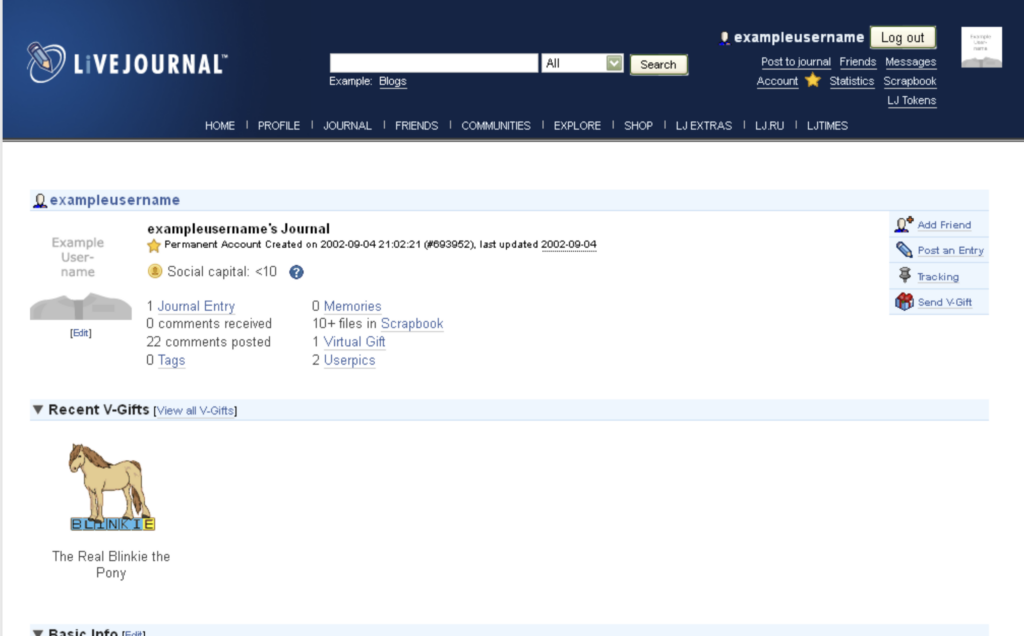
LiveJournal separated itself from other blogging sites by combining social networking tools with heavy customization. Paid account holders got extra perks, including advanced design options that let them shape a page to match their own style.
Beyond look and feel, users could also control who saw each post through detailed privacy settings.
The platform also allowed adult content under strict guidelines, making room for a wide range of writing while holding to community standards. Its large Russian audience added a distinct cultural character that set it apart among social media channels.
Taken together, these features pushed blogging past plain diary entries into something interactive, encouraging people to connect and create across countries.
(Image Credit: LiveJournal)
Community Interaction
LiveJournal changed how people interacted online by adding group journals called “communities.” Each community assigned clear roles: owners set the direction, maintainers and moderators enforced the rules, members joined the discussions, and watchers followed along.
That setup created active online societies where any member could add to a wider conversation.
The platform mattered most in Russia, where it grew into a major social networking tool known by the nickname ZheZhe. Russian users relied on LiveJournal’s US-based servers to build spaces for open expression, posting dissenting views out of reach of local censorship laws.
Moving those servers to Russia changed everything. A site once treated as a haven for free speech now fell under tight rules that put both user privacy and open debate at risk.
(Image Credit: LiveJournal)
Privacy and Content Control
With a personal journal, controlling who reads it matters. LiveJournal handled this through detailed privacy settings that let users choose their audience.
You could mark entries public or private, so sensitive posts stayed with people you trusted. Comment controls then let you set who could reply and how those replies were handled and shown.
For more personal writing, LiveJournal’s “friends only” setting added another layer of privacy. Building custom user groups narrowed the circle further, which helped when discussing private topics.
Adult content was allowed, but with one firm rule: label it clearly to keep the platform safe for all ages. This balance between free expression and responsibility kept shifting, shown in the updated security options the site added after past account security incidents. Together, these controls let users write freely while still deciding exactly who could read, respond to, and share each entry.
LiveJournal’s History
LiveJournal’s history is a mix of growth, change, and controversy. From its founding in 1999 to its sale to Six Apart and SUP Media, the platform sat at the center of several key disputes and criticisms over the years.
Founding and Early Years
Brad Fitzpatrick started LiveJournal in 1999, laying the ground for its early growth and community building. In those first years, its personal diary-style blogging caught on quickly with users.
Early on, the platform gave people a place to connect through their online journals, and that became the seed of a lively digital community.
It hit notable milestones during this early period, building a space where users could share their thoughts and experiences while reading and responding to other journal writers. The mix of open journals and friend connections gave the site a rhythm closer to a conversation than a broadcast, and that set the tone for everything the platform became.
Sale to Six Apart and SUP Media
After its founding and early years, LiveJournal went through a major change in ownership in 2005 when it was bought by Six Apart. That deal was a turning point in its history.
The sale carried real consequences for LiveJournal’s direction and brought new dynamics to how it grew as a blogging and social networking platform. It changed the company’s leadership, its strategy, and the day-to-day user experience. New owners meant new priorities, and those priorities filtered down to the features users saw and the way the community was run.
Later, SUP Media took over LiveJournal. These ownership handovers shaped how the platform changed over time, affecting its features, community activity, and standing online.
Key Controversies and Criticisms
LiveJournal ran into several controversies over the years, most tied to ownership changes and censorship. Its servers moved from California to Russia in 2016, which exposed the platform to Russian state requests for user data and led to censorship and the prosecution of dissenting views.
In April 2017, LiveJournal removed the ability for paid contributors to stop ads from showing to their readers. The platform also drew criticism over its invite system, its use of the word “friends,” and decisions by the Abuse Prevention Team.
Its handling of ad placement added to the frustration. Taking away the option for paid contributors to control ad displays upset much of the community.
Notable LiveJournals and Users
Several LiveJournals and users left a lasting mark on the platform. One is Bruce Sterling, an influential science fiction writer who used LiveJournal to stay in touch with his fans.
Another is Mark Frauenfelder, co-founder of Boing Boing, a popular group blog that gained wide recognition partly through its ties to LiveJournal. Their presence shows the range of writers the platform attracted within the blogging community.
Communities such as “Oh No They Didn’t!” also drew big followings and heavy participation, a sign of how LiveJournal kept its user engagement strong.
These examples show how the platform built real connections among its users while shaping online conversation in its own way. Writers used it to reach readers directly, and communities gave those readers a place to gather, react, and keep the discussion going long after a post went up.
LiveJournal’s Impact on Blogging and Social Networking
LiveJournal helped blur the line between traditional blogging and social networking, building a platform that supported both community interaction and content sharing.
Its effect on global communities of bloggers changed how people connect and share their thoughts and experiences online.
(Image Credit: LiveJournal)
Blurring the Lines Between Journaling and Networking
By blurring the line between personal journaling and networking, LiveJournal turned online self-expression into a shared activity. Users posted personal reflections and, at the same time, talked with a global community of like-minded people, mixing diary-style blogging with social media.
Pairing personal writing with interactive features changed how people connect and talk in digital spaces. Readers were no longer a silent audience; they became part of the story through comments, friend lists, and shared communities.
LiveJournal’s influence on blogging and social networking shows in how it combined user-generated content with community engagement, making it more than a blogging site. It also worked as a meeting ground for many different perspectives and experiences.
Influence on Global Communities of Bloggers
LiveJournal’s effect on global communities of bloggers was real, mixing personal journaling with social networking. Its community features drew people in and connected online diarists from many cultural backgrounds.
Its popularity among Russian-speaking bloggers stands out, and it helped bring a wide range of voices together online. At the same time, LiveJournal faced controversies over censorship and ownership changes that shaped its place in blogging history and the wider social web.
LiveJournal’s path keeps shaping personal blogging and social media, carrying both its historical weight and today’s challenges.
As technology keeps changing how people connect online, LiveJournal remains worth studying as an early force in bringing together global communities of bloggers.

Current Status and Future Prospects of LiveJournal
LiveJournal still draws a varied user base, with a strong presence in Russia and other former Soviet Union countries. Even so, it struggles to stay relevant against newer social media platforms.
Its future may depend on how well it adapts and innovates to meet the changing needs of online communities. The users who remain tend to value what newer platforms lack: long-form writing, tight privacy controls, and communities built around shared interests rather than algorithmic feeds.
Current User Demographics
LiveJournal’s users today form a varied community of online journaling fans. The platform offers several account tiers, including basic, plus, “early adopters”, paid, and permanent options.
Although its user base has shrunk since the mid-2000s peak, LiveJournal keeps a loyal group of long-term users who value its mix of blogging and social networking.
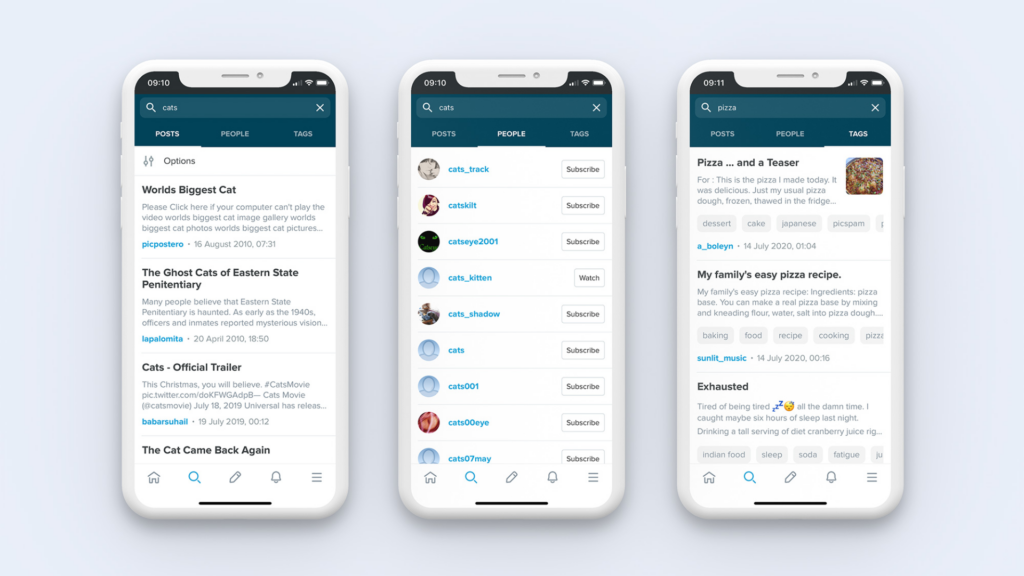
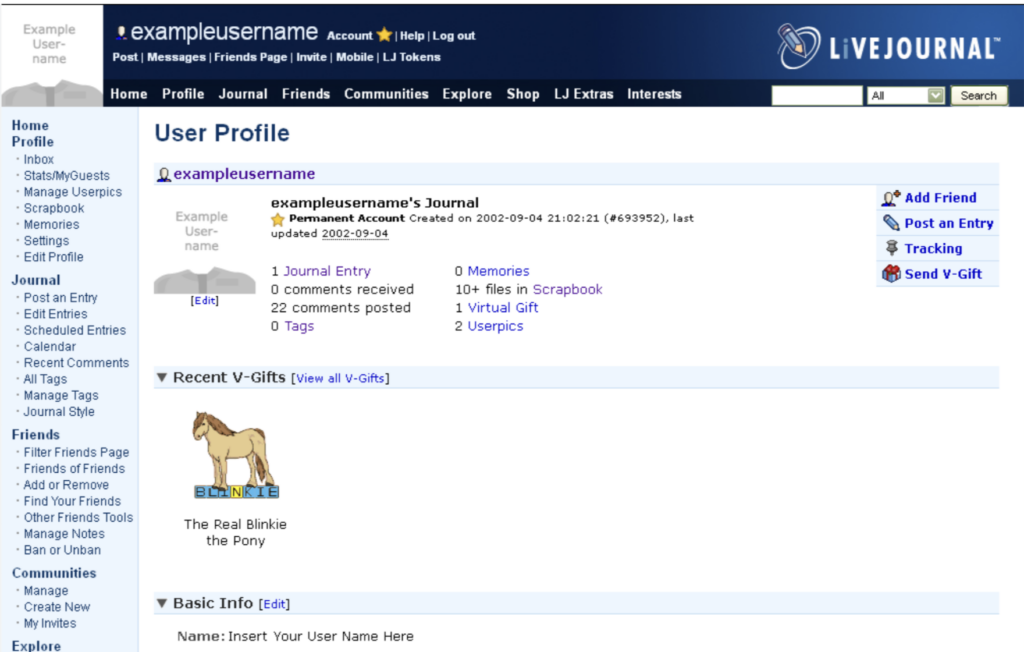
User profiles work as personal diaries where people write about themselves and engage with others in the community. That community activity stays central to the platform’s appeal, connecting users through shared interests and experiences.
Potential Future Developments
User security could face bigger threats as LiveJournal keeps changing. Cybersecurity risks and possible data breaches may put accounts in danger, which calls for more attention to platform rules and account security.
The platform may also run into more problems around content moderation and privacy, along with legal cases tied to freedom of speech and online censorship.
Given these possibilities, LiveJournal’s future stays uncertain, and much of it rests on choices made by its owners and by the legal system it now answers to.
The move to Russia opened the door to more censorship, with consequences for its global users. Future changes in how it handles terms-of-service violations or content moderation could reshape the user experience.
Legal Cases and Censorship Involving LiveJournal
Legal cases and censorship have been a running problem for LiveJournal, from lawsuits against bloggers to the controversy over its Russian jurisdiction. These challenges help explain the platform’s tangled history and the ongoing debate about free expression in online communities.
Lawsuits against Bloggers
In 2007, LiveJournal was pulled into a legal fight with bloggers over how its Abuse Prevention Team handled Terms of Service violations. A leaked policy document the team used prompted further legal action from users, exposing the tension between writers and the platform’s administrators.
LiveJournal also drew criticism and possible legal exposure over controversial decisions, such as removing default user pictures that showed breastfeeding and adding a new user type, Sponsored+ (later renamed Plus), which caused an uproar and possible lawsuits.
These lawsuits mark a key point in the platform’s history, raising real questions about online content moderation and enforcement. The disputes are part of understanding LiveJournal’s effect on the blogging community and later debates over how user-generated content should be governed.
LiveJournal Blocking and Russian Jurisdiction
In 2007, LiveJournal changed hands again when the Russian media company SUP Media bought it. That sale raised concerns about whether the platform would hold to international standards and free-speech protections.
In 2016, LiveJournal moved its servers to Russia, which stirred worry about possible government intervention and internet censorship under Russian jurisdiction.
The move also led to access restrictions in several countries, with LiveJournal blocked outright in places such as China, Kazakhstan, and Uzbekistan.
Relocating the servers raised legal questions about content moderation and whether LiveJournal could protect free expression across differing national laws.
The chance that government authorities could step in may affect how users interact online and complicate life on an increasingly connected internet. For a platform that once served as a refuge for dissenting voices, this shift under Russian jurisdiction reversed much of what had drawn those users in the first place.
Conclusion
LiveJournal grew from a personal diary platform into a space where online journaling and social networking meet, influencing global communities of bloggers. With a history marked by controversies and ownership changes, it still raises concerns about censorship and government control after its server move to Russia.
Despite these challenges, LiveJournal’s effect on digital networking is clear, and its early features helped shape later blogging platforms. Going forward, it will be worth watching how LiveJournal handles legal cases and censorship while holding its place in a constantly shifting social media world.
Frequently Asked Questions
What is LiveJournal used for?
LiveJournal is a social media platform that combines elements of blogging and online journaling, allowing users to share their thoughts, experiences, and interests with a community of readers.
How has LiveJournal influenced the landscape of social networking?
LiveJournal has played a significant role in shaping the early days of online communities by fostering personal connections, creating spaces for niche interest groups, and pioneering features like friend lists and user comments.
Can I still use LiveJournal today?
Yes, you can still use LiveJournal as it continues to be an active platform for blogging and interacting with other users who share similar interests.
What distinguishes LiveJournal from other social networking platforms?
LiveJournal stands out due to its emphasis on long-form content, privacy control options, customizable user profiles, and vibrant sense of community among its users.
How might LiveJournal evolve in the future?
The future trajectory of LiveJournal may involve integrating modern features such as multimedia sharing options or adapting to changing trends in digital communication while preserving its essence as a distinct blend of blogging and social networking.
Related Articles

Cybersecurity
10 Best CrowdStrike Alternatives in 2026 (Ranked for Every Security Team)
Continue reading →

Cybersecurity
Best Cybersecurity Software in 2026: Complete Guide for Every Business Size
Continue reading →

Cybersecurity
Best Identity and Access Management Software (IAM) in 2026
Continue reading →
Buyers guide
How To Choose The Best Security Awareness Training Software For 2026
Continue reading →