

Artificial intelligence has been reshaping the business world for the past two years, and cybersecurity is one of the areas most affected by it. Companies now lean on AI across nearly every part of their security operations, from monitoring to response. Used well, it has clearly strengthened how companies defend themselves against threats they used to struggle to catch in time.
AI can automate cybersecurity tasks, which cuts costs and frees up teams to focus on running the business rather than chasing every alert manually. It also speeds up how quickly a company can respond to emerging threats, so attacks get handled before they turn into a bigger problem.
The same advantages cut both ways, though. Cybercriminals can automate their own attacks with AI too, making them faster, more efficient, and considerably harder to detect than attacks built by hand. In payment fraud specifically, that’s dangerous: AI lets attackers run automated payment attacks at scale, sidestepping traditional security measures and targeting customers with far more precision than older, blunter methods ever managed.
Payment fraud has already been climbing for the last five years, which makes this trend worth paying close attention to, especially as the tools available to fraudsters keep getting more capable. The chart below shows the scale of the increase:
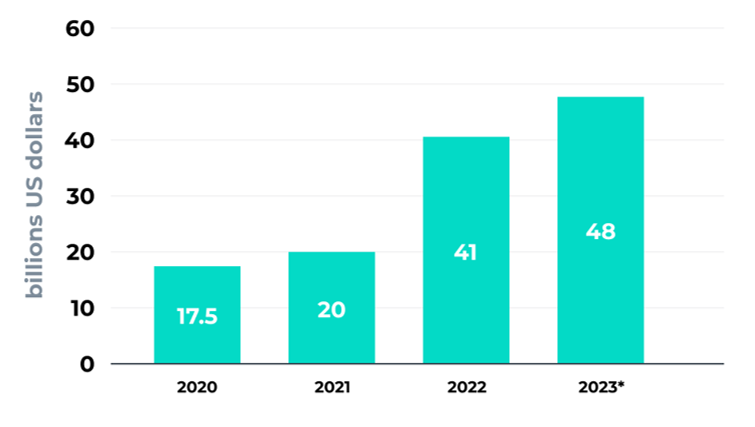
Between 2020 and 2023, payment fraud cases grew 174%, and the pace of attacks hasn’t slowed since. As cybercriminals get more comfortable working with AI, and the underlying technology keeps advancing, that number has plenty of room to keep climbing higher still.
AI Making Payment Fraud More Effective
Understanding where payment fraud is headed starts with looking at how AI is already making it more effective today. One way is through phishing: AI helps cybercriminals build far more convincing attacks by using machine learning software to analyze communication patterns and mimic the tone of real businesses or individuals.
These systems can pull data from social media, emails, and websites to learn a target’s tone, language, and typical behavior, then use that information to write personalized emails or SMS messages that are hard to tell apart from the real thing. Phishing remains one of fraudsters’ most-used tactics in 2025, but most attempts are still recognizable to a careful reader, whether through poor grammar, an odd request, or a suspicious URL, which gives users a real chance to spot a phishing attack and avoid it before it causes any damage.
As AI use grows, though, those tell-tale signs start to disappear, and the messages become far more likely to trick victims into handing over sensitive payment information. Cybercriminals can also launch hundreds or thousands of targeted attacks in a fraction of the time it used to take a human operator working alone.
AI is also behind automated account takeovers, where advanced botnets study a user’s behavior over time and then replicate it closely enough to pass as genuine. It can mimic a real user’s buying habits, purchasing at similar times of day, using the same devices, or entering matching shipping details, which makes it much harder for fraud detection systems to tell the difference. That same automation can crack passwords or bypass multi-factor authentication, testing millions of combinations per second while probing for any weak spots in a company’s security protocols.
The Future of AI in Payment Fraud
Phishing and account takeovers are just two examples of what AI is already doing for payment fraudsters, and there is more on the way. Perhaps more concerning still is that AI is making it easier for cybercriminals to develop self-learning malware, capable of more stealthy, persistent attacks that are specifically designed to get around whatever new defenses businesses put up.
As business keeps moving further online, this is especially risky for startups that lean on cheaper, outdated cybersecurity practices simply to keep costs down while they get established.
It’s not one-sided, though. AI remains genuinely useful for legitimate businesses trying to protect their own systems, and that usefulness hasn’t gone away just because attackers have caught up. The same technology that helps attackers refine their phishing, account takeover, and malware techniques also helps businesses defend against them, automating threat detection, surfacing vulnerabilities before attackers find them, and speeding up how quickly a business can respond once an attack begins.
By analyzing data from past attacks, AI can also help businesses forecast potential vulnerabilities ahead of time and offer proactive recommendations for reducing the risk before it turns into an actual incident. What matters most, in the end, is that businesses actually put these defenses into practice and choose the tools that genuinely fit their needs, rather than leaving good technology sitting unused.
Related Articles

AI Software
AI Matching in ATS: What It Is, How It Works and Why It Matters for Hiring
Continue reading →

AI Software
How AI-Powered ATS Tools Boost Diversity in Hiring — Real DEI Use Cases (2026)
Continue reading →

AI Software
Best AI Resume Screening Tools in 2026 to Hire Faster
Continue reading →

AI Software
Is Riverside FM the Best AI for Podcasts and Video Recording?
Continue reading →