

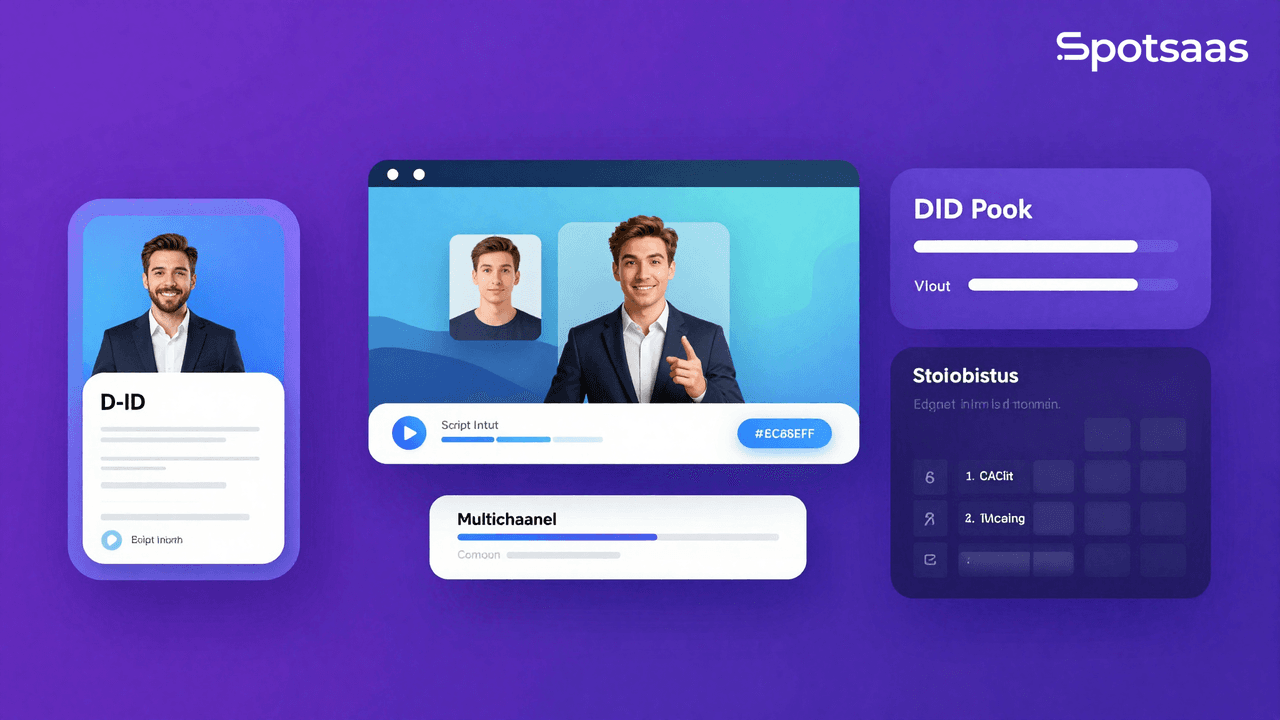
Making videos that hold an audience’s attention is harder now that people scroll past more content than they can watch. D-ID AI Video Generation Technology takes a different route: it uses artificial intelligence to turn photos and text into talking video, changing how digital media gets produced.
This post explains how D-ID builds video content and how it changes the way businesses in different industries interact with their audiences. The short version: it turns still images into characters that speak.
Key Takeaways
- D-ID AI Video Generation Technology uses AI to create realistic videos, with features such as emotional recognition and Natural Language Processing that shape how people interact with digital characters.
- Because the technology can make customer experiences feel more human and deliver personalized content, businesses can expect stronger engagement and loyalty from their clients.
- Bringing D-ID’s NUI into educational tools points toward adaptive learning environments that adjust more closely to each student’s needs.
- D-ID backs ethical AI practices by offering encryption for user data in its app and publishing guidelines for responsible use of its technology.
- As artificial intelligence advances, D-ID is expected to keep improving user interface technology across marketing, sales, education, and other fields, with data protection as a priority.
Understanding D-ID AI Video Generation Technology

D-ID AI Video Generation Technology combines Natural Language Processing with emotional recognition to build realistic digital interactions. The tool reads human expressions and speech patterns, then pairs them with user input to produce video that looks convincingly real.
Treat it as a link between virtual reality and everyday communication, where artificial intelligence brings still images to life by turning them into moving video content.
The technology cuts down the work of making a video, and it opens the door to personalized digital characters that can deliver a message, teach a lesson, or walk you through a mobile app. What used to take a camera, a studio, and a person on screen can instead start from a photo and a block of text, with the AI handling the face, the voice, and the timing. That lowers the barrier for teams that want video but lack the budget or crew to produce it the old way.
Each interaction D-ID produces gives users a more human-like connection with their devices. From these foundations, the next question is how digital interfaces got here in the first place.
The Evolution of Interfaces
Digital interfaces have changed a great deal, moving from the rigid button clicks of early computers to today’s swipes and voice commands. Graphical user interfaces (GUIs) put visual cues on the screen and set the pattern for more natural exchanges between people and machines.
Natural User Interfaces (NUIs) now sit at the front of that shift, closing the gap between the physical and digital worlds. Instead of asking people to learn a menu or a command, an NUI tries to meet them where they already are, reading gestures, speech, and expression the way another person might.
NUI technology draws on emotional intelligence and natural language processing to build experiences that read users more accurately than earlier interfaces could.
This puts human needs first and lets people work with technology in ways that feel personal and responsive. Users can look forward to smoother conversations with AI as tools like D-ID move toward a point where digital companions hear our words, register our emotions and intentions, and respond with support that fits the situation.
How D-ID is Revolutionizing Customer Experience
D-ID is setting a new bar for customer experience with its Natural User Interface (NUI). The technology connects customers to digital platforms and makes those exchanges more intuitive and engaging.
Picture chatting with a digital agent that reads your emotions and reacts the way a person would. That kind of interactivity raises customer satisfaction and makes people feel more connected to the brand.
The company’s products change how designers think about user interfaces. They let businesses send personalized video messages in place of generic emails or texts. A birthday greeting from a favorite store arrives not as a plain text but as a video made for the recipient.
Experiences like these build stronger ties between companies and their clients, which lifts loyalty and, in turn, sales. That momentum carries directly into how D-ID reshapes marketing, where the same tools reach potential customers in more meaningful ways.
Transforming Marketing Strategies with D-ID
D-ID changes marketing through its Natural User Interface (NUI), which makes interactions with digital technology feel more human. When businesses bring D-ID’s NUI into their campaigns, they can create more engaging and personalized experiences for customers.
This lets companies connect with their target audience on a deeper level, which improves communication and strengthens brand loyalty. A message that carries a face and a voice tends to hold attention longer than plain copy, and it gives a brand a consistent presence across every touchpoint where a customer meets it.
D-ID’s range of products gives marketers concrete tools to change how they reach consumers. Creative Reality Studio™ builds immersive marketing content, while Chat.D-ID supports customers through AI-driven chatbots, so marketing teams have more ways to make campaigns land with today’s digitally-savvy consumers.
The move toward more personalized and interactive marketing is shaping the future of consumer engagement. Marketers who adopt D-ID’s technology can keep pace as expectations rise, since smooth interactions now decide whether a campaign succeeds.
D-ID in Education: A New Era of Learning
D-ID’s work in marketing shows how much it affects the way digital technology develops. In education, the company brings a new approach to learning through its Natural User Interface (NUI) and Digital Agents.
These tools make interactions feel more human and give students around the world a more immersive learning experience. Libi Michelson’s articles on NUI, along with the top buzzwords for 2024, explain the interface changes that will shape future education systems.
D-ID agents also matter here because they supply resources built to improve how users learn. The collaboration between D-ID and educators marks a move toward personalized and adaptive learning environments that meet individual student needs. A digital agent can restate a concept, answer a follow-up question, or pace a lesson to the student in front of it, which is hard to do at scale in a standard classroom.
As digital technology keeps advancing, D-ID’s role in education sets up bigger changes that update traditional teaching methods while raising student engagement and helping learners retain more.
D-ID’s Unique Features
D-ID’s main features are Creative Reality Studio™, D-ID Agents, and Chat.D-ID. These tools change how people create and interact with video content.
The sections below look at each feature in more detail.
Creative Reality Studio™
D-ID offers Creative Reality Studio™, a product built to change how users work with the technology. Through the platform, developers reach the Developer Hub, an API Integration Guide, live coding sessions, and the D-ID community, where they can take part in how interfaces evolve.
The platform aims to improve the user experience with interactive interfaces that let developers build original designs and encourage smooth interaction. A builder does not have to start from scratch; the studio’s tools help shape how a digital character looks and behaves, and then wire that character into an app or a website.
Creative Reality Studio™ also supplies advanced developer tools for API development, which gives builders room to try new ideas in interface design and create engaging experiences.
D-ID Agents
D-ID Agents change how people work with the technology by safeguarding biometric privacy through face recognition protection. This feature, part of D-ID’s product suite, puts weight on responsible AI use and ethical practice.
Under the “Evolve to NUI” banner, users can try interactive interfaces and draw on D-ID’s wider technology ecosystem, including D-ID Agents.
By pushing forward user interface design and keeping the focus on responsible use, D-ID Agents help shape where artificial intelligence ethics goes next.
Chat.D-ID
Chat.D-ID reworks conversations and interactions, and it is one of D-ID’s notable products. It changes communication channels through a fresh take on how a conversation is built.
With this tool, D-ID advocates responsible AI use and ethical practices in interaction technology. Users can read resources on D-ID’s platform to learn about Chat.D-ID and put its features to work for a better chat experience.
As we look more closely at how D-ID’s ideas get applied, it is worth returning to another key feature: Creative Reality Studio™.
D-ID for Developers: A New Frontier in AI Development
D-ID gives developers access to the Developer Hub, an API Integration Guide, live coding sessions, and the D-ID community. Keeping responsible AI in view, D-ID also publishes an ethics pledge and guidelines for using AI technology.
The Developer Hub holds resources for developers who want to add D-ID to their digital products while sticking to ethical technology practices.
The API Integration Guide walks through how to add D-ID’s capabilities to existing software and applications. Developers also get chances to join live coding sessions and connect with the D-ID community to trade ideas and get help with their AI work. That mix of documentation, hands-on sessions, and community support gives a team more than one way to get unstuck when they build with the API.
The Role of D-ID in Sales & Marketing
D-ID plays a real part in sales and marketing while stressing responsible AI and ethical use of AI technology. The D-ID AI Video Generator mobile app gives teams a lot of creative room, which makes it a useful tool in both fields.
- Over 150 million videos have been created with D-ID’s AI video generator, a sign of how well it works for sales and marketing.
- D-ID has drawn strong interest, with 60,000 new sign-ups per day on the desktop version of Creative Reality Studio, which points to its sales and marketing potential.
How D-ID Keeps Your Data Safe
D-ID protects user data with encrypted communication in the AI Video Generator app. This keeps personal information private while it moves across the network. Users can also request deletion of their data from the app, which gives them more say over privacy and confidentiality.
With encrypted communication and data deletion in place, users can hand their personal information to the AI Video Generator app and keep control over their privacy. Because the app works with faces and voices, that control matters more than it would for a plain text tool, and the option to remove data gives users a clear way to walk back what they have shared.
User Reviews and Feedback on D-ID AI Video Generation App
The D-ID AI Video Generation App holds a rating of 3.2 stars, based on 3.03K user reviews. One review raised concerns about the app’s pricing plans and pointed to possible bait-and-switch tactics.
- Customers have flagged several pricing concerns, including misleading pricing and subscription plans.
- Several users have written about their experience with the app, focusing on video creation and AI-generated videos.
- User ratings show a mix of positive and negative experiences, which reflects a wide range of opinions.
- Some customers have called for transparent pricing and clear communication about subscription plans.
- Taken together, the feedback suggests a spread of experiences, with individual ratings reflecting different satisfaction levels.
Similar Apps to D-ID: A Comparative Look
Look across AI video generation tools and you find several apps that compete with D-ID. Each brings its own features and takes a slightly different position in the market.
- Synthesia: A London-based company with AI video synthesis technology that customizes avatars and produces videos in multiple languages. It is known for being easy to use and suits businesses that want video content without camera equipment or actors.
- Deepfake Studio: Focuses on face-swapping technology that lets users put their faces onto videos. It has entertainment value and a niche in memes and parodies, though it raises concerns about the ethics of deepfakes.
- Reface: Became popular for swapping faces in videos and GIFs from a single selfie. Reface uses machine learning to make its results look real and is common in social media entertainment.
- Zao: This Chinese app rose fast for putting users’ faces into scenes from movies and TV shows. It is very popular in China but has drawn scrutiny over its privacy policies and the risk of misuse.
- Wombo: Uses AI to animate still photos into singing videos, adding a playful twist to digital interactions. Wombo often shows up in lighthearted content and viral social media challenges.
- Hour One: Like D-ID, Hour One uses AI to build realistic video characters, especially for e-learning and customer service. It stands out for its focus on professional uses.
- Lumen5: This platform uses AI to help marketers and creators turn blog posts and other text into engaging videos. Lumen5 puts speed and simplicity first and automates much of the production.
- Descript: Offers a set of video and audio editing tools, including an Overdub feature that clones voices for smoother edits. Its focus on podcasting and video editing makes it a full option for creators who want more than AI video generation.
- CrazyTalk: Animation software that turns photos into talking animations. It is friendly and approachable for people new to animation and AI.
- FaceApp: Not a video generation tool, but it offers AI-driven photo editing such as changing age or gender and adding effects. FaceApp hints at how AI can personalize digital content.
As AI and machine learning keep advancing, the competition among video generation tools will grow. Each platform is claiming its own space and serving different audiences and use cases. Next, we turn to what D-ID’s technology means and where it is headed.
The Future of D-ID: What to Expect
After looking at similar apps and D-ID’s own features, it helps to ask what comes next for the technology. As artificial intelligence keeps moving fast, D-ID is expected to push further in user interface technology, language models, emotional analysis, and digital enhancements.
Pairing D-ID with other AI technologies is also expected to change several industries, from marketing and sales to teaching methods. And as privacy concerns grow, D-ID plans to keep ethics and data safety central as it builds new products.
With those changes ahead, D-ID looks set to hold an influential place in how digital technology develops. The direction is toward characters that read context more closely and respond in a way that feels less scripted, which would widen where the technology fits, from a support desk to a lesson to a marketing message.
The Ethical Considerations of D-ID and AI Governance
D-ID stands behind responsible use of AI technology, following ethical guidelines and a pledge that keeps ethics at the center of its governance. These commitments guide how D-ID builds and rolls out its video technology, with attention to user engagement and to data protection and privacy.
As D-ID works within AI governance regulations, these principles stay part of its mission.
The focus on responsible AI reaches past the technology itself. D-ID shows its commitment through concrete actions and sets a standard for ethical use in video technology.
Conclusion
Given the ethics and governance around D-ID, it is clear that artificial intelligence technology is moving to change many industries. Looking ahead, D-ID’s AI video generation technology sits near the front of that shift in customer experience, marketing, education, and more.
With its features and its focus on responsible AI, D-ID is opening the way for new uses of machine learning and computer vision. Pairing D-ID with other AI technologies points to real possibilities for richer digital interactions and creative content.
Exploring the Integration of D-ID with Other AI Technologies
D-ID’s integration with other AI technologies marks a turning point in how interfaces develop. Combining D-ID’s capabilities with natural language processing and emotional intelligence can raise the quality of user experiences.
Bringing D-ID together with other AI technologies holds a lot of potential for human-computer interaction and opens the way to interface design that puts user experience and privacy protection first.
The integration also gives developers a chance to join an active community and weigh the ethical questions around AI. As artificial intelligence advances, D-ID’s place in this integration confirms its part in shaping how people will interact with digital tools.
See more of what AI technology can do in our guide on D-ID’s AI video generation.
FAQs
How does D-ID AI Video Generation Technology work?
It uses deep learning algorithms to create realistic, personalized videos from a single image or video.
Can D-ID AI generate videos from any type of image or video?
Yes. D-ID AI can generate videos from many types of images and videos, including portraits and other media content.
What are the potential applications of D-ID AI Video Generation Technology?
Uses include creating personalized marketing videos, improving visual storytelling in entertainment, and making virtual communication feel more natural.
Is there a privacy concern associated with using D-ID AI Video Generation Technology?
There can be. Because the technology can create hyper-realistic fake videos, it could be misused for deceptive purposes.
How accurate is the video generation capability of D-ID AI?
Accuracy depends on factors such as image quality and the data available, but it generally produces high-quality results.
Related Articles
AI Software
Fireflies vs Otter 2026: Pricing, Limits and Which to Pick
Continue reading →
AI Software
AI in Finance: 12 Use Cases for Corporate Finance Teams in 2026
Continue reading →
AI Software
Copilot vs ChatGPT for Business (2026): Price, Security and Use Cases
Continue reading →
AI Software
AI in Procurement in 2026: 10 Use Cases, Tools and How to Start
Continue reading →