

If you sell to businesses, you already know the problem: not every lead is worth the same amount of your sales team’s time. Some are ready to buy today. Others are months away, or will never convert at all. Without a system for telling them apart, sales reps end up chasing the loudest inbound signal instead of the most qualified one.
Lead scoring, paired with marketing automation, solves that problem directly. It gives every lead a number based on how well they fit your ideal customer and how engaged they actually are, so your team can prioritize outreach instead of guessing.
This guide covers what lead scoring is, the two main types of scoring models, why businesses need one, how to build a model with marketing automation, and which software options are worth evaluating.
What Is Lead Scoring?
Lead scoring is a methodology used in sales and marketing to rank and prioritize prospective customers, or leads, based on their level of engagement and likelihood to become a paying customer.
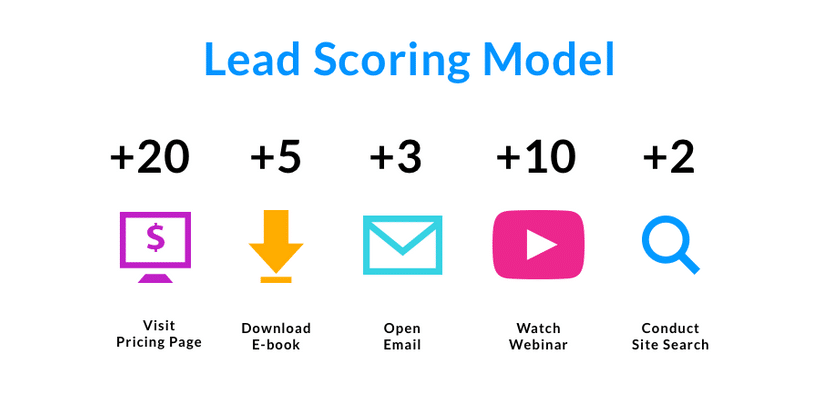
It involves assigning points or scores to each lead based on specific criteria such as their demographic information, behavior, and interactions with your business.
By using lead scoring, you can better understand which leads are the most qualified and ready to purchase, and focus your time and resources on those that are most likely to convert.
Lead scoring can also help you identify which leads require additional development or follow-up before they are ready to make a purchase, allowing you to tailor your communication and engagement strategies accordingly.
What Is Marketing Automation?
Marketing automation is a software-based solution that enables businesses to streamline, automate, and measure their marketing tasks and workflows. It typically involves using software tools to automate repetitive marketing tasks such as email marketing, social media management, lead generation, lead nurturing, and analytics.
Marketing automation helps businesses save time and resources by automating repetitive tasks, and it enables them to personalize their marketing efforts to better engage with their audience. By using marketing automation, businesses can also collect valuable data about their customers and leads, which can be used to refine marketing strategies and improve overall business performance.
Marketing automation and lead scoring work together closely: the automation platform is what actually tracks the behavior (page visits, email opens, form fills) that feeds the score, and it’s what triggers the follow-up action once a lead crosses a scoring threshold.
What Are the Types of Lead Scoring Models?
There are two main types of lead scoring models:
- Traditional lead scoring: This model uses explicit data provided by the lead, such as their job title, company size, industry, and location. It also takes into account the lead’s behavior, such as their website visits, email opens and clicks, and downloads of marketing materials. Traditional lead scoring is based on a set of predefined rules and point values allocated to each data point or behavior.
- Predictive lead scoring: This model uses machine learning algorithms to analyze large sets of data and identify patterns and correlations that indicate a lead’s likelihood to convert into a paying customer. Predictive lead scoring takes into account a wide range of factors, including explicit data, behavior, and external data such as market trends and industry benchmarks. It then assigns a score to each lead based on their likelihood to convert, continuously updated as new data comes in.
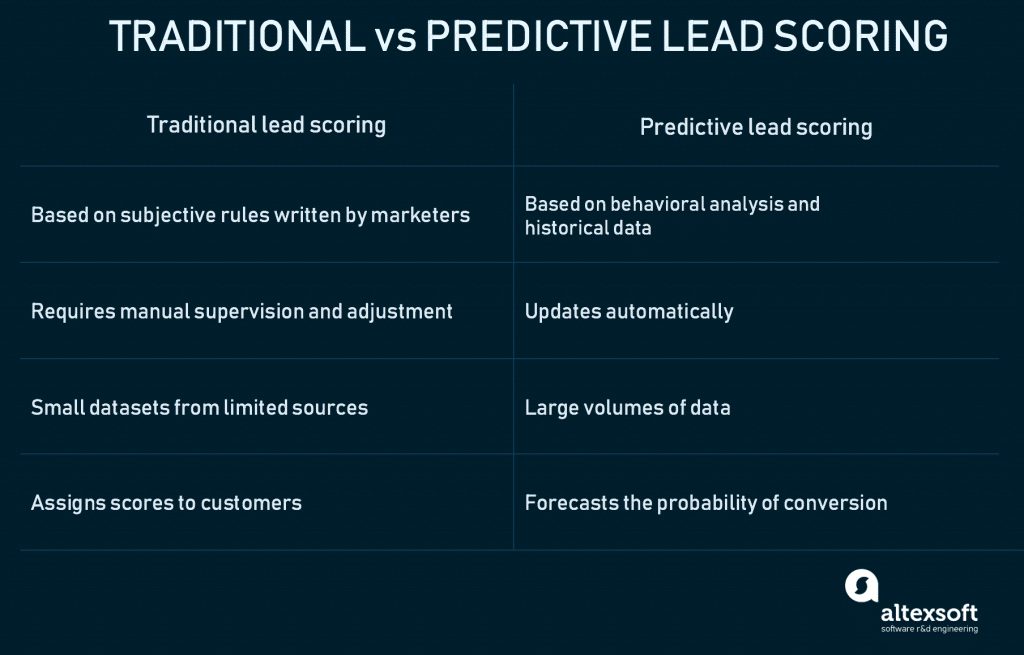
Both types of lead scoring have their advantages and disadvantages, and the best model for your business depends on your specific goals and needs.
Traditional lead scoring may be a good fit for smaller businesses or those with limited data, while predictive lead scoring is more suitable for larger businesses with a lot of data and a need for more advanced analysis.
Why Do Businesses Need a Lead Scoring Model?
Businesses need a lead scoring model for several reasons:
- Prioritization: A lead scoring model enables businesses to prioritize leads based on their likelihood to become a paying customer. This helps sales teams focus their time and resources on leads that are most likely to convert, rather than spending time on unqualified leads.
- Improved conversion rates: By focusing on the most qualified leads, businesses can improve their conversion rates and generate more revenue from their marketing and sales efforts.
- Personalization: A lead scoring model can help businesses personalize their communication and engagement strategies with leads, tailoring their message and approach based on the lead’s specific needs and behaviors.
- Nurturing: A lead scoring model can help businesses identify leads that require further development or education before they are ready to purchase. This allows businesses to tailor their communication and engagement strategies to the needs of each lead, and increase their chances of eventually converting them into a paying customer.
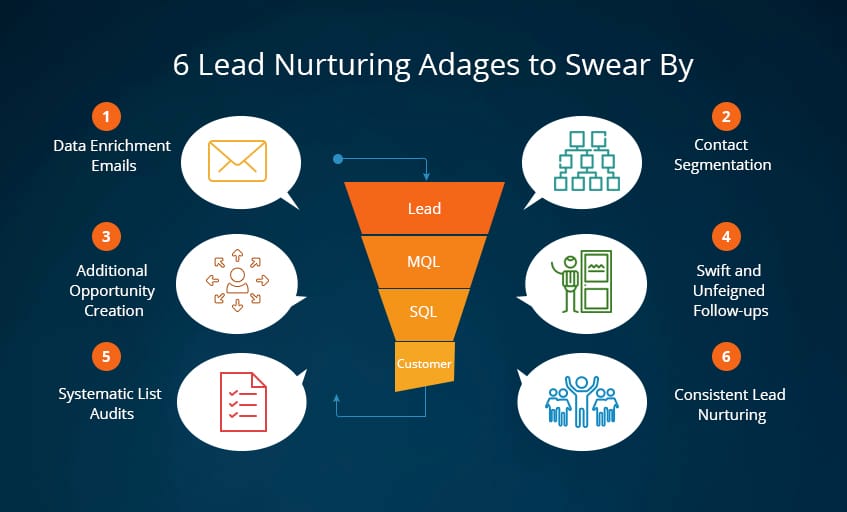
- Optimization: A lead scoring model provides businesses with valuable data and insights into their sales processes. By analyzing the data generated by the model, businesses can identify areas for improvement, optimize their processes, and improve overall business performance, including the performance of marketing teams.
A lead scoring model is an essential tool for businesses that want to improve their sales efforts, increase revenue, and compete more effectively for the same pool of buyers.
How to Create a Lead Scoring Model With Marketing Automation
Setting up a lead scoring model with marketing automation involves several steps:
- Define your ideal customer: Before you can start assigning scores to leads, you need to have a clear understanding of your ideal customer. This includes their demographics, behavior, pain points, and buying journey.
- Determine your scoring criteria: Based on your ideal customer profile, determine the criteria you will use to score leads. This may include demographic data, such as job title and company size, as well as behavioral data, such as website visits and email engagement.
- Assign point values: Assign point values to each criterion based on its importance in determining a lead’s likelihood to convert. For example, a lead’s job title may be given a higher value than their company size.
- Set up automation rules: Set up automation rules that trigger based on a lead’s score, such as sending them to a specific email campaign or notifying a sales representative.
- Test and refine: Test your lead scoring model to ensure that it is accurate and effective in identifying the most qualified leads. Refine your model as needed based on the results of your testing.
- Continuously evaluate and adjust: Continuously evaluate the performance of your lead scoring model and adjust it as needed to ensure that it remains effective over time.
Setting up a lead scoring model with marketing automation requires careful planning, testing, and ongoing evaluation. Following these steps helps you build a model that identifies the most qualified leads and drives more revenue from your marketing and sales efforts. None of these steps is a one-time task: scoring criteria that fit your business today will need adjusting as your product, market, and ideal customer evolve.
Lead Scoring Software
Lead scoring automation software is designed to help businesses automate the lead scoring process, making it easier to identify and prioritize leads based on their behavior, characteristics, and other factors. Some popular lead scoring automation software options include Pardot and Act-On.
Pardot
Pardot’s lead scoring and grading tools allow businesses to assign scores to leads based on their behavior, demographics, and other criteria, and then use those scores to organize follow-up activities.
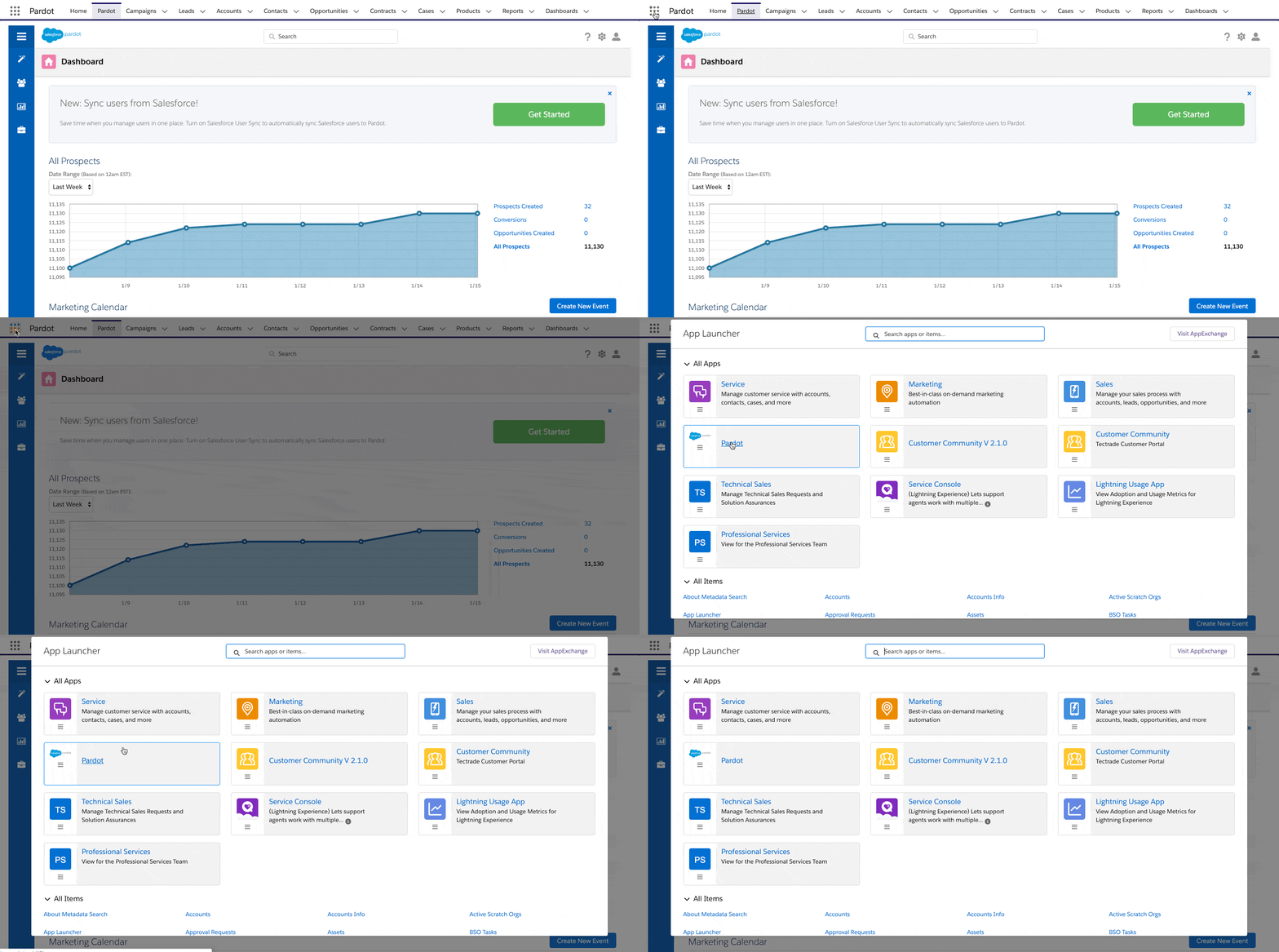
Pardot Features
- Email marketing
- Search tracking and optimization
- Journey builder
- Lead management
- Analytics and attribution
- Personalization
Pardot Pricing
The paid plans for Pardot start at $1250 per month, and Pardot does not offer a free plan. Pardot has 4 different paid plans:
- Growth at $1250.00 per month
- Plus at $2500.00 per month.
- Advanced at $4000.00 per month.
- Premium at $15000.00 per month.
Pardot Pros & Cons
| Pros | Cons |
|---|---|
| Integration with leading CRM | Navigation across the platform is tricky |
| Automation capabilities | Unlocking features across price tiers |
| Journey Builder | CMS integration |
Act-On
Act-On’s lead scoring tools allow businesses to score and segment leads based on their behavior and other criteria, and then use that data to automate personalized marketing campaigns.
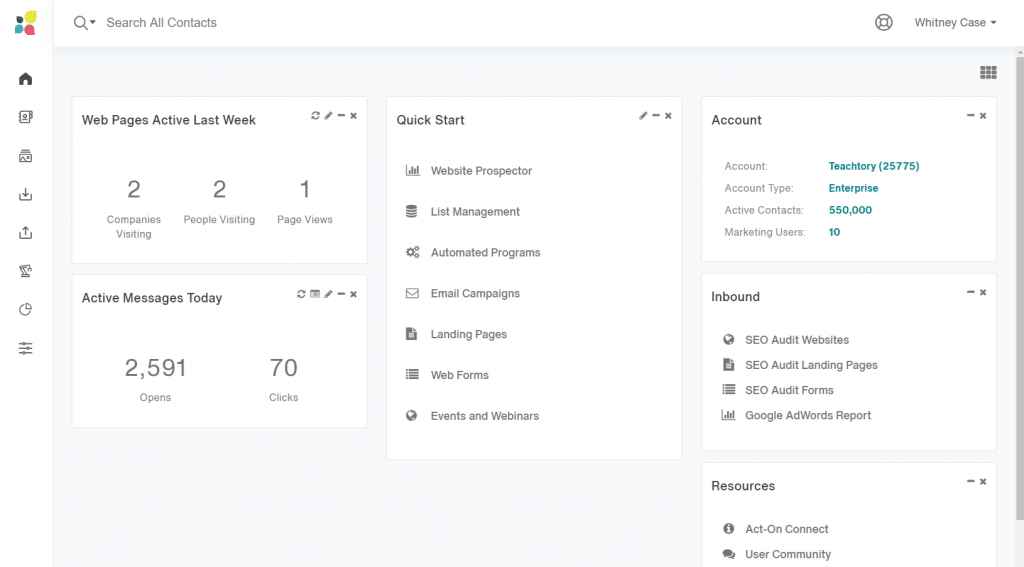
Act-On Features
- Lead Management
- Marketing Lead Database
- Data Quality Management
- Segmentation
- Lead Scoring and Grading
- Lead Nurturing
Act-On Pricing
Act-On does not offer a free trial plan for its users. The software offers 2 paid plans: Professional and Enterprise.
The Professional plan starts at $900 per month and includes features like:
- Score visitors, prospects and customers
- Deliver landing pages and forms that engage your market and capture info
- Interactive analytics and reporting dashboards
and more.
The Enterprise plan is quotation-based and includes additional features like:
- CRM Integration
- Data Studio for advanced reporting and BI integration
- Account-Based Marketing
and more.
Act-On Pros & Cons
| Pros | Cons |
|---|---|
| Advanced email marketing | Mapping features lags |
| Smart automation | Slow learning curve |
| User-friendly |
Examples of Lead Scoring Automation
Lead scoring is a process of assessing the potential value of a lead based on their behavior, characteristics, and other factors. Automating lead scoring can save time and improve the accuracy of lead qualification. Here are a few examples of basic lead scoring automation:
- Website behavior scoring: Assign points to leads based on their interactions with your website, such as the number of pages they visited, the time they spent on each page, and the actions they took (e.g., filling out a form).
- Demographic scoring: Assign points to leads based on their demographic data, such as their job title, company size, and industry. This can help you classify leads based on their fit with your ideal customer profile.
- Email engagement scoring: Assign points to leads based on their engagement with your email campaigns, such as the number of opens, clicks, and replies. This can help you identify leads who are actively interested in your product or service.
- Social media engagement scoring: Assign points to leads based on their engagement with your social media accounts, such as the number of likes, comments, and shares. This can help you identify leads who are interested in your brand and may be more likely to convert.
- Lead source scoring: Assign points to leads based on the channel or source they came from, such as a paid search ad or a referral from another customer. This can help you understand which marketing channels are driving the most valuable leads.
Getting Started
Implementing a lead scoring model with marketing automation helps you classify your leads and focus your sales efforts on those with the highest potential for conversion.
By tracking and analyzing your leads’ behavior, characteristics, and interactions with your B2B or B2C brand, you can better understand their needs and tailor your messaging accordingly.
Start with the simplest version of a scoring model you can build, get it running with your existing marketing automation tool, and refine it as you see how leads that score highly actually convert. A basic model in production beats a perfect model that never ships.
Read More
Automate Workflow Management – Learn How Strong Workflow Automation Help Businesses In 2023
Lead Generation: How To Create And Execute A Successful Strategy
Frequently Asked Questions (FAQs)
What is lead scoring in marketing automation?
Lead scoring is a methodology used in marketing automation to evaluate and rank leads based on their level of interest and readiness to make a purchase. The goal of lead scoring is to identify which leads are most likely to become customers, and to prioritize sales efforts accordingly.
How do you build an effective lead scoring process?
Building an effective lead scoring process involves several steps: Define Your Ideal Customer Profile Identify Your Buying Signals Assign Point Values Determine Your Lead Scoring Threshold Continuously Monitor and Refine
What are lead scoring methodologies?
There are several lead scoring methodologies that can be used to evaluate and rank leads based on their level of interest and readiness to make a purchase. Here are some common methodologies: Demographic Scoring Behavioral Scoring Fit Scoring Predictive Scoring Combined Scoring
What is lead scoring?
Lead scoring is the process of assigning points to potential customers or leads based on their actions, behavior, and demographic information, to rank them in terms of their level of interest and readiness to buy. The goal of lead scoring is to identify and prioritize the leads that are most likely to convert into customers, and to focus sales and marketing efforts on those leads.

- Independent picks for exactly what you just read about
- Matched to your team size & needs
- Vendors don't pay for placement
Step 1 of 4
How big is your team?
We tailor recommendations to companies your size.















Related Articles

Buyers guide
How To Choose The Best Audience Response Software For 2026
Continue reading →
Best Tools
Best Web Analytics Tools & Software: A Complete 2026 Guide
Continue reading →
Best Tools
5 Best Marketing Automation Software Tools in 2026: Find the Best Tool for Your Business
Continue reading →
Buyers guide
How To Choose The Best Contest Software To Boost Engagement For 2026
Continue reading →