
ACV, TCV, and ARR show up constantly in SaaS finance conversations, and it’s easy to mix them up because all three describe “how much a contract is worth” from slightly different angles. Getting them straight matters: each one feeds into how you forecast revenue, price deals, and judge whether the business is actually growing.
The confusion usually comes down to timeframe. ACV compresses a contract into a single year, TCV keeps the whole contract term in view, and ARR rolls every active subscription across the company into one number. Once you separate those three timeframes, the calculations themselves are straightforward.
Below is a plain breakdown of what each metric measures, how to calculate it, and when to reach for which one.
Key Takeaways
- ACV, or Annual Contract Value, measures the average yearly revenue generated from a single contract in subscription-based businesses.
- TCV, or Total Contract Value, provides a comprehensive view of the overall value that can be generated from all aspects of a customer’s subscription-based contracts over time.
- ARR, or Annual Recurring Revenue, represents the total revenue value generated from all recurring contracts over a 12-month period for measuring growth and performance in subscription-based businesses.
Understanding ACV, TCV, and ARR
ACV, TCV, and ARR are the three metrics sales, finance, and customer success teams lean on to gauge performance and revenue growth in subscription-based businesses.
Annual Contract Value (ACV)
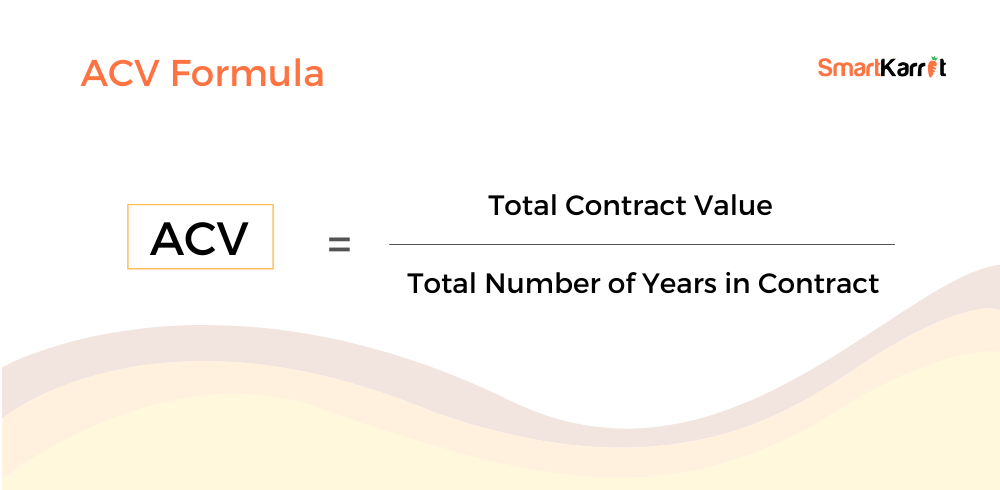
Annual Contract Value (ACV) is the metric companies with subscription pricing use most. It normalizes a contract’s worth into a single-year figure, no matter how long the deal actually runs.
For instance, a two-year deal worth $24,000 works out to an ACV of $12,000. That per-year number makes it easier to compare deals of different lengths and forecast what a given customer contributes annually.
ACV doesn’t capture the full lifespan of a contract the way TCV does, but it’s still the go-to number for gauging annual profitability at companies built on recurring revenue models such as Software as a Service (SaaS).
Total Contract Value (TCV)
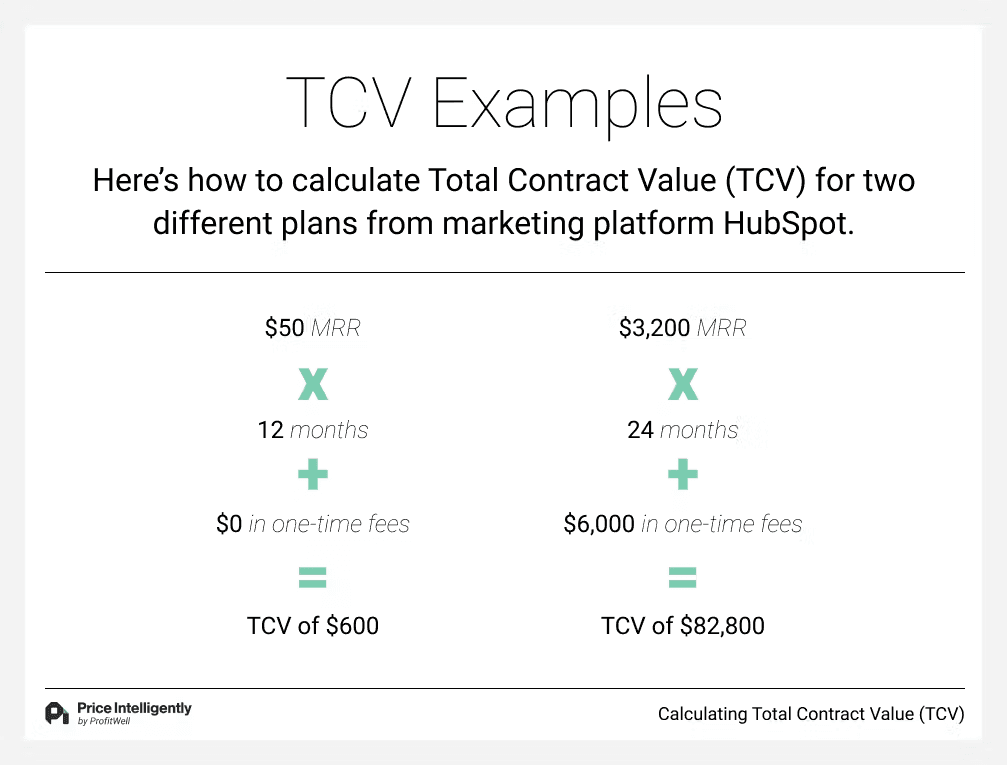
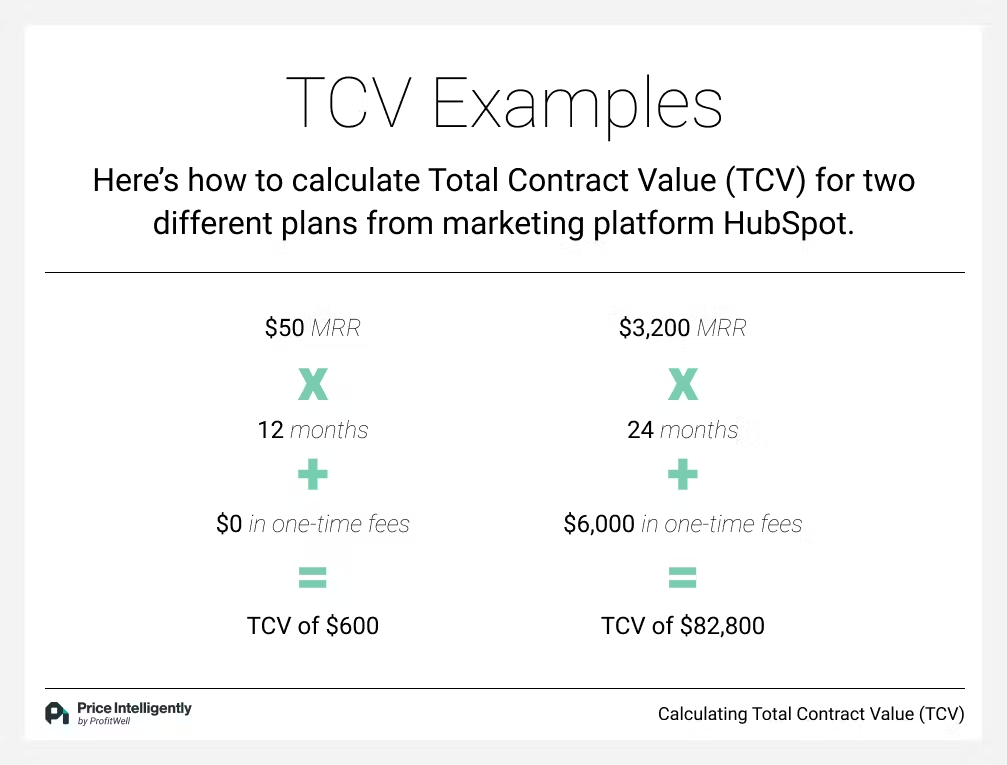
TCV, or Total Contract Value, adds up the full worth of a contract across its whole term, not just a single year. Where ACV flattens a multi-year deal into an annual number, TCV keeps the entire duration in the picture.
That full-term view matters for sales and customer success teams, since it shows the complete revenue a customer relationship can generate, not just its yearly slice. It’s also the figure most useful when a company is weighing whether a long-term contract is worth the discount often used to win it.
With that number in hand, teams can allocate resources and prioritize the accounts that will drive the most growth year over year.
Annual Recurring Revenue (ARR)
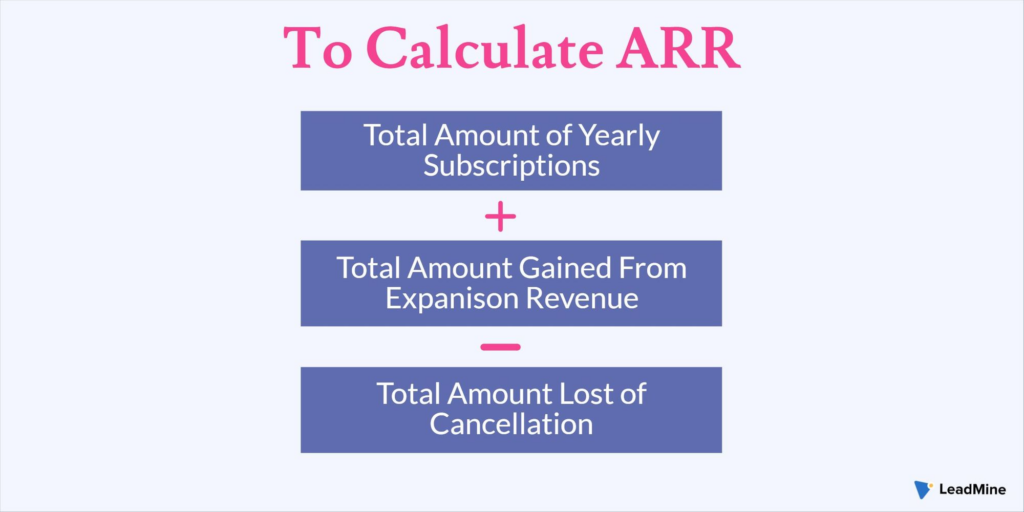
Annual Recurring Revenue (ARR) zooms out from a single contract to the whole business. It’s the total revenue value a company collects from every recurring contract over a 12-month period.
ARR tells a company its yearly take from active subscriptions, which is a direct read on financial stability and growth potential. Tracking it over time surfaces shifts in customer retention and sales performance, and gives leadership the numbers they need to protect revenue and grow the customer base.
Differences and Applications of ACV, TCV, and ARR
In short: ACV prices a contract for one year, TCV prices it for its whole term, and ARR rolls up every subscription contract into one company-wide revenue figure. Put the earlier example to work here: a two-year, $24,000 deal has an ACV of $12,000 and a TCV of $24,000 — same contract, two different lenses on the same money.
ACV measures the value of a contract for a single year
Go back to the $24,000 two-year deal from earlier: its $12,000 ACV is what tells you the revenue that one contract contributes in a given year, independent of how long it runs.
Because ACV isolates a single year, sales teams use it to check a contract’s annual performance and spot accounts worth expanding.
With that reference point, a company can set pricing and allocate resources with a clearer view of what a typical deal is actually worth per year.
TCV measures the value of a contract throughout its duration
TCV takes that same deal and instead reports its value across the full contract term rather than compressing it into one year. This is the number that matters most for businesses running long-term or multi-year subscription agreements.
Looking at the complete lifespan gives a company a truer read on what it will collect from a customer relationship over time.
TCV helps teams judge overall account performance and make strategic calls based on projected revenue from those contracts.
ARR measures the revenue value of all subscription-based contracts
ARR sums recurring revenue across every subscription contract a company holds, over a set period such as a year.
Any subscription-model business can use it to watch ongoing revenue streams. Sales and customer success teams track ARR to gauge year-over-year growth and see how the subscription business as a whole is performing, not just one account.
Calculating ACV, TCV, and ARR
Each of these three metrics comes from a simple formula. Here’s how to work out each one, with a worked example.
ACV formula and example
Multiply monthly recurring revenue (MRR) by 12 to get ACV. A customer paying $100 a month works out to an ACV of $1,200 ($100 x 12 months).
This is the formula to reach for when you need one account’s value over a single year, whether you’re tracking sales performance or comparing accounts of different sizes.
TCV formula and example
TCV covers the whole life of a contract, including every year it runs and any extra services or features baked into the agreement.
The formula: multiply ACV by the number of years in the contract term. A three-year contract with an ACV of $10,000 per year gives a TCV of $30,000 ($10,000 x 3).
Sales teams use this figure to understand a contract’s full value and to compare account performance year over year. It’s also the number that matters most when a deal is being negotiated, since a buyer signing a longer contract wants to know the total commitment, not just the annual installment.
ARR calculation
To find a company’s ARR, add up the revenue from every subscription-based contract active during a given period. It’s the number that shows the total value of ongoing subscriptions and lets a company track growth year over year.
Sales and customer success teams use ARR to check how well they’re acquiring new customers and keeping existing ones, and to get a read on overall financial health.
The quick way to get there: sum the monthly recurring revenue (MRR) of every active contract within the period you’re measuring.
Which Metric to Use and When
Reach for ACV when you need one contract’s yearly value, TCV when you need its full-term value, and ARR when you need a company-wide read on recurring revenue and growth.
Use ACV to measure individual contract value
When the question is “what’s this one account worth per year,” ACV is the answer. It puts every contract on the same annual footing, which is what sales and customer success teams need to judge account performance fairly.
Because it isolates the year-one number, ACV also makes it easy to see how well a sales strategy is converting deals into revenue.
Use TCV to measure the overall value of contracts
When you need the full picture across every contract’s entire duration, TCV is the metric that sums it up.
It’s especially useful for companies running long-term contracts or subscription services, since it feeds directly into pricing decisions, customer retention strategy, and plans for future growth.
Combined across all contracts, TCV gives stakeholders an accurate picture of the organization’s total revenue base.
Use ARR to measure growth and recurring revenue
ARR is the metric for tracking growth and revenue across the whole subscription business, not just one contract. It totals the annual value of every recurring subscription over a given period.
Tracking ARR tells a business roughly how much revenue to expect on an ongoing basis, which pushes teams to focus on customer satisfaction and renewal rates.
It also shows the overall health of a business by illustrating growth year over year and flagging where things need attention. Because ARR is built from the same MRR figures used in the ACV calculation, a company that keeps clean monthly numbers can roll them up into ARR without extra work.
Conclusion
ACV, TCV, and ARR each measure contract value from a different angle, and knowing which is which is essential for reading sales performance and customer success accurately. Together, they let a business calculate contract value, track growth year over year, and monitor revenue from subscription-based contracts.
Whether you’re sizing up one account with ACV or the full contract lifecycle with TCV, understanding these metrics is what makes revenue planning reliable. And once those two are clear, ARR is simply the sum of the ACVs from every active contract on the books, which is why it works so well as the top-line growth number for a subscription business.
Frequently Asked Questions
1. What are ACV, TCV and ARR?
ACV stands for Annual Contract Value, TCV is Total Contract Value and ARR represents Annual Recurring Revenue. These terms relate to subscription-based contracts in the SaaS (Software-as-a-Service) business model.
2. How do I calculate these values?
To calculate ACV, you average the total contract value over one year of a subscription-based contract’s term length. For TCV, consider the total monetary worth of a signed agreement for its entire duration. ARR is measured by adding the MRR (Monthly Recurring Revenue) across a year.
3. How can understanding these values contribute to business growth?
To calculate ACV, you average the total contract value over one year of a subscription-based contract’s term length. For TCV, consider the total monetary worth of a signed agreement for its entire duration. ARR is measured by adding the MRR (Monthly Recurring Revenue) across a year.
4. Generalizing it all, what’s LTV?
LTV or Lifetime Value provides an estimate of net profit attributed to the entire future relationship with each customer in comparison with customer acquisition cost; thus providing critical insights into long-term profitability.
Compare alternatives to the tools in this post

- Independent picks for exactly what you just read about
- Matched to your team size & needs
- Vendors don't pay for placement
Step 1 of 4
How big is your team?
We tailor recommendations to companies your size.















Related Articles

Finance & Billing Software
Best Payroll Software for Contractors and Freelancers in 2026
Continue reading →

Buyers guide
How To Choose The Best Cryptocurrency Exchanges For 2026
Continue reading →

401K Providers
Top 5 Best 401k Providers for Small Businesses in 2026
Continue reading →

Accounting Software
How To Choose The Best Procure-to-Pay Software For 2026
Continue reading →